The Eastern Shore: Where the Amalfi Coast Stops Performing
The road east from Amalfi tells you immediately that something is about to change. The cliff face loosens its grip on the sea. The terraced lemon groves flatten into something more domestic. The villages stop competing with one another for dramatic effect and simply exist, at sea level, facing the water without performance.
This is where Maiori and Minori are.
They sit side by side on the SS163, eight and nine kilometres from Amalfi respectively, separated from each other by a ten-minute walk along the seafront. They do not appear in the opening scenes of most visitors’ Amalfi Coast itineraries. They are not on the ferry posters. The famous photogenic staircases are entirely absent.
What they have instead is a beach long enough to find a quiet patch of, a Roman villa that has been here for two thousand years and has seen it all, the oldest pasta in Italy, and the best pastry counter on the entire coast. The case for visiting is quieter than the one Positano makes. It is also, I think, more durable.
What to book before you come
These two are where the coast becomes affordable and ordinary in the best sense. Maiori has the only long flat beach on the Amalfi Coast, and neither town charges you to exist in it. The bookable things are along the water and in the next towns over.
- Caves, beaches and snorkelling from Amalfi. Amalfi is fifteen minutes west by bus or boat, and this is the stretch of coast these two towns sit on.
- The full coast and Positano by boat. 4.9 from nearly two and a half thousand people. The day trip that shows you the whole thing.
- Positano, Amalfi and Ravello in a day. Everything the buses make slow, done in one go.
Maiori s beach, the Roman villa at Minori with its mosaics, and the lemon terrace path between the two towns are free or very nearly. This is the cheapest stretch of the Amalfi Coast and it is not a compromise.
Getting There
From Naples, the choice is the one you always face on this coast: road or sea.
The sea is better. The ferry from Salerno runs year-round to Maiori, a forty-minute crossing that deposits you directly in front of the beach. In summer the same route connects with Amalfi, Positano, and Capri. The ferry schedule is worth checking before you arrive, since it changes seasonally and the timetable boards at each pier are more reliable than anything you find online, but in high season the boats run several times a day.
From Amalfi town, Maiori and Minori are reachable by the SITA bus, which runs along the SS163 throughout the day. The fare is a few euros. The journey takes fifteen minutes and passes through Atrani, which you will want to note for another occasion.
The same bus connects both towns to Salerno, which has a high-speed rail link to Naples. From Salerno’s train station to Maiori by bus or ferry is roughly an hour. It is not a complicated arrival.
Driving the SS163 is possible, and the road between Amalfi and Maiori is marginally wider than the sections to the west, which is a relative statement. Parking in both towns is limited, and in summer it is effectively a negotiation you will lose. If you have a car and can leave it, leave it. The car parks at the eastern end of Maiori’s lungomare have the best odds.
Between the two towns themselves, the walk along the seafront takes about twelve minutes. It is flat and pleasant, and there is no reason not to do it.
Plan Your Visit to Maiori and Minori
A few things I booked and loved. These help support the blog, at no cost to you.
- Where I stayed: search Maiori and Minori hotels
- Amalfi Coast boat tours and tickets
- Stay connected: get a travel eSIM
This section contains affiliate links. If you book through them I may earn a small commission, at no extra cost to you.
When to Go
May, June, and September are the most straightforward answer.
May brings the coast into full flower. The lemon groves above Minori are at their most fragrant. The sea is cool enough to make the first swim feel like a genuine event. The towns are occupied by people who chose them specifically, rather than by everyone who could not find a room in Positano.
September is the month I prefer. The sea has accumulated three months of warmth. The light turns amber earlier in the afternoon. The pastry shops, which never really close, somehow seem more rewarding after a long summer of heat. The Ravello Festival, up the hill from Minori, is still running into early September, and a day divided between the coast and the gardens above it is a particular combination that these two towns are uniquely positioned to offer.
July and August are different here than elsewhere on the coast. The western end of the Amalfi Coast fills with international tourism in high summer. Maiori and Minori fill instead with Italian families from Naples and Salerno, people who have been coming here every August for generations and who treat the towns with a domestic familiarity that changes the atmosphere entirely. It is not a tourist crowd. It is a family crowd, which is something different. The beach on a Saturday in August in Maiori is loud and full and entirely alive with people who genuinely love being there. If that sounds appealing rather than alarming, August might be exactly the right time.
Best Things to Do in Maiori and Minori
Maiori and Minori are neighbours, a short seaside walk apart, and easily seen together. These are the things worth your time in both.
Spend a morning on Maiori’s beach, the longest on the Amalfi Coast, then climb to its Norman watchtower and the Sanctuary of Santa Maria a Mare above the town. Walk the coast path to Minori, smaller and quieter, for its Roman maritime villa and the Basilica of Santa Trofimena. Above all, eat, since Minori is the pastry capital of the coast and both towns still cook the old dishes, from ndunderi to the lemon everything grown on the terraces above. This is the Amalfi Coast at its most local and least crowded. Each of these has its own section below.
Where to Stay
The accommodation at this end of the coast runs quieter and considerably less expensive than the famous addresses to the west.
In Maiori, a number of seafront hotels occupy the lungomare with varying degrees of ambition. The better ones have sea-view rooms and balconies, and the practical advantage of being ten steps from the beach without the room costing what it would in Positano. Ask specifically for a sea view. The difference, as everywhere on this coast, is between two entirely different holidays at the same address.
Above both towns, in the hills, several agriturismi work the same terrain that the lemon growers have always occupied. These are working farm properties that have added guest accommodation, and the ones that do it well offer a combination of mountain air, homegrown food, and a perspective on the coast from above that the seafront hotels cannot provide. The drive down to the beach takes ten minutes. The quiet at night is absolute.
Minori’s accommodation is smaller in scale, reflecting the town’s size. A few well-run pensions and small hotels cluster near the beach and the Roman villa.
If the priority is access to both towns along with Ravello above and Amalfi to the west, Maiori makes the more logical base. It has more infrastructure, better ferry connections, and Minori is a twelve-minute walk along the sea.
Maiori
The Beach
Maiori has the longest beach on the Amalfi Coast. This is not a minor distinction.
The coast is not generous with its beaches. Most are small coves or rocky platforms, extraordinary in their way but offering no room to breathe. The long sweep of grey-black sand and pebble at Maiori, backed by the lungomare and framed by the hills on either side, has a spaciousness that the rest of the coast cannot match.
The beach clubs line the central section and provide umbrellas, loungers, and the usual service. A free public stretch exists at either end. In high summer the beach fills, but the length means there is always a quieter section if you are willing to walk past the most congested part toward the east.
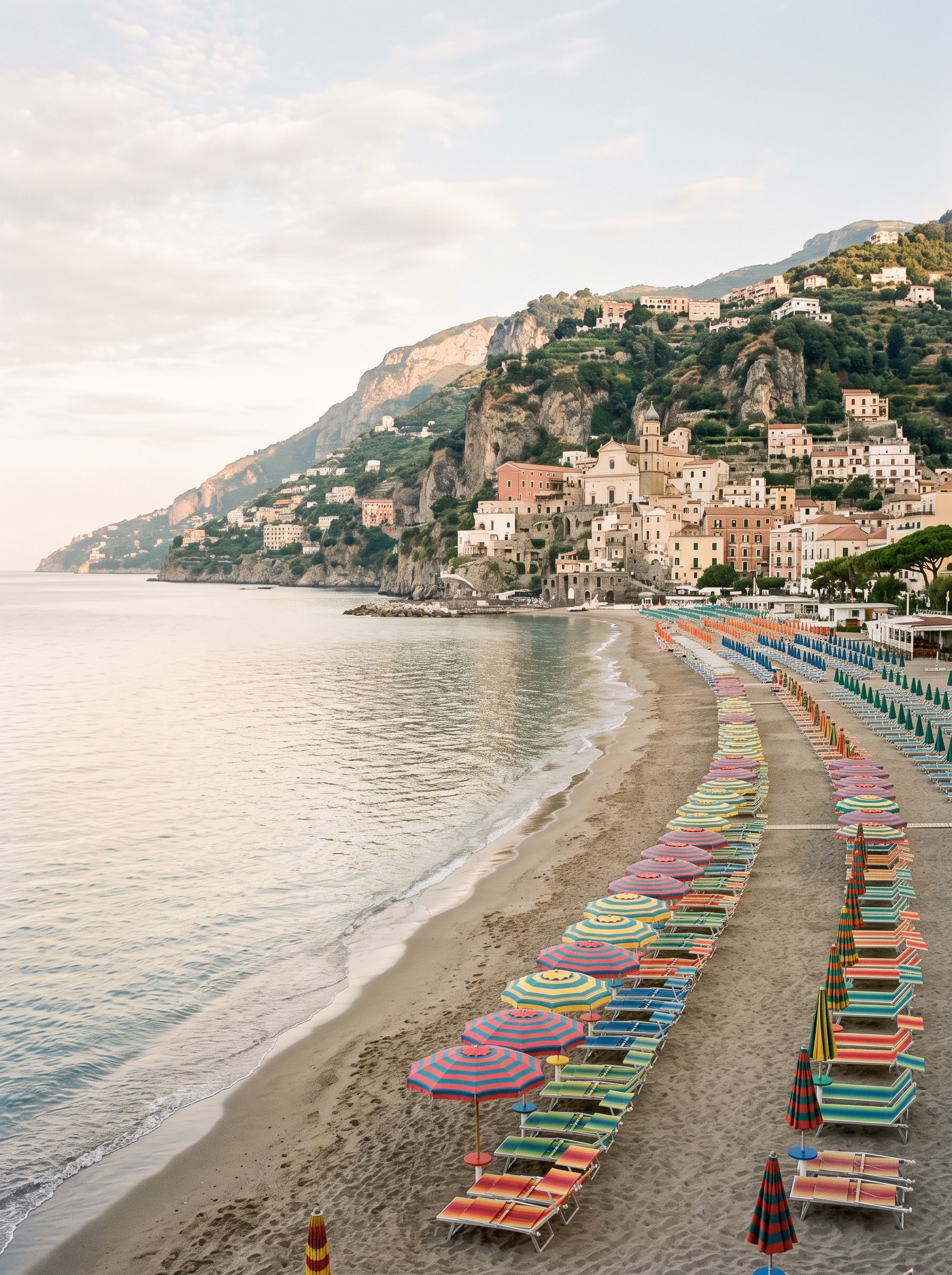
The lungomare itself is worth noting separately. It is flat, wide, planted with palms, and one of the few genuinely walkable promenades on a coast otherwise defined by staircases. For anyone who has spent three days negotiating Positano’s vertical streets, Maiori’s seafront is a genuine relief.
Torre di Maiori
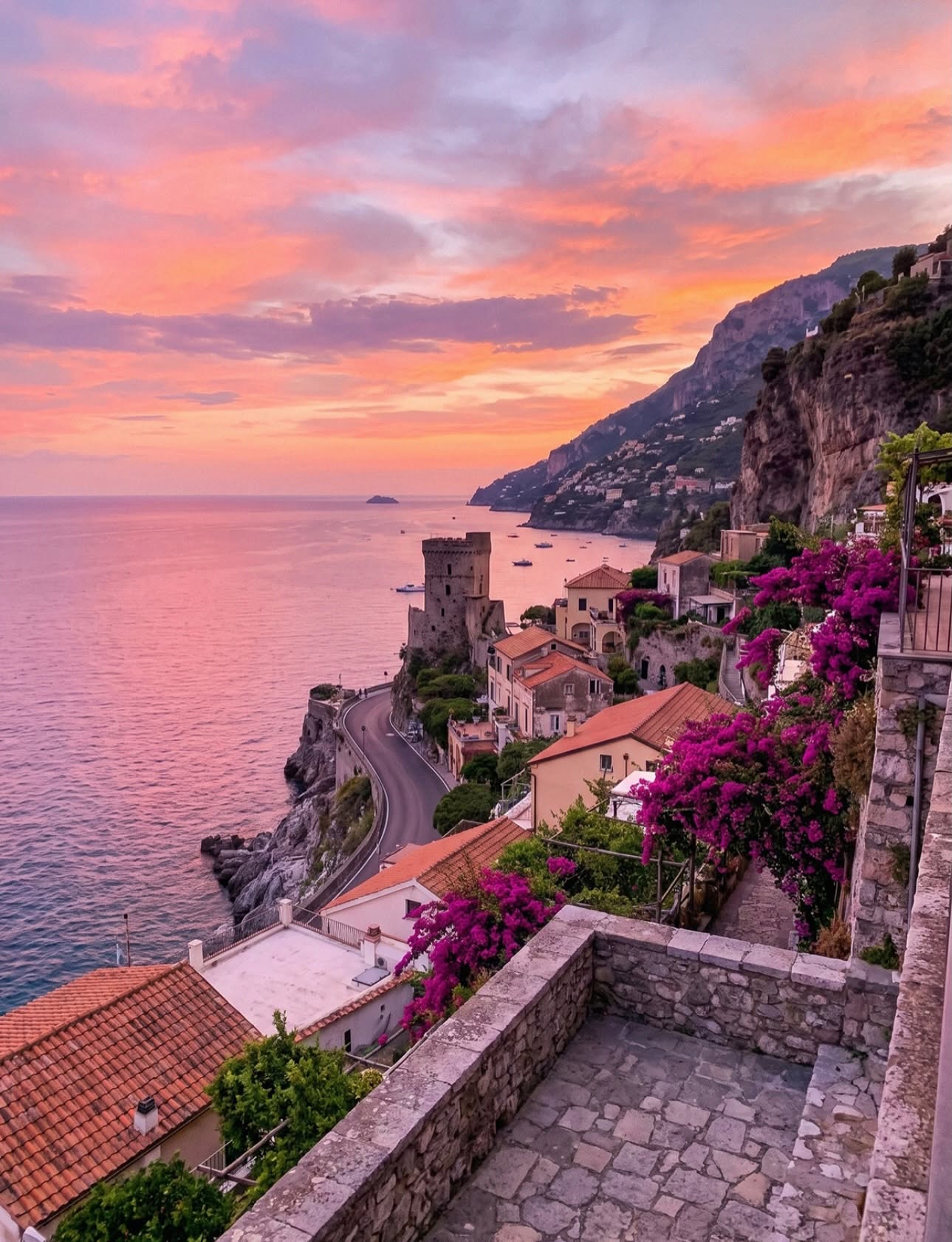
Above the harbour at the western end of town, the Torre Normanna di Maiori rises on a spur of rock that has been watching this stretch of coast since the eleventh century. The Norman watchtower was built as part of the defensive network against Saracen raids, a series of towers placed along the coastline close enough to signal each other with fire. It is partially ruined now, damaged by the landslide that remade much of Maiori’s geography in 1954, but the remaining structure retains a useful authority.
The view from the base, which requires a short climb through the old quarter above the harbour, is the best elevated perspective of Maiori’s beach and the coast stretching east toward Salerno.
Maiori’s historic centre is newer than it looks. The 1954 flood was catastrophic: a wall of water and mud came down the valley and stripped the town to its foundations. The rebuilt streets are wider and more modern than those of neighbouring Amalfi or Minori, and it would be dishonest to pretend otherwise. The loss is visible. So is the recovery. The town rebuilt itself around a different geometry, more practical than picturesque, and there is a directness to it that I find, after several days on the more theatrical end of the coast, quietly refreshing.
Sanctuary of Santa Maria a Mare
Three kilometres above Maiori, reached by a road that climbs into the hills above the town, the Sanctuary of Santa Maria a Mare occupies a position that makes most churches look as though they are not trying hard enough.
The Benedictine monastery here dates in some form to the ninth century, though it has been added to, altered, and restored at intervals since then. The current church holds a Byzantine icon, a black Madonna, to which the devotion of the local population has attached itself with a tenacity that suggests what a particular combination of altitude and antiquity can produce in people who have lived beneath it for a long time.
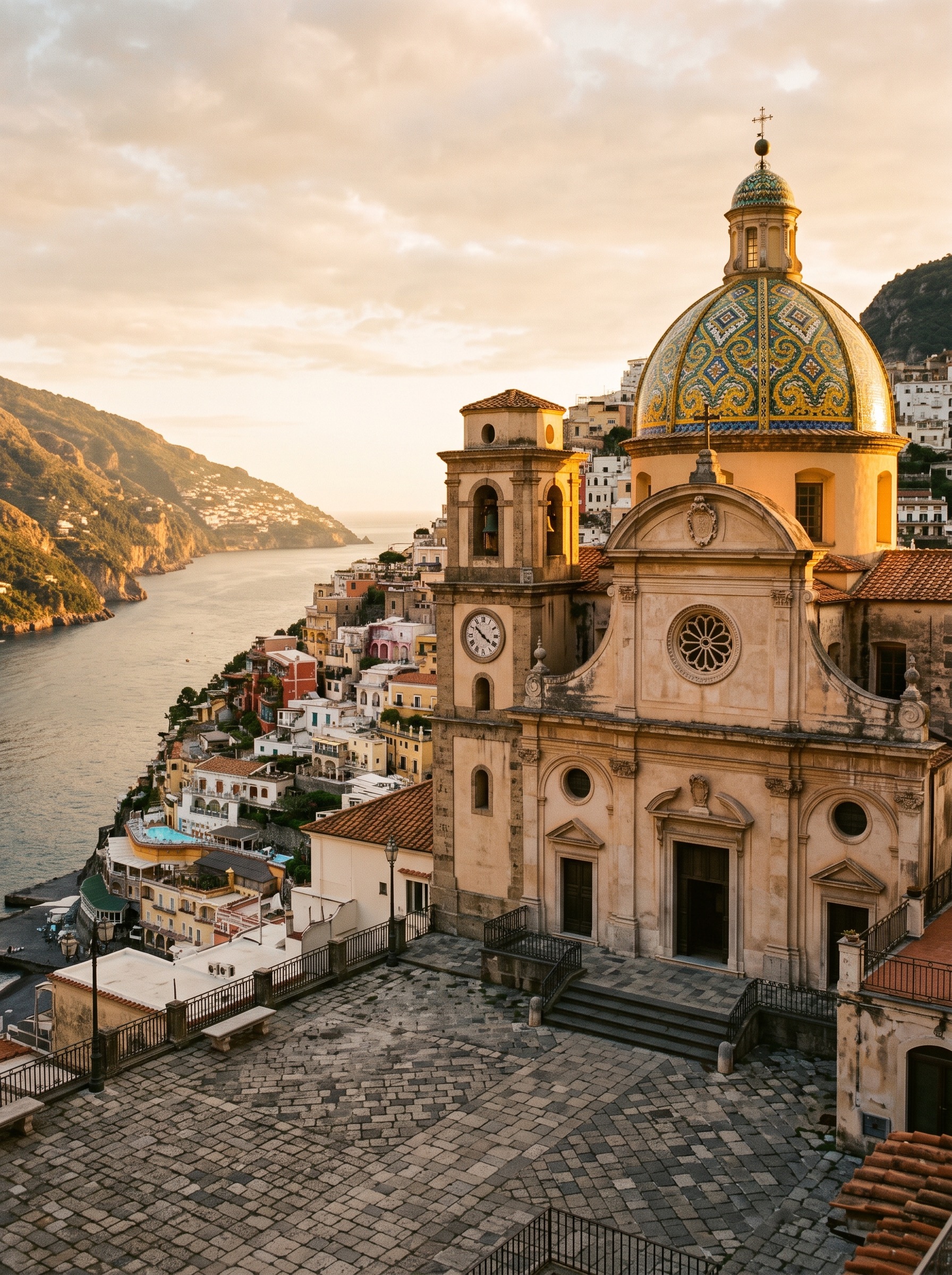
The sanctuary hosts a pilgrimage each September 8th, and if your visit coincides with it, the procession up the hill from Maiori is worth watching.
The drive up is also an excuse for the views. The geometry of the hills above Maiori, the terraced lemon groves and the ruined towers and the sea below going on until the horizon, reveals itself fully only from up there.
Minori
The Roman Villa
Under the streets of Minori, below what used to be the main road before a small plaza was arranged to direct visitors to it, lies the best-preserved Roman building on the Amalfi Coast.
The Villa Marittima dates to the first century AD. It was the residence of a wealthy Roman family, built on what would have been a working harbour. The excavated rooms have a quality of completeness that is unusual in open archaeological sites. The triclinium, the formal dining room, still has its floor. The nymphaeum still has its frescoes. The indoor swimming pool, the natatio, is still legible as a swimming pool. The garden above the excavation has been replanted with species that a Roman garden of this period would have contained, which is either scholarship or reconstruction depending on your temperament, but makes the visit feel inhabited rather than merely historical.
The villa was discovered in the 1930s and excavated over the following decades. The museum holds ceramic finds, household objects, and architectural fragments. The attendant, in my experience, will tell you considerably more than the panels do if you ask.
Most visitors to Minori walk past the entrance sign without registering it. The excavation sits below street level, and the approach is not dramatic. This is, I think, precisely the point. It does not compete for attention. It simply exists, two thousand years old, and waits.
Entrance is modest. Allow an hour.
The Basilica di Santa Trofimena
The Basilica di Santa Trofimena is a nineteenth-century church containing something considerably older: the relics of a Sicilian martyr whose story, like many saints’ stories, involves a sea voyage, a coastline, and a divine instruction to stay. Whether the hagiography interests you or not, the church is worth entering. The crypt is quiet, and the atmosphere is one of accumulated belief rather than performed devotion, which is a meaningful distinction in a region that knows the difference.
The Lemon Groves
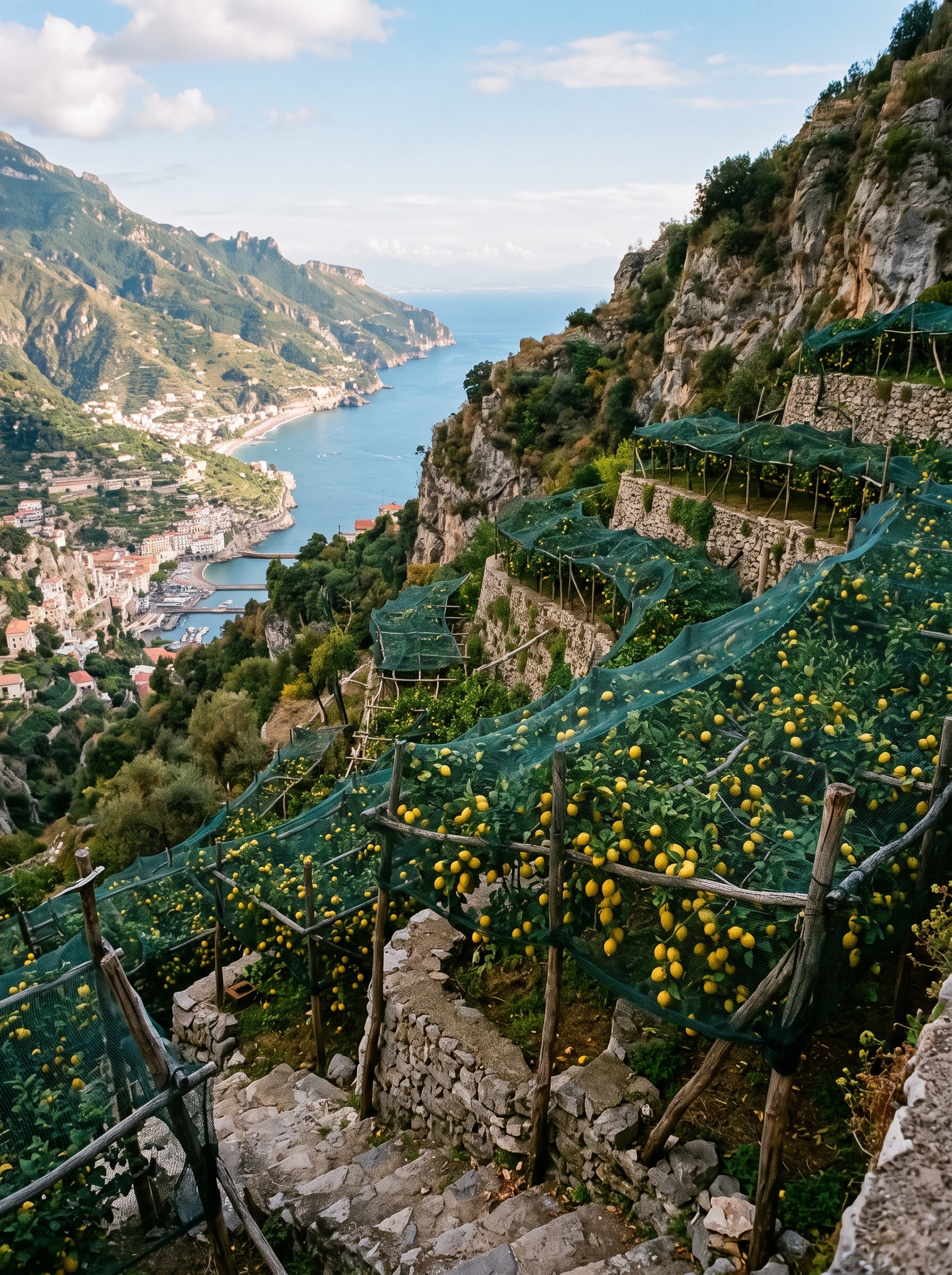
The lemon cultivation above Minori and Maiori is a different visual experience from the terraces above Positano. Here the groves are closer to the road and more accessible, the farmsteads that maintain them still working rather than ornamental. The sfusato amalfitano, the long pale lemon specific to this coast, grows on wooden pergola structures called pagliarelle that shade the fruit and create cathedral-like interiors where the light filters green and yellow through the leaves. If a grower’s gate is open, ask. The answer, in my experience, has always been yes.
Food and the Table
Minori’s Pastry Inheritance
Minori calls itself the City of Sweets. The claim is not idle.
The Neapolitan pastry tradition runs deep here, reinforced by proximity to Salerno and a confectionery culture that predates tourism by centuries.
Sal De Riso is the address that explains this to visitors who have not yet heard of it. Salvatore De Riso is one of the most celebrated pastry chefs in Italy, a Minori native who trained in the Neapolitan tradition and made it into something specific and serious. His pasticceria on the Lungomare Capone is, by any reasonable measure, one of the finest pastry shops in southern Italy. The delizia al limone, the dome of sponge and lemon cream that is the coast’s signature dessert, is made here with a precision that makes every other version feel approximate. The millefoglie is extraordinary. The seasonal tarts are worth whatever they cost.
Come in the morning. Come more than once.
The sfogliatella at the smaller pasticcerie in Minori’s back streets is also worth seeking. Both forms: the riccia with its layered pastry shell, the frolla with its softer casing. The riccia eaten warm at a bar counter with a short espresso is the correct way to start any day on the Amalfi Coast. Minori makes a strong argument for starting it here.
Ndunderi
Ndunderi is the pasta that Minori has been making since, according to a sixteenth-century cookbook that mentions them by name, at least 1547. They predate every pasta you have likely heard of.
Made from ricotta and flour, shaped into short dumplings, and served with a meat ragu or a simple tomato sauce depending on the cook. The texture is somewhere between gnocchi and fresh pasta, lighter than either suggests. Most trattorias in Minori serve them. Ordered anywhere else on the coast, they are an import. Ordered here, they are simply what they have always been: the local lunch.
The Table in Maiori
The seafront restaurants in Maiori range from the seriously honest to the efficiently tourist-facing, and the difference is usually visible from the menu. Look for the places where the fish is on a board rather than a laminated card, and where the spaghetti alle vongole is made with that morning’s clams rather than explained on a placard.
The aperitivo hour on the lungomare in the early evening is relaxed and local. Campari and Aperol and the particular pleasure of a drink taken at a table that is not trying to sell you anything more than a drink. It begins around six, and the energy is unhurried in a way that the more famous end of the coast rarely manages.
The gelato in both towns is made with sfusato lemons, and the granite in the mornings, particularly before the heat has fully arrived, is the kind of simple cold thing that the Amalfi Coast makes necessary and its own lemons make excellent.
Evenings
Dinner in both towns begins late, by which I mean after eight, and the local rhythm rewards patience. A glass of the local Fiano or Falanghina while you wait. Fresh pasta and grilled fish when they arrive. The sea close enough to hear. There are worse ways to spend an evening on the Italian coast, and most of them involve booking further in advance.
Practical Notes
Getting between the towns: The seafront walk is the answer. Twelve to fifteen minutes, flat, and the route passes nothing uninteresting.
Ravello from Minori: The road up from Minori to Ravello takes approximately twenty-five minutes by car or bus. There is a path for the serious walker. This proximity is the eastern end of the coast’s particular advantage: you can swim in the morning, eat ndunderi for lunch, and hear an orchestra in a garden above the sea by evening without moving a car or booking a transfer. I have done this more than once and it remains one of the better days the coast is capable of producing.
Costs: Both towns are less expensive than the central Amalfi Coast and considerably less expensive than Positano. The restaurants are priced honestly. The beach clubs charge less. The hotels cost less. This is not a compromise. It is simply what the coast looks like when it is not performing for a crowd that has been told to expect something.
What to pack: Everything you would bring to the Amalfi Coast. Linen for the days. A layer for evenings, since the temperature drops once you are away from the retained warmth of the stone. Flat shoes with grip if you intend to climb above the towns. A hat that can survive a sea wind.
A note on the Roman villa: The excavation operates on limited hours, typically morning through early afternoon, and occasionally closes for conservation work without much notice. Check locally before making it the centrepiece of a day. The admission is inexpensive and the visit is short enough that there is no reason to rush it.
More images from Maiori and Minori









Frequently Asked Questions
Are Maiori and Minori worth visiting?
Yes, especially for travellers who want the Amalfi Coast without the crowds and the prices. The two towns are quieter and more local than Positano or Amalfi, with the coast’s longest beach and its best pastries.
How many days do you need in Maiori and Minori?
A day sees both towns comfortably, since they are a short walk apart. Stay a night or two to use them as a calmer and cheaper base for exploring the rest of the coast.
How do you get to Maiori and Minori?
By the SITA bus along the coast road, by ferry in the warmer months, or by car. Both towns sit on the coast between Amalfi and Salerno and are easy to reach from either.
What is Minori known for?
Its pastries above all. Minori is the pastry capital of the Amalfi Coast, famous for sfogliatella and other sweets, along with its Roman villa and its lemon groves.
What is the best time to visit Maiori and Minori?
Late spring and early autumn, for warm weather and quiet beaches. Both towns stay more lived in and local than the busier towns even in high summer.
A Last Word
There is a version of the Amalfi Coast that is about demonstrating you were there. The photograph at the famous viewpoint. The dinner at the famous address. The ferry queue in August.
Maiori and Minori offer a different version. The Roman who built his villa above the harbour at Minori was not performing the Amalfi Coast. He was living in it. The families who return to Maiori every August are not consuming an experience. They are continuing one.
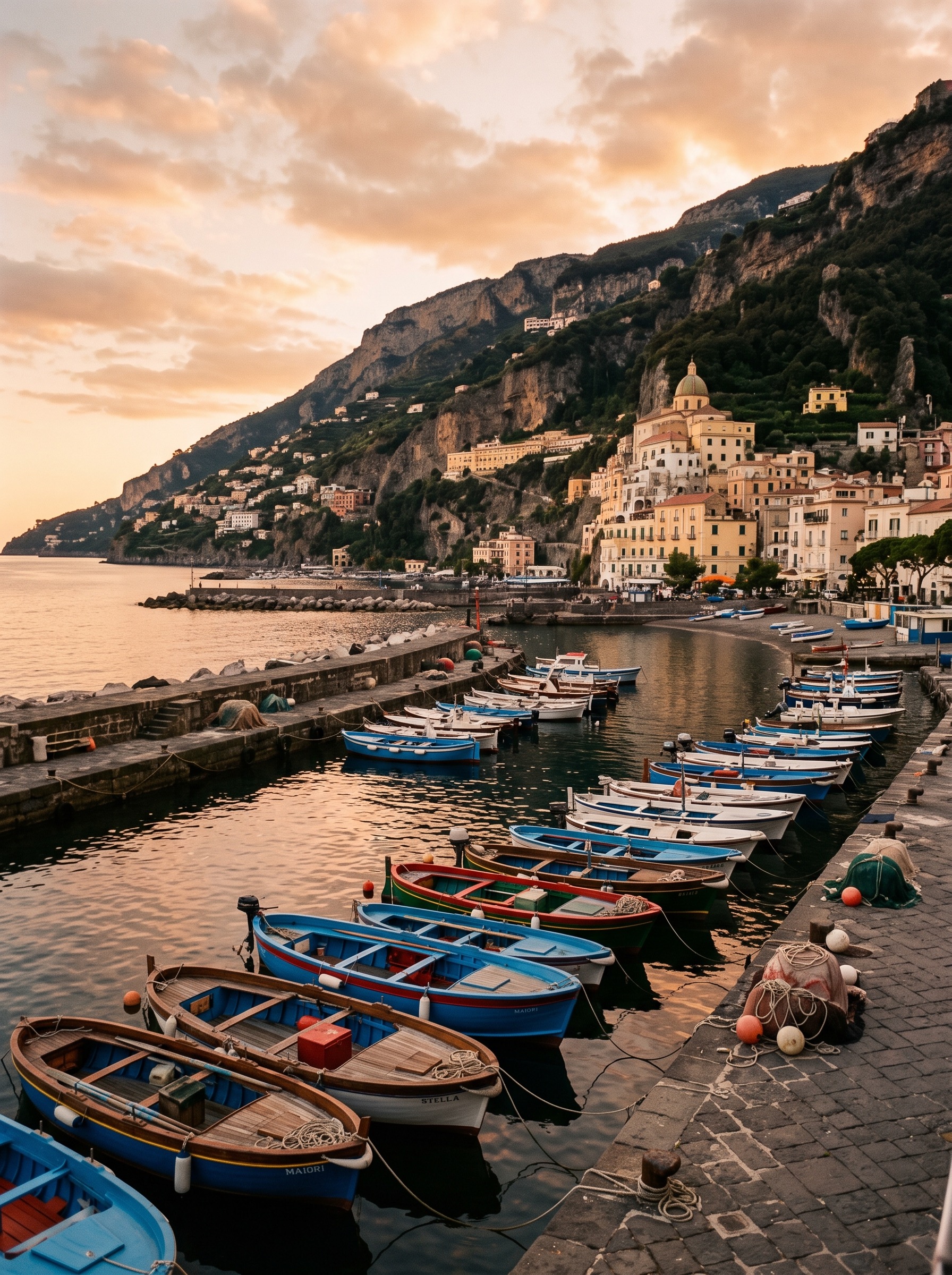
There is something clarifying about spending time in places that have no particular interest in being discovered. The beach is long enough. The pastry is exceptional. The Roman villa has been waiting for two thousand years and will wait another twenty while you finish your coffee at Sal De Riso and consider whether to have one more thing from the display case.
You probably will.
It would be a mistake not to.
V.
Read my complete guide to the Amalfi Coast here. For the town above the coast, the Ravello guide is here.