Ascot Racecourse, Berkshire, England
There are events you attend for the racing, and there are events you attend for everything else. Royal Ascot is, uniquely, both. In five days each June, it assembles the finest flat racing in the world alongside something altogether different: a theater of manners, of hat construction, of garden party conversation, of the peculiarly English art of dressing as though the occasion demands everything you have and then doing it with an air of absolute nonchalance.
I have been coming here since before I fully understood what I was attending. The Royal Procession appearing at the top of the course each afternoon, the carriages moving at exactly the right speed, the crowd turning as one to watch, there is something in that sequence that never quite loses its effect, however many times you have seen it. Britain does ceremony well. At Ascot, it does it better than anywhere.
This guide is my attempt to pass along what I know: the enclosures, the dress code, the races worth watching, the hospitality worth seeking, and the things that no guide tells you but that make the difference between a good day and a great one.
What Royal Ascot Is
Royal Ascot is a five-day horse racing festival held each June at Ascot Racecourse in Berkshire, six miles from Windsor Castle. It was founded in 1711 when Queen Anne, riding out from the castle, decided that a nearby stretch of open heath would make an ideal setting for horse racing. Three hundred and fifteen years later, the event has grown to approximately 300,000 racegoers across the week, a prize fund of millions of pounds, thirty-five races across five days, and a global television audience that runs into the tens of millions. It is the most prestigious flat racing meeting in the British calendar. The Royal Family attends every day.
None of that fully explains what it is like to be there.
Royal Ascot occupies a singular position in the English social calendar, somewhere between sport and ceremony, between genuine passion for horses and the elaborate performance of enjoying a summer afternoon. The racing is world-class: Group 1 races with the best horses from Britain, Ireland, France, and further afield. Fashion is the stuff of newspaper front pages. The champagne flows from shortly after midday. The enclosures fill with people who have spent months deciding what to wear and will spend the week pretending they dressed without much thought.
It is not for everyone. It is formal. It is expensive. It requires planning. But if you are someone who finds pleasure in ceremony, in beautiful clothes, in the particular electricity of a racecourse on a summer afternoon, in the sound of five thousand people watching something extraordinary happen in thirty seconds: Royal Ascot delivers all of it with a consistency that is its own kind of achievement.
Plan Your Visit to Royal Ascot
A few things I booked and loved. These help support the blog, at no cost to you.
This section contains affiliate links. If you book through them I may earn a small commission, at no extra cost to you.
Planning Your Visit
When It Takes Place
Royal Ascot runs for five days each year from Tuesday to the Saturday of the third week of June. The dates shift slightly year to year, but the pattern is fixed. Royal Ascot 2027 runs from Tuesday 15th to Saturday 19th June.
The weather in Berkshire in June is genuinely unpredictable. Some years, the week is golden from start to finish. Others produce rain of sufficient ambition to test even the most elaborate hat. Bring something for warmth in the evening, regardless of the forecast. The English summer is a known variable.
Tickets and How to Book
Ascot operates a four-enclosure system, each with different prices, dress codes, and atmospheres. Tickets go on sale in the autumn for the following year’s Royal Meeting, and the most popular days, particularly Ladies’ Day on Thursday and the final Saturday, sell out quickly. Book as early as possible.
General admission tickets range from approximately £45 for the Windsor Enclosure to £99 for the Queen Anne Enclosure. The Royal Enclosure operates on a membership basis and cannot be purchased like a standard ticket. Hospitality packages across all enclosures begin at around £350 per person and rise considerably from there. If hospitality is what you want, book it six months to a year ahead, or further: the most sought-after packages for Ladies’ Day are typically full before Christmas.
Which Day to Choose
Each day has its own character and its own argument for why it is the best day to go.
Tuesday is the purist’s choice: three Group 1 races, including the Queen Anne Stakes, which opens the meeting, and the sense of a week beginning with its best racing foot forward.
Wednesday holds the richest race of the week, the Group 1 Prince of Wales’s Stakes, and tends to be slightly less crowded than the days around it. It is a good choice for a first visit.
Thursday is Ladies’ Day. It is the most fashion-focused day of the week and the most socially animated. The Gold Cup, two and a half miles of stamina racing, is one of the most emotionally charged events in the British racing calendar. Thursday is also the busiest and most expensive day.
Friday is underrated. The Coronation Stakes for three-year-old fillies and the Commonwealth Cup for sprinters make for an excellent racing card, and the crowd tends to be at its most relaxed. People have found their rhythm by Friday.
Saturday closes the week with the Queen Elizabeth II Jubilee Stakes and the Queen Alexandra Stakes, the longest flat race in Britain at two miles and five furlongs. There is something elegiac about the final afternoon, the week winding down, the summer stretching ahead.
The Enclosures
Ascot is divided into four distinct areas, each with different access, atmosphere, and amenities. Understanding the enclosures before you arrive makes an enormous difference to your experience.
The Royal Enclosure
The Royal Enclosure is the most exclusive area at Royal Ascot, and entry is genuinely restricted. Membership requires sponsorship by two existing Members and is subject to approval by His Majesty’s Representative at Ascot. This is not bureaucratic theatre: the Royal Enclosure has operated this way since an area was first reserved for the household of King George III in 1807, and the exclusivity has been maintained ever since.
If you are not a Member or the guest of one, there is a second route in: a reservation at one of the handful of designated Royal Enclosure restaurants comes with a personalised day badge. These reservations are expensive and go fast, but they are the practical path for most people attending for the first time.
The Royal Enclosure has the strictest dress code, the best viewing positions close to the parade ring and Winners’ Enclosure, and the atmosphere of a very large garden party to which only certain people have been invited, which is, of course, exactly what it is.
The Queen Anne Enclosure
The Queen Anne Enclosure is the premier public enclosure and my recommendation for most first-time visitors who want a full day’s experience. It gives you access to the parade ring, where you can watch the horses before each race, to the grandstand ground floor, and to a large number of bars and restaurants. The atmosphere is lively, and the views from the grandstand are excellent.
Queen Anne tickets typically cost between £85 and £99 per day. The dress code applies in full and is enforced at the gates; more on that below.
The Village Enclosure
The Village Enclosure was introduced in 2017 and sits beyond the winning post, offering good views of the iconic Ascot grandstand and a more relaxed atmosphere than the Queen Anne. It has its own food and drink options, giant screens showing the racing and replays, and, perhaps its best argument, a genuine afterparty that continues well into the evening once the racing finishes. If you are going with a group and the social element matters as much as the racing, the Village is worth considering.
The Windsor Enclosure
The Windsor Enclosure runs along the Straight Mile and is Ascot at its most accessible: affordable, informal, and the only enclosure without a formal dress code, though smart daywear is encouraged. It is popular with families, with groups of friends who want to bring a picnic, and with people who are coming primarily for the atmosphere rather than the ceremony. The Windsor is not the full Royal Ascot experience in the traditional sense, but it is a real day at the races, and the views of the Straight Mile, where several of the sprint races are decided, are genuinely good.
The Dress Code
Royal Ascot’s dress code is famous and, in the Royal Enclosure and Queen Anne, strictly enforced. This is not decoration. People are turned away at the gate every year for outfits that do not meet the requirements. Know the rules before you buy your outfit.
Royal Enclosure
Women: Dresses, skirts, or jumpsuits must be of modest length, falling at the knee or longer. Shoulder straps must be at least one inch wide. Strapless, off-the-shoulder, halter neck, and spaghetti strap styles are not permitted. No sheer or see-through fabrics. Midriffs must be covered. A hat or headpiece with a solid base of at least four inches is mandatory; a fascinator on a clip does not meet the standard. Full-length trouser suits in matching colour and material are permitted.
Men: Black, grey, or navy morning dress with a waistcoat and a tie. No cravats. A black or grey top hat is required and must be worn except within a restaurant, private box, or enclosed seating area. Black shoes with socks.
Queen Anne and Village Enclosures
The requirements for women are largely the same as the Royal Enclosure: modest length, covered midriff, no sheer fabrics, and straps at least one inch wide. Hats and fascinators are encouraged but not mandatory in the Queen Anne. In the Village Enclosure, a fascinator is acceptable.
Men in the Queen Anne must wear a suit with a tie. No bow ties or cravats. In the Village Enclosure, the rules ease slightly: a jacket with full-length trousers, a collared shirt, and a tie are required, and bow ties and cravats are permitted here even if they are not in the Queen Anne.
Jackets and ties must be kept on at all times unless given permission to remove them due to high temperatures. This rule is real and is applied.
Windsor Enclosure
No formal dress code. Smart daywear is encouraged. Fancy dress, sportswear, and beachwear are discouraged.
A Word on Hats
The hat question is asked constantly and deserves a direct answer: if you are in the Royal Enclosure, a substantial hat with a solid base of at least four inches is not optional. In the Queen Anne and Village, you have more freedom; a smaller headpiece or a well-placed fascinator will do. In Windsor, anything goes.
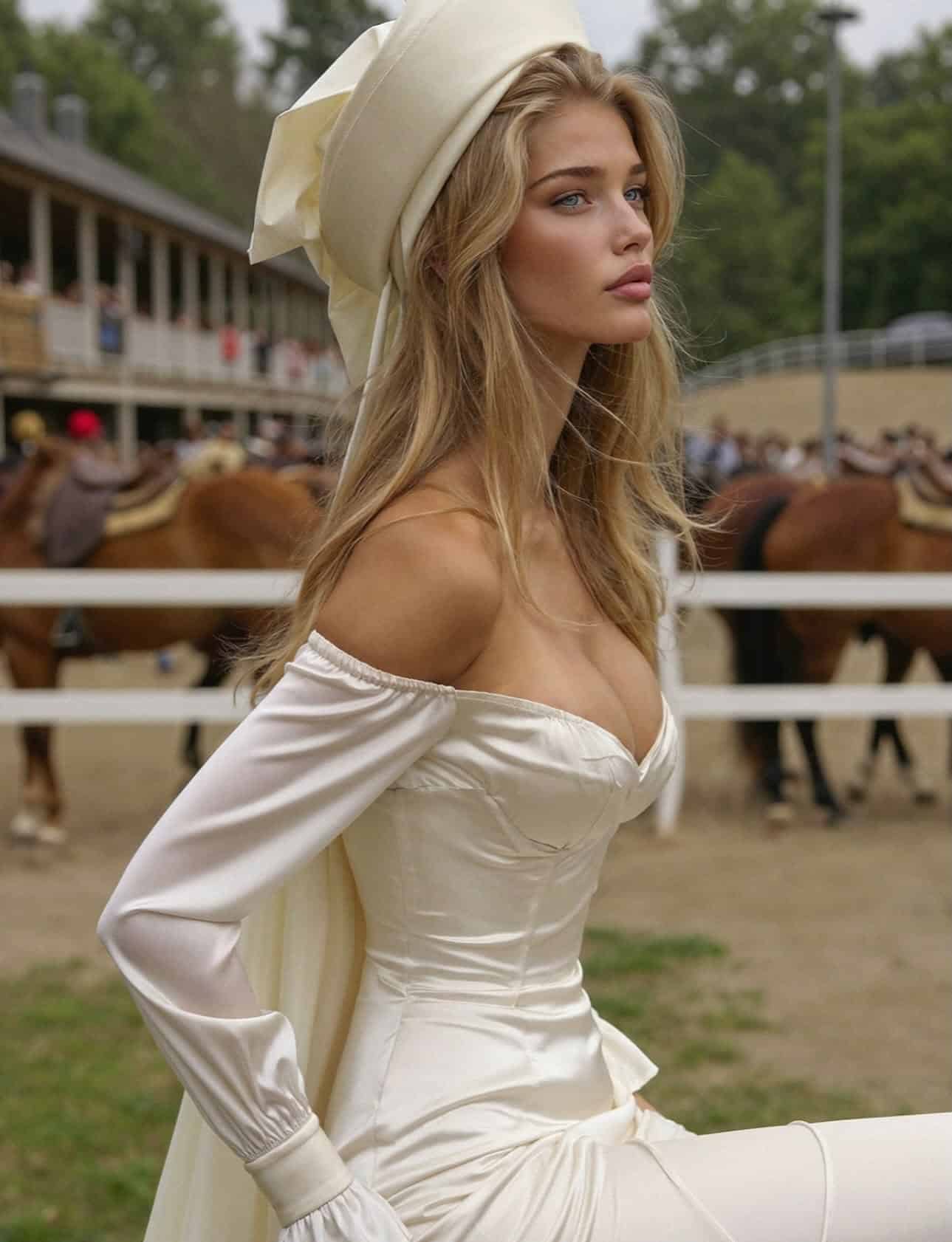
The hat is also, plainly, one of the great pleasures of Royal Ascot. The week produces some genuinely extraordinary millinery. The newspaper photographers are at the gate every morning, hoping for exactly this, and the designs range from classical perfection to complete architectural ambition. I have never regretted going further than I thought I needed to.
The Racing
Royal Ascot is first and last a racing festival. The five days produce thirty-five races, eight of them at Group 1 level, the highest classification in European racing. These are the best horses in the world, run by the best trainers and jockeys, over distances that test every dimension of thoroughbred ability. If you come without any knowledge of racing, you will still feel the electricity of the finish line. If you come knowing what you are watching, you will feel it twice.
Tuesday: Opening Day
The week begins with arguably the strongest single day of flat racing in Britain. The Queen Anne Stakes over one mile opens the card: a Group 1 for older horses that consistently attracts the mile specialists from across Europe. The King Charles III Stakes, a five-furlong sprint, is one of the fastest and most visceral races of the week. The St James’s Palace Stakes completes a Group 1 treble, a one-mile contest restricted to three-year-olds who have already proven themselves in the season’s Classics. The Coventry Stakes, a Group 2 for two-year-olds, gives the first glimpse of the next generation.
Tuesday draws the racing purists. It is also, before the mid-week crowds, slightly less hectic than the days that follow.
Wednesday: The Richest Day
Wednesday’s headline race is the Prince of Wales’s Stakes, the richest race of the Royal Meeting. Run over a mile and two furlongs for older horses, it consistently draws the best middle-distance performers in Europe. The race has a prize fund that exceeds any other at the meeting, and the quality of horses in the field reflects it. Wednesday also features the Queen Mary Stakes, a five-furlong sprint for two-year-old fillies that has launched many of the sport’s great mares.
Thursday: Ladies’ Day and the Gold Cup
Thursday is the day the newspapers talk about, and not only for the Gold Cup, though the Gold Cup deserves everything said about it.
The Ascot Gold Cup is two miles and four furlongs of flat racing, contested by horses that specialise in distance and stamina rather than speed. It is a different kind of race from the sprints and mile contests that surround it: slower to develop, longer in its tension, resolved by reserves of endurance rather than explosive acceleration. The roar that builds as the field turns for home in a Gold Cup finish is distinct from anything else at the meeting. Previous winners include Yeats, who won four consecutive Gold Cups and became one of the most beloved horses in British racing history.
Ladies’ Day brings the largest crowds and the most ambitious fashion. It is the day the gates open widest, and the atmosphere is at its most festive. If you come for the spectacle rather than the racing, Thursday is your day. If you come for serious racing with spectacle as a bonus, Thursday delivers both.
Friday: The Fillies’ Day
Friday is underrated in conversation and excellent in practice. The Coronation Stakes is the championship mile race for three-year-old fillies, typically featuring the best of the Classic generation. The Commonwealth Cup, a six-furlong Group 1 for three-year-old sprinters of both sexes, is reliably competitive. The King Edward VII Stakes gives the top middle-distance colts a chance to race over a mile and four furlongs. Friday’s atmosphere has a particular ease to it: the week’s initial intensity has settled into something more relaxed, and the people who are still there on Friday are, almost without exception, people who genuinely want to be.
Saturday: The Final Day
Saturday closes the meeting with the Queen Elizabeth II Jubilee Stakes, a six-furlong Group 1 for the best older sprinters in training, and the Hardwicke Stakes, a middle-distance Group 2 with consistent historical depth. The card ends with the Queen Alexandra Stakes, at two miles and five furlongs, the longest flat race in the British calendar, run late in the afternoon by horses that have spent their careers building to this precise test. The race sounds archaic, and it is, and it is also unexpectedly moving.
There is a quality to the final afternoon at Royal Ascot that I find difficult to describe precisely. Something about endings done properly, in a setting that takes ceremony seriously.
The Royal Procession
At approximately two o’clock each afternoon, the Royal Procession enters the course at the top of the Straight Mile and moves at an elegant pace toward the Royal Enclosure. The carriages are horse-drawn. The occupants include members of the Royal Family and their guests. The crowd on both sides of the course turns to watch, and for a few minutes the racing and the hats and the champagne all pause in favour of this daily ritual.
It is one of those moments that photographs adequately but does not fully reproduce. The scale of the course, the sound of the horses on the turf, the uniformity of the crowd’s attention, is better witnessed than described.
King Charles III has attended Royal Ascot every year of his life and has been known to run horses of his own at the meeting. The Royal Procession is not a performance for the public. It is a tradition that has continued for over three centuries and shows no signs of concluding.
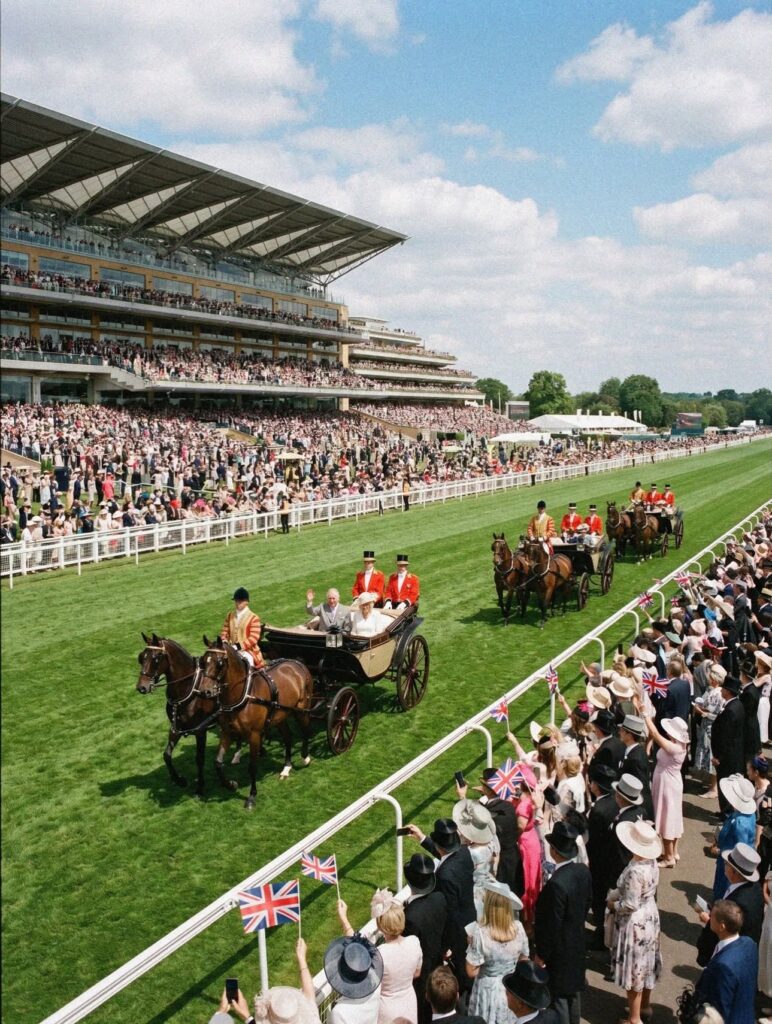
Find a position on the rail before two o’clock on whichever day you attend. You will not regret it.
Food, Drink, and Hospitality
Champagne
Champagne is the drink of Royal Ascot in the same way that coffee is the drink of mornings: everywhere, expected, and perfectly calibrated to what is happening around it. Every enclosure has champagne bars. The quality varies; the availability does not. If you have preferences about labels, the Royal Enclosure and Queen Anne restaurants can accommodate them. In the Village and Windsor, something cold and fizzy in a glass is the standard and entirely fine.
Dining
The Royal Enclosure restaurants represent the highest level of formal dining at Ascot: four-course lunches, white tablecloths, views over the course, the specific pleasure of eating very well in a beautiful setting, while horses parade past the window. The Wyndham Restaurant overlooks the Royal Enclosure Gardens and is the standard by which others are measured. Reservations are required, and the better days book up early.
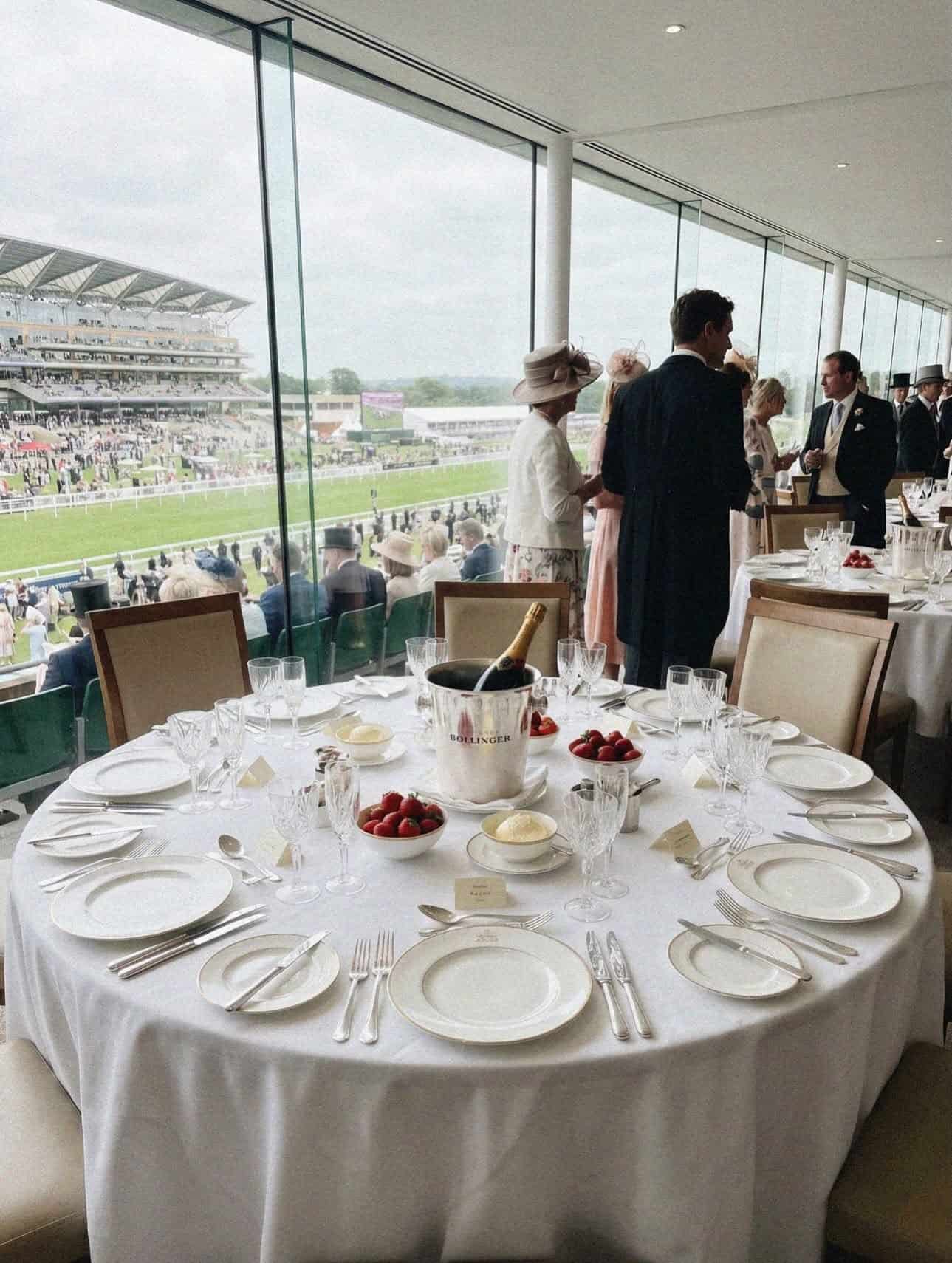
In Queen Anne, the Furlong Restaurant offers a private balcony with views of the finishing straight alongside a seasonal menu. It is a considerable step up from the general catering and is worth the additional cost if a proper meal is part of what you want from the day.
The Village Enclosure has its own food options and a more relaxed register: grazing plates, chefs’ stations, the kind of eating that fits a long afternoon outdoors.
General Catering
General catering across all enclosures has improved substantially over the past decade. There are fish and chip stalls, afternoon tea offerings, Pimm’s, Guinness, and every kind of summer food that a warm day in Berkshire might suggest. None of it is cheap. Plan accordingly.
The Afterparty
One of the Village Enclosure’s genuine advantages is that it runs a proper afterparty once racing ends, with music and a crowd that tends to be in a celebratory mood regardless of how their selections performed. If the day racing is the main event, the Village after dark is an unexpectedly good continuation.
Where to Stay
Ascot Racecourse sits in Berkshire with Windsor to the north and the Surrey commuter belt to the south. There is no shortage of accommodation, but the best options fill quickly in the months before the Royal Meeting.
Coworth Park in Ascot, a Dorchester Collection property, is ten minutes from the course and combines luxury with genuine ease of access. The grounds are beautiful, the service is exceptional, and staying here removes any anxiety about transport at the end of a long day. It is where I stay when I am at the meeting for multiple days, and it has yet to disappoint.
Pennyhill Park, a few miles toward Bagshot, is another country house hotel of real quality and a popular choice for Royal Ascot week.
Windsor itself offers several good hotels, the most central of which put you within easy reach of both the course and the castle, which is worth a morning visit if you have time before the racing begins.
For those coming from London for the day, the train journey from Waterloo or Paddington is straightforward and the journey time is under an hour. Many people make Royal Ascot a day trip, and it works perfectly well. Staying nearby, however, means arriving unhurried, departing at leisure, and having a drink in the evening at a pace that a train schedule does not permit.
Getting There
By train: The most straightforward option from London. Trains run from London Waterloo and London Paddington to Ascot station, from which the racecourse is a seven-minute walk along a paved path away from roads. The trains run frequently on Royal Ascot days, and the journey takes approximately fifty minutes from Waterloo.
By car: The M3 and M4 both provide access to Ascot. Parking is available to purchase in advance and becomes unavailable closer to the event, so book it alongside your tickets. The roads around the course are busy on race days, and arrival at least ninety minutes before racing begins is advisable.
By helicopter: Several helicopter services operate transfers to Ascot during Royal Ascot week, landing at a designated area near the course. If this is within your budget and your timeframe is tight, it is also, objectively, a very good way to arrive.
Gates open: 10:30 am. The first race starts at approximately 2:30 pm, preceded by the Royal Procession at 2:00 pm. Arriving by noon gives you time to orient yourself, find a good position for the Procession, have lunch if you have a reservation, and be at the rail for the opening race with something already behind you.
Practical Notes
The race card: Pick one up on arrival. It contains the race programme, the runners and riders, and the form guide. You do not need to understand everything in it to enjoy the racing, but reading it between races makes each subsequent race more involving.
Betting: There are Tote and bookmaker windows throughout all enclosures. Betting is part of the day for most people, and there is no obligation to understand it deeply. A small wager on a race you have read about, even briefly, makes the finish considerably more interesting.
Photography: The light at Ascot in the afternoon, falling across the course from the west, is consistently beautiful. The grandstand, the parade ring, the Royal Procession: all of it is worth photographing. The horses in the parade ring before a big race are worth particular attention; the tension in a thoroughbred before a Group 1 is visible and remarkable.
Shoes: The ground at Ascot is well-maintained, but you will spend a full day on your feet, and the paths between enclosures are uneven. Heels are standard in the Royal Enclosure and Queen Anne, but the practical wisdom is a heel that can manage turf, cobbles, and several hours of standing. Many people bring a spare pair for the journey home. I have learned this lesson and act on it.
Timing your enclosure moves: If you are in the Queen Anne or Village, you can move between the grandstand viewing areas and the trackside rail throughout the day. For the most important races, the rail fills quickly. Position yourself fifteen minutes before post time.
Why It Stays With You
I have been asked why Royal Ascot, specifically, is worth the planning and the cost and the careful attention to a hat.
The honest answer is that very few events deliver everything at the same time: great sport, great ceremony, great fashion, a setting of genuine beauty, and the particular pleasure of a tradition so well-established that it has confidence enough to allow itself to be enjoyed without irony. Royal Ascot does not apologise for what it is. It has been doing this since 1711, and it does it well.
The Gold Cup on a Thursday afternoon, the crowd three deep at the rail, a field of horses going past at thirty miles an hour, two and a half miles into a race that tests everything they have, that is an experience that lives in the body as well as the memory. So does the Royal Procession appear at the top of the Straight Mile, carriages on turf, the crowd turning. So does champagne in the sun when the favourite wins and everyone around you, regardless of whether they knew anything about the horse beforehand, feels exactly the same thing at exactly the same moment.
That shared experience, in a beautiful place, dressed well, with something at stake, that is what Royal Ascot is actually about.
V.
Royal Ascot takes place each June at Ascot Racecourse, Berkshire. Tickets, hospitality packages, and further information are available at https://www.ascot.com
Victoria’s Royal Ascot diary entries, Royal Ascot Day One and Royal Ascot: The Final Day, are published separately on this site.