The smallest town in Italy. The least photographed mile of the most photographed coastline in the world. A beach that still belongs to the people who live above it.
What to book before you come
Atrani is the smallest town in southern Italy and there is nothing here to buy, which is precisely its appeal. It sits a ten minute walk from Amalfi and everything worth booking leaves from that harbour next door.
- Caves and beaches from Amalfi. Ten minutes along the front and you are on the water, on the stretch the coaches never stop on.
- The full coast by boat, with snorkelling. 4.9 from nearly two and a half thousand people.
- The Ravello villas, up the hill. The path from Atrani up to Ravello is the old way, and doing it on foot and coming back by bus is the best half day here.
The piazza, the beach, the church steps and the tunnel under the coast road cost nothing. Atrani is the one town on this coast where sitting down does not require a decision.
What Atrani Actually Is
Most people who visit the Amalfi Coast never see Atrani. They walk the length of Amalfi‘s main street, eat at one of the restaurants along the seafront, look at the Duomo, and leave believing they have understood the coast. They have understood a version of it. Atrani is something else.
The town sits immediately east of Amalfi. A ten-minute walk, perhaps fifteen if you stop. In terms of distance, it could not be closer. In terms of character, the difference is significant. Amalfi has been managed for visitors for long enough that it now operates primarily for them. Atrani has not. Locals sit in the piazza in the evenings. Laundry appears on the lines above the alleyways. The restaurants open when they open, and the people who work in them know the people who eat in them.
This is not a romantic idea projected onto a place. It is simply what Atrani is.
The town covers 12 hectares of land, making it the smallest municipality in Italy by area. The population hovers around a thousand people. The main square, Piazza Umberto I, is one of the smallest municipal piazzas in the country. A fountain, a church, and a handful of tables belonging to the bar at the corner. In the evenings in high summer, it is standing room only, and the people standing there are mostly Italian.
Plan Your Visit to Atrani
A few things I booked and loved. These help support the blog, at no cost to you.
- Where I stayed: search Atrani hotels
- Amalfi Coast boat tours and tickets
- Stay connected: get a travel eSIM
This section contains affiliate links. If you book through them I may earn a small commission, at no extra cost to you.
A Short History
Atrani is old in the way that few places on the coast are old. Its name appears in the historical record as early as 596 AD, in a letter from Pope Gregory I to the Bishop of Amalfi. The town itself is Roman in origin. It was called Atranum then, and the terraced structure of the hillside, the way the buildings climb in organized layers above the sea, still carries something of that Roman instinct for controlled geography.
But Atrani’s most significant period came during the medieval centuries when the Duchy of Amalfi was one of the four great maritime republics of Italy, alongside Venice, Genoa, and Pisa. It was the Amalfi Republic that first codified maritime law, that traded across the Mediterranean with the Arab world, that brought the Arab-Norman aesthetic to southern Italy. At its peak, Amalfi was a serious power. And Atrani was where that power was formalized.
The Church of San Salvatore de’ Birecto, built in the tenth century, served as the Palatine Chapel of the Duchy. The Dukes of Amalfi were elected, crowned, and buried here. The name comes from the birecto, the ceremonial hat that was placed on the head of each new Duke at his investiture in this church. The building still stands on the eastern side of the town, its bronze doors cast in Constantinople in 1087, brought to Atrani in the same year the Normans were consolidating their hold on southern Italy. Stand in front of those doors, and you are standing in front of something that predates most of what passes for history in the places you have probably visited.
The Republic of Amalfi declined in the twelfth century, undone by a combination of Norman conquest, Pisan rivalry, and a catastrophic storm that destroyed much of the lower city in 1343. What remained was absorbed into larger political structures, and the coast settled into the long centuries of provincial obscurity that preserved it. The buildings were not torn down and rebuilt because there was no particular reason to rebuild them. The result is that Atrani today is, by most accounts, the best-preserved medieval town on the entire coast. Not restored. Preserved.
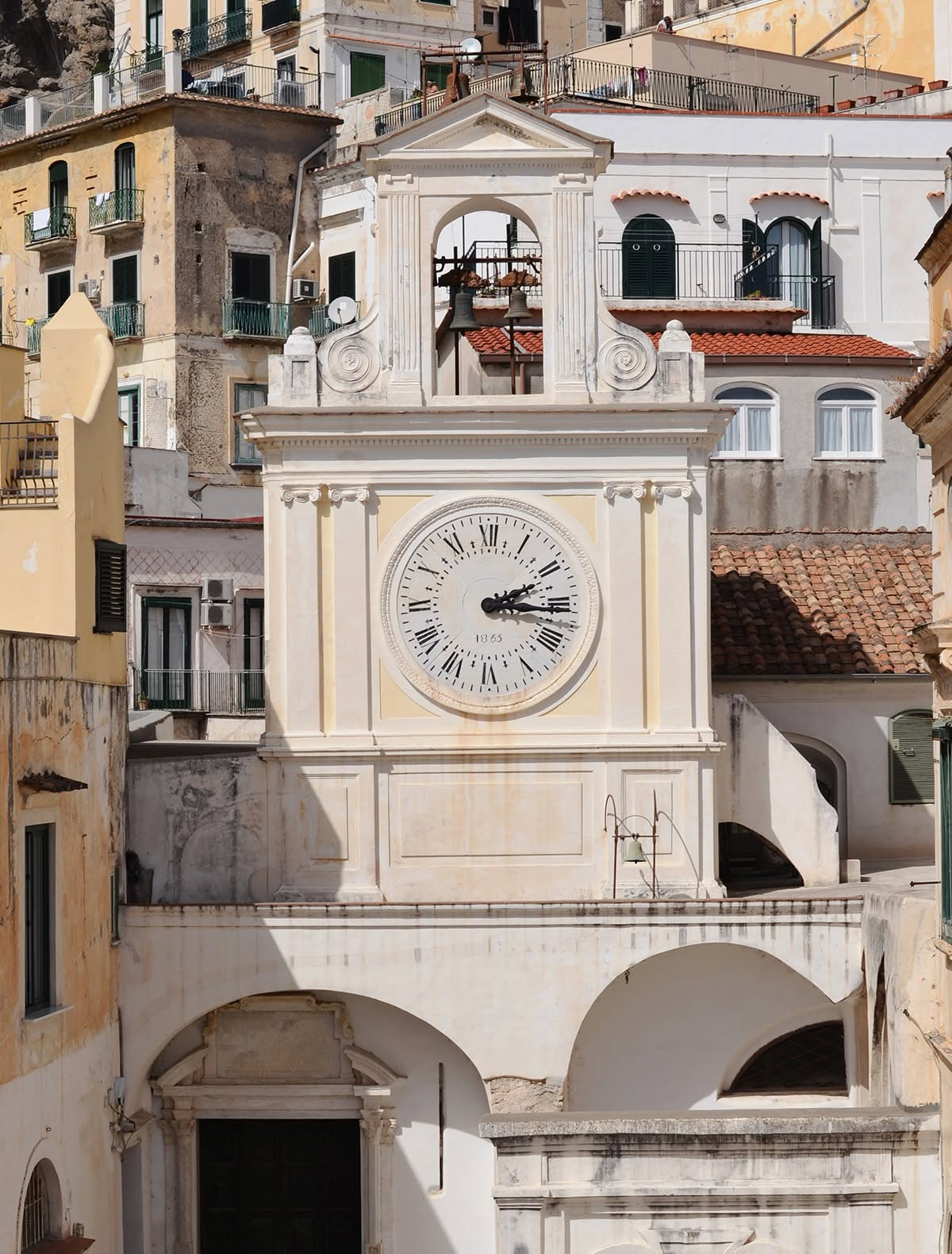
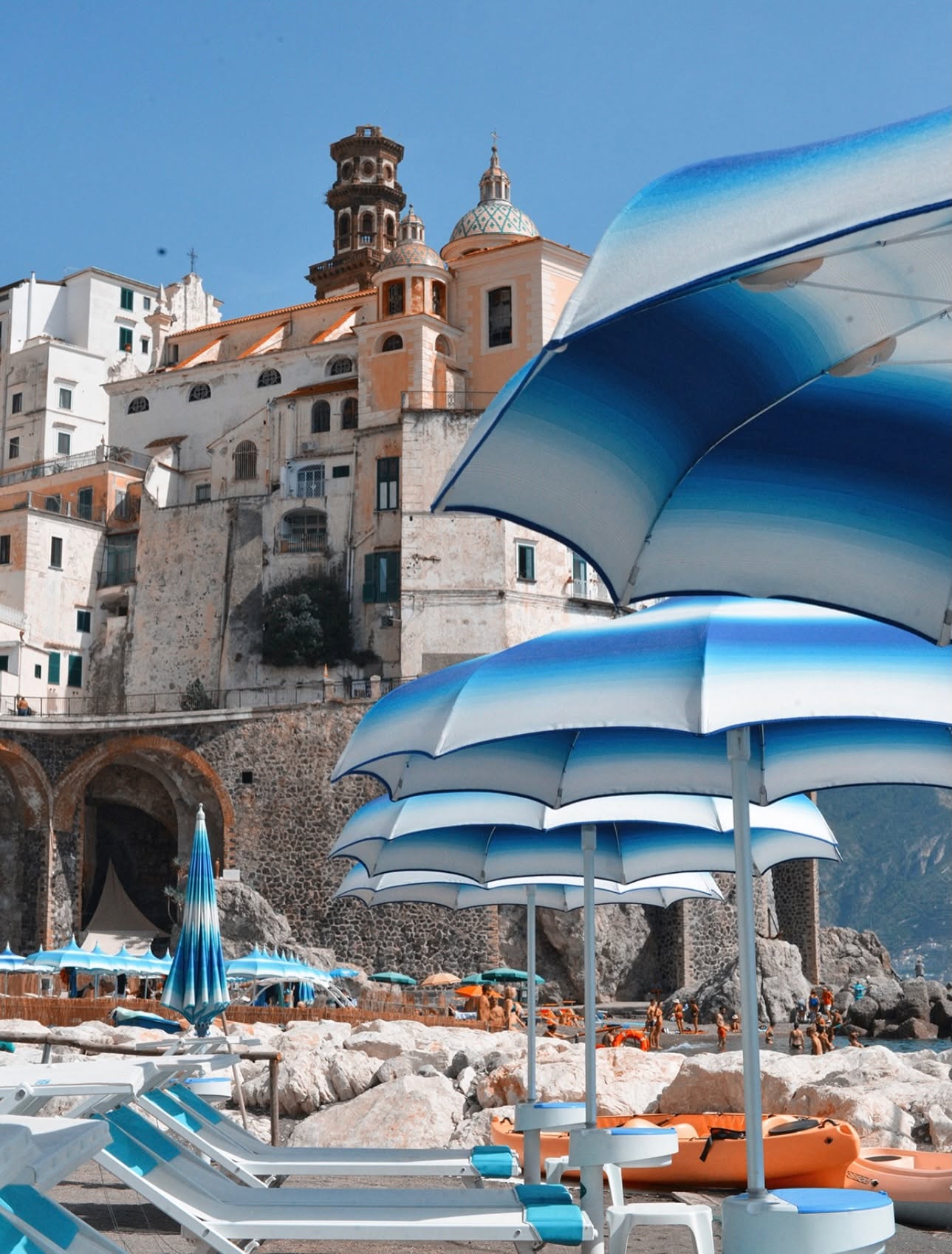
The Collegiata di Santa Maria Maddalena, the church whose baroque tower dominates the view from the beach, was consecrated in 1274 and substantially rebuilt in the eighteenth century. A clock was set into the facade in 1865. The bells still strike the hours.
Getting to Atrani
From Naples
Naples is the primary gateway to the Amalfi Coast. From Naples Centrale, the fastest option is the Circumvesuviana train to Sorrento, followed by a SITA bus along the SS163 to Atrani or Amalfi. The bus journey along the coast road takes approximately ninety minutes from Sorrento, and the views are as good as anything you will see from a boat, at a fraction of the cost. SITA buses run regularly throughout the day.
The ferry from Naples to Amalfi operates seasonally and takes roughly two hours, depending on stops. From the Amalfi ferry terminal, Atrani is a ten-minute walk east along the waterfront.
From Salerno
Salerno is closer and considerably calmer than Naples. Ferries run from Salerno to Amalfi throughout the day in season, taking approximately one hour. SITA buses also connect Salerno to Amalfi and Atrani directly. If you are arriving by train from Rome or the south, Salerno is the more practical entry point.
By Car
Driving the SS163, the Amalfitana, is one of the great scenic drives in Italy and one of the more anxious ones. The road is narrow, the buses are large, and in summer the traffic can come to a complete standstill. If you drive, arrive early. Parking in Atrani is essentially nonexistent within the town itself. The Luna Rossa parking structure on the eastern edge of Amalfi is the most practical option. From there, the walk to Atrani is five minutes.
The Walk from Amalfi: The Tunnel
This is the detail that most visitors to the Amalfi Coast do not know, and it is worth knowing.
On the eastern side of Amalfi, near the Luna Rossa parking structure and close to Café Déjà Vu along the waterfront, there is a pedestrian tunnel. It is open at all hours. It is not marked on most tourist maps. It was built in 1951, originally to connect the parking garage to the town, and it has the functional plainness of something designed for locals rather than visitors. The tunnel is roughly four hundred metres long. It is lit and wide enough for two people to walk abreast.
You enter on the Amalfi side, walk east through the rock, and emerge directly into Atrani. The transition is immediate. One moment, you are in the orbit of a tourist town. The next time you are in a medieval piazza, where a man is reading a newspaper outside a bar.
The tunnel entrance is easy to miss the first time. Walk east along Amalfi’s waterfront from the main piazza, keeping the sea on your right. When the road curves away from the shore and begins to rise toward the cliffs, look left. The tunnel entrance is set into the rock face, marked by a modest arch. If you reach the point where the road narrows and begins its climb up the coast, you have gone slightly too far.
Alternatively, you can walk the coastal path. From the eastern end of Amalfi’s seafront, a path traces the rocky shoreline heading east, passing above the water with the cliffs rising to your left. The path involves some steps and in places requires attention, but the views directly down into the water are worth it. The walk takes about twenty minutes at a reasonable pace and deposits you at the western edge of Atrani’s beach.
Most people who know Atrani take the tunnel in and the coastal path back, or vice versa.
The Beach
Atrani’s beach is dark. The pebbles are almost charcoal in color, quite different from the pale grey shingle of Amalfi’s beach a kilometre to the west. When the water pulls back between waves, it makes a particular sound, glass being sorted, that is specific to heavy dark pebbles and not replicated elsewhere.
The beach is not large. In high summer, it fills, but the crowds here are different in composition from the crowds on Amalfi’s beach. More Italian, more local, more mixed in age. Families. Old men in the shade. Children in the shallows.
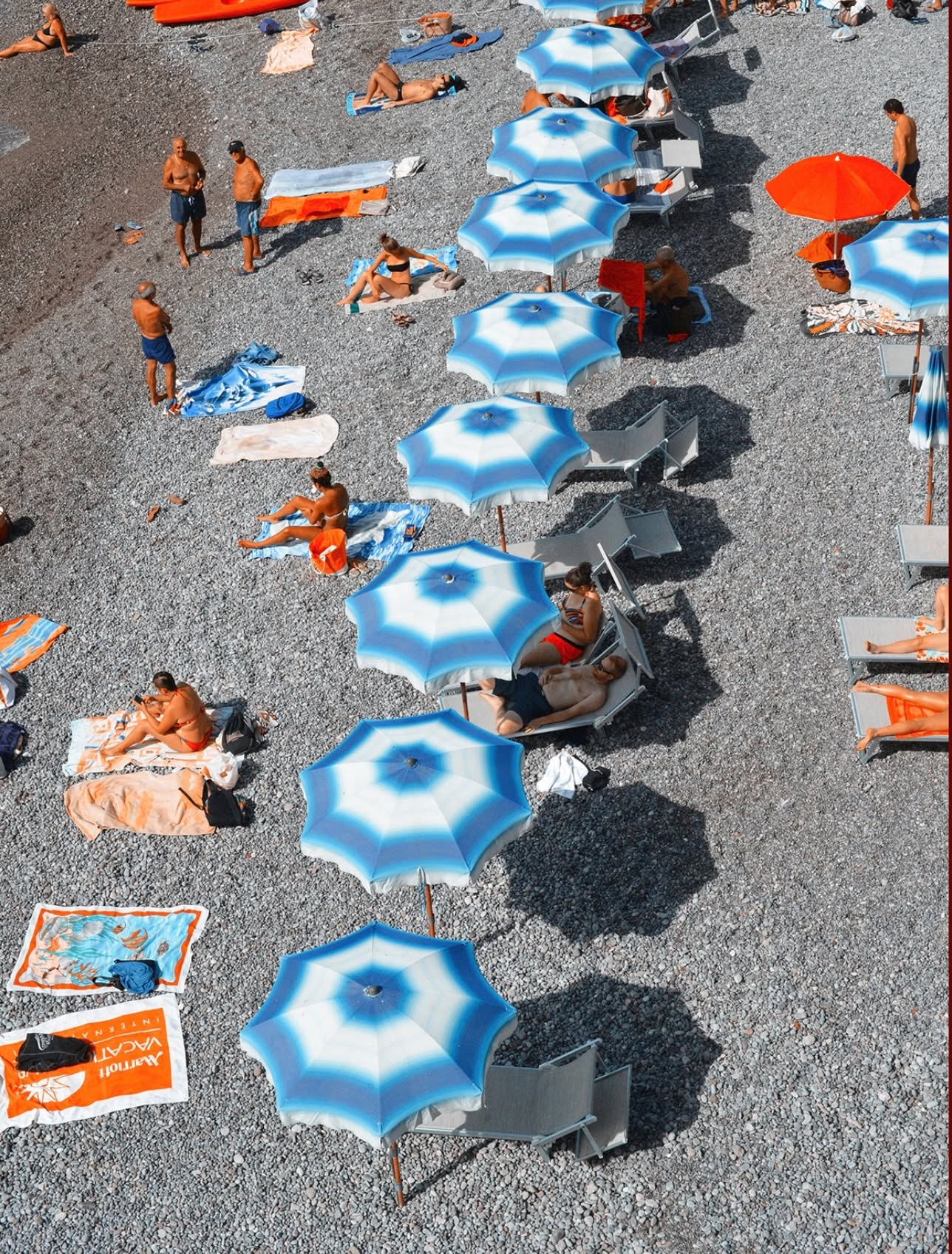
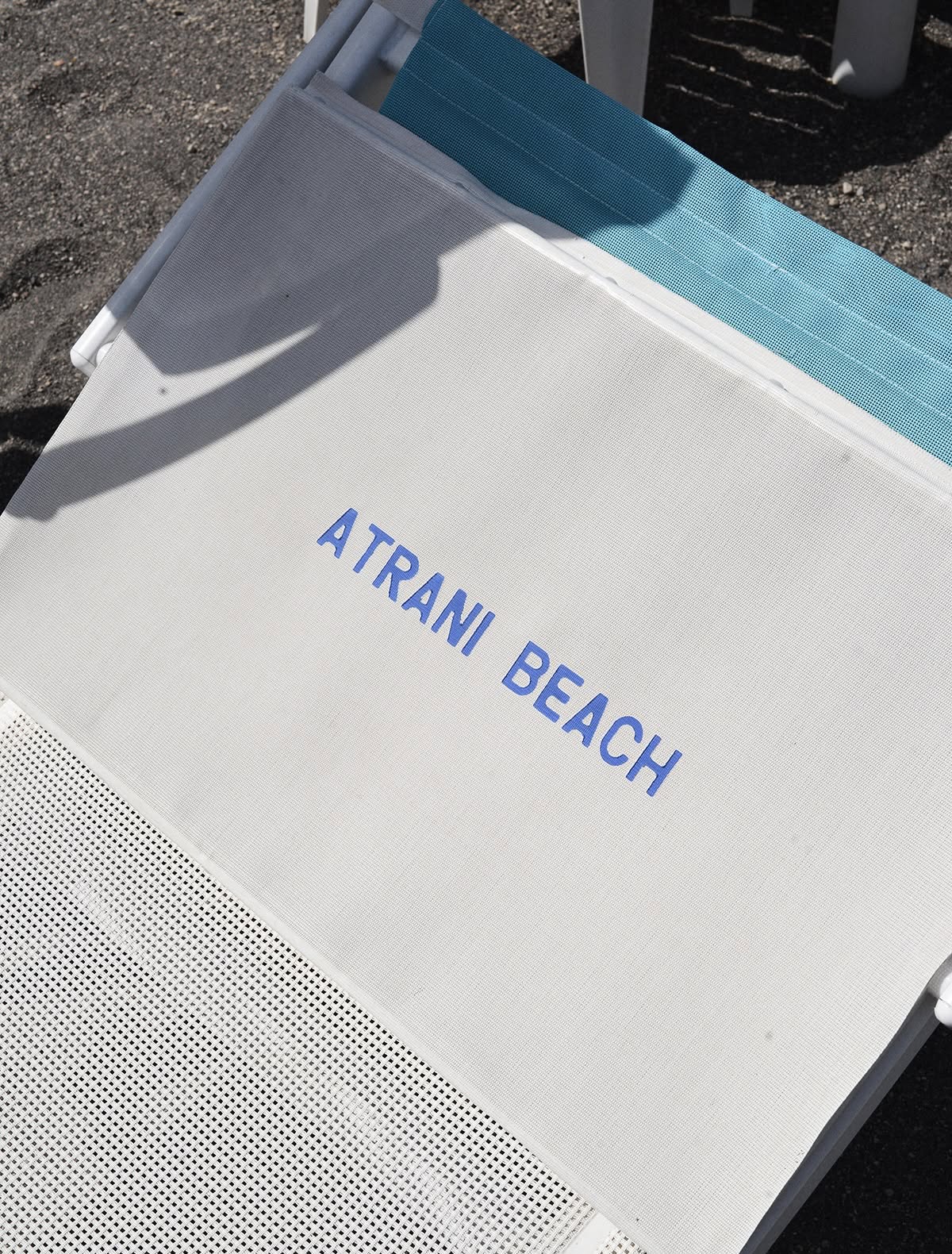
The Atrani Beach Club occupies a section of the beach and offers the standard arrangement: loungers, umbrellas, and a bar. The umbrellas are the classic blue and white striped kind, the ones that appear in every Italian beach photograph from every decade since the 1950s. There is a reason they persist. They work, they look right, and the shadow they cast at midday is exactly the right shape.
The water here is clean. The Amalfi Coast’s designation as a UNESCO World Heritage Site in 1997 came with various environmental protections, and the water quality reflects this. The seabed drops reasonably quickly off the rocks at the western end of the beach, making the swimming good.
The beach club has outdoor showers at its perimeter, the traditional Italian beach installation: doccia freda on one side, doccia calda on the other. Cold shower on the left, hot shower on the right. The cold shower after an afternoon in the Mediterranean is one of the more reliably good sensory experiences available on the coast.

What to See
The Church of San Salvatore de’ Birecto
The most historically significant building in Atrani sits at the eastern edge of the town, a short walk from the main piazza. The tenth-century church is small and not immediately impressive from the outside, but the bronze doors are extraordinary. Cast in Constantinople in 1087 and brought here the same year, they represent one of the finest surviving examples of Byzantine metalwork in southern Italy. The church is sometimes locked outside of service times. It is worth the effort to find it open.
The Collegiata di Santa Maria Maddalena
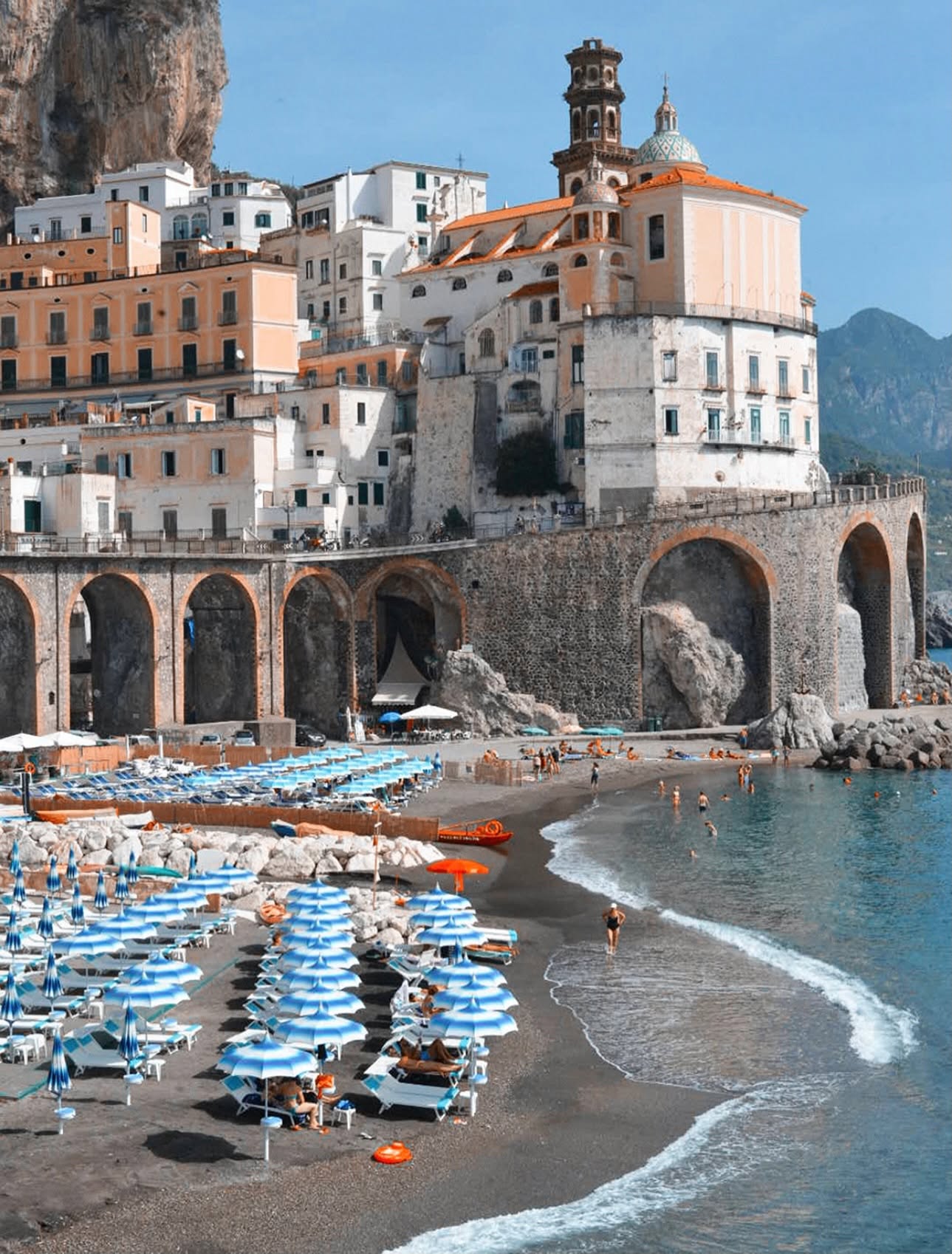
The church that faces the beach from above, the one with the baroque tower and the clock dated 1865 and the green and white tiled dome that is visible from the water. The current building dates primarily from the eighteenth century, though the original church was consecrated in 1274. The interior contains good paintings and the characteristic southern Italian baroque confidence with colour and ornamentation. The view from the steps is directly down the alleyway to the sea.
Piazza Umberto I
The main square of Atrani is genuinely small. It is not the carefully managed pedestrianized version of a small Italian piazza that you encounter in tourist towns. It is an actual piazza where actual people spend actual time. The bar at the corner opens early and stays open late. There is a fountain. There are chairs. Sit in one of them for long enough, and you will see the town’s rhythms.
The Alleyways
Atrani is traversable on foot in twenty minutes, but the pleasure of it is not traversal; it is getting briefly lost in the network of covered alleyways, staircases, and vaulted passages that connect the different levels of the town. Many of these passages are vaulted with arches that date to the medieval period. Some of them are so narrow that you have to turn slightly sideways. They smell of stone and, depending on the time of day, of whatever is being cooked in the apartments above.
The Waterfront Arches
Looking at Atrani from the sea or from the beach, the most striking architectural element is the series of large stone arches that carry the old road along the base of the cliff at the waterline. These arches, which also feature in the aerial view of the town that has become its most reproduced image, are medieval in origin and give the waterfront a distinctly Roman aqueduct quality. They are at their best in the low light of morning or in the late afternoon when the sun comes from the west and casts long shadows across the rock.
Where to Stay
Atrani’s accommodation options are limited by the town’s size, which is itself part of the appeal. There are no large hotels. What exists is small, personal, and embedded in the fabric of the place.
Palazzo Ferraioli is the closest thing Atrani has to a conventional luxury option: a renovated historic palazzo offering elegant rooms, sea views, and a wellness centre. The building has a genuine architectural presence, and the position in the town is excellent.
Hotel L’Argine Fiorito is a family-run hotel near the beach with a traditional Amalfi Coast character. The rooms are comfortable, the staff know the town, and the prices are noticeably more reasonable than comparable accommodation in Amalfi.
Me. Fra Camere is a small guesthouse in the centre of the town, modestly priced and well-regarded. The kind of place where the owner knows who you are by the second morning.
A Scalinatella is a well-known hostel that has accommodated several generations of travellers on a budget. The setting in the town is excellent, and the social atmosphere reflects its reputation.
For those who prefer more privacy, private apartment rentals in Atrani represent excellent value compared to Amalfi or Positano. A week in a self-contained apartment with a terrace here costs significantly less than the same quality of accommodation one kilometre to the west.
It is also worth noting that Ravello, seven kilometres inland and several hundred metres above the coast, makes a practical and aesthetically extraordinary base for exploring Atrani and Amalfi. The road down is steep but short, and Ravello’s comparative calm makes the coast easier to negotiate on a day trip.
Where to Eat
Atrani’s restaurant scene is small and largely free from the tourist-pricing that affects Amalfi’s waterfront. The standard of the cooking is generally good. Fresh seafood, pasta with local sauces, sfogliatella in the morning.
Ristorante Da Zaccaria has a particular distinction: the dining room is in Amalfi, and the kitchen is in Atrani, the restaurant spanning the municipal boundary through the tunnel. This is either a curiosity or a genuine reflection of the town’s geography, depending on your disposition. The food is good.
Bar La Risacca on the piazza is where you sit in the evening when the square fills up. Aperitivo, local wine, the particular quality of late southern Italian light.
La Pergola is a wine bar with a good selection and a terrace. The kind of place that does not need to advertise because the people who find it come back.
The bar culture in Atrani follows Italian rhythms: coffee in the morning, standing at the counter, something cold in the afternoon, and wine in the evening. Follow the rhythm and the town will cooperate.
When to Go
June and September are the optimal months. The water is warm, the light is good, and the crowds are present but not overwhelming. July and August bring the full weight of Italian summer tourism to the coast. Atrani handles this better than Amalfi does, but better is relative. August in particular should be approached with clear expectations.
May and October are less predictable in terms of weather, but often produce the best quality of experience for people who are more interested in the place than in the swimming. The coast in autumn light is a different proposition from the coast in high summer, and not an inferior one.
The winter months, November through March, see most of the tourist infrastructure shut down. What remains is the actual town, and some people prefer this.
Practical Notes
The SS163 that runs through the area is served by SITA buses that connect Atrani to Amalfi (a few minutes), Ravello (via Atrani and a connecting road up the hill), Positano (westward, approximately forty minutes), and Salerno (eastward, approximately one hour). The bus system is reliable and cheap, and does not require a car. A multi-day ticket is available.
There is no pharmacy in Atrani. The nearest is in Amalfi. There is a small supermarket for groceries.
Atrani has no significant nightlife. The last bus back along the coast toward Salerno leaves in the evening, but the exact time shifts seasonally. Check the SITA schedule before committing to an evening in town without a return plan.
The beach is pebbly. Bring appropriate footwear for the water. Water shoes are not glamorous, but they are correct.
Atrani experiences the same Amalfi Coast heat as everywhere along the SS163 in summer. The narrow alleyways retain heat. The beach is fully exposed. Factor accordingly.
Frequently Asked Questions
Is Atrani worth visiting?
Yes, especially if you want the Amalfi Coast without the crowds. Atrani is one of the smallest towns in Italy, a quiet tangle of alleys and arches around a little piazza and beach, minutes from Amalfi but a world away in feeling.
How do you get to Atrani?
Atrani sits right beside Amalfi, an easy walk of a few minutes through the tunnel along the coast road, or reached by the SITA bus, or by ferry to Amalfi followed by that short walk.
How long do you need in Atrani?
An hour or two shows you the town, but it rewards longer. Stay for a meal or a night to have the piazza and the beach to yourself once the day visitors have gone back to Amalfi.
Does Atrani have a beach?
Yes, a small sheltered beach right below the town, quieter than Amalfi’s and framed by the old waterfront arches.
What is the best time to visit Atrani?
Late spring and early autumn, for warm days and an even quieter town than in the summer peak.
Why Atrani
There is a version of the Amalfi Coast that exists primarily to be photographed and consumed. It is not false. The coast is genuinely beautiful. The cliffs are genuinely dramatic. The light in the late afternoon genuinely does something to the sea that is difficult to describe and easy to remember.
But Atrani offers something that the more famous parts of the coast do not: the experience of a place that exists for reasons other than your presence in it. The people in the piazza in the evening were there the evening before you arrived and will be there the evening after you leave. The bells on the Collegiata struck the hours long before the SS163 was built to bring visitors here, and will strike them long after the current season of tourism has ended.
That continuity is available to you. You have to walk through a tunnel to find it, but it is there.
V.
Here is my journal entry for a day at Atrani Beach.
You can find my full Amalfi Coast Guide here.
More images of Atrani here:












Atrani sits immediately east of Amalfi on the SS163. The pedestrian tunnel entrance is on the eastern side of Amalfi, near the Luna Rossa parking garage and Café Déjà Vu along the waterfront. The coastal path from Amalfi takes approximately twenty minutes heading east. Atrani Beach Club offers loungers and umbrellas directly on the dark pebble beach.