My first morning on the island I put a hand into the sea at Sorgeto and took it straight back out. Not cold. Hot, properly hot, hot enough to make me laugh in front of strangers who had clearly watched a hundred people do the same.
That is Ischia. The water comes out of the ground warm, and the island has spent two thousand years building things around it: Roman bath houses, cure hotels, and now a handful of thermal parks that are, for many visitors, the whole reason for the ferry ticket.
They are not interchangeable. One is a faded pleasure palace, one is a beautiful garden, one is where Neapolitan families go, and two of the best are free.
Why Ischia Has Hot Water at All
The island is a volcano that never quite finished. At the centre sits Monte Epomeo, 789 metres, and although it looks like a peak it is not a cone at all. It is a block of green tuff pushed upward from below by a shallow body of magma, lifting something like 900 metres over the last thirty thousand years, cracking the ground along its edges as it went.
Rain soaks into that porous tuff, sinks, is heated at depth, picks up minerals on the way, and comes back up through those cracks. Which is why the springs are not in one tidy spot. They surface all over the island, at different temperatures and mineral loads, from Casamicciola in the north to the shore at Sant’Angelo in the south. The parks simply built pools where the water already was.
Giardini Poseidon at Citara, Forio
The big one. Twenty-two pools stacked up a terraced hillside above Citara bay, from about 15 to 40 degrees, plus a private stretch of beach below, a steam grotto cut into the rock, and Kneipp baths where you walk hot then cold then hot until your legs feel like someone else’s.
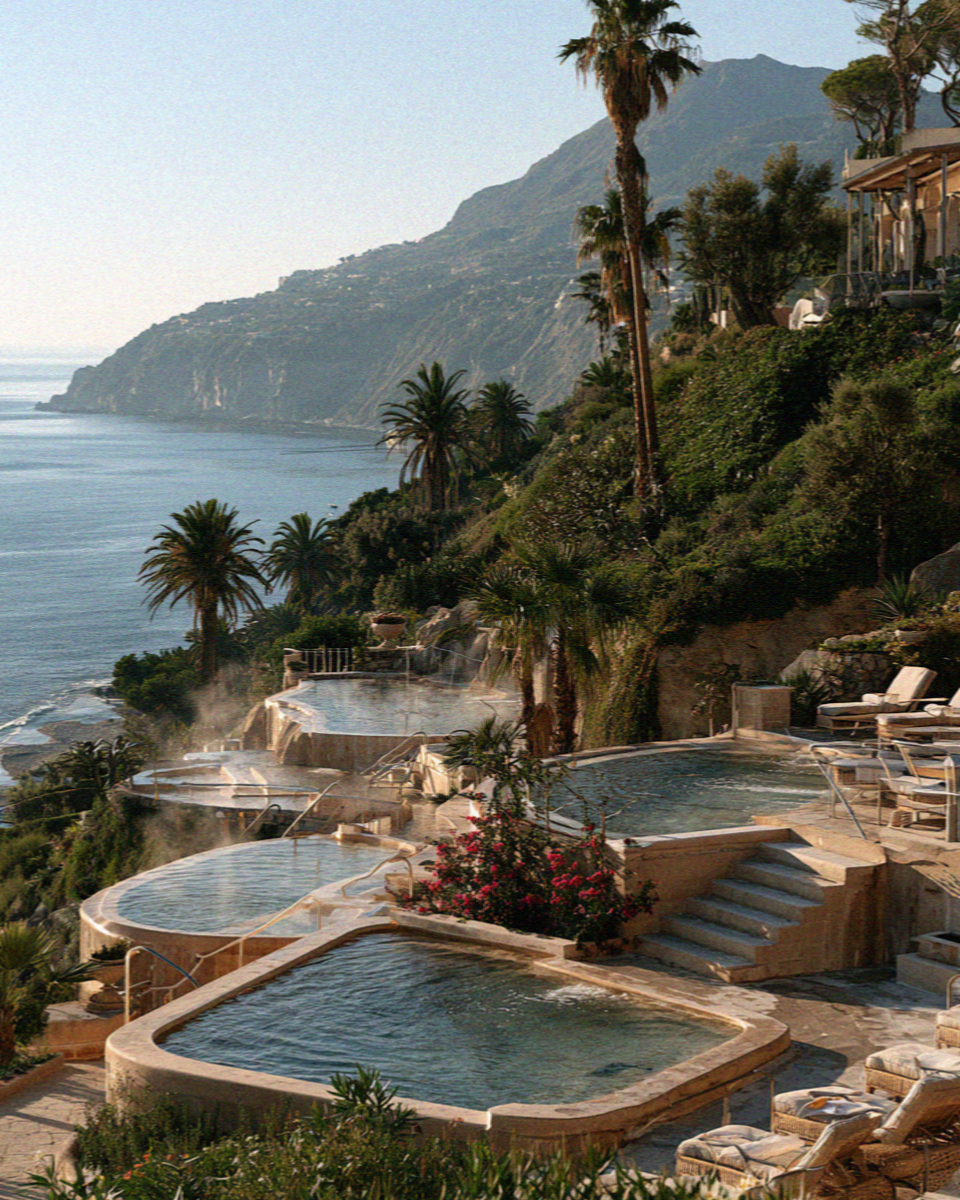
Poseidon opens around mid-April and runs to the end of October, roughly nine to seven, closing earlier in October. Entry when I looked was about 41 euros in April, May and October, around 43 in the summer months and up towards 48 in August, plus a small refundable cash deposit for the wristband. Loungers and umbrellas are included. Towels are not.
It is enormous and it is popular, and in August it feels it between eleven and three. Go at opening, do the top terraces first while the groups are still queueing at the bottom, and you get an hour almost to yourself. The architecture is dated in a way I found charming, white curved walls and stone steps and bougainvillea, and the bay faces west, so the last hour of light is extraordinary. Best for a full slow day, for families, and for variety rather than beauty.
Negombo at San Montano, Lacco Ameno
The one I liked most. Negombo sits in the horseshoe of San Montano bay, laid out from 1947 by Duke Luigi Silvestro Camerini, who decided the bay looked like Negombo in what was then Ceylon, planted a botanical garden and dropped the pools into it.
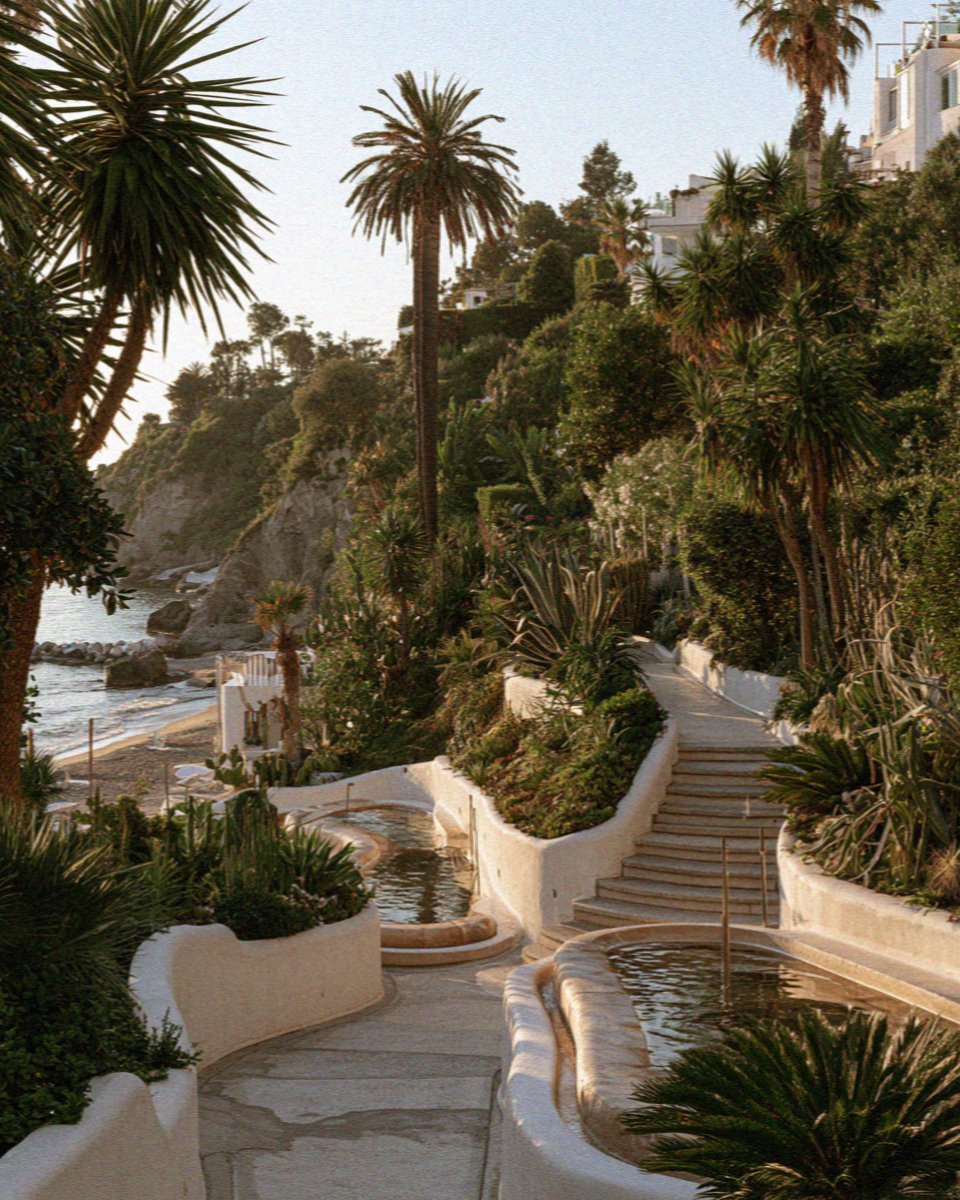
Around fourteen pools, thermal and marine, threaded through olive, myrtle, melaleuca and rosemary, with sculpture set among the planting and a real sand beach at the bottom. It feels like a garden you are allowed to swim in rather than a leisure complex.
It opens later and closes earlier than Poseidon, roughly late April to the second week of October, from half past eight. It is also the most expensive: a full day in high summer ran to about 70 euros when I checked, around 50 in the shoulder weeks, with afternoon entry after roughly half past one at about 30 to 40. Towel hire is around 8 or 9 euros.
That afternoon ticket is the smart buy. Arrive at two, take the pools while everyone else is eating, stay until they turn the lights on.
Castiglione at Casamicciola
The local favourite, and the one foreign visitors skip. Ten pools terraced above the sea between Casamicciola and Lacco Ameno, eight of them thermal at 30 to 40 degrees, plus an Olympic-length seawater pool and a small beach reached by lift down the cliff. Open roughly late April to early October, nine to seven.
Pricing is built around what you sit on rather than a flat ticket, so it lands around 25 to 35 euros a head for a half or full day, less for children, more for two beds and an umbrella together. Best value of the three big parks, best sea views of any of them, and busier with Italian families than with tourists, which for me was the point.
Aphrodite Apollon and the Sant’Angelo Parks
The southern end has its own smaller, gentler set. Aphrodite Apollon sits on the shore just east of Sant’Angelo, eight pools between roughly 20 and 40 degrees, a sauna in a natural cave, no chlorine in the thermal water at all. Around 31 euros for the day when I looked, open from about mid-April to the end of October, nine to six. Reach it on foot from the village in a quarter of an hour, by electric taxi, or by taxi boat from the pier for a few euros.
It is small and quiet and has no ambitions to be anything else. If your idea of a thermal park does not include a queue for the slide, this is your side of the island.
The Free Water: Sorgeto, the Fumarole and Cavascura
Sorgeto is the one that stays with you. A pebble cove below Panza where a hot stream runs off the hillside and gas vents rise through the seabed, so where the two meet the water sits between 30 and 37 degrees, held in rough stone pools that people rebuild by hand every season.
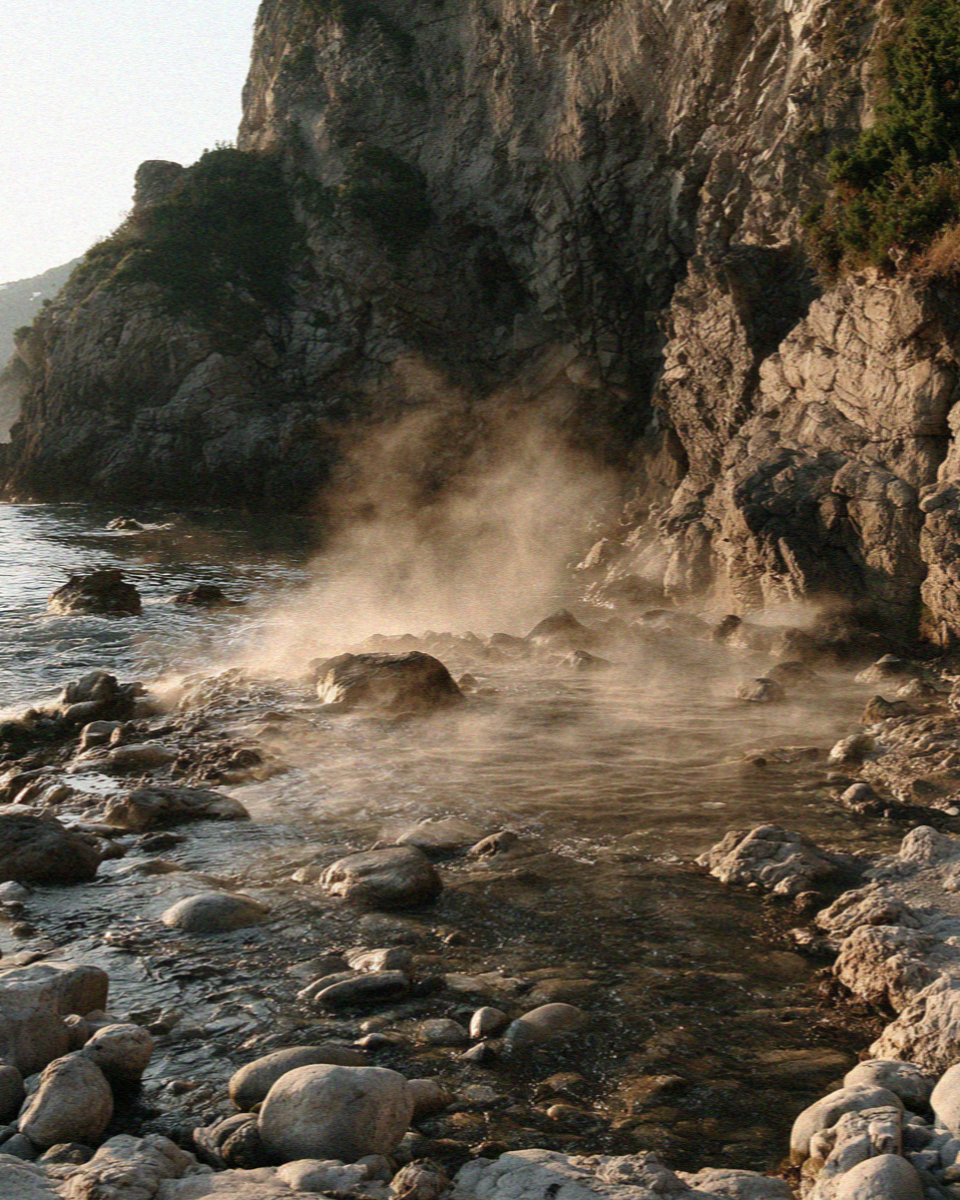
It costs nothing. The price is the staircase: a couple of hundred steps down from the road, and every one of them again on the way up. A taxi boat runs from Sant’Angelo if your knees have views on the subject. Bring water shoes, because the stones are sharp and in places too hot to stand on, and test with a hand before you sit.
Go in winter. Sorgeto never closes, and sitting in 37-degree water in February with the cold sea slapping at your shoulders is one of the strangest and best things I have done in Italy.
At the eastern end of Maronti the sand itself is hot. The Fumarole are steam vents where the ground runs well over 100 degrees a few centimetres down, hot enough that local families cook eggs and chicken buried in foil. Dig a shallow hollow, let it cool, lie in it. Test with your hand first, because it varies enormously spot to spot.
Ten minutes on foot from the same end of Maronti, up a narrow gorge, Cavascura is a rough bath house in the rock: pools carved from the walls, a hot waterfall, stone changing huts. Entry around 10 to 15 euros, open roughly May to October. Not luxurious. Closer to what all of this looked like before anyone sold a ticket.
What People Get Wrong
Towels. Nobody includes them. Bring your own or pay 8 or 9 euros at the desk. Two if you plan on the beach as well.
The season. The paid parks run April to October and then shut. In winter you have the free springs, which are wonderful, and hotel spas, the only indoor thermal water on the island.
Cool months are better for hot pools. May, late September and October are the sweet spot. Forty-degree water in August, after an hour, stops being a treat.
Half day versus full day. Poseidon rewards a whole day because there is more of it. Negombo does not, and the afternoon ticket saves real money.
Water shoes. For Sorgeto and Maronti, not optional.
A Thermal Park Is Not a Spa Treatment
Worth saying plainly, because the words blur. A thermal park is a day out: you buy entry, you use the pools, you bring a book. A spa treatment is a booked, timed thing with a therapist, and on Ischia that usually means the fango cure, volcanic mud matured in thermal water and applied hot, or inhalation therapy, or massage. Most parks have a treatment wing you book separately, as do hotels with thermal licences. If you have come for the mud rather than the swim, book ahead, and know it is a clinic room, not a garden.
More on fitting these into a week in my complete guide to Ischia.
If you only do one: Negombo in the afternoon. If you have two days: Negombo, and Sorgeto at dusk.
Read also: The Best Beaches in Ischia | Where to Stay in Ischia | The Complete Guide to Ischia
Frequently Asked Questions
Which is the best thermal park in Ischia?
Negombo at San Montano is the most beautiful, a 1947 botanical garden with around fourteen pools threaded through it and a sand beach. Giardini Poseidon at Citara is the biggest, more than twenty pools, better for a full day with children. Castiglione at Casamicciola is the best value and the most local.
How much does it cost to enter a thermal park in Ischia?
Roughly 41 to 48 euros at Poseidon depending on the month, around 50 to 70 for a full day at Negombo with cheaper afternoon entry from about half past one, and roughly 25 to 35 at Castiglione. Aphrodite Apollon near Sant’Angelo is around 31. Loungers are generally included, towels are not.
Are Ischia’s thermal parks open in winter?
No. The paid parks run from around mid or late April to somewhere between early and late October, then close. In winter your options are the free natural springs, which never close, and hotels with their own thermal spas.
Are there free hot springs on Ischia?
Yes. Sorgeto cove below Panza is free and open all year, natural pools of 30 to 37 degrees where a hot stream meets the sea, reached by a couple of hundred steps or by taxi boat from Sant’Angelo. The Fumarole at the eastern end of Maronti are free too, where the sand itself is hot enough to cook in.
Do I need to bring my own towel to an Ischia thermal park?
Yes, or budget for hire. None of the parks include towels and hire runs to about 8 or 9 euros. Bring water shoes as well for Sorgeto or the Maronti fumaroles, where the stones and sand get too hot to stand on.