Syracuse was once the largest city in the Greek world. Bigger than Athens. Cicero called it the most beautiful of them all, and he had seen a great many.
It is now a working provincial city of about 120,000 people on the south east coast of Sicily, and the thing almost nobody tells you before you arrive is that the part you have come for is not really the city at all. It is an island stuck onto the front of it, about a kilometre long, joined by two short bridges, and you can walk the whole of it in twenty minutes.
That island is called Ortigia, and it is where you should stay, eat, and spend most of your time.
The rest of Syracuse is where people live, and where the archaeological park is, and it is worth a morning of anyone’s attention. But the reason this place makes people quiet is Ortigia, and the reason Ortigia makes people quiet is that it has been continuously inhabited for something close to three thousand years without ever being turned into a museum.
Here is all of it: what to see, where to sleep, what to eat, when to come, and how to get here.
What to book before you come
Ortigia is free and walking it is the best of Syracuse. What is worth booking is the two things you cannot do on foot: the sea, and the archaeology.
- The sea caves around Ortigia. Ninety minutes around and under the island. 4.8 from nearly three thousand people, and the most booked thing here for good reason.
- The Greek theatre and the Neapolis, guided. The park is largely unlabelled and the quarries beside it are the better half.
- The Ortigia food walk. Rated 4.9. Do it on the first evening so you know which market stalls to return to.
The cathedral, the Fonte Aretusa and the whole Ortigia waterfront are free. More in my guide to the best things to do in Syracuse.
The shape of the place

Understand the geography and everything else falls into place.
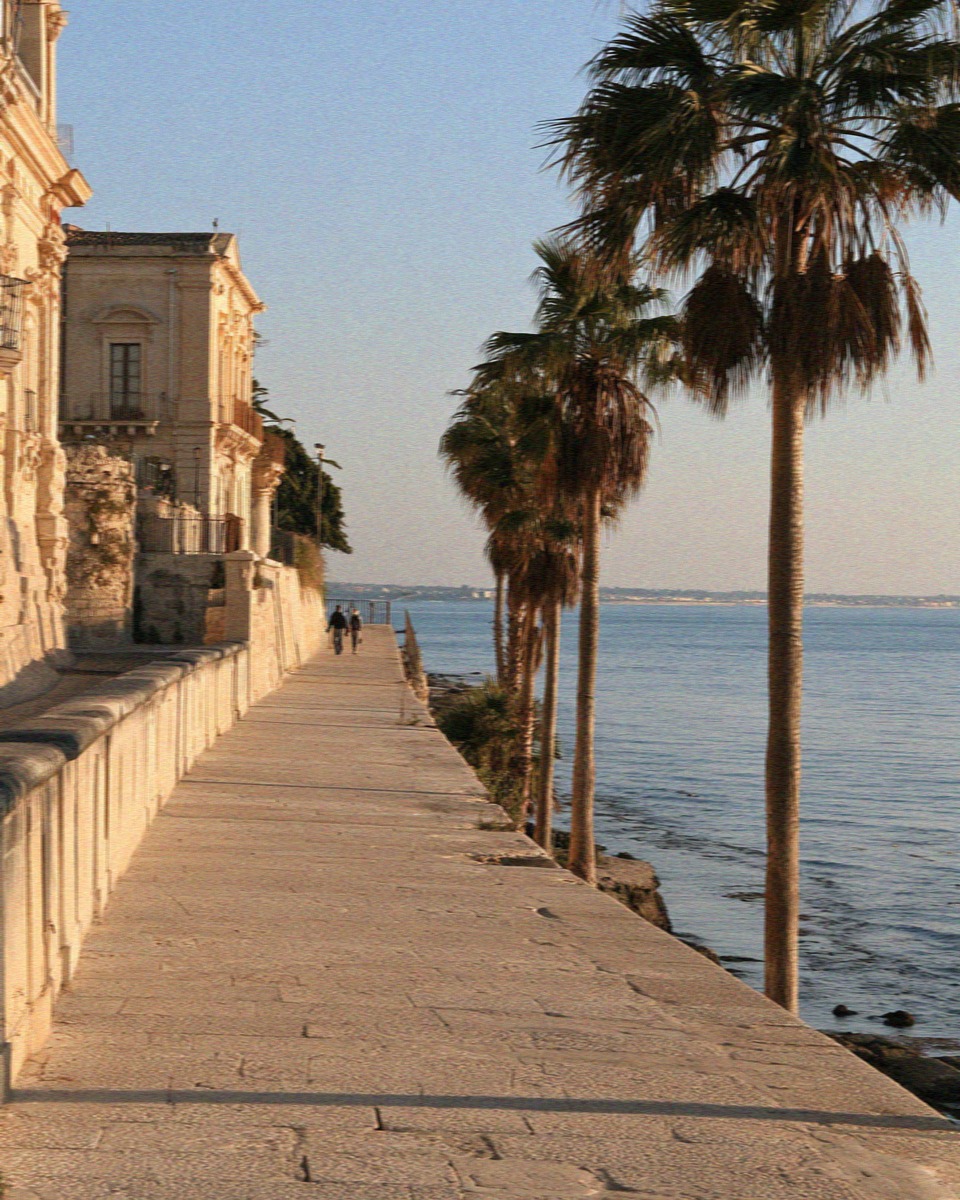
Ortigia is the island. It holds the cathedral, the market, the sea wall, almost every good restaurant and almost every hotel worth booking. Cars are heavily restricted. It is small, dense, made of honey coloured limestone, and it is where you will actually be.
The mainland city starts the moment you cross the bridge. Ordinary streets, ordinary shops, the bus and train stations, and about fifteen minutes further out, the archaeological park.
The coast runs south from the city into a series of beaches and a marine reserve, which is where people go in July and August when the town is too hot to enjoy.
That is the whole of it. Three parts, and you can hold them in your head after one afternoon. I have written the island up on its own in my guide to Ortigia, because it deserves the room.
Plan Your Visit to Syracuse
A few things I booked and loved. These help support the blog, at no cost to you.
This section contains affiliate links. If you book through them I may earn a small commission, at no extra cost to you.
A Greek temple with a church built into it

This is the single most extraordinary building in Sicily and it does not look like much from the outside.
The cathedral on Ortigia is a temple to Athena, built in the fifth century BC, after the Greek victory at Himera. In the seventh century AD the Christians did not knock it down. They walled up the gaps between the columns, cut arches through the inner wall, and moved in.
So the Doric columns are still there. All of them. Standing inside the walls of a working cathedral, fluted and weathered and enormous, load bearing after two and a half thousand years. You can put your hand on a column that was carved when Athens was still building the Parthenon.
The Arabs stripped it. The Normans reconsecrated it in 1085. The 1693 earthquake brought the façade down and it was rebuilt in high Sicilian Baroque, which is why the front looks like nothing at all to do with the inside.
Entry is two euros. It is UNESCO listed. The full version is in my guide to the cathedral and its Greek temple.
The archaeological park

Twenty minutes’ walk from the bridge, or a short bus ride, and worth a morning.
The Neapolis archaeological park covers twenty four hectares. The Greek theatre is the centrepiece, cut directly into the bedrock rather than built up out of it, and large enough to have held fifteen thousand people. Aeschylus staged plays here in his own lifetime.
Then there are the quarries. This is the part people do not expect. The latomie are vast pits from which the city’s stone was cut, and they are now sunk gardens full of lemon and orange trees with sheer white walls a hundred feet high. Cool, green, completely silent.
And in one of them, the tall pointed cave the locals call the ear. Twenty three metres high, cutting sixty five metres into the rock, shaped like a keyhole and with acoustics that turn a whisper into something else entirely.
There is a Roman amphitheatre too, oval and half sunk into the ground, which feels like a different city because it is.
Tickets start around twenty one euros fifty with an audio guide, and the gates open at half past eight. Go at opening. By eleven the coaches have arrived and there is no shade anywhere in it. Everything else is in my guide to the archaeological park.
The theatre is still used, which changes everything
This is the thing to know if you have any flexibility about when you come.
Every year from early May to late June the Fondazione INDA stages Greek tragedy in that theatre. Not a re-enactment and not a son et lumière. A full professional season, in Italian, on the original stone, with an audience of thousands sitting where the audience has always sat. 2026 is the 61st season, running 8 May to 28 June, with Euripides, Sophocles and Aeschylus on the bill.
Seeing Antigone performed at dusk in the theatre it was written for is not a thing you can do anywhere else on earth. Tickets go through the INDA foundation and sell by subscription as well as singly, and if your dates are anywhere near that window I would build the trip around it rather than around the weather.
A first walk, which takes about two hours
If you arrive with an afternoon and no plan, do this.
Cross the bridge and keep going straight. The main street narrows almost immediately and the noise of the mainland stops within about thirty seconds, which is the first thing that surprises people.
Bear left into the market if it is before two, right past it if it is not. Come out at the top and work down toward the cathedral square, which you will find by accident because everything funnels there.
Sit down. Have something. Then walk out along the sea wall on the eastern side, all the way to the fort at the point, and back up the other side past the freshwater spring.
That is the island. You have now seen most of it and you will spend the next two days going back over the same four hundred metres finding things you walked straight past.
The papyrus, which is genuinely unusual
There is a freshwater spring on the sea wall with papyrus growing out of it, and just south of the city there is a river with papyrus growing along its banks for a couple of kilometres.
This is the only place in Europe where it grows in the wild. Nobody is quite certain how it got here, though the likeliest story is a gift from Ptolemaic Egypt a couple of thousand years ago that simply took.
The practical upshot is that Syracuse still has papyrus workshops making paper by hand the old way, splitting the stem, laying the strips in a cross hatch, pressing them until the plant’s own sap glues the sheet together. It is the least kitsch souvenir in Sicily and it costs almost nothing. You can also take a small boat up the river through the reeds, which is a pleasant slow hour and completely unlike the rest of the trip.
The market, and the eating
The market on Ortigia runs six mornings a week and it is not a tourist attraction that happens to sell food. It is where the town shops.
Crates of tomatoes and lemons on the pavement, whole swordfish laid out on ice with the blade still attached, men shouting prices in Sicilian that even Italians do not entirely follow. The red prawns are the thing to look for, scarlet and eaten raw with nothing but lemon, and they are genuinely a local speciality rather than a menu word.
There is a cheese counter in the middle of it that makes a sandwich which has become mildly famous. It opens at seven and closes at four, and if you go at eleven you will queue for forty minutes. Go at half past nine or after half past two. The correct order is fai tu, which means you decide, and then you stand back and watch it get built.
I have put the restaurants, the market and the whole business of eating here into my guide to where to eat in Syracuse.
Three things people miss
A Caravaggio, in a small church on the cathedral square.
The Burial of Saint Lucy was painted here in 1608, while Caravaggio was on the run from a murder charge in Rome, and it is enormous: over four metres by three. Lucy is the patron saint of Syracuse and was buried in the city, which is why the commission came to him. It hangs in Santa Lucia alla Badia on the south side of the cathedral square. It is dark, unbalanced, mostly empty at the top, and one of the last great things he did. Check opening hours locally because they move.
The fort at the tip of the island.
Castello Maniace sits on the very point of Ortigia, thirteenth century, built under Frederick II, low and square and military in a town that is otherwise all curves and carving. Sea on three sides. Go for the walk out to it as much as for the building.
Archimedes was from here.
He was born in Syracuse around 287 BC, worked here, designed the machines that held off the Roman siege for two years, and was killed here by a Roman soldier when the city finally fell in 212 BC. There is no great monument to him and that is somehow right. But you are walking around a town that produced one of the three or four best mathematicians who have ever lived, and it is worth holding that in your head while you do.
The evening, and the square

The cathedral square is the best public room in Sicily.
It is a long oval of pale limestone, closed on every side by baroque façades, and there is not a car in it. In the late afternoon the stone goes the colour of the inside of a peach. After dark it is lit from below and the whole square glows.
What happens there is simply that the town turns up. Not tourists especially, though there are plenty. Families, teenagers, older couples walking arm in arm at a pace that suggests they have nowhere at all to be. It goes on until midnight and nobody is drunk.
If you do one thing here, sit in that square with a drink at about nine and do nothing for an hour.
The beaches
Syracuse is not a beach town, but it has beaches, and in high summer you will want them.
Fontane Bianche is the big one. Broad pale sand, shallow water, family territory, and it takes its name from freshwater springs that come up through the seabed. About twenty minutes south and reachable by train, which is unusual and useful.
Arenella is a sheltered golden bay, calmer, good for a lazy day with children.
Plemmirio is the other kind entirely. A marine protected area on the headland just south of the city, with no sand at all: low white cliffs, rock ledges, and water clear enough to make snorkelling worth the trip. This is the one I would choose.
All three, and how to reach them without a car, are in my guide to the beaches near Syracuse.
Getting here
Catania airport is the one. It is about an hour away and it is where everything flies.
The bus is the answer, and unusually it is both the cheapest and the fastest option. Direct from outside the airport terminal to Syracuse in fifty five to seventy minutes for about six euros sixty, running every half hour to hour through the day. It drops you near the bridge.
The train does not go to the airport. You would have to get into Catania Centrale first and then take the coastal line down, which is about an hour and three quarters all in. It is a pretty ride and it is the wrong way to arrive.
Do not hire a car for Syracuse itself. Ortigia is restricted, parking is a genuine ordeal in August, and you will not use it. Hire one at the end if you are touring the south east.
Full detail, plus the day trips, is in getting to Syracuse and the day trips worth taking.
Getting around once you are here
On foot, on Ortigia. The island is about a kilometre end to end. You will not need anything else, and the streets are too narrow for most of what you might have hired.
The archaeological park is a twenty five minute walk from the bridge, uphill and dull for the last stretch, or a short bus. In July take the bus.
The beaches are a bus or a train south. Fontane Bianche has its own station, which makes it the easy one without a car.
Taxis exist and are not plentiful. Book ahead for an early flight rather than assuming.
Parking, if you do arrive by car: leave it in one of the car parks on the mainland side and walk in. Do not attempt to drive into Ortigia in August.
Day trips, briefly
Noto is twenty eight kilometres away, half an hour, and it is the finest baroque town in Sicily. The whole place was flattened by the 1693 earthquake and rebuilt at once in the same honey coloured stone, so it has the coherence of a stage set. It is UNESCO listed as part of the Val di Noto.
Marzamemi is twenty minutes beyond it, a small fishing village built around a square that opens straight onto the sea, with an old tuna processing works at one end. Go for dinner rather than lunch.
Both fit into one day and they belong together.
Vendicari sits between them, a coastal nature reserve of salt pans, dunes and empty beaches with a ruined tuna works standing on the shore. It is a walk rather than a sight, and in spring and autumn it fills with migrating birds including flamingos. If you have a car and a spare morning, this is the one that surprises people.
Catania is an hour north and is the anti-Syracuse: big, loud, black with volcanic stone, with a fish market that is one of the great markets in Italy. Go for a morning, eat, come back. It is also where your flight leaves from, so it works as a last day.
Is it safe, and other practical worries
Yes, and unremarkably so. Ortigia at midnight is full of families. Ordinary city sense on the mainland after dark, the same as anywhere.
Cash. Cards are accepted almost everywhere now, but the market runs on cash and so do the smaller places. Carry some.
The heat. July and August genuinely reach the high thirties and the pale stone throws it back at you. The town adapts by shutting from one until four, and you should too.
Sundays. The market does not open. Plan the archaeological park or a beach.
Language. English is widely spoken in restaurants and hotels on Ortigia and much less so on the mainland side. A little Italian goes a long way in the market and is enjoyed rather than judged.
How long you need
Two nights is the honest minimum. One full day for Ortigia, one morning for the archaeological park, and an evening in the square.
Three nights is right. It gives you a beach afternoon or the Noto and Marzamemi run without hurrying anything.
Four or more and you start using Syracuse as a base for the whole south east, which it does very well.
A day trip from Taormina or Catania is possible and I would not do it. Two hours each way, and you would see the park and miss the town, which is the wrong half.
When to come
May, June, September and early October are the good months. Warm, swimmable, and the town still belongs to itself.
July and August are hot, busy and expensive, and the light in the middle of the day is punishing on all that pale stone. Come anyway if that is when you can, but plan around the heat: early mornings, long lunches, late evenings.
Winter is underrated. Cool, bright, half empty, and the restaurants that stay open are full of locals. It does rain.
The month by month version is in the best time to visit Syracuse.
Where to stay, in one paragraph
Stay on Ortigia. This is not a close call. Everything worth doing at night is there, and crossing the bridge at midnight to get back to a business hotel is a sad way to end an evening. The island has converted palazzi with courtyards, small design hotels, and a lot of apartments. The mainland side just over the bridge is cheaper and quieter and perfectly fine if the island is full. My full breakdown is in where to stay in Syracuse.
What it costs, roughly
Prices move, so treat these as bands rather than quotes.
- Cathedral: about 2 euros
- Archaeological park: from about 21.50 with audio guide
- Bus from Catania airport: about 6.60
- A room on Ortigia in shoulder season: roughly 90 to 180 euros for something good
- The same room in August: expect half as much again
- Dinner with wine, a proper one: 35 to 55 a head
- The market sandwich: under 10, and it is lunch for two
The town is noticeably cheaper than Taormina and about the same as Catania.
What most people get wrong
They come for the day. Syracuse in daylight is a good archaeological site attached to a pretty town. Syracuse at nine in the evening is something else, and you only get that by sleeping here.
They do the park in the middle of the day. There is no shade. Go at opening.
They stay on the mainland to save forty euros and then spend the whole trip walking back over a bridge.
They skip the cathedral because it looks baroque from the square. It is a Greek temple. Go in.
More images from Syracuse




Your Syracuse Guides
Everything here in detail, guide by guide.
- Ortigia: the Island Old Town of Syracuse
- The Neapolis Archaeological Park in Syracuse
- The Cathedral of Syracuse: a Church Inside a Greek Temple
- The Best Things to Do in Syracuse
- A Syracuse Itinerary: 1 to 3 Days
- Where to Stay in Syracuse
- Where to Eat in Syracuse
- The Best Beaches Near Syracuse
- The Best Photo Spots in Syracuse
- The Best Time to Visit Syracuse
- Getting to Syracuse and the Best Day Trips
Syracuse Travel Diaries
Frequently Asked Questions
Is Syracuse worth visiting?
Yes, and for longer than most people give it. The island of Ortigia is one of the loveliest old towns in Italy and it is still a working one rather than a preserved one. Add the Greek theatre, the quarries and a cathedral built inside a fifth century BC temple, and two or three nights is easily justified.
How many days do you need in Syracuse?
Two nights as a minimum, three is better. One day for Ortigia, one morning for the archaeological park, and at least one evening in the cathedral square. Four nights lets you add the beaches or a day trip to Noto without rushing.
Should you stay in Ortigia or on the mainland?
Ortigia, if you can. Almost everything worth doing in the evening is on the island, and the mainland side is a walk back over a bridge at the end of every night. The streets just over the bridge are cheaper and a reasonable fallback in high season.
How do you get from Catania airport to Syracuse?
Take the direct bus. It runs from outside the terminal, takes fifty five to seventy minutes, costs around six euros sixty and goes every half hour to hour. There is no train from the airport itself, so rail means changing in Catania and takes closer to two hours.
What is Syracuse cathedral built on?
A Greek temple to Athena from the fifth century BC. Rather than demolish it, the early Christians filled in the gaps between the Doric columns and cut arches through the wall, so the original columns still stand inside the building. Entry is about two euros.
What is the best time to visit Syracuse?
May, June, September and early October. Warm enough to swim, quiet enough to enjoy, and the light is kinder than in high summer. July and August are hot and crowded, and winter is cool, cheap and surprisingly good if you do not need the beach.
Is Syracuse good for a day trip from Taormina or Catania?
It is possible and it is not the way to see it. Two hours each way means you get the archaeological park and lose the evening, and the evening is the best part of Syracuse. Stay a night.
V.