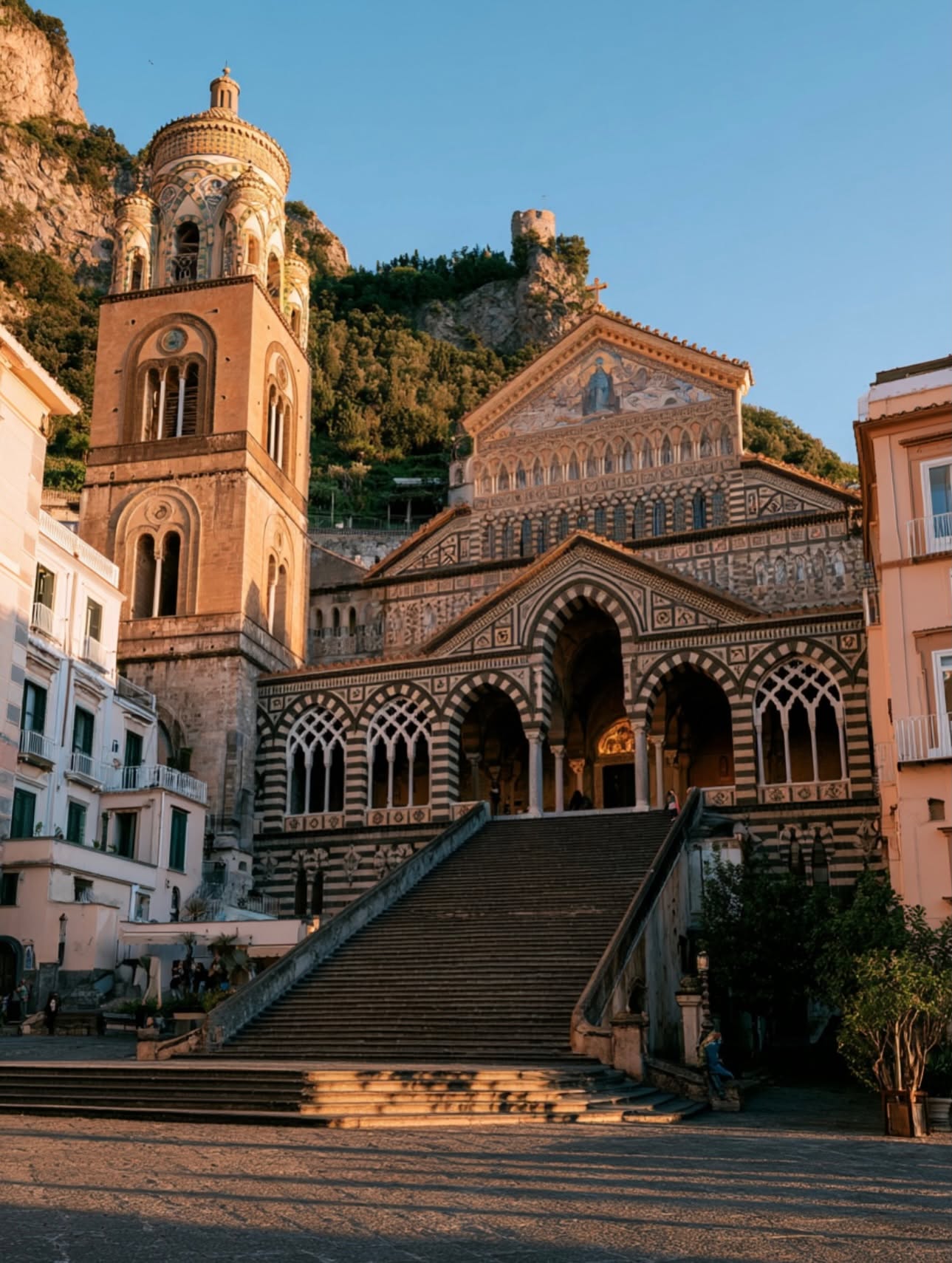
There is a moment, when you first look up at the Duomo di Amalfi from the piazza below, when the town seems to hold its breath. The Cathedral of Sant’Andrea rises above the square on its long flight of steps, striped and gilded, more Eastern than Italian, and it is impossible not to stop. I have come to Amalfi many times, and I have never once climbed those steps without pausing at the bottom first. This is a building that asks you to slow down before you have even entered it.
The Sixty-Two Steps and the Facade
There are sixty-two of them, rising steeply from the Piazza del Duomo to the facade, and they are part of the experience rather than an obstacle to it. Climb slowly. The facade reveals itself as you go, and it is unlike almost anything else on this coast: striped Arab-Norman work, alternating bands of grey volcanic stone and white marble, laid into geometric patterns that owe far more to Cairo and Constantinople than to Rome.
This was deliberate. Amalfi was once a maritime republic, a small state grown rich on trade with Byzantium and the Levant, and the cathedral was built to announce that wealth to anyone who arrived by sea. Stand at the top and turn around, as I always do, and you understand the logic of it. The facade is a statement, and the steps are its pedestal.
Plan Your Visit to the Amalfi Coast
A few things I booked and loved. These help support the blog, at no cost to you.
- Where I stayed: search Amalfi Coast hotels
- Boat tours and Amalfi Coast tickets
- Stay connected: get a travel eSIM
This section contains affiliate links. If you book through them I may earn a small commission, at no extra cost to you.
The Bronze Doors from Constantinople
At the top, set into the porch, are the bronze doors, and they are older than almost everything around them. They were cast in Constantinople in 1065, commissioned by an Amalfitan merchant named Pantaleone di Mauro, and they were the first bronze doors in Italy to be made outside the country. They still serve as the main entrance.
I like to touch the metal before I go through, worn smooth by nine and a half centuries of hands. The panels are inlaid with silver, their figures faint now, half read rather than seen. There is something moving about a merchant sending home a set of doors from across the sea, a private act of devotion that became a piece of the town’s memory.
The Interior Nave
The inside takes some adjustment. If you expect the interior to continue the striped Eastern language of the facade, it does not. The nave was heavily reworked in the eighteenth century and is thoroughly Baroque now, gilded and coffered, all white and gold and ornament. It can feel like a different building entirely.
I confess I love the outside more than the inside, and I do not think there is any harm in saying so. But give the nave a few minutes. Let your eyes settle. The coffered ceiling, the columns, the quiet coming and going of people who have climbed all those steps to be here, it composes itself eventually into something worth the climb.
The Chiostro del Paradiso
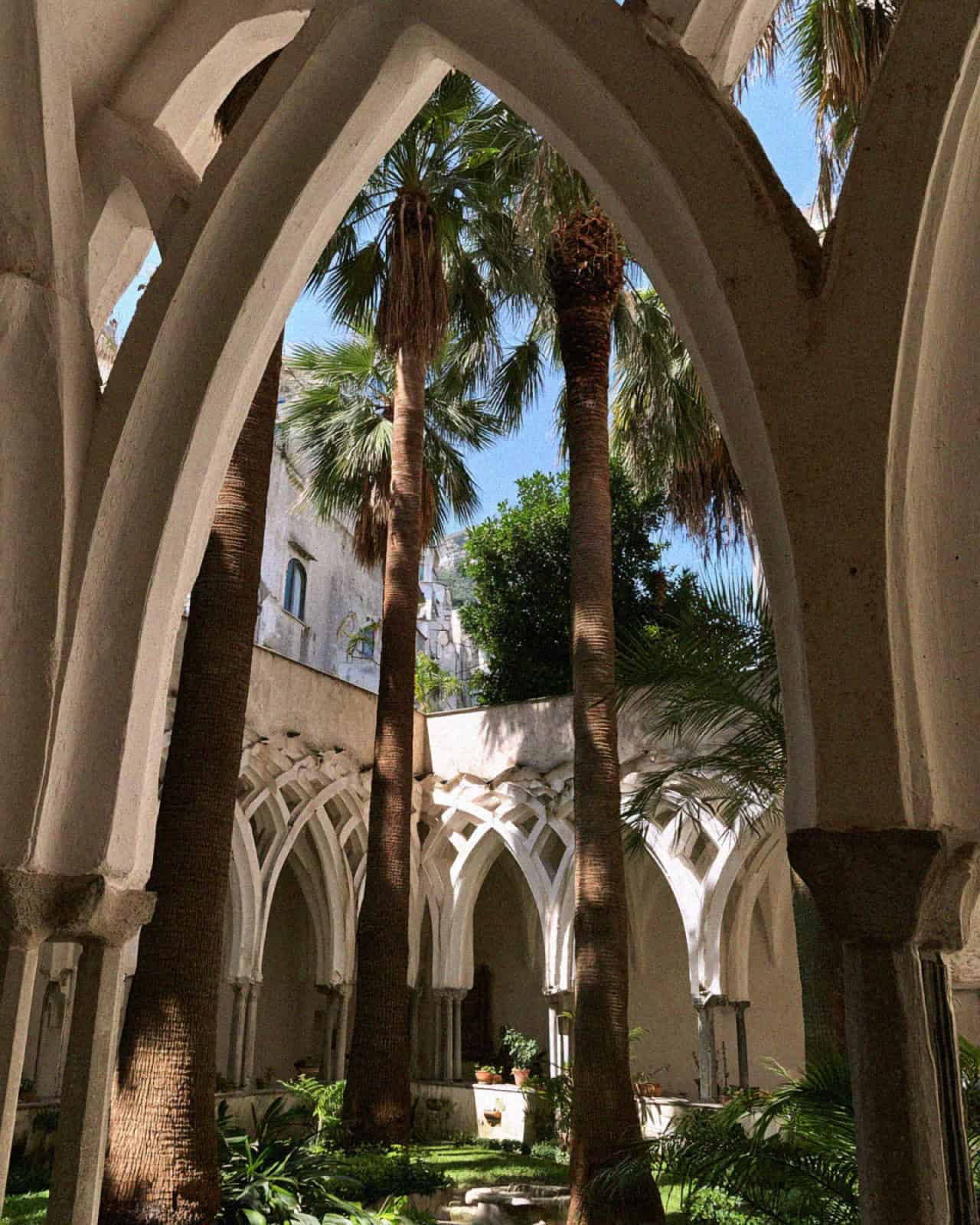
For me the Cloister of Paradise is the heart of the complex, and the reason I return. It was built in 1266 as a burial ground for the noble families of Amalfi, and it remains one of the loveliest small spaces on the whole coast. The interlaced Moorish double arches enclose a garden of palms, and around the edges lie ancient sarcophagi and fragments of Roman stone, gathered here across the centuries.
It is the most photogenic corner of the cathedral, and rightly so, but I would ask you not to rush it for a picture and then leave. Sit on the low wall for a while. The cats will find you if you stay in the garden long enough; there is usually one asleep in a patch of sun. The light moves through the arches slowly, and the noise of the town falls away.
The Crypt of Sant’Andrea
Beneath the high altar lies the Crypt of Sant’Andrea, and it is the most sacred part of the cathedral. The relics of Saint Andrew the Apostle were brought here from Constantinople in 1208, and he has been the patron of Amalfi ever since. The crypt is richly decorated, low and gilded, and it holds the particular hush of a place people come to for reasons other than architecture.
His feast falls on the thirtieth of November, when a procession carries the saint down the cathedral steps, a rite that has run in this town for eight centuries. I have never been in Amalfi in late November, and it is one of the small omissions I mean to correct. Even on an ordinary day, though, the crypt is worth the descent.
The Basilica del Crocifisso and Diocesan Museum
The paid visitor route runs through four spaces in a set order, and it begins in the Basilica del Crocifisso, the older church built alongside the present cathedral, now home to the Diocesan Museum. Here are the fragments the centuries left behind: liturgical treasures, works of art, the mother-of-pearl inlays and the objects that trace Amalfi’s long reach across the Mediterranean.
From the basilica the route leads to the Cloister of Paradise, then down into the Crypt, and finally into the Cathedral itself. It is a well-judged sequence, moving from the museum through the garden to the sacred centre and out into the great nave, and it means you never double back on yourself.
Tickets, Hours and How to Visit
Entry to the cathedral itself is free. The museum-and-cloister complex, which is the route described above, costs around four euros, which is one of the better small sums you will spend on this coast. Hours run roughly from 9.00 to 18.45 from March to June, and from 9.00 to 19.45 from July to September. In winter, from November to February, the cathedral keeps reduced hours, something like 10.00 to 13.00 and again 14.30 to 16.30, and times shift around services throughout the year.
A full, unhurried visit takes thirty to forty-five minutes. It is not a place that demands a whole morning, which is part of its charm. You can fold it into a day and still have time for the harbour and a long lunch.
The Best Time of Day
If you can manage it, come early, between 7.00 and 9.00, before the coach groups arrive and the steps fill with people photographing one another. In those first hours the piazza is nearly empty, the shopkeepers are still setting out their tables, and the facade catches the low morning light. You can climb alone and have the cloister almost to yourself.
The other good hour is dusk. As the sun drops, the grey and white of the facade warms to amber, and the whole front of the cathedral seems to glow above the square. I have sat in the piazza with a glass of something at that hour and watched the colour change, and I can think of few finer ways to end a day in Amalfi.
Frequently Asked Questions
How much does it cost to visit the Amalfi Duomo?
Entry to the cathedral itself is free. The museum-and-cloister complex, which takes you through the Basilica del Crocifisso and Diocesan Museum, the Cloister of Paradise, and the Crypt, costs around four euros. For that small sum you see the most beautiful parts of the building, so I would always pay it.
How many steps are there?
There are sixty-two steps rising from the Piazza del Duomo to the facade. They are steep but not long, and I would climb them slowly rather than briskly, letting the facade reveal itself as you go. At the top, turn and look back over the piazza; the view is part of the reward.
Is the cathedral free?
Yes, entering the Cathedral of Sant’Andrea to see the nave is free of charge. The four euro ticket applies only to the guided museum route through the cloister, crypt and Diocesan Museum. If your time is short you can step into the cathedral for nothing, though the cloister is the part I would not want you to miss.
The Duomo is the point around which the whole town turns, and it deserves an unhurried morning early or a slow drink at dusk. For everything else, from the harbour to the hills above it, I have gathered my thoughts in Victoria’s Complete Guide to Amalfi, along with the best things to do in Amalfi and where to eat in Amalfi when the climb has left you hungry.