Some links in this guide are affiliate links. If you book through one, this site may earn a small commission, at no extra cost to you. How this works.
The best things to do in Polignano a Mare are mostly free, mostly outdoors, and mostly a matter of being in the right place at the right hour rather than buying a ticket. This is a small town on a limestone cliff in Puglia with a famous cove, a network of sea caves underneath it and a very good coffee. Here is what is actually worth your time, roughly in the order I would do it.
What to book before you come
The town costs nothing. The caves under it are the one thing you cannot see from the land, and in July and August the good boats go days ahead.
- The speedboat run to the caves, with an aperitif. Two hours, and the single most booked thing in this town: 4.8 from over four and a half thousand people. It goes into the Grotta Palazzese from the water, which is the view the restaurant charges three figures for.
- The ninety minute cave tour. The shorter, cheaper version on a larger boat. Take this one if you have children or are only here for a day.
- A private boat to the caves. Rated 4.9. Worth the difference at sunset, when the shared boats are full and the light on the cliff face is the reason anybody photographs this place.
Lama Monachile, the old town, the terraces over the water and the statue of Domenico Modugno are all free.
Walk in through the Arco Marchesale
Start at the gate.
The Arco Marchesale, also called Porta Grande, is a sixteenth-century arch that was once the only way into the walled town, and the ruined shell of a fifteenth-century church still sits above it. Walk through and the sound changes. The streets narrow, the render goes white, cars stop existing.
It is a threshold, and the town is designed around it. Go through slowly the first time.
Get lost in the centro storico on purpose
The old town is small. You cannot really lose an afternoon in it unless you try, and trying is the point.
Every few turns an alley delivers you to the edge of the cliff without warning. There is no signage and no build-up. You are in a white corridor and then there is a low wall and then there is the Adriatic, twenty metres straight down.
Terrazza Santo Stefano is the one everyone knows and it deserves the attention. But the smaller unnamed terraces are better, precisely because nobody is standing on them.
The rule that works: pick a lane you have not walked, head toward the sound of water, and see where it puts you.
Read the walls
Look down as you go.
A local poet who signs himself Guido il Flâneur has been painting lines of verse onto doors, walls and steps across the old town for years. Start on Via Commedia delle Mura, where they cluster, and then simply keep your eyes down as you wander. Half the pleasure is finding one nobody has pointed you at.
It could easily be twee. It is not. At seven in the morning, with the lanes empty and the light coming in low, finding a line of Italian poetry on a worn step is a genuinely lovely thing.
Stand on the Ponte Borbonico
The old bridge over the ravine is a viewpoint disguised as a piece of road.
From the parapet you look straight down into Lama Monachile, the pebble cove wedged between two vertical limestone walls, and out through the gap to open sea. It is the image of Polignano that everybody has seen.
Which means: go at first light, or accept standing shoulder to shoulder. Between about ten and five in summer this parapet is three deep.
Swim somewhere quieter
Everyone goes down the stairs to Lama Monachile. It is beautiful, it is tiny, and in July and August it is full by nine in the morning.
The better move on a hot day is to walk fifteen or twenty minutes and get in off the rocks instead. Cala Paura, about a kilometre and a half from the centre, is a set of rocky inlets where the bottom drops away fast, which makes it excellent for snorkelling and for jumping in. If you want sand and a gentle entry, go south toward Porto Cavallo and San Vito instead.
Bring water shoes. This is not a suggestion. Almost every entry here is over rock.
Take a boat into the caves
The cliff under the town is hollow, and you cannot see any of it from land.
Boats leave Cala Ponte Marina and work the coastline through a chain of sea caves: Grotta Palazzese, Grotta Azzurra, Grotta Piana, Grotta delle Rondinelle, Grotta Ardito, Grotta degli Innamorati, the Grottone, out past Scoglio dell’Eremita and Cala Port’Alga.
Trips run roughly 1.5, 3 or 4.5 hours. The short one shows you the caves. The longer ones stop in coves you have no other way of reaching, drop a ladder over the side, and generally finish with a prosecco.
If you do one paid thing in this town, do this one.
Eat the coffee, do not drink it
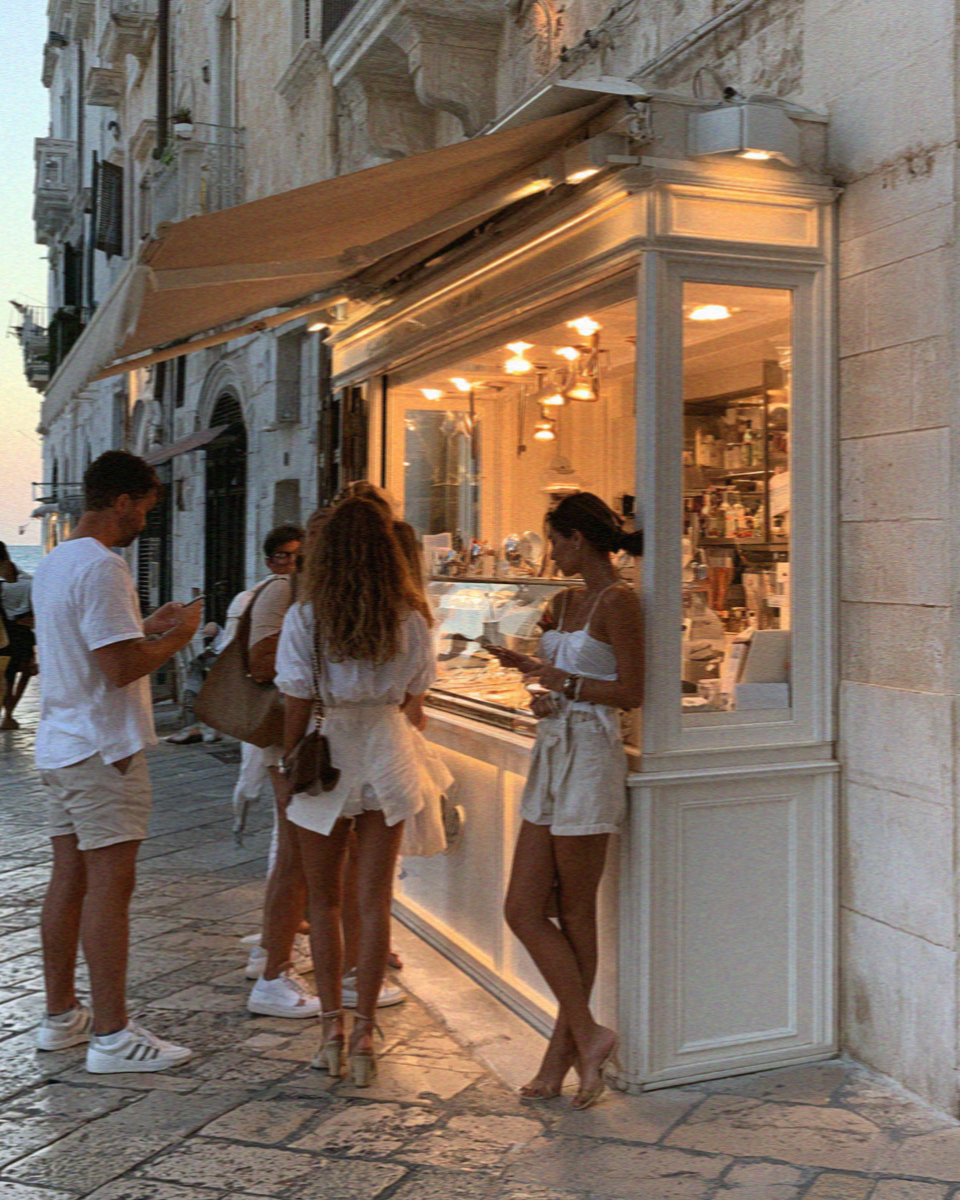
Caffè speciale was invented here, at Mario Campanella, Il Super Mago del Gelo on Piazza Giuseppe Garibaldi. Espresso, cream, amaretto and lemon zest, served warm in a glass.
It arrives layered and you are meant to take it as it comes rather than stirring it into a beige. It is sweet, it is strong, and it tastes like almond and citrus and coffee arriving one after another. Every other bar in town now serves a version. The original is still the one.
There will be a queue in the evening. Join it.
Say hello to Modugno
On the seafront there is a three-metre bronze man with his arms flung open, mid-song.
Domenico Modugno was born in Polignano and wrote Nel blu, dipinto di blu, which the world knows as Volare. The statue, by the sculptor Hermann Mejer, is the town’s other great photo queue, and people line up to stand beside him with their own arms up.
It is unashamedly sentimental and you should absolutely do it.
Stay for the evening
The single best thing in Polignano is free and happens after the day visitors go.
Around seven the coaches leave, the temperature drops and the town exhales. Lamps come on warm against the white walls. The terraces fill with people who are not going anywhere. The cove under the bridge is floodlit and turns an unreasonable green.
If you come as a day trip you will see the busiest, hottest, most crowded version of this town and wonder what the fuss is. Stay one night and you get the other one.
Frequently Asked Questions
What is Polignano a Mare famous for?
Its cliff setting and the cove at Lama Monachile, a pebble beach in a ravine between two vertical limestone walls in the middle of the town. It is also known for the sea caves under the cliffs, for the cave restaurant Grotta Palazzese, as the birthplace of Domenico Modugno who wrote Volare, and as a stop on the Red Bull Cliff Diving World Series.
How many days do you need in Polignano a Mare?
One full day covers the old town, a swim and a boat trip if you start early. Two days is more comfortable and lets you reach the quieter coves and take a half day out to Monopoli or the trulli. A half-day trip from Bari technically works but shows you the town at its most crowded.
Is Polignano a Mare walkable?
Very. The historic centre is a limited traffic zone and effectively car free, and you can cross the whole old town in ten minutes. The furthest thing most people walk to is Cala Paura, about a kilometre and a half from the centre. Wear shoes with grip, because the polished limestone is slippery.
Can you visit Polignano a Mare without swimming?
Yes, and plenty of people do. The old town, the terraces, the painted verses, the bridge, the coffee and the evening passeggiata are all worth the trip on their own. That said, the coast is the reason the town exists, so at minimum take a boat out to see the cliffs and caves from the water.
Read also: A Polignano a Mare Itinerary: One to Two Days | The Best Beaches in Polignano a Mare | The Complete Guide to Polignano a Mare