Where you sleep in Ostuni matters more than it does in most towns this size, because the two realistic options produce two genuinely different holidays.
You can stay inside the old town, in the white lanes on the hill, and walk everywhere. Or you can stay out on the plain in a masseria, among the olive groves, and drive everywhere. Neither is better. They suit different trips, and picking the wrong one is the most common way to be mildly disappointed by an otherwise excellent place.
Staying in the old town
This is what I would recommend for a first visit, and for anyone staying two nights.
The old town is the reason you came. Sleeping inside it means you get the two hours that day visitors never see: the lanes at seven in the morning, cool and blue-shadowed and completely empty, and the town after nine at night when the lamps are on, the whitewash has gone warm and everyone out in the streets lives there.
It also means you can walk to dinner, which sounds trivial and is not. It removes the entire question of driving, parking and who is staying sober, and it lets you eat at half past nine like a local rather than at seven like someone with a car to think about.
What the rooms are like
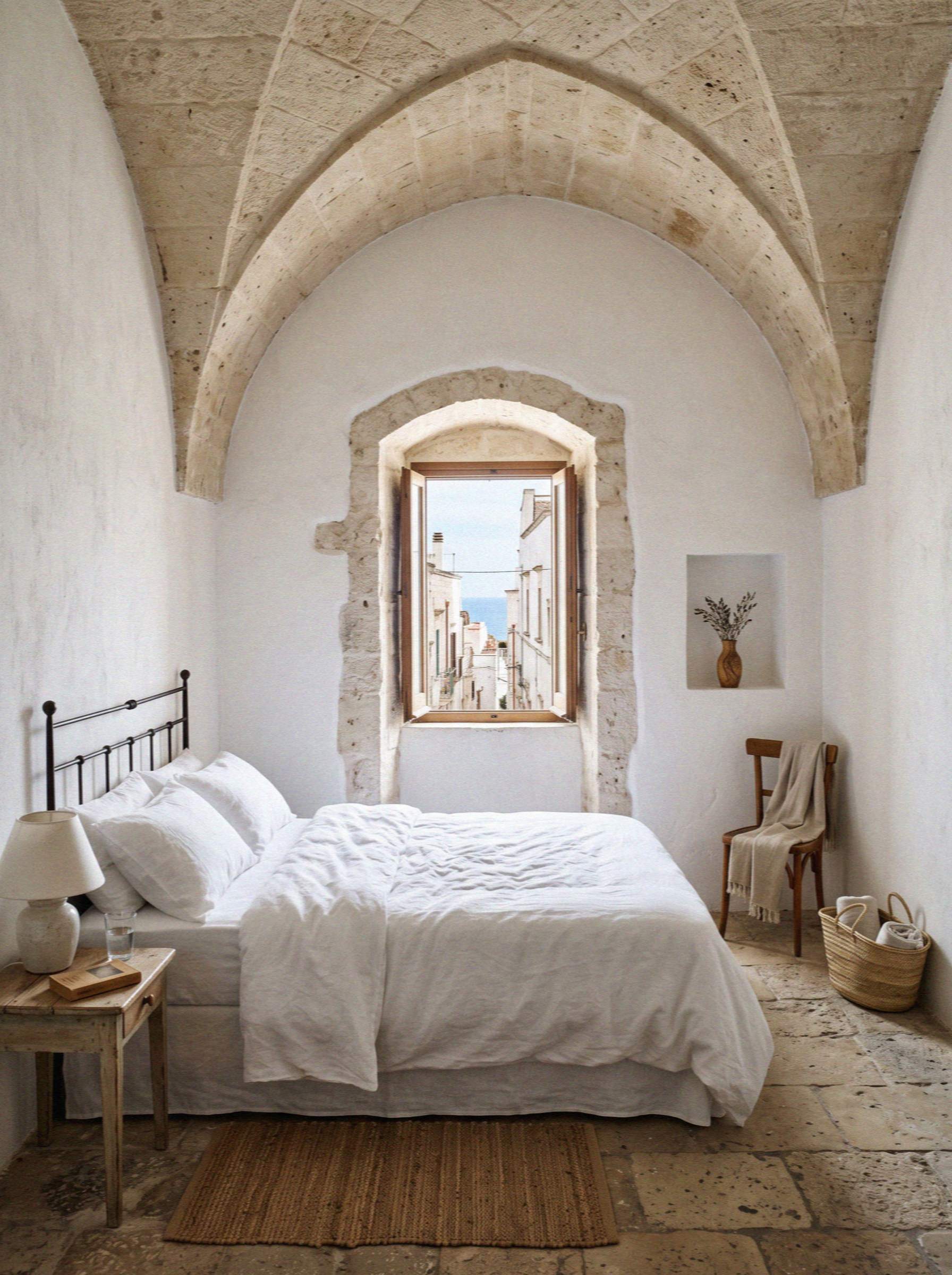
The old town’s buildings were not built as hotels, and the conversions are better for it.
Expect vaulted stone ceilings, thick lime-washed walls, deep-set windows and stone floors. The rooms are often small, sometimes irregularly shaped, and reliably cool, because a metre of limestone is better air conditioning than most air conditioning. Many places have a roof terrace, and a roof terrace here is worth paying for: you are on a hill above a plain, so the view runs all the way to the sea.
What to check before booking. Stairs, because the old town is stepped and many properties have no lift and a flight or two from the nearest point a car can reach. Luggage access, for the same reason, since a wheeled suitcase over worn stone steps in August is genuinely unpleasant. And parking, because there is essentially none inside the walls, so ask exactly where you are expected to leave a car and how far you will be carrying bags.
Staying in a masseria
The alternative is to stay out on the plain in a converted farm estate.
Masserie are fortified farm complexes, white and thick-walled, built out among the olives. Many now operate as hotels, from simple agriturismi through to serious luxury estates with pools, spas and their own restaurants. You get space, silence and a swimming pool, which in a Puglian August stops being a luxury and becomes the middle of your day.
The trade-off is total car dependence. Everything requires driving, including dinner, and most guests end up eating at their own estate most nights. For three or more nights with a car it is a lovely way to be in Puglia. For two nights without one it is a mistake.
I have written about the estates, what they cost and who they suit in staying in a masseria near Ostuni.
What it costs
Rooms in the old town cover a wide range, from simple guesthouses to small design hotels with terraces, and the price tracks the view and the season more than anything else.
Out on the plain the spread is wider still. At the luxury end Masseria Torre Coccaro starts somewhere around 314 dollars a night, and Masseria Le Carrube sits lower at roughly 217 to 280 dollars depending on source and date. Both figures are booking-site starting prices, which means the cheapest room on a quiet night, and they move a great deal between the shoulder months and August. Check real dates rather than trusting any published number, including mine.
When to book
Ostuni is a small town with a finite number of rooms and a very concentrated season, which means booking behaves differently here than in a city.
For July and August, book months ahead. This is peak international season and it overlaps with the Italian holiday month, when a large part of the country moves to the coast. The good rooms in the old town and the well-known masserie go early and the prices at the top of summer bear little relation to the ones you will see quoted in the shoulder months.
For May, June, September and October, a few weeks is usually enough, and you will pay materially less for the same room.
For winter, check that your chosen place is open at all. A number of masserie close for a stretch of the season, and some smaller guesthouses in town do the same.
One booking note specific to Ostuni: the photographs sell the view and the view is often from a shared roof terrace rather than the room. If a terrace over the plain is what you are paying for, confirm whether it belongs to your room or to the building.
Where not to stay
Two things worth knowing.
The coast. There are resorts and beach clubs on the shore below Ostuni, and some are perfectly pleasant, but staying down there means you are not really visiting Ostuni. You will drive up for an evening, find parking, and drive back. If the white town is what drew you, sleep near it.
Anywhere you have to drive into the centre. The old town is a limited traffic zone, camera enforced, with fines in Puglia running around 80 to 100 euros. If a property tells you that you can drive to the door, confirm exactly how, because most cannot.
How to choose in one line
Two nights, no car, first visit: the old town. Three or more nights, a car, travelling as a couple, coming in high summer: a masseria. If you have four or five nights, split them, and finish out among the olives.
Frequently Asked Questions
Is it better to stay in Ostuni old town or outside it?
The old town if you want to walk everywhere, see the lanes early and late, and are staying two nights or fewer. Outside, in a masseria, if you have a car, three or more nights, and want space and a pool. The old town suits a first visit; the masseria suits a slower second one.
Can you park at hotels in Ostuni old town?
Rarely. The historic centre is a limited traffic zone with fines around 80 to 100 euros, and there is very little parking inside the walls. Most guests use the Ex Foro Boario car park, which costs about four euros a day and is seven to ten minutes on foot from the centre. Ask your property exactly where to leave a car before you arrive.
Are hotels in Ostuni old town accessible?
Often not. The centre is steep and stepped, and many converted buildings have no lift. If stairs or luggage are a concern, ask specifically how many steps there are between the nearest vehicle access and the room, rather than relying on a general accessibility statement.
How much does it cost to stay near Ostuni?
Old town rooms span guesthouses to small design hotels. Out on the plain, luxury masserie such as Torre Coccaro start around 314 dollars a night and Le Carrube around 217 to 280 dollars, both being booking-site starting prices that vary significantly by season. Simpler agriturismi cost considerably less.
Read also: staying in a masseria near Ostuni, an Ostuni itinerary, and the complete guide to Ostuni.