At six the city is still shut.
Not closed. Shut, the way a hand is shut. Shutters down, lanes empty, the limestone holding the whole of the day it has been given and handing none of it back. I went out at half past five thinking I would get ahead of something. There was nothing to get ahead of. A boy on a bicycle. A dog lying full length on the one cool flagstone he had found and plainly meant to keep.
The practical version of this city, the tickets and the hours and the business of arriving, I have set down in my complete guide to Lecce. This is not that. This is one hour of it.
Because somewhere between seven and half past, Lecce opens.
The stone lets go
You feel it before you see it. Lecce is built almost entirely of pietra leccese, a limestone soft enough when it comes out of the ground to be worked like wood, and it takes heat the way a pan does. In July and August the days run into the low thirties and the nights do not go below about nineteen or twenty, so nothing cools down properly. What happens instead is that the walls begin returning the day at about shoulder height, slowly, all evening, and you walk through it in bands. Warm at the corner. Cooler across the mouth of a lane. Warm again.
I put my palm flat on a wall in a side street to check, the way you check a kettle.
My father did that with everything. He would come to a stone parapet or a boat rail or the flank of a horse and put his hand on it first, before he looked, before he spoke, as if the temperature of a thing were the first honest fact about it. I have never managed to stop doing it either. I do it in every city and it tells me almost nothing and I keep doing it.
The wall gave back a whole afternoon.
Then everyone comes out
I had a table on the edge of a square and I watched it fill.
It does not happen gradually. There is an hour when nobody is out and then there is an hour when everyone is, and nothing announces the change. Men who have known one another for sixty years, arriving separately and standing in exactly the arrangement they must stand in every night. Women in twos with their arms linked. Boys circling on scooters they are not really going anywhere on. Girls done up as though for something, and the something is this. Prams. Very small children still upright at ten. A woman carrying a cake box by its ribbon, holding it out from her body, walking with enormous care.
Nobody is buying anything.
That is the part I keep turning over. This is a shopping street at the wrong end of the day, and almost no one is shopping. They are walking to the end, and turning, and walking back. The whole city has come out to be among itself.
There is a nice trick in Piazza Sant’Oronzo, which is that it has a Roman arena sunk into it, below the pavement, about a third of it uncovered and the rest still under the buildings. In the daytime people lean on the rail and look down into it. In the evening they turn their backs to it and look at each other. The arena sits there in the dark like a dropped stitch and nobody minds.
My father held that being looked at is not the same as performing, and that the difference is most of a person’s character. I did not understand it as a child. I understood it in a square in Puglia at eight in the evening, watching several thousand people be extremely well dressed and completely unbothered about who was watching.
The churches stay open
The other thing Lecce does, which I had not expected, is stay open late.
From April to September the churches on the combined ticket run until nine, which means you can walk into the Duomo after dinner has already started somewhere behind you. Piazza del Duomo has effectively one entrance, so it is not a crossroads, it is a room. You come through the gap and the noise of the passeggiata stops as though a door had shut, and it is suddenly cool, and there is a bell tower going up out of the floor of it.
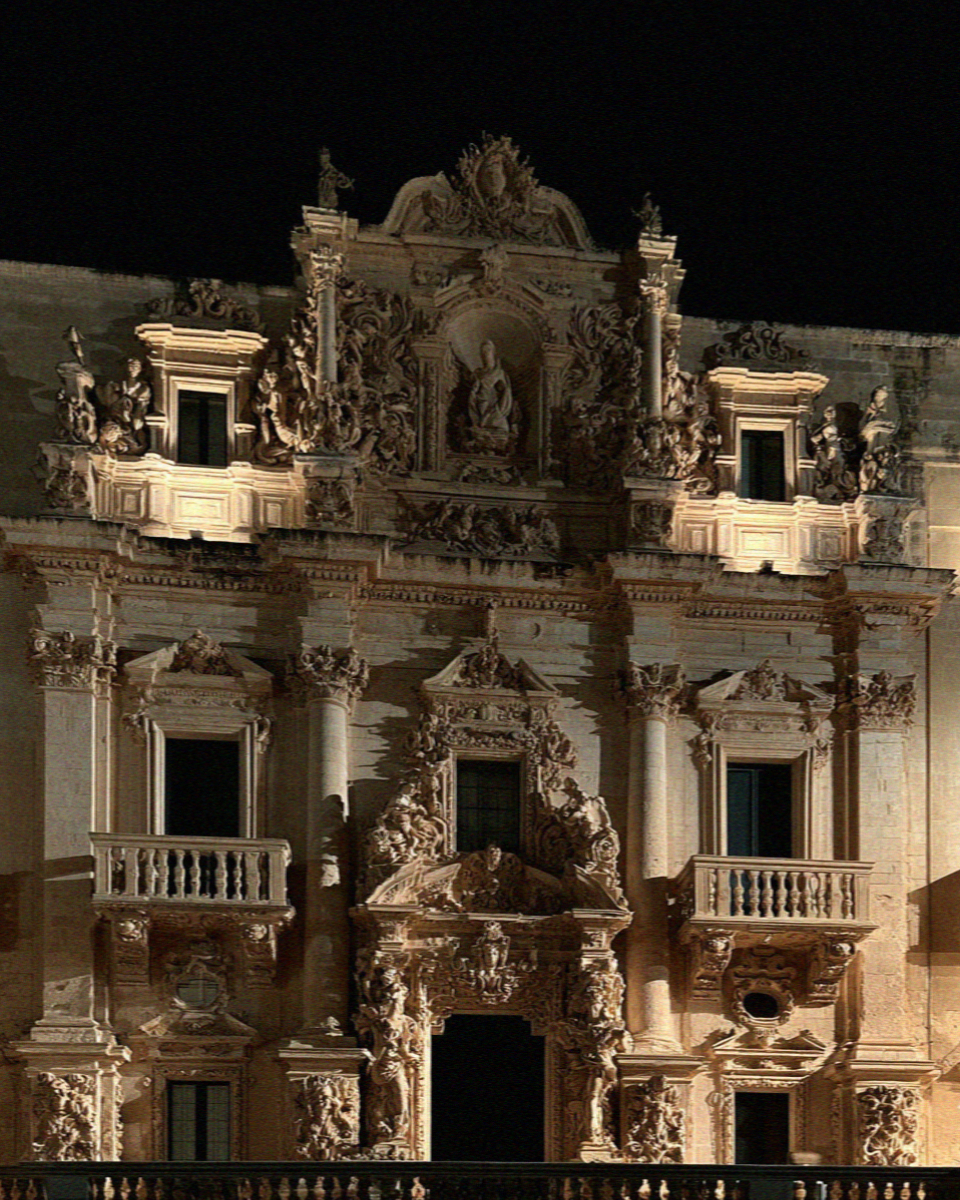
Santa Croce takes about a century to explain and I will not do it here. Begun in 1549, finished in 1646. The facade is a rose window with a riot underneath it, animals and figures and foliage cut so deep that in daylight it goes slightly flat, all that detail cancelling itself out.
At night they light it from below and it comes back.
Everything with an edge acquires a black shadow twice its own size. The grotesques lean out. The foliage separates. You can suddenly read the thing, which you cannot really do at two in the afternoon, and there are people standing under it with their heads back at a quarter past ten, quite a lot of them locals, looking at a facade they have walked past their entire lives.
Soft stone, cut deep, waiting all day for a light coming the right way.
Late
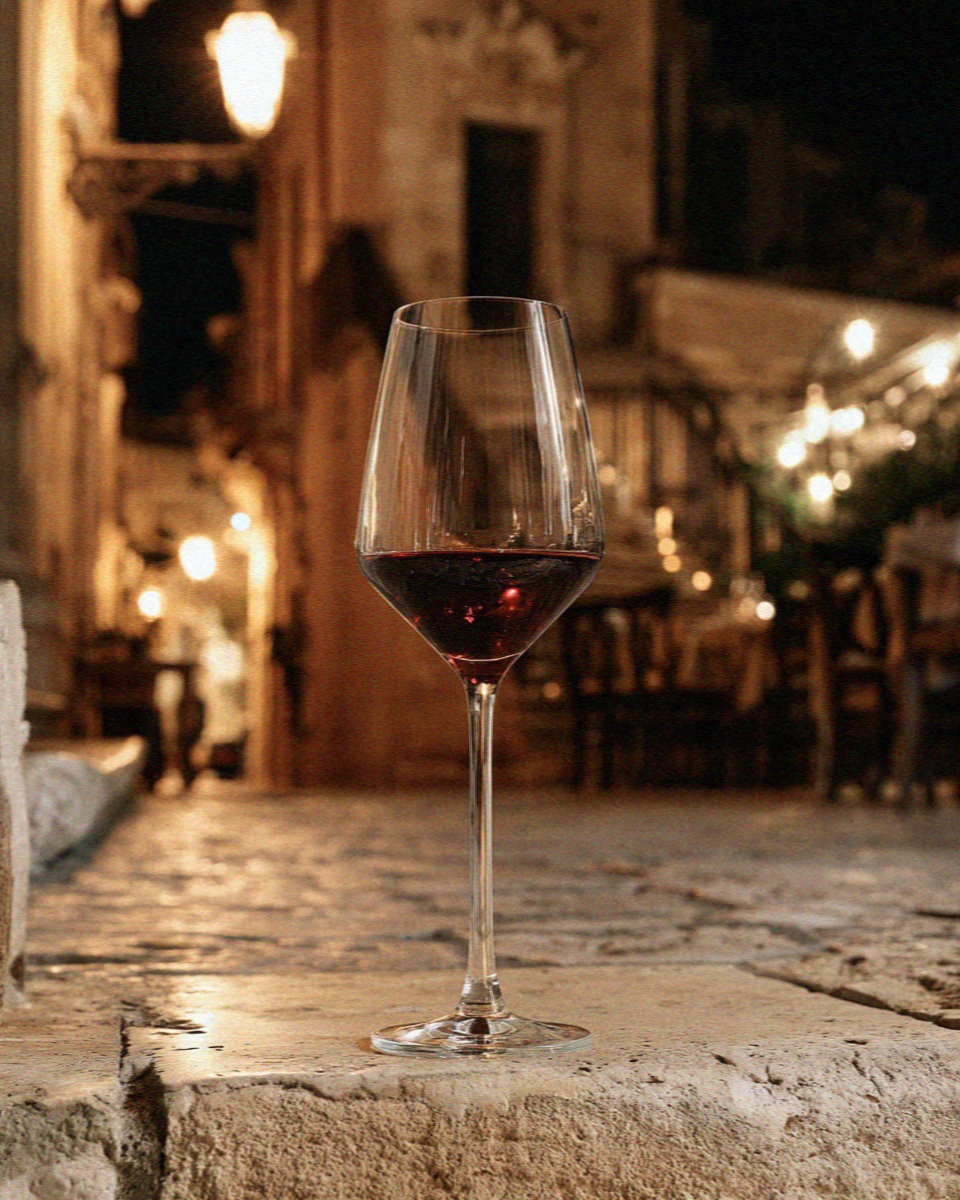
Dinner was late and long and I will write about the food properly another time. Chickpeas with pasta, half of it fried and half of it boiled so that the plate has two textures, which is a genuinely good idea. Negroamaro after, dark and a little bitter at the back, poured cold and warming up too fast in the glass.
I ended on a step in a side lane with the glass beside me because there was nowhere else to put it down.
Above the balconies the sky had gone properly black. The lane was lit by one lamp and a lit window, and both of them made the limestone look softer than it is. Somewhere near, a shutter going up, not down. Somebody calling a name twice.
I put my hand flat on the step. Still warm. Still giving it back.
Then I carried the glass inside and went up to bed with the windows open.
V.