The beaches here are not the reason the Costa Smeralda is expensive. That is worth saying first, because it changes how you plan a week.
The beaches are free. All of them. There is no gate, no wristband, no booking window that opens at six in the evening for the day after next. You drive to a bay, you pay a few euros to leave the car in a dust car park under some pines, and you walk down. The hotel behind the dune may cost three thousand euros a night and it has precisely no claim on the water in front of it, because in Italy the shoreline is public and this coast is no exception.
What you are actually managing here is not money. It is parking, and time of day.
The shape of the coast, and why it matters
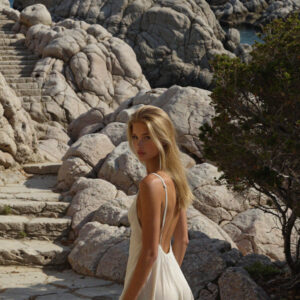
The granite is the whole story. It erodes into huge rounded boulders that come down to the water in shoulders and spurs, and those shoulders chop the coastline into dozens of separate small bays rather than one continuous run of sand.
So there is no promenade. There is no walking from one beach to the next along the front. Each bay has its own turning off the road, its own car park, and its own capacity, and when that capacity is gone it is gone. A bay that holds sixty people is full at sixty people and there is nowhere for the sixty-first to go except back up the track to the car.
That single fact governs everything below.
The long one
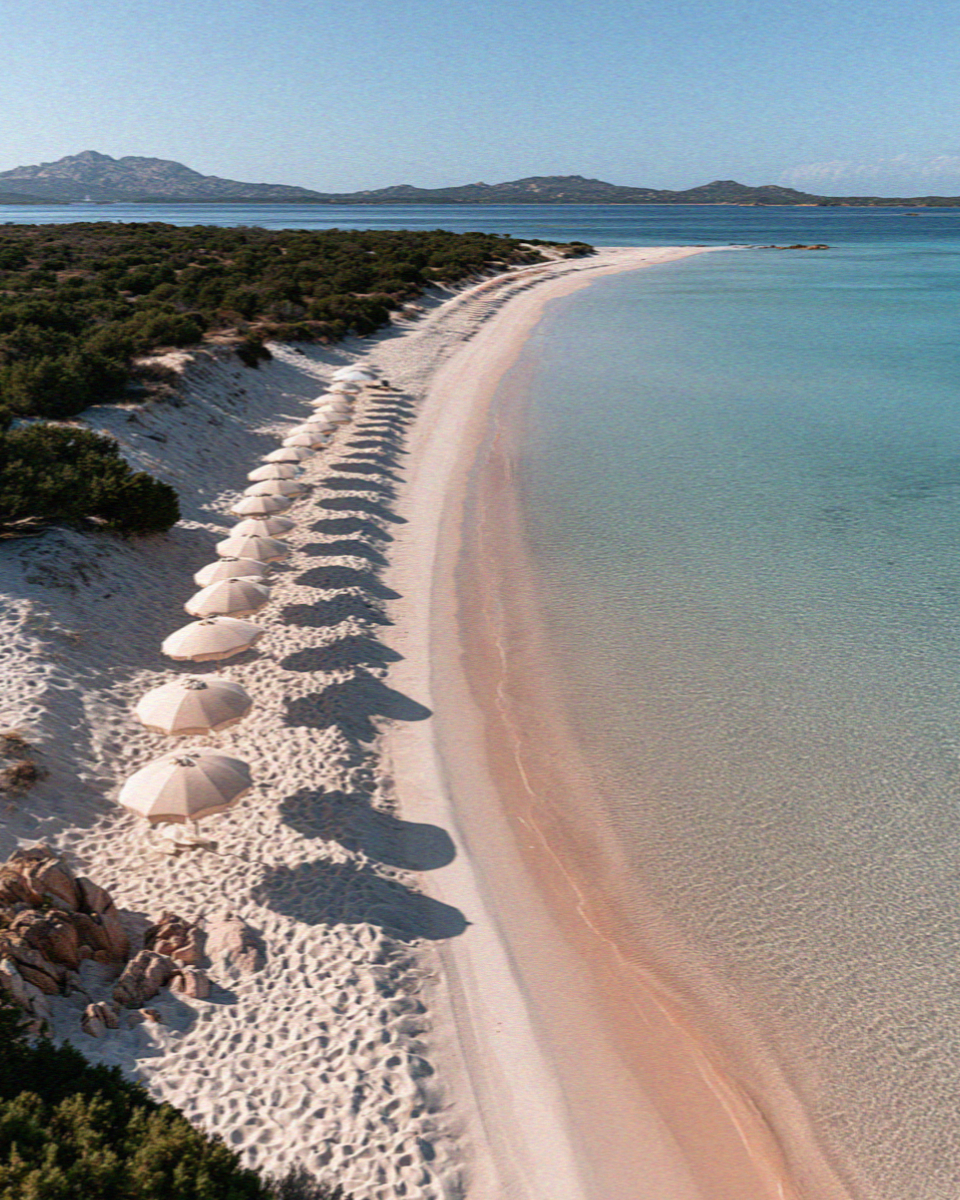
Liscia Ruja is the longest beach on this stretch, a wide curve of pale pink-tinged sand running for something close to half a kilometre, which by local standards is enormous. It is the one I would send anybody to on their first day.
Length is the point. The crowd spreads along it instead of stacking up, there is a lido section at one end and a great deal of unclaimed sand toward the other, and if you walk for five minutes away from where you came down you will find room in August, which is not true of anywhere else on this coast.
The parking sits about two hundred metres back and runs around €5 to €8 for a day. Arrive after eleven in high summer and you will be parking on the verge a long way further along the track, which is legal, unpleasant in bare feet, and entirely avoidable by going early.
The other long-beach option, and a quieter one, is the run of sand below the road toward Cala Petra Ruja, where the sand is coarser and the water gets deep faster.
The small ones

The famous ones are small, and their fame is the problem.
Spiaggia del Principe, in the Romazzino direction, is the one on every postcard: a short crescent of very pale sand held between two granite headlands, with the water going through about four distinct colours between your ankles and the far rocks. It earns the reputation. It also has a walk in from the parking, which is a mercy, because it filters out some of the traffic.
Capriccioli, fifteen kilometres from Porto Cervo, is a pair of small beaches either side of a low granite spit, so you can move round to whichever side the wind is not on. There is paid parking and a small free area above it holding around forty cars, and that free area is gone by nine.
Grande and Piccolo Pevero sit near each other with a paid car park serving both, five minutes’ walk to the small one and another five to the large. Piccolo Pevero is tiny and often the busier of the two, which makes no sense until you see how much closer it is to the car.
Romazzino and Cala di Volpe have the famous hotels behind them and are, again, free to anyone who walks down.
None of these hold a big crowd. Treat them as a morning, not a day.
Parking, which is the whole problem

Here is the practical rule that made my week work, and I wish somebody had written it plainly.
Be at the beach you want by half past eight, or accept that you are going to the second-choice one.
The car parks are small, unsurfaced, mostly under thin pines, and they charge somewhere between €5 and €8 for the day, often to a man with a bag rather than a machine. They fill between nine and ten in July and August. Once they are full, the overflow is the verge of the access track, and the walk in from the far end of the overflow can be fifteen minutes in full sun carrying everything.
Going early has a second benefit that nobody mentions: the light is better and the water has not been churned up. The sea at eight in the morning is glass.
Coming late works too. From about half past four the car parks start emptying, the heat drops to something civilised, and the beach in the last two hours of the day is a genuinely different and much better place than the beach at noon.
What you will not find
No booking systems. Sardinia has introduced daily visitor caps and paid entry on a few of its most fragile beaches, and travellers arrive here braced for it, but those beaches are on other parts of the island: La Pelosa near Stintino in the north-west, where entry is ticketed and capped through the summer, and Cala Brandinchi at San Teodoro, south of Olbia. Neither is on this coast and neither system applies here.
Very little shade. These bays have low scrub and a few pines set back from the sand, and no natural shade to speak of on the beach itself. If you are not renting an umbrella, bring one.
Not many facilities. Some of the bigger beaches have a bar and a lido with loungers; several of the small ones have absolutely nothing, no toilet, no water, no shop. Fill a bottle before you leave.
One rule worth taking seriously: do not take sand, pebbles or shells off a Sardinian beach. It is prosecuted, it is checked at the airport, and the fines run into thousands of euros. This is not a folk tale.
Which beach on which day
If it is windy, and it will be at some point, go to whichever bay faces away from the wind. The mistral comes from the north-west, so a beach tucked behind a headland on the eastern side stays swimmable when the exposed ones are unusable. This is the main reason to have several bays in mind rather than a favourite.
If the coast is full, go north. The bays above Baja Sardinia and around Cannigione are less famous, less pretty in the specific postcard sense, and much easier to park at.
If you want the best water of the week, take a boat rather than a beach. The archipelago north of here has shallows the colour of nothing you have seen from a car, and the full day is set out in the La Maddalena boat trip guide.
Frequently Asked Questions
Do you have to pay to go on the beaches on the Costa Smeralda?
No. The beaches are free and public, including the ones directly in front of the famous hotels. You pay for parking, usually €5 to €8 for the day, and for a lounger and umbrella if you want them. There is no entry ticket and no reservation system anywhere on this coast.
Do you need to book beaches in Sardinia?
Not on the Costa Smeralda. Booking and daily visitor caps apply on a small number of protected beaches elsewhere on the island, notably La Pelosa near Stintino and Cala Brandinchi at San Teodoro, both of which are some distance from this coast. Nothing between Olbia and Arzachena requires a reservation.
What is the best beach on the Costa Smeralda?
Liscia Ruja if you want space and a full day, because it is long enough to absorb a crowd. Spiaggia del Principe if you want the view everybody photographs and are willing to arrive early for it. Capriccioli if the wind is up, because you can move to the sheltered side of the spit.
What time should you arrive at the beach in summer?
Half past eight, or after half past four. Parking is the binding constraint rather than room on the sand, and the spaces are gone by mid-morning in high summer, leaving a long walk in from the access track. The late option is the underrated one: spaces free up from about four, the heat drops and the light is at its best.
Is there shade on the Costa Smeralda beaches?
Almost none. There are pines behind the dune line but nothing standing over the sand itself, and the glare comes up off the water as well as down from the sky. A few of the larger beaches rent umbrellas. Several of the small coves have no facilities of any kind, not even a tap.
Read also: Where to Stay on the Costa Smeralda | A Costa Smeralda Itinerary: 3 to 5 Days | The Complete Guide to the Costa Smeralda