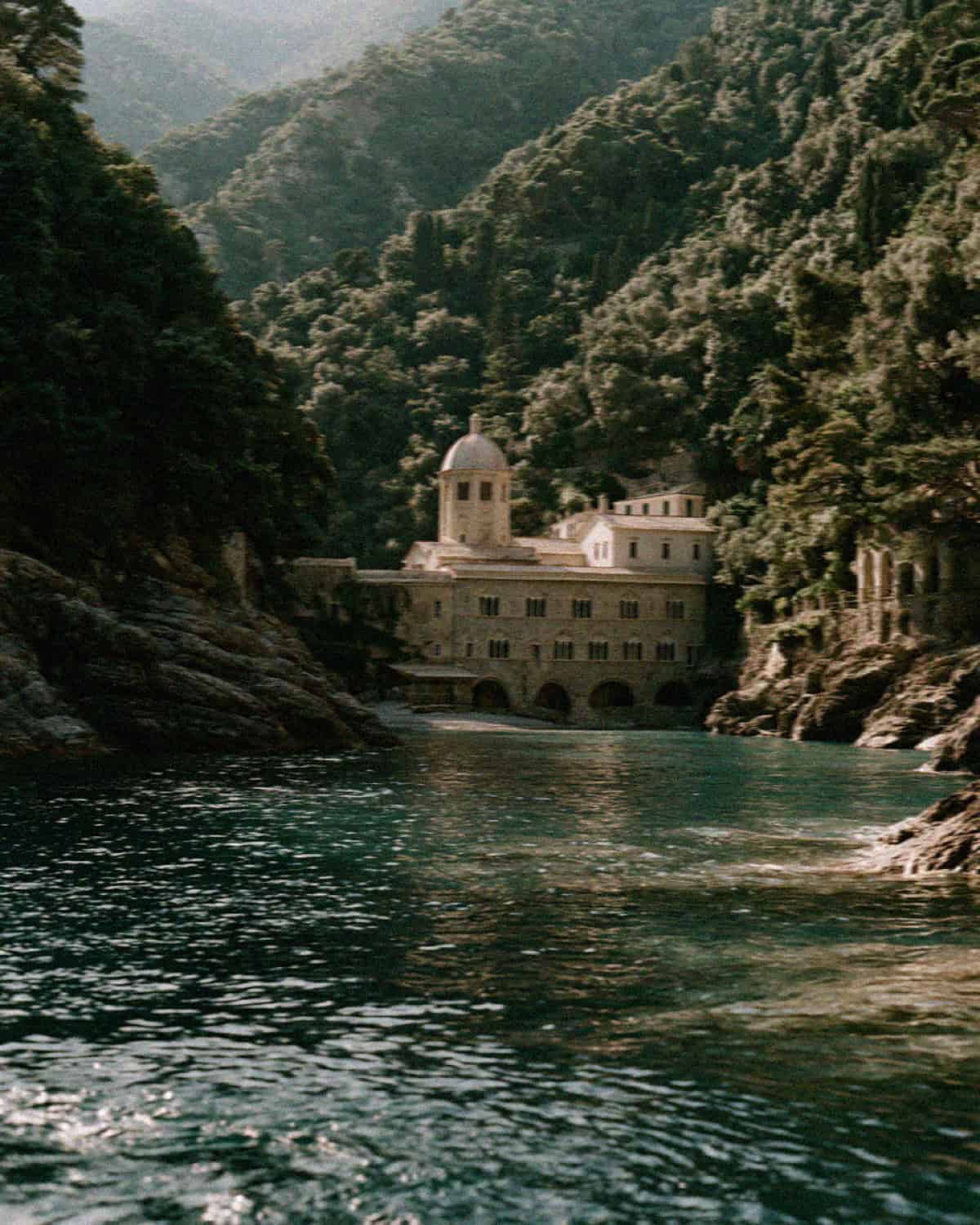
San Fruttuoso is one of those places that rearranges your sense of the coast. You cannot drive to it. There is no road, no car park, no coach turning circle. There is only a fold in the Portofino promontory where a medieval abbey sits with its feet almost in the water, reachable by boat or on foot and nothing else. I have arrived both ways over the years, and I still think the first sight of it from the sea, that pale stone arcade rising straight out of a green cove, is one of the great small theatrical moments of the Italian Riviera.
This is a guide to doing it well: how to get there, what the abbey actually is, the strange and moving Christ that lies on the seabed just offshore, and the handful of practical things that make the difference between a rushed hour and an afternoon you will keep.
Where San Fruttuoso Is, and Why It Feels Hidden
San Fruttuoso di Capodimonte sits in a bay on the western flank of the Monte di Portofino, tucked between Camogli and Portofino itself. It is roughly five kilometres from Portofino as the coast runs, but the terrain between them is steep wooded headland, which is exactly why the monks chose it. A place this hard to reach was a place that could be defended, and later a place that could be forgotten.
The result today is a cove with almost nothing modern in it. A small crescent of pebble beach, a scatter of fishermen’s houses turned into simple restaurants, the Doria watchtower on the rocks above, and the abbey at the centre of it all. Because there are no cars and no through road, the noise you hear is water, voices, and the churn of the next ferry coming in. That absence is the whole point.
Plan Your Visit to Portofino
A few things I booked and loved. These help support the blog, at no cost to you.
This section contains affiliate links. If you book through them I may earn a small commission, at no extra cost to you.
Arriving by Boat, Which Is How I Would Do It

If you take one piece of advice from me, take this: arrive by boat at least once. The abbey was built to be seen from the sea, and it rewards that approach in a way no photograph quite manages.
Ferries run from several towns along the Tigullio coast, operated principally by the Servizio Marittimo del Tigullio and, from Camogli, by the Golfo Paradiso line. From Camogli the crossing is the shortest and prettiest, around thirty minutes, and I have paid in the region of ten euros one way and fifteen return, though do check current fares at the ticket office, as they shift with the season. You can also come up from Santa Margherita Ligure, Rapallo, and Portofino, with the longer routes calling at Portofino on the way so you can string the two together in a single day. Tickets on the Tigullio line are generally bought at the quayside kiosk rather than online, and boats need a minimum number of passengers to sail, so the very first or very last departure on a quiet day is the one most likely to be cancelled.
The service is also entirely at the mercy of the sea. In a stiff swell the boats simply do not run, and San Fruttuoso has no back door. Which brings me to the single most important sentence in this whole article: check the return timetable before you disembark, and note the last boat out. I have watched more than one couple realise, at half past five, that they were about to spend the night in a cove with four restaurants and no road.
Getting There on Foot, Over the Promontory
The other honest way in is to walk, and the walk is glorious. San Fruttuoso sits inside the Parco di Portofino, laced with trails, and there are two classic approaches.
From the Camogli side you climb up to the village of San Rocco and then follow the inland forest path through the Pietre Strette pass, descending to the cove through chestnut, pine, and olive. Reckon on around two hours from San Rocco, or closer to two and a half to three if you start down at Camogli station, with a good stretch of climbing and about four hundred metres of ascent. It is an intermediate walk, not a stroll, but it is well marked and manageable for anyone reasonably fit in proper shoes.
There is also a spectacular coastal variant, the Sentiero delle Batterie, which runs past old wartime gun emplacements with sections secured by fixed chains above the drop. It is thrilling and not for anyone with vertigo, and I mention it with a caution: parts of this route have been subject to closures in recent years after landslip near the Passo del Bacio, so confirm it is actually open before you set your heart on it. When in doubt, take the Pietre Strette path.
From the Portofino side the walk is shorter, roughly an hour and a half over the headland via the same web of park trails through Base 0 and Pietre Strette. My own favourite plan, if I have the legs for it, is to walk in from one side and let the boat carry me out. You earn the cove, then you get the sea view as a reward.
Whichever way you come, carry water. There are drinks for sale in the cove but not on the paths, the climbs are hot from late spring onward, and there is no shop of any real size once you arrive.
The Abbey Itself

The Abbazia di San Fruttuoso di Capodimonte began as a Benedictine monastery, with origins reaching back to the tenth century. From the thirteenth century its fortunes became bound up with the Doria family, the great Genoese dynasty, who reworked the buildings, added the graceful loggia you see from the water, and made the lower church their family burial place. The tombs are still there, ringed in the pale and dark stone of the Ligurian tradition.
Today the abbey is cared for by the FAI, the Fondo per l’Ambiente Italiano, Italy’s national trust, and it is beautifully kept. Entry at the time of writing runs to about ten euros for adults, with a reduced rate of around five euros for ages six to eighteen, free for younger children and for FAI members. Opening hours track the seasons, broadly from ten in the morning until late afternoon, later in high summer, with reduced winter days and closures on some Mondays, so it is worth a glance at the FAI page before you go. You can wander it yourself or take the roughly hour-long guided visit, and I would give it a proper hour whichever you choose. Stand up in the cloister and look back out through the arches at the boats, and you understand something about why people gave their lives to this rock.
The Christ of the Abyss
Out in the bay, about fifteen to seventeen metres down on the seabed, stands a bronze figure with its arms raised toward the surface. This is the Cristo degli Abissi, the Christ of the Abyss, lowered here in 1954 as a memorial to those lost at sea, divers and sailors among them. It has become one of the most quietly famous underwater sights in the Mediterranean.
You can meet it in three ways. Divers descend to it directly. Snorkellers on a calm day can float above and look down through clear water to the pale shape below, which is how I have done it, and there is something genuinely stirring about hanging on the surface with the sun behind you while that upturned face gathers light from the deep. When the sea is flat, small glass-bottomed boats run out over the spot. And if the water will not cooperate, there is a full-size replica inside the abbey church, so no one leaves without seeing it.
My honest counsel: if you are a confident swimmer and the sea is calm, bring a mask and go in from the beach or a boat rather than only viewing the copy. The original, seen through moving water with your own breath in your ears, is the version that stays with you.
The Beach, Lunch, and How Long to Stay

The beach is a small crescent of pale pebble and coarse sand right below the abbey, and it fills quickly on summer weekends, so an early boat pays off. The water is clear and swimmable and shelves fairly steeply.
Ranged along the shore is a handful of simple, family-run seafood places, four or so in all, with names like Da Giovanni and La Cantina. Do not come expecting Portofino polish. Come expecting fried anchovies, a plate of pasta, a carafe of white wine, and a table close enough to the water that your feet are almost in it. That is the correct San Fruttuoso lunch, and it is one of the loveliest on the coast precisely because it is so unbothered.
How long to stay depends on your pace, but I would build in the abbey, a swim, a slow lunch, and time to simply sit. Three or four hours is right. Any less and you have merely touched it.
Frequently Asked Questions
How do I get to San Fruttuoso?
Only by boat or on foot; there is no road. Ferries run from Camogli, Santa Margherita Ligure, Rapallo, and Portofino, with Camogli the shortest at about thirty minutes. On foot you cross the Portofino promontory, roughly two to three hours from San Rocco or Camogli via Pietre Strette, or about an hour and a half from Portofino.
How much does the abbey cost to visit?
The Abbazia di San Fruttuoso is managed by the FAI, and entry is around ten euros for adults, about five for ages six to eighteen, and free for young children and FAI members. Hours run broadly from ten in the morning to late afternoon and vary by season, so check before you travel.
Can I actually see the Christ of the Abyss?
Yes, in several ways. Divers reach the bronze statue directly on the seabed, snorkellers can float above it on calm days, and glass-bottomed boats run out over the spot when the sea is flat. A full-size replica also stands inside the abbey church for days when the water is rough.
What should I bring, and are there any warnings?
Bring water, sun protection, proper shoes if you are walking, and a swimsuit. Carry cash for the boat and lunch. The single real hazard is the timetable: boats can be cancelled in rough seas and there is no road out, so always confirm the last return departure before you disembark.
Is the hike hard, and which trail is best?
The inland Pietre Strette route is intermediate, well marked, with a solid climb and around four hundred metres of ascent from the Camogli side. The dramatic coastal Batterie trail with its fixed chains is not for anyone with vertigo and has faced closures after landslips, so verify it is open, and default to Pietre Strette if unsure.
Read also: The Beaches Near Portofino | The Best Things to Do in Portofino | The Complete Guide to Portofino