The Circuit de Monaco is worth understanding before you arrive. Most people come for the yachts, the champagne, and the sense that they have wandered into a film, and all of that is real. But the reason the whole spectacle exists is a ribbon of public road, 3.337 kilometres long, that the principality closes to traffic and hands to the fastest drivers in the world. If you know what you are looking at, the weekend transforms. You stop watching cars pass and start reading a conversation between driver and barrier, one that has been going on since 1929. These are the corners that matter, and this is what happens at each of them.
What Makes This Circuit Unlike Any Other
Monaco is the oldest and most celebrated race on the Formula 1 calendar. It belongs to the Triple Crown of motorsport alongside the Indianapolis 500 and the 24 Hours of Le Mans, a trio so difficult that only one driver in history has won all three. It is also, and this surprises people, the slowest circuit of the season. Nineteen corners are threaded through the streets of Monte-Carlo with concrete barriers set inches from the bodywork. There is no run-off, no forgiving gravel, no margin. A mistake that would cost a second elsewhere costs a suspension arm here, and often the race.
That combination of slow and unforgiving is precisely what makes Monaco the most demanding weekend of the year. Speed alone does not win here. The circuit rewards a kind of surgical precision, the ability to place a car within a centimetre of a wall at the exact moment the wall curves away. The fastest drivers on wide, modern autodromes are not always the fastest here, because Monaco asks a different question. It asks how close you are willing to run to the point of disaster, lap after lap, without ever touching it.
You will hear people complain that overtaking at Monaco is nearly impossible, and they say it as though it were a flaw. I have never understood this. The near impossibility of passing is the whole drama. It means Saturday qualifying effectively sets the result, which loads every one of those flying laps with enormous consequence. It means a driver who finds a tenth of a second on Saturday afternoon has done something that will echo through Sunday. The tension does not arrive in a single overtaking move. It accumulates across the entire weekend, tightening with every session, and by the time the cars line up on the grid it is almost unbearable. That is a feature, not a fault.
Plan Your Visit to Monaco
A few things I booked and loved. These help support the blog, at no cost to you.
This section contains affiliate links. If you book through them I may earn a small commission, at no extra cost to you.
From Sainte-Devote to the Hairpin
The lap begins with a short sprint down the start-finish straight into Sainte-Devote, turn one, a tight right-hander named for the small chapel that sits just beyond it. This is where lap-one drama is born and where optimistic overtakes come to die. The braking zone is narrow, the corner offers room for one car and a hopeful second, and on the opening lap it regularly folds under the weight of everyone arriving at once. Watch here and you will understand within thirty seconds why track position at Monaco is everything.
From Sainte-Devote the cars climb the tree-lined Boulevard d’Ostende, a genuine hill, up toward Casino Square. This is one of the most famous corners in all of motorsport, and rightly so. The drivers crest a blind rise while braking hard, the car going light over the top, and then thread the square directly in front of the Casino de Monte-Carlo with its belle epoque facade and its valet-parked supercars. Grandstand B looks straight onto it. There is a theatricality here that no purpose-built track can manufacture, the sight of a modern racing car flicking past a nineteenth-century casino at the moment it is most unsettled.
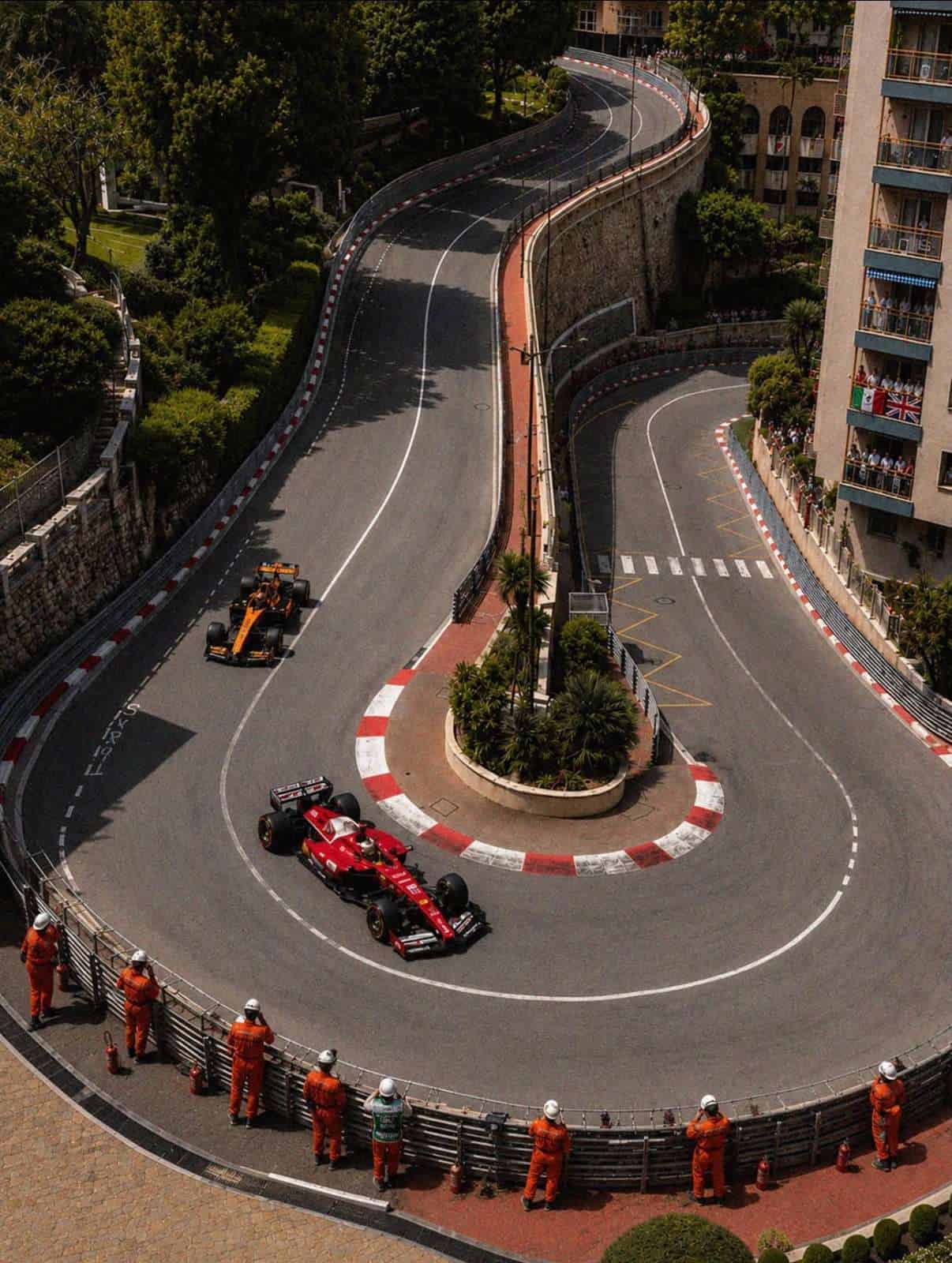
The road then drops away toward the Grand Hotel Hairpin, which older enthusiasts still call Loews and which now carries the Fairmont name. This is the slowest corner in Formula 1, taken in second gear at roughly 50 kilometres per hour. It is so tight that the cars run a special steering setup just to get around it. I love the hairpin because it hides nothing. At that speed there is no aerodynamic trickery, no engine advantage, only the driver’s hands and feet and judgement, fully exposed. You can see the technique. You can see who is smooth and who is fighting the car. It is the most honest corner on the calendar.
The Tunnel, the Harbour, and the Swimming Pool
Below the hairpin the circuit gathers speed again and plunges into the Tunnel, the only covered section anywhere on the F1 calendar. The cars go from full Mediterranean sunlight into sudden darkness and back out into blazing light, all at around 280 kilometres per hour, eyes adjusting on the move. It is a separate experience acoustically as well. Stand near either mouth of the tunnel and the sound arrives before the car does, a rising howl compressed and thrown out of the concrete, unlike anything else on the lap.
Out of the tunnel the drivers hit the brakes hard for the Nouvelle Chicane, the new chicane, a left-right flick that is one of the few real overtaking opportunities on the circuit, then sweep left through Tabac. These corners bring the cars down to the harbour front, and the setting becomes almost absurd in its glamour. The yachts of Port Hercule sit close enough that you can pick out the faces of the people watching from their decks, glasses in hand, a few metres of water and barrier between them and a car at full commitment.
Then comes the section I would send any first-time visitor to see, the Swimming Pool. It is named without ceremony for the public pool it runs alongside, and it consists of two chicanes in rapid succession, left-right then right-left, taken at genuine speed. It is among the fastest and most technical sequences in Formula 1. The barriers are right there, the rhythm is everything, and any mistake in the first chicane is punished immediately in the second. The photography here is extraordinary, the blue of the pool and the harbour behind the car, the walls so close they frame the shot for you.
La Rascasse, Anthony Noghes, and Where to Watch
The lap closes through La Rascasse, the slow penultimate corner named for the restaurant on its apex, best watched from Grandstand T, from where you can also see the pit-lane entry and the strategic drama of who is stopping and when. Finally the cars turn through Anthony Noghes, the last corner, named for the man who founded the race, which fires them back onto the start-finish straight to begin it all again.
If you are choosing where to sit, match the seat to the moment you want. Grandstand B at Casino Square gives you the most photogenic corner and the belle epoque backdrop. The hairpin grandstands reward those who want to study driving technique up close. Anything overlooking the Swimming Pool or the harbour front delivers the glamour that Monaco is famous for, cars and yachts in a single frame. For a fuller comparison, I have written a dedicated guide to the best grandstands at the Monaco Grand Prix, and if the water is where you would rather be, watching the Monaco Grand Prix from a yacht covers that in detail.
Understanding the circuit is what turns a glamorous weekend into a genuinely thrilling one. For everything else you need to plan the trip, return to Victoria’s Guide to the Monaco Grand Prix.
Frequently Asked Questions
How long is the Circuit de Monaco?
The circuit is 3.337 kilometres long with nineteen corners, run on the public streets of Monte-Carlo. It is one of the shortest laps of the Formula 1 season, which is part of why the cars complete so many laps on race day.
Why is overtaking so hard at Monaco?
The streets are narrow, the corners are slow and tight, and the barriers leave no margin for error, so there is rarely enough room to pass without contact. This is why Saturday qualifying is so decisive and why the tension builds across the entire weekend rather than exploding in a single moment.
What is the slowest corner at Monaco?
The Grand Hotel Hairpin, also known as Loews or the Fairmont Hairpin, is the slowest corner in all of Formula 1. It is taken in second gear at roughly 50 kilometres per hour, and it exposes a driver’s technique completely.
What is the most famous corner at Monaco?
Casino Square is arguably the most famous, where cars crest a blind rise while braking and thread past the Casino de Monte-Carlo. The Tunnel and the Swimming Pool section are close rivals, each iconic in its own way.
Read also: Victoria’s Guide to the Monaco Grand Prix