Ostuni is one of the easier places in Italy to photograph and one of the harder ones to photograph well, and the reason is the same in both cases: it is entirely white.
A whitewashed town is enormously forgiving of composition and completely unforgiving of timing. At midday the walls throw so much light back that a camera has no idea what to do, faces go into hard shadow and the whole scene flattens into glare. Two hours either side of that, the same lane is one of the loveliest things you will shoot all year.
So this guide is as much about when as about where.
The view back at the town
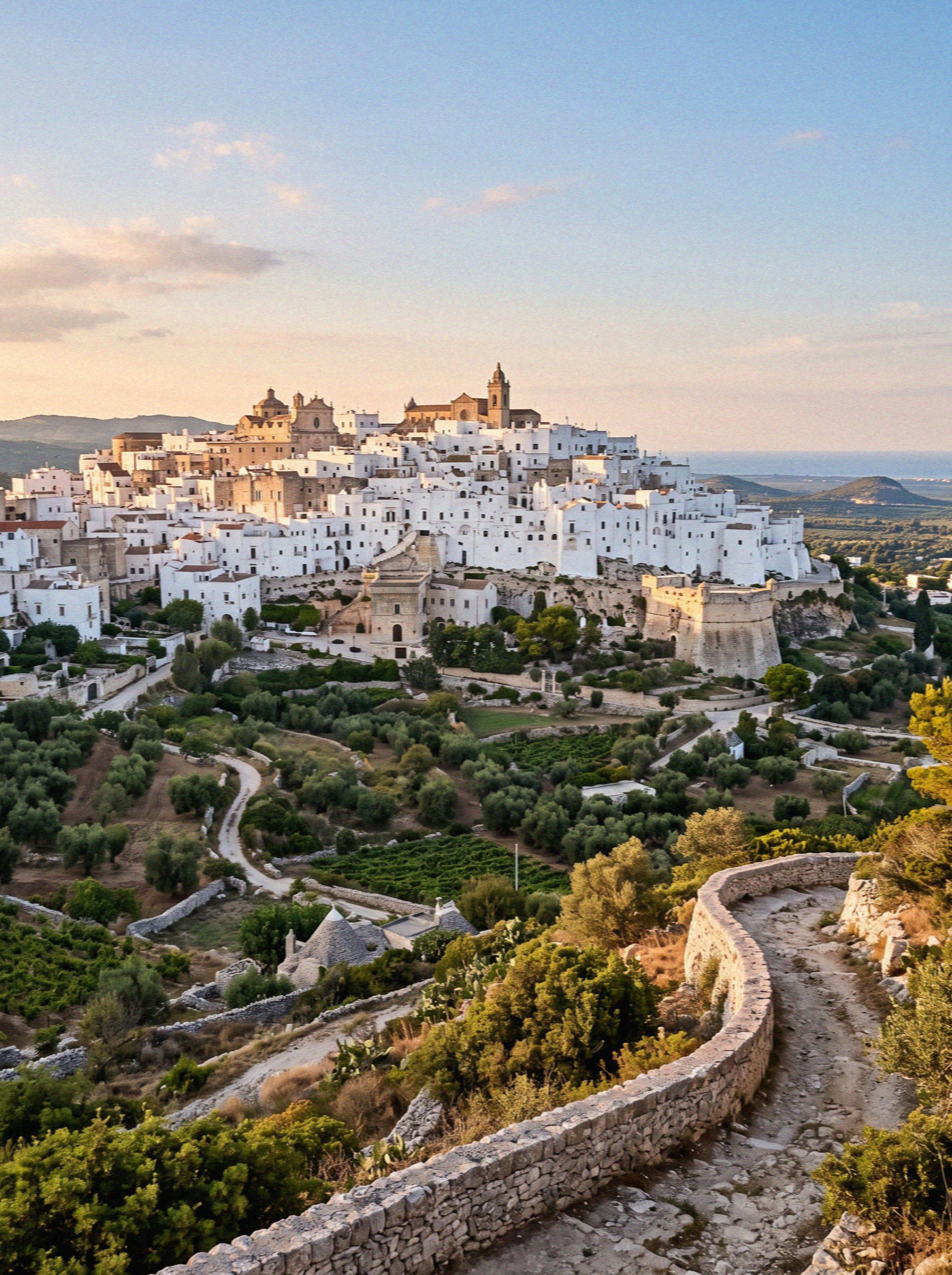
The photograph everybody wants of Ostuni cannot be taken inside Ostuni. It is the one looking back at the whole white mass of it stacked on its hill, and for that you need to be outside the town.
The classic vantage is from Piazzetta Martiri delle Foibe, about a ten to fifteen minute walk from the centre. Remarkably few visitors make the walk, which is why the shot still feels like a find.
Go in the last hour of light. The low sun turns the lime-wash faintly gold and then pink, the shadows between the buildings deepen, and the whole town reads as one object rather than a jumble. At midday from the same spot it is a white smear.
The other version of this shot is from the plain below, on the approach road, where the town appears above the olive groves like something spilled down the hillside. Pull over safely and shoot it with the silver-green groves in the foreground.
The rose window
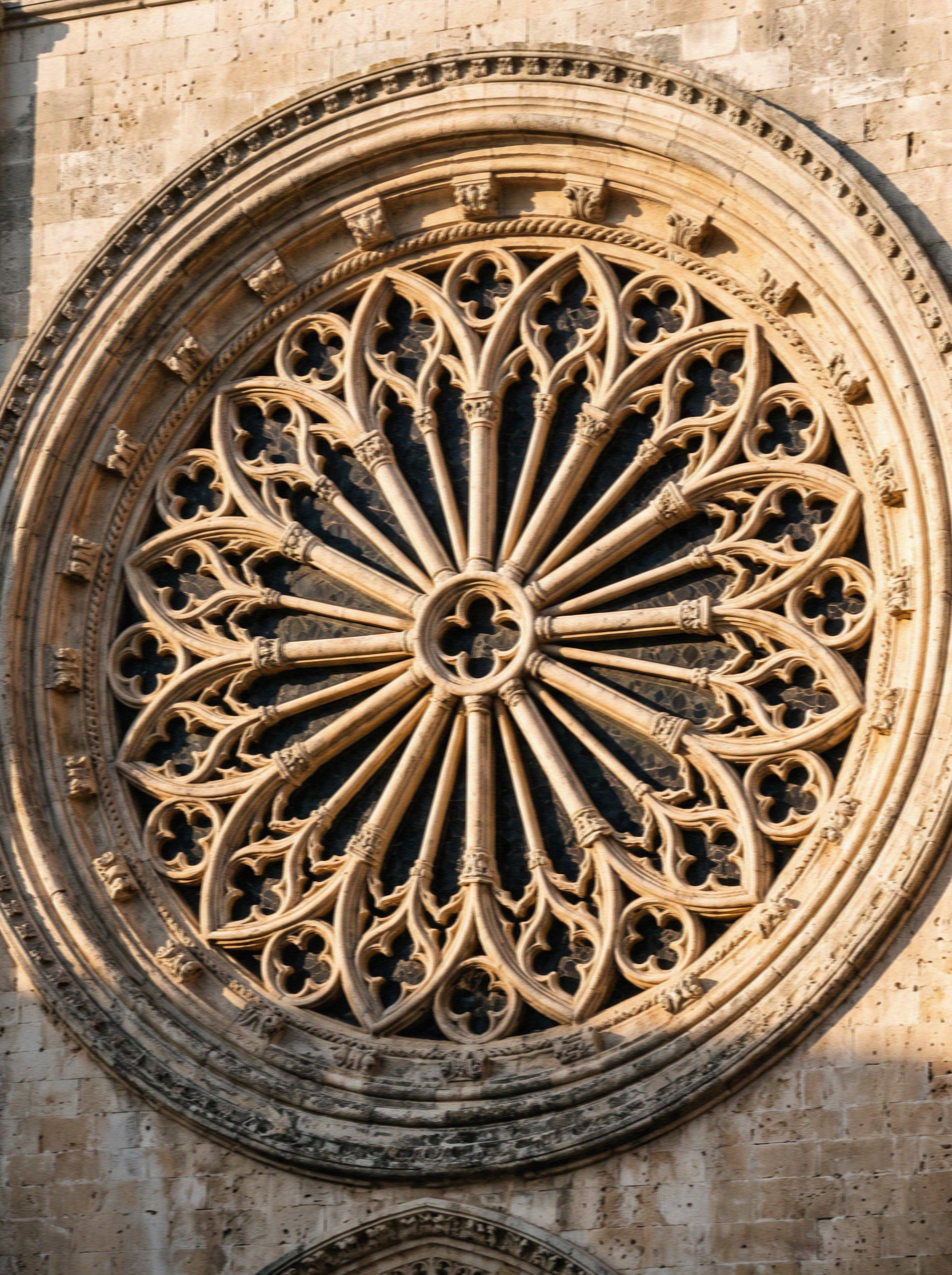
The Concattedrale di Santa Maria Assunta has one of the largest rose windows in Italy, with twenty-four finely carved rays radiating from the centre, set into a pale limestone facade rebuilt in Gothic style between 1469 and 1495.
The mistake is to shoot it flat and whole from directly in front at midday, which gives you a grey disc. Come in the late afternoon, when the light rakes across the facade at an angle and the carving develops actual depth and shadow. Shoot it tight enough to fill the frame with the stonework, and the tracery becomes the subject rather than a detail.
The little square in front is cramped, so a wider lens helps if you want the whole facade.
The lanes
The old town is a defensive spiral of narrow lanes, staircases and arches thrown between buildings, and it is the most photogenic part of Ostuni at the right hour.
Shoot early. Before about nine the lanes are empty, the light comes in low and sideways rather than straight down, and the walls are cool blue-white in the shade with warm slots of sun cutting across them. That contrast is the picture.
Look for the arches, where a vault crosses a lane and frames the bright street beyond it. Look for the blue and green painted doors, which are the only colour in the whole town and read strongly against all that white. And look for the gaps, where the wall on one side simply stops and gives you the olive plain and a strip of Adriatic.
The gates
Porta Nova and Porta San Demetrio, the surviving Aragonese gates, both work well because they give you a dark stone frame around a bright view. Stand inside the arch and expose for the light outside it.
The column
The Colonna di Sant’Oronzo, twenty metres of carved stone on the square below the old town, is hard to shoot in isolation because of what is around it. It works best either very tight, so the carving fills the frame against sky, or at dusk when the square lights come on and it silhouettes.
The olive groves
The plain below the town is a landscape most photographers drive through, which is a waste.
The trees are ancient, enormous, hollow and split, propped into shapes closer to sculpture than agriculture, and they run in rows across red earth between dry stone walls. Shoot them in the morning or the evening when the sun is low enough to come through the branches sideways, and get close enough that one trunk fills the frame. The texture of the bark on a five hundred year old olive is worth a frame on its own.
The shot most people miss
Everyone photographs the lanes and the view back at the town. Almost nobody photographs the gaps.
Because Ostuni is stacked on a hill above a plain, the wall on one side of a lane will periodically just stop, and in the space where it stopped you get the entire olive country and a band of Adriatic behind it, framed hard on both sides by whitewash. It is the most characteristic thing about the town visually and it is the shot that explains where you are.
They are easy to walk past because they arrive without warning. Slow down, look left and right rather than ahead, and when you find one, expose for the bright landscape and let the white walls on either side go slightly hot. The frame within a frame does the work.
A note on the light itself
It is worth understanding what a lime-washed town does to light, because it explains every piece of advice above.
Whitewash does not absorb, it bounces. So in Ostuni the light is not coming only from the sky, it is coming from every wall around you, arriving from several directions at once. In the middle of the day this fills in every shadow, flattens every face and removes the modelling that makes a photograph feel three dimensional.
Early and late, when the sun is low, the same bounce becomes an advantage. One wall catches direct sun and throws a soft warm fill onto whatever is standing opposite it, which is very close to having a reflector held just out of frame. That is why portraits taken in these lanes at eight in the morning look the way they do, and why the identical spot at one in the afternoon looks like nothing.
Timing, in one list
- Before 9am for the lanes, the arches and the doors.
- Late afternoon for the cathedral facade and the rose window.
- The last hour of light for the view back at the town from outside it.
- Dusk for the lit lanes, the square and the terraces at the edge of the walls.
- Avoid 11am to 4pm for anything involving white walls, which in July and August is most of the town.
Two practical notes
The whitewash will fool your camera’s meter into underexposing, because it reads all that brightness as something to pull down. Expect to dial in positive exposure compensation in the lanes and check your highlights.
And the town is a working place where people live behind those pretty doors. Photographing somebody’s front step is fine. Photographing through their window is not.
Frequently Asked Questions
Where is the best view of Ostuni?
From outside the town looking back at it, with Piazzetta Martiri delle Foibe the classic spot, about a ten to fifteen minute walk from the centre. The approach road across the olive plain gives the other good angle, with the white town sitting above the groves.
What time of day is best for photographing Ostuni?
Early morning before about nine for the lanes, and the last hour before sunset for the town seen from outside. Avoid the middle of the day, when the white walls throw so much light that scenes flatten out and faces fall into hard shadow.
Can you photograph inside Ostuni cathedral?
Visitor reports indicate admission is free, but I could not confirm current opening hours or any photography policy, so check on the day. The exterior facade and its rose window are the stronger subject in any case, especially in raking late afternoon light.
Is Ostuni good for photography?
Very, provided you work with the light rather than against it. An entirely lime-washed hill town gives you strong graphic shapes, hard blue shadows and constant sudden views out over the olive plain. The same qualities make it very difficult at midday.
Read also: the best things to do in Ostuni, the best time to visit Ostuni, and the complete guide to Ostuni.