Some links in this guide are affiliate links. If you book through one, this site may earn a small commission, at no extra cost to you. How this works.
You can spend a whole day on Capri and never see it.
That sounds like a line, and it is not. The ferry drops you at Marina Grande, the funicular takes you up to the Piazzetta, and from there the island is lanes, shops, a very expensive coffee and two viewpoints. It is lovely. It is also about a fifth of the place. The reason anyone has been coming here since Tiberius is the coastline, and the coastline is a wall of limestone that falls straight into the water with no road along it and almost no path. There is exactly one way to see it.
So on Capri, more than anywhere else in Italy I have written about, the boat is not an excursion. It is the visit.
What a tour around the island actually shows you
The circuit is about nine nautical miles and takes between an hour and a half and two hours depending on how much your skipper likes stopping. Going anticlockwise from Marina Grande you get the Palazzo a Mare and the Roman ruins at Bagni di Tiberio, then the whole north-western shoulder of the island, then Punta Carena and the lighthouse, and then the south coast, which is the good half.
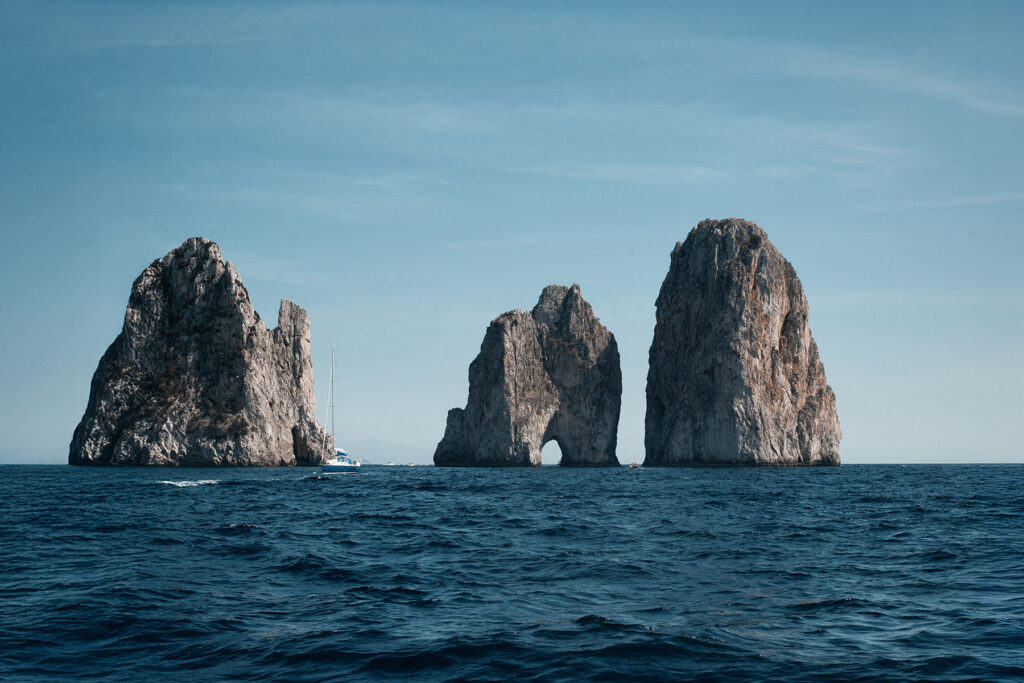
The south is where the arches are. Two of them, the Arco Naturale high up on the cliff and the Faraglioni offshore, and the middle one of the three Faraglioni stacks has a hole through it wide enough to take a boat. Small boats go through. Large ones do not, and if being driven through a rock is the picture you have in your head, ask before you book, because it is the single most common disappointment on this island.
Then the caves. The Grotta Bianca and the Grotta Verde on the south side, the Grotta Meravigliosa, and a series of smaller ones the boats duck into where the water goes an unreasonable colour because sunlight is coming up through it off a white sand floor rather than down onto it.

The Blue Grotto, honestly
The Blue Grotto is a real thing and it is genuinely extraordinary, and I want to be straightforward with you about what visiting it involves, because a great many people come away cross.
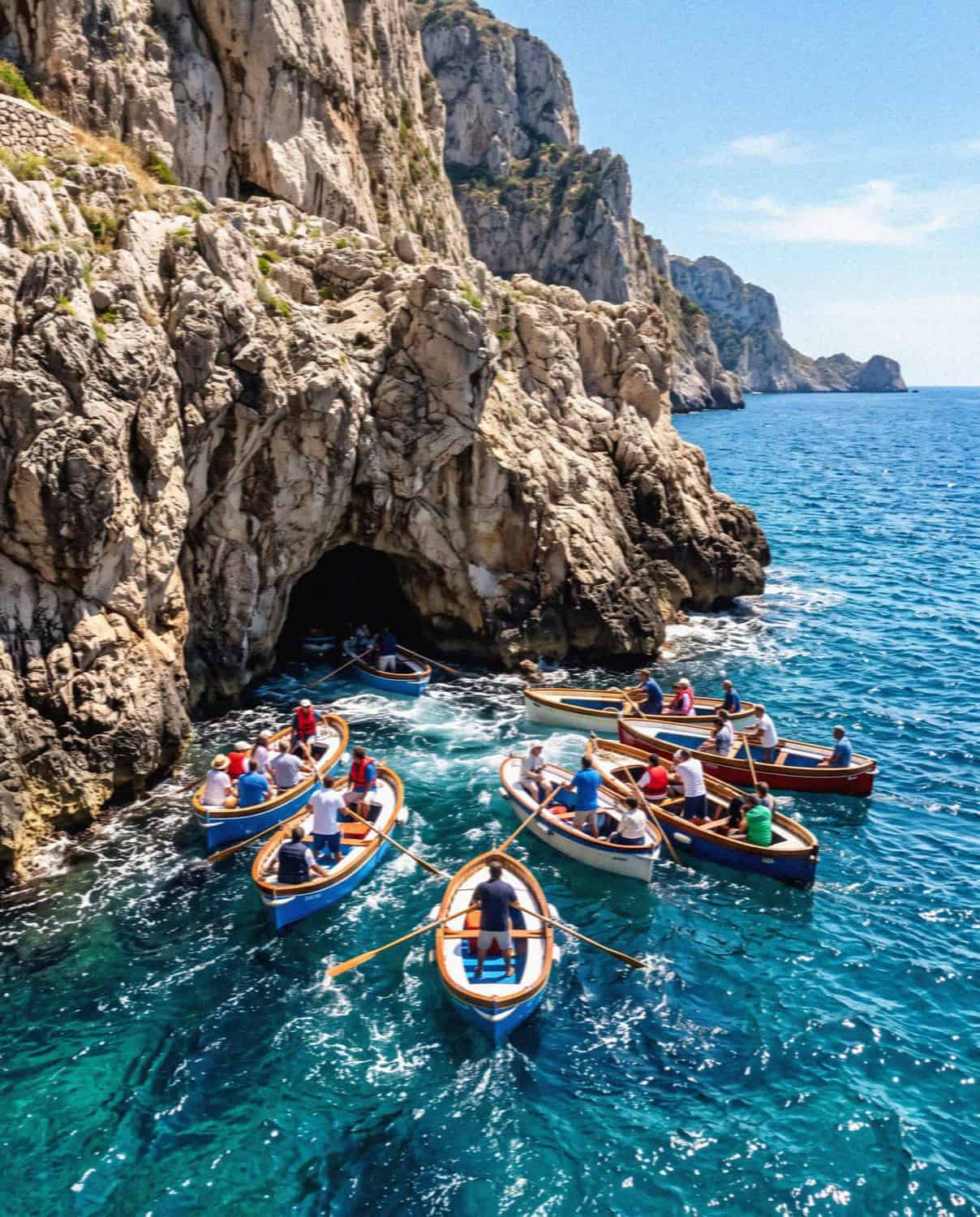
The entrance is about two metres wide and a metre high. You cannot go in on the boat you arrived on. You transfer, offshore, onto a small wooden rowing boat with a boatman, you lie down flat in the bottom of it, he pulls the boat through on a chain fixed to the rock, and you are inside for perhaps five minutes. The blue is caused by light entering through a second, larger opening below the waterline, so the whole cave glows from underneath.
Three practical things. It closes whenever there is any swell at all, and no ticket protects you from that, so go early in your stay rather than on your last day. There is a separate charge paid to the boatman inside, in cash, on top of whatever your tour cost. And in high season the queue of tenders waiting outside can run past an hour, which is why the phrase you want to look for when booking is “Blue Grotto optional” or “with priority”, and why the morning departures matter so much.
If the sea is up and it is shut, you have not lost your day. The rest of the coast is still there and is, for me, the better part.
Which boat to take
I have been round this island on four different kinds of boat and they suit genuinely different trips.
- The shared island tour. The standard: a covered gozzo or a small motor launch, ten to twenty people, a fixed route with one or two swim stops. It is the cheapest way to see the whole coast and the boats are small enough for the arch. This is the right answer for most people, and the island tour with the Blue Grotto is the version I would take.
- A small group grotto cruise with swimming. Fewer people, longer in the water, usually limoncello and a swim at the Faraglioni. The small group cruise is rated 4.7 from over eight hundred people and is the sweet spot if you are two or four and would rather not be on a bench.
- A private boat. Three hours, your own skipper, you stop where you want and stay as long as you like. On an island where a sunbed at a beach club and two spritzes will run you a similar figure, splitting a private boat between four people is a much smaller premium than it sounds. It is also the only version where you swim when the light is right rather than when the schedule says. If you take one thing from this page, take the private option and go late in the afternoon.
- From the mainland. If you are staying in Sorrento or on the Amalfi Coast, there are boats that do the crossing and the island circuit in one day, which saves you the ferry queue at Marina Piccola. That queue in August is what eats people’s days. The full day from Sorrento with transfers is rated 4.9 from nearly two thousand people.
When to go, and the weather nobody warns you about
Morning. I know every guide says morning and I know it is tiresome. Here is why it is true on Capri specifically: the wind on this coast almost always gets up in the early afternoon, the Blue Grotto shuts on swell rather than on rain, and a cancelled afternoon is not refunded as a rule if the boat sailed and simply could not enter the cave.
Season matters more than the hour. May, June and September are the good months: warm water, boats running, and space on them. July and August the sea is at its calmest and the island is at its most crowded, which is a genuine trade rather than a reason not to come. In April and October you will find plenty of boats but the Grotto closes more often, and by November most operators have stopped.
Prices, checked in September 2026 and certain to move: a shared island tour sits in a band of roughly thirty five to sixty euros a head; a small group cruise with swimming and drinks around seventy to a hundred; a three hour private boat from about four hundred and fifty for the boat, which is where four people makes the arithmetic work. The Blue Grotto entrance and the rowing boat are extra, usually around twenty euros, cash, paid inside.
What to bring
A towel, because most boats have none. Shoes you can take off, because you will be barefoot on the deck and the boarding at Marina Grande is a step down onto a moving gunwale. A cover up for the Grotto, where you are lying down in a wooden boat with a stranger and the ceiling is a foot above your face. And cash, for the boatman, which catches people out constantly.
Do not bring a hat you are attached to. I have watched three go into the water off the Faraglioni and none came back.
Frequently Asked Questions
How long does a boat tour around Capri take?
The full circuit of the island takes an hour and a half to two hours. Add roughly an hour if the tour includes the Blue Grotto, more in July and August when the queue of tenders outside the entrance can be long. Tours that include swimming stops usually run three to four hours.
Can you go into the Blue Grotto on the tour boat?
No. The entrance is about two metres wide and a metre high, so everyone transfers offshore onto a small wooden rowing boat with a boatman, who pulls it through on a chain. You lie flat as you go in. There is a separate charge for this, paid in cash to the boatman, on top of the price of your tour.
Is the Blue Grotto worth it?
Yes, on a calm day, with your expectations set. You are inside for about five minutes and the colour is genuinely unlike anything else. But it closes on any swell, the queue can be an hour, and it costs extra. Treat it as a bonus on top of the island circuit rather than the reason for the trip, and you will not be disappointed.
Do the boats go through the arch in the Faraglioni?
Small boats do. The middle stack, Faraglione di Mezzo, has an opening wide enough for a gozzo or a small launch but not for a large tour boat. If passing through the arch matters to you, check the boat size before booking rather than after.
Is it better to take a boat from Capri or from Sorrento?
If you are staying on Capri, book from Marina Grande. If you are on the mainland, a combined crossing and island tour from Sorrento is usually better value and it removes the ferry queue, which in high season is the thing that ruins a day trip.
When do the boats stop running?
Most operators run from roughly April to the end of October, with the fullest schedule between May and September. In winter a handful of boats run on demand and the Blue Grotto is closed far more often than it is open.
Read also: The Blue Grotto, in detail | The best beaches in Capri | The Complete Guide to Capri