Everybody comes here for the coast and then discovers, around day three, that they have run out of beach.
That is not a criticism of the beaches. It is arithmetic. The bays are small, they fill by mid-morning, and after two or three days of the same rhythm the appetite for a fourth car park under the pines starts to fade. This is the point at which the inland half of Gallura becomes interesting, and it is genuinely good.
Everything here is within an hour’s drive, most of it within half an hour, and all of it needs a car.
The Thursday market inland

San Pantaleo, fifteen minutes inland, is the best village on this side of the island and the best half-day out from the coast.
It is a small place of granite houses sitting directly beneath a set of jagged granite peaks that look considerably more dramatic than a fifteen-minute drive ought to produce. Since the seventies it has had a working community of artists and craftspeople living in it, which sounds like the sort of thing a tourist board says and in this case happens to be true: there are potters, painters and jewellers with actual studios here.
The market runs every Thursday morning from about eight until half past one, May to October, and fills the square in front of the church. Linen, ceramics, hand-made jewellery, second-hand clothes, flowers, and food from the surrounding farms. It is a real market rather than a souvenir operation, and it is the one I would build a day around.
Go early. Parking in the village on a Thursday is difficult by ten.
If you cannot make Thursday, the market rotates: Porto Cervo on Friday mornings and Porto Rotondo on Saturday, roughly nine to noon, both smaller and both worth twenty minutes if you happen to be there.
And even on a Tuesday, San Pantaleo is worth the drive for the square, the church and lunch under a tree.
The rock formations up the coast
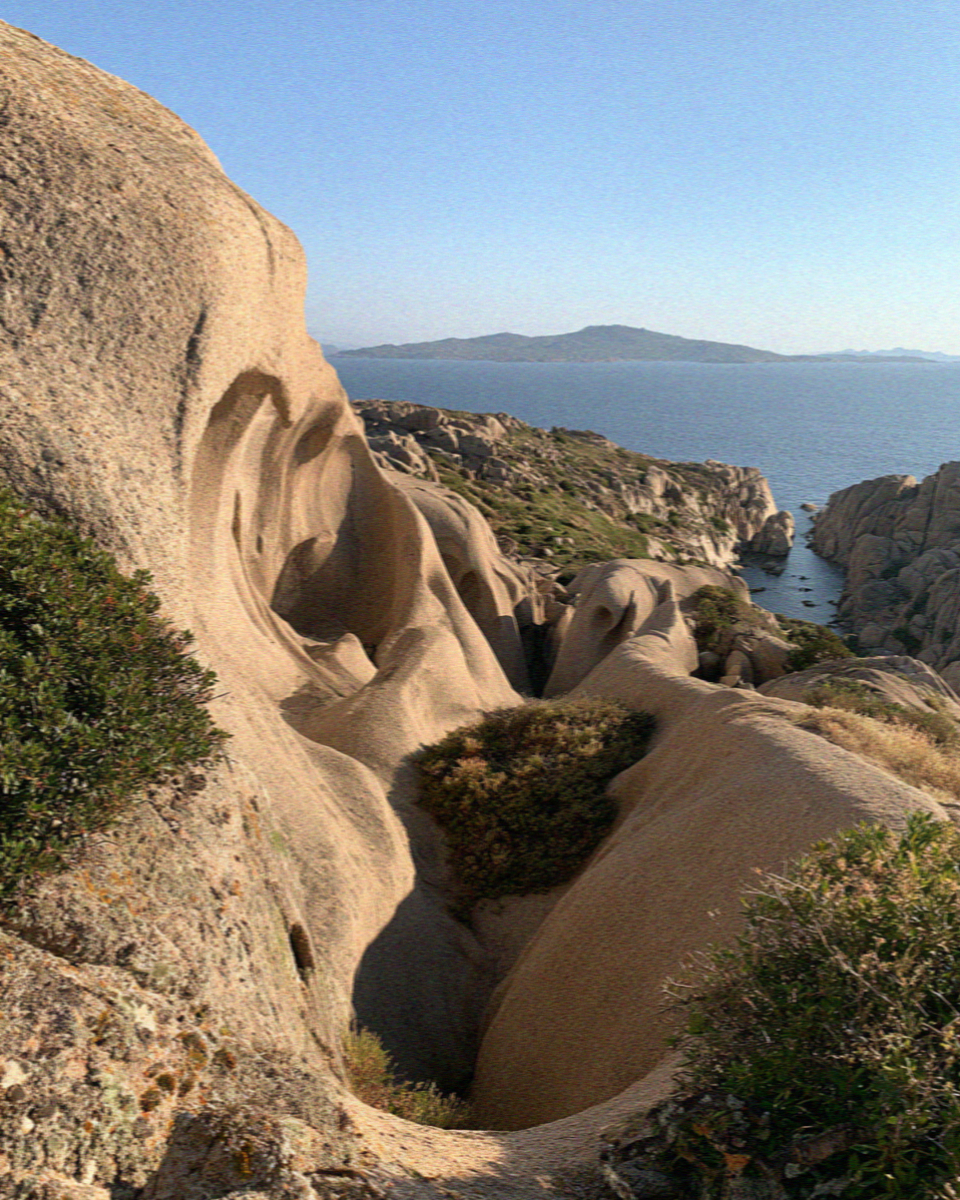
North of the Costa Smeralda proper the granite gets stranger. The mistral has been working on it for a very long time and the results are hollowed, undercut, balanced shapes, some of which have been given names for the obvious reason that they look like things.
The best known is on the headland above Palau, where a huge wind-carved rock sits high above the strait with a marked path up to it, a small ticket booth at the bottom and a view over the archipelago from the top that is worth the climb. It takes perhaps twenty minutes up from the car park, in full sun, so go early or late.
The wider point is that the whole drive north through this granite country is the trip, not just the named rock. Pull over. It is empty in a way the coast is not.
Porto Rotondo
Twenty-five minutes south, toward Olbia, Porto Rotondo is the Costa Smeralda’s smaller and less shouty cousin. Also purpose-built, also handsome, with a piazza that works as an open-air theatre, a small marina and rather good ice cream.
It is a nice couple of hours rather than a day, and it is the right destination for an evening when Porto Cervo feels like too much effort.
Tavolara and the coast south
The great flat-topped limestone slab visible offshore south of Olbia is Tavolara, and it is one of the more startling things on the Sardinian coast: an island that rises 500 metres straight out of the water with almost vertical sides.
Small boats run out to it from Porto San Paolo in summer, and there is a beach and a couple of restaurants on the sheltered end. Reckon on a full day by the time you have driven down and back.
The same run south takes you past the beaches around San Teodoro, which are wider and sandier than the Costa Smeralda’s coves. Be aware that the rules change once you cross into that stretch: a few of those beaches are ticketed and rationed through the summer in a way nothing up here is, and the check happens at the car park rather than on the sand. Sort it online before you set off.
The archaeology
Ten minutes inland from Porto Cervo there is a set of bronze age sites around Arzachena: dry-stone towers built without mortar, and the long communal tombs known as tombs of the giants.
This is my favourite half-day inland and it deserves its own page rather than a paragraph, so it has one: the nuraghi and tombs of the giants at Arzachena. Go in the morning before the heat, and take water, because there is no shade at any of them.
The wineries
The hills between Arzachena and the coast grow Vermentino di Gallura, the only DOCG appellation on Sardinia, and several of the estates run tours and tastings by appointment.
It is a good use of a windy day, when the sea is unpleasant and the beach is not worth the drive. Book ahead rather than turning up, and take someone who is not drinking, because the drink-drive limit here is 0.5 and the roads back are dark and winding. More on the wine in where to eat on the Costa Smeralda.
The boat day
The single best day out from this coast goes north by water into the La Maddalena archipelago, and it is a whole day rather than a trip. Prices, ports and the pink beach you cannot land on are all in the La Maddalena boat trip guide.
Which to do, if you only do two
Take the boat north, and take a morning inland at San Pantaleo or Arzachena.
Between them they give you the two things the coast itself does not: water clearer than anything you can reach by car, and the version of Sardinia that existed before 1962. Where those fit in a three to five day trip is worked out in the Costa Smeralda itinerary.
Frequently Asked Questions
What are the best day trips from the Costa Smeralda?
The La Maddalena archipelago by boat is the standout full day. Inland, San Pantaleo for its Thursday market and the bronze age sites around Arzachena are the best half-days. Porto Rotondo makes a good evening, and the wind-carved granite headlands north toward Palau are worth the drive on their own.
When is the San Pantaleo market?
Thursday mornings, opening around eight and winding up by early afternoon, from May through October. Stalls fill the square by the church with linen, ceramics, jewellery, flowers and produce off the surrounding farms. Come before ten or you will be leaving the car a long way out.
Which markets run on the Costa Smeralda?
Three, on three different days: Thursday inland at San Pantaleo, Friday in Porto Cervo and Saturday at Porto Rotondo, the last two running roughly nine until noon. Only the first is worth arranging your week around; the other two are worth twenty minutes if you happen to be passing.
Is Tavolara worth visiting?
Yes, if you can give it a whole day. It is a sheer limestone slab standing 500 metres out of the water off the coast below Olbia, with a beach and a restaurant or two tucked at the low sheltered end, reached by small boat from the mainland opposite in summer. The driving each way is what makes it a full day rather than a half.
Do you need to book beaches near San Teodoro?
Some of them, yes, which is different from the Costa Smeralda. Cala Brandinchi and one or two neighbouring beaches operate a summer booking system with a daily visitor cap and a small per-person charge. Book online in advance if you are driving south, or you may be turned away at the car park.
Read also: The Nuraghi and Tombs of the Giants at Arzachena | The La Maddalena Boat Trip from the Costa Smeralda | The Complete Guide to the Costa Smeralda