Twenty minutes west of Alghero the land simply stops.
Capo Caccia is a headland of white limestone that drops something close to two hundred metres straight into the sea, and from the water it does not look like a cliff so much as a wall somebody built. Griffon vultures nest on it. There is a lighthouse on top. And at the very bottom, at sea level, there is a hole in the rock.
That hole is Neptune’s Grotto, and getting into it is the whole business of this page.
What it actually is
A sea cave, discovered by fishermen in the eighteenth century, running several hundred metres back into the headland. Inside there is a saltwater lake so still it works as a mirror, a forest of stalactites and stalagmites, and a set of chambers that have been given the sort of names Victorian visitors gave things.
You see it on a guided walk of roughly thirty to forty minutes, on a fixed walkway, in a group, at a set entry time. There is no wandering and no lingering. That sounds restrictive and in practice it is fine, because the cave is not enormous and the guide is what stops it being just wet rock.
Getting down there, which is the real decision
There are two ways in and they are not equivalent.
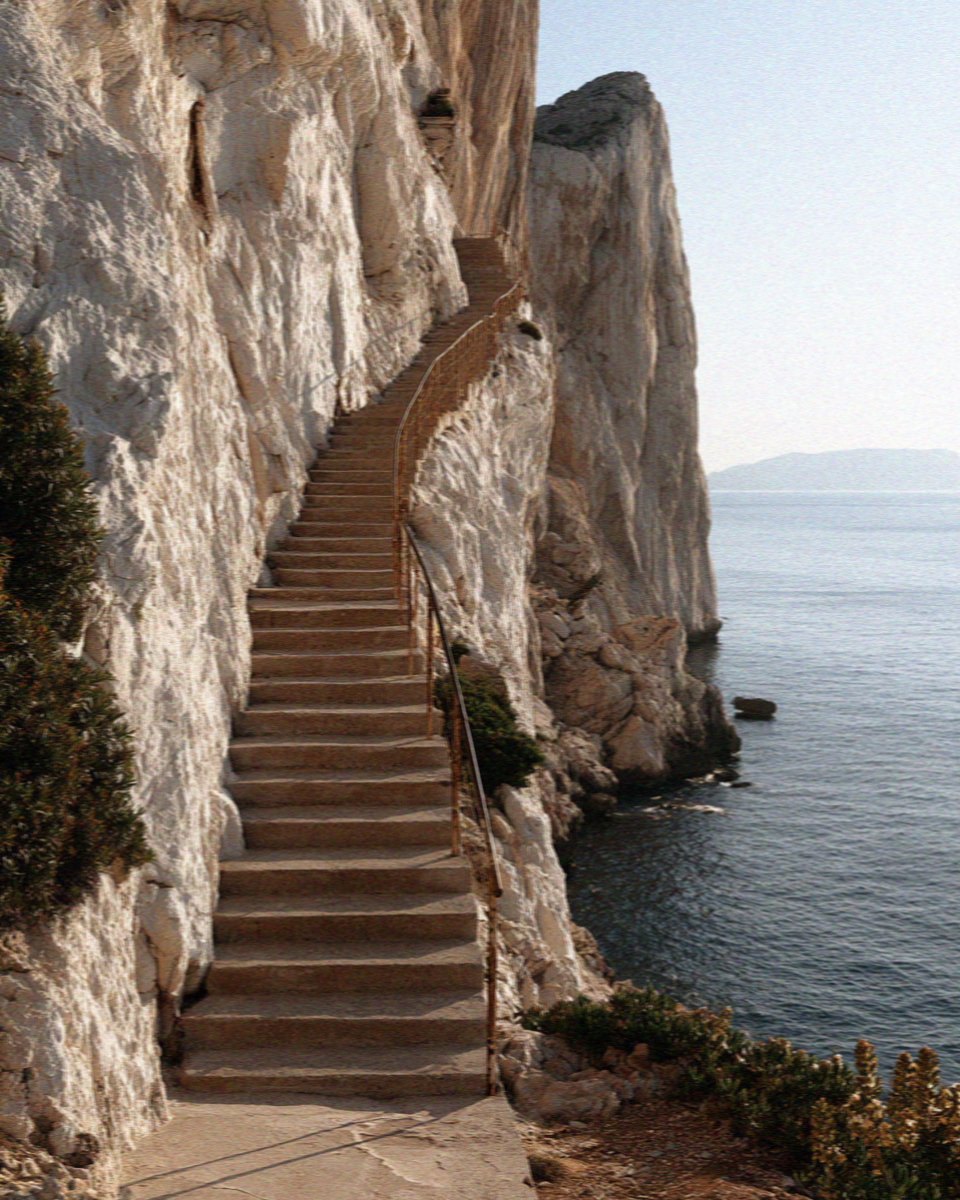
The Escala del Cabirol. A stairway cut into the cliff face, switchbacking down the rock to the cave mouth. It is spectacular, it is open all year, and it is free to walk. It is also 654 steps.
I want to be honest about that number, because it is quoted cheerfully in a lot of places. Going down is easy on the legs and slightly alarming on the nerves. Coming back up, in August, in full sun, with no shade anywhere on the cliff and no water for sale at the bottom, is a serious piece of exercise. I watched two people turn back. If you have knees, heart or heat problems, or small children, take the boat.
The boat from Alghero. Leaves the harbour, runs down the coast under the cliffs, and puts you at the cave mouth. It is the easier option and the better sightseeing, because you see the headland from the water, which is the angle that makes sense of it.
The catch: the boat runs only from spring to late autumn, roughly April to November, and it does not run at all if the sea is up. The stairway runs year round.
The practical detail
Entry is around eighteen euros full, roughly ten reduced, paid at the cave rather than at the top of the stairs. The boat is separate and extra.
Entries are at fixed times through the day. In July and August the middle of the day is busy and the queue at the bottom of the steps sits in full sun, so the first or second entry of the morning is worth getting up for.
Take water. There is nothing to buy at the bottom. Take a layer, because the cave is cool and damp and you will have arrived hot. Wear something with grip; the walkway inside is wet in places.
Inside
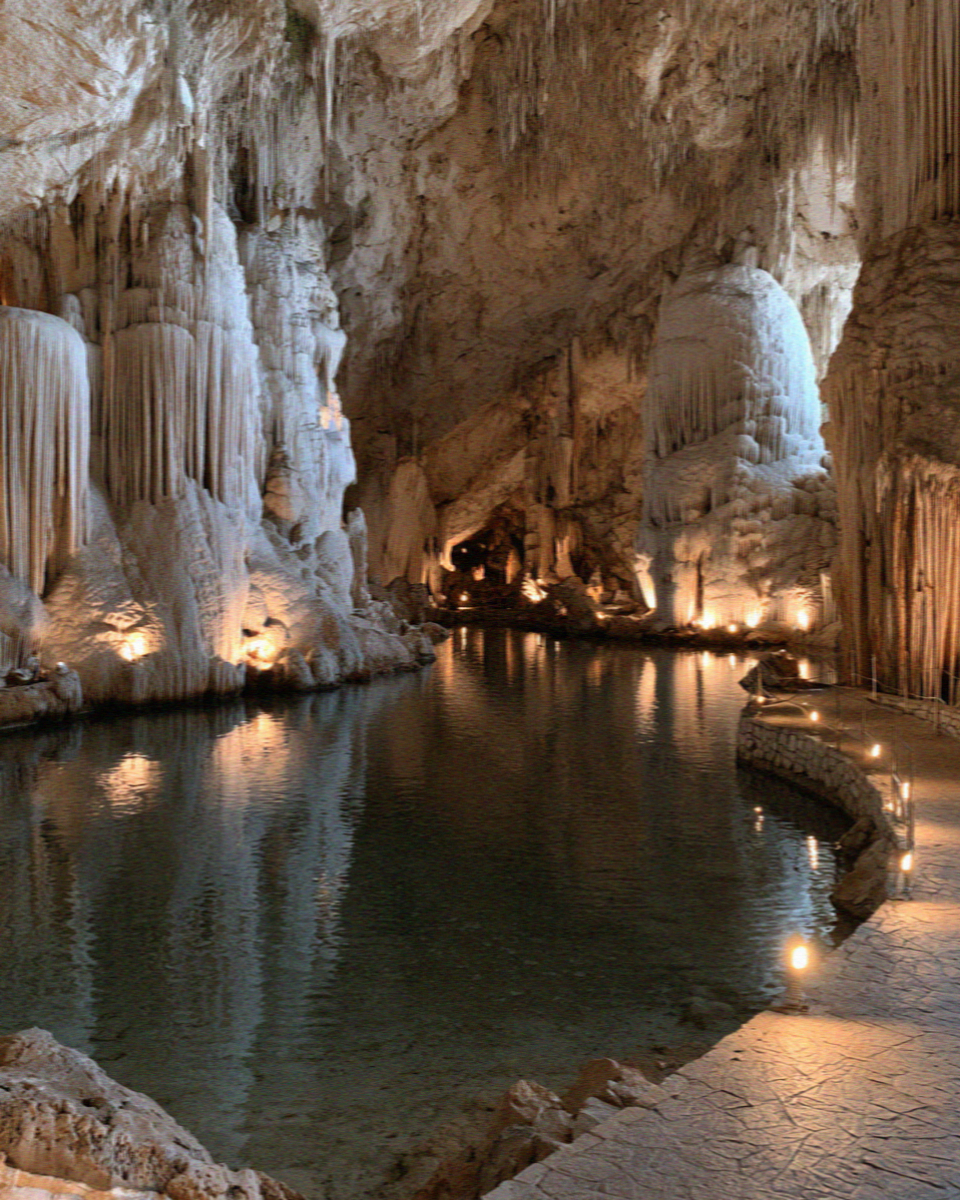
The first thing is the smell, which is cold stone and salt, and the second is the temperature, which after the climb is a physical relief.
Then the lake. It is about a hundred metres long, it is seawater, and because there is no wind down there it is completely flat. The lighting is warm and low and the reflection doubles everything, so the roof appears twice.
The formations are the usual cave inventory of columns and curtains and organ pipes, and they are good ones. But what stays with me is the scale of the entrance chamber and the fact that this thing has been sitting here, filling and emptying with the tide, for a very long time before anybody found it.
The rest of the cape
Do not drive out here only for the cave.
The road along the headland is one of the best short drives in Sardinia, and there are pull-ins along it where you can look back at the whole bay of Porto Conte. The lighthouse at the top gives you the view down the vertical face and across to the little island of Foradada.
Below and behind the cape is Porto Conte, a deep sheltered bay that is a marine protected area, and it is the calmest water on this coast. Most of the sailing and snorkelling trips out of Alghero come here rather than going outside into the swell, which is covered in the best Alghero boat tours.
And on the way back, fifteen minutes from the cape, are Le Bombarde and Lazzaretto, which means the sensible shape of a day is cave in the morning, beach in the afternoon. Both are in the best beaches in Alghero.
The vultures, if you are lucky
Capo Caccia holds one of the last colonies of griffon vultures in Sardinia, and they are enormous: close to three metres across the wings.
You will not always see them, and nobody can promise it. But they ride the updraught off the cliff face in the middle of the day, which is exactly when you are climbing back up the stairway, and looking up from step four hundred to find one hanging motionless above you is a fair reward for the state of your legs.
Bring binoculars if you have them. From the lighthouse road you can sometimes pick out the nest ledges on the far side of the face.
Getting there without a car
In summer the beach bus from Alghero runs the coast road out as far as Capo Caccia, which makes the whole thing doable on public transport for a couple of euros. Check the last bus back before you set off, because it is earlier than you want it to be and there is nothing out there.
Out of season the bus service thins considerably and you are looking at a car, a taxi or a tour. Full transport detail is in getting to Alghero and getting around.
Frequently Asked Questions
How much does Neptune’s Grotto cost?
Around eighteen euros for a full adult ticket and about ten reduced, paid at the cave itself. If you take the boat from Alghero harbour rather than the cliff stairway, the boat fare is separate and additional.
How many steps are there down to Neptune’s Grotto?
The Escala del Cabirol is 654 steps cut into the cliff face. Going down is straightforward; the climb back up in summer heat, with no shade and no water available at the bottom, is genuinely demanding.
Can you visit Neptune’s Grotto by boat?
Yes, from Alghero harbour, and it is the easier and more scenic option because you see the cliffs of Capo Caccia from the water. The boat runs roughly April to November only and is cancelled when the sea is rough. The stairway is open year round.
How long does the visit take?
The guided walk inside is about thirty to forty minutes. Allow half a day in total from Alghero once you add the journey, the descent and the climb back up.
Is Neptune’s Grotto worth it?
Yes, if you go early and treat the cape as the day rather than the cave alone. The drive along the headland, the view from the lighthouse and a beach on the way back make it a full outing. The cave on its own is thirty minutes.
Read also: The Best Alghero Boat Tours | The Best Beaches in Alghero | Victoria’s Complete Guide to Alghero