There are around seven thousand nuraghi on Sardinia, stone towers built between roughly 1800 and 1100 BC by a civilisation that left no writing, and nobody is certain what they were for. Su Nuraxi di Barumini, an hour inland from Cagliari, is the best preserved of all of them and the one on the UNESCO list.
It is the single most remarkable thing within reach of the city, and it is the one that needs planning, because you cannot simply walk in.
The thing to know before you go
Entry is by guided tour only. You do not wander Su Nuraxi on your own.
- Groups leave every half hour.
- The tour lasts about one hour.
- The last departure is one hour before closing.
- Adult entry is 15 euros, 13 for ages 13 to 17, 10 for ages 7 to 12.
- The ticket is a combined one covering Su Nuraxi, the Casa Zapata museum complex in the village, and the Centro Giovanni Lilliu.
Winter months, roughly January, February, November and December, run 09:00 to 17:00, with later closing through the summer.
That last-departure rule is what catches people. Arriving at four in November means you are too late, whatever the gate says.
Getting there
About an hour inland from Cagliari by car, north across the Campidano plain and up into the Marmilla, a landscape of low rolling hills and flat-topped basalt outcrops that looks nothing like the coast.
If you would rather not drive, guided day tours from Cagliari run about five to six hours, include hotel or port pickup, and start somewhere around 75 to 80 euros with entry. Given that entry is guided anyway and the drive is an hour each way, this is one of the few places where the organised option genuinely makes sense.
What a nuraghe actually is

A nuraghe is a truncated cone of unmortared stone, built by stacking enormous blocks in courses that step inward until they close. No mortar. No arch as the Romans would understand it. Just weight, geometry and extremely good judgement about how stone behaves.
Su Nuraxi is not a single tower but a complex: a massive central tower, originally perhaps eighteen metres tall, ringed by four corner towers joined by a curtain wall, with a courtyard and a well inside. Around that, a whole village.
What they were for is genuinely unresolved. Fortresses, is the obvious answer, and the defensive layout supports it. Others argue for temples, chieftains’ houses, granaries, astronomical markers, or all of those at different times across seven centuries. The honest position is that we do not know, and standing in the courtyard you feel that absence rather than resent it.
The site was buried under a hill of earth until Giovanni Lilliu excavated it from 1949, which is why it survived so completely.
The village around it
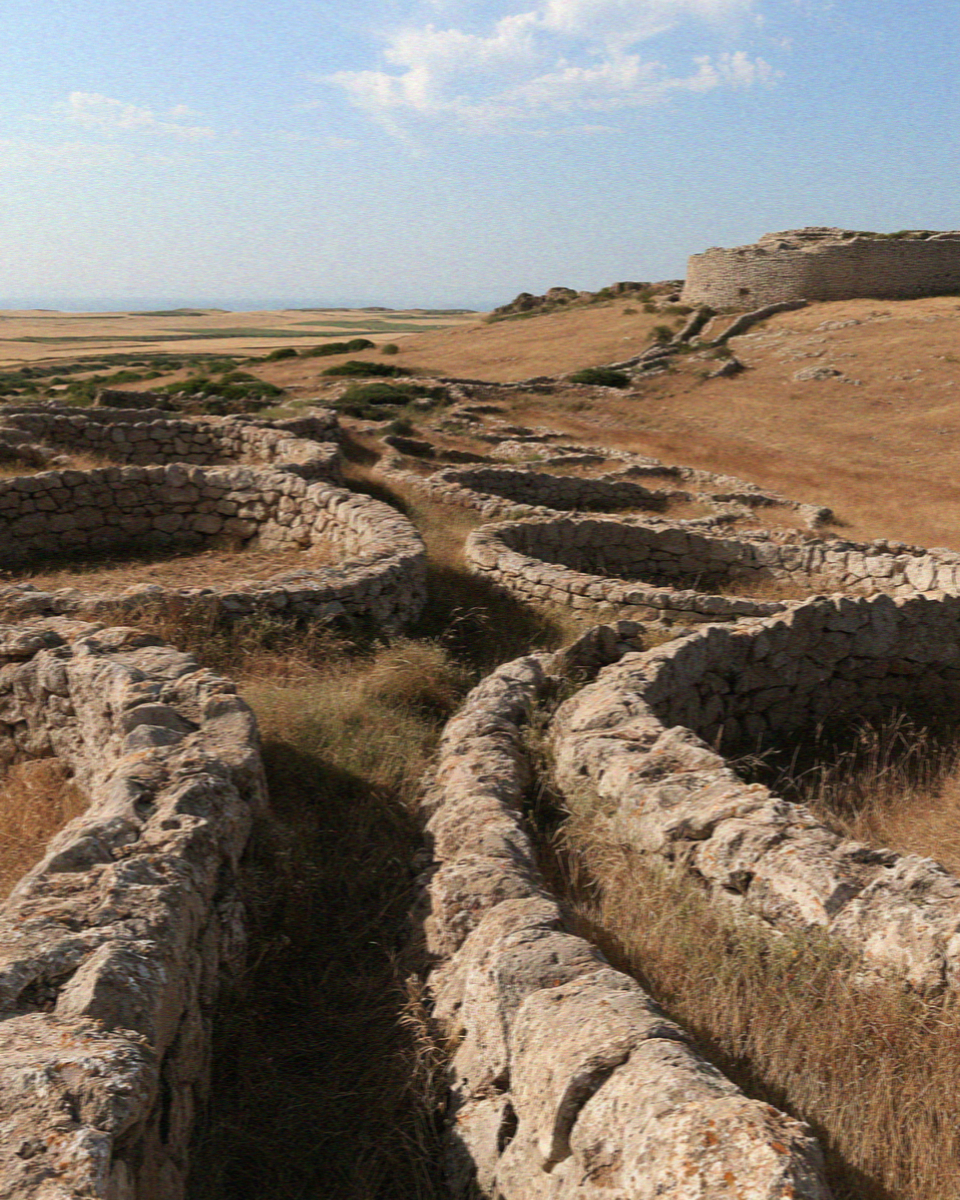
The part that surprises people is not the tower. It is the village.
Dozens of circular stone huts crowd the base of the fortress, their walls still at waist height, forming a maze of round rooms and narrow lanes. You can see doorways, hearths, benches, and the layout of a settlement where people lived for centuries.
One of the round buildings is usually identified as a meeting house, with a stone bench running around the inside wall. Whether that is what it was, again, nobody can prove. But it is very hard to stand in it and think anything else.
Inside, and looking up

The interior chamber of the central tower is the moment.
You come in low through a passage, the temperature drops, and then the space opens above you: courses of rough unmortared blocks stepping inward and inward to a small circle of white sky at the apex. It is called a tholos, a corbelled vault, and it has held that shape for over three thousand years without a single binding agent.
Photographs do not do it. The scale reads as a cathedral and the technology reads as a dry stone wall, and holding both of those at once is the whole experience of the place.
Combining it with Casa Zapata
Your ticket includes the Casa Zapata complex in Barumini village, which is worth the extra half hour. It is a noble house built directly over another nuraghe, with glass floors so you walk above the excavated tower inside the building.
That superimposition tells the Sardinian story neatly: the Bronze Age is not a separate layer here, it is under the floor of the sixteenth century.
Why it survived, and why the others did not
Su Nuraxi is the best preserved nuraghe on Sardinia for an accidental reason: it was buried.
Over the centuries the complex silted up and grassed over until it was a hill with a bump on top, and the village around it disappeared entirely under earth. Local people knew there was something there, in the way that local people usually do, but it was not until Giovanni Lilliu began excavating in 1949 that the scale of it emerged.
Burial protected it from the two things that destroy old stone: weather, and people taking the blocks away for their own walls. Most of the seven thousand surviving nuraghi across the island stand exposed and half collapsed, and many more were quarried out of existence entirely. This one had a hill on top of it for two and a half thousand years.
You can see the consequence in the masonry. The lower courses are enormous and precisely fitted; the upper ones, which were above the earth line for longer, are rougher and more disturbed.
What to look for on the tour
The guide will cover the history. These are the details worth watching for yourself.
The doorway lintels. Single slabs of stone, some of them enormous, spanning the openings. There is no arch anywhere in the building, so every opening is limited by how big a stone they could lift.
The stairway in the wall thickness. The walls are thick enough to carry a staircase inside them, spiralling up between the inner and outer faces. Look for the entrances to it.
The well in the courtyard. Which tells you the complex was built to be held for a while rather than simply occupied.
The difference in the stone. Basalt for the main structure, hauled from outcrops some distance away, which is a considerable logistical statement for a society without wheels of any useful kind.
Practical notes
- Book or arrive early in high season. Tours leave every half hour but they do fill.
- Wear proper shoes. Uneven stone, low passages, some scrambling.
- Shade is limited on the site and the Marmilla is hot and dry in summer.
- Allow half a day with the drive, or a full one if you add lunch in a village.
- Do not pair it with a beach day. The fixed tour times and the inland drive will beat you.
See the museum in Cagliari first, if you can
Su Nuraxi makes far more sense after an hour with the bronzetti in the archaeological museum in Cagliari. Those small bronze figures of archers, wrestlers, priests and shepherds are the same civilisation’s own account of itself, and having seen them, the towers stop being anonymous stonework.
That museum is covered in my guide to the best things to do in Cagliari.
Frequently Asked Questions
Can you visit Su Nuraxi di Barumini without a guide?
No. Entry is by guided tour only, with groups departing every half hour and the last one leaving an hour before closing. The tour lasts about an hour and the guide is included in the ticket price.
How much does Su Nuraxi di Barumini cost?
Adult entry is 15 euros, 13 euros for ages 13 to 17 and 10 euros for ages 7 to 12. The ticket also covers the Casa Zapata museum complex and the Centro Giovanni Lilliu in Barumini village.
How far is Barumini from Cagliari?
About an hour inland by car, north across the Campidano plain into the Marmilla hills. Guided day tours from Cagliari run five to six hours including pickup, entry and the drive both ways.
What is a nuraghe?
A Bronze Age Sardinian tower of unmortared stone, built roughly between 1800 and 1100 BC, with blocks stepped inward to form a corbelled vault. Around seven thousand survive on the island. Their purpose is still debated: fortress, temple, dwelling and store have all been argued.
Read also: Nora: The Roman City on the Water | The Best Day Trips from Cagliari | The Complete Guide to Cagliari