You arrive at Herculaneum and the first thing you do is look down.
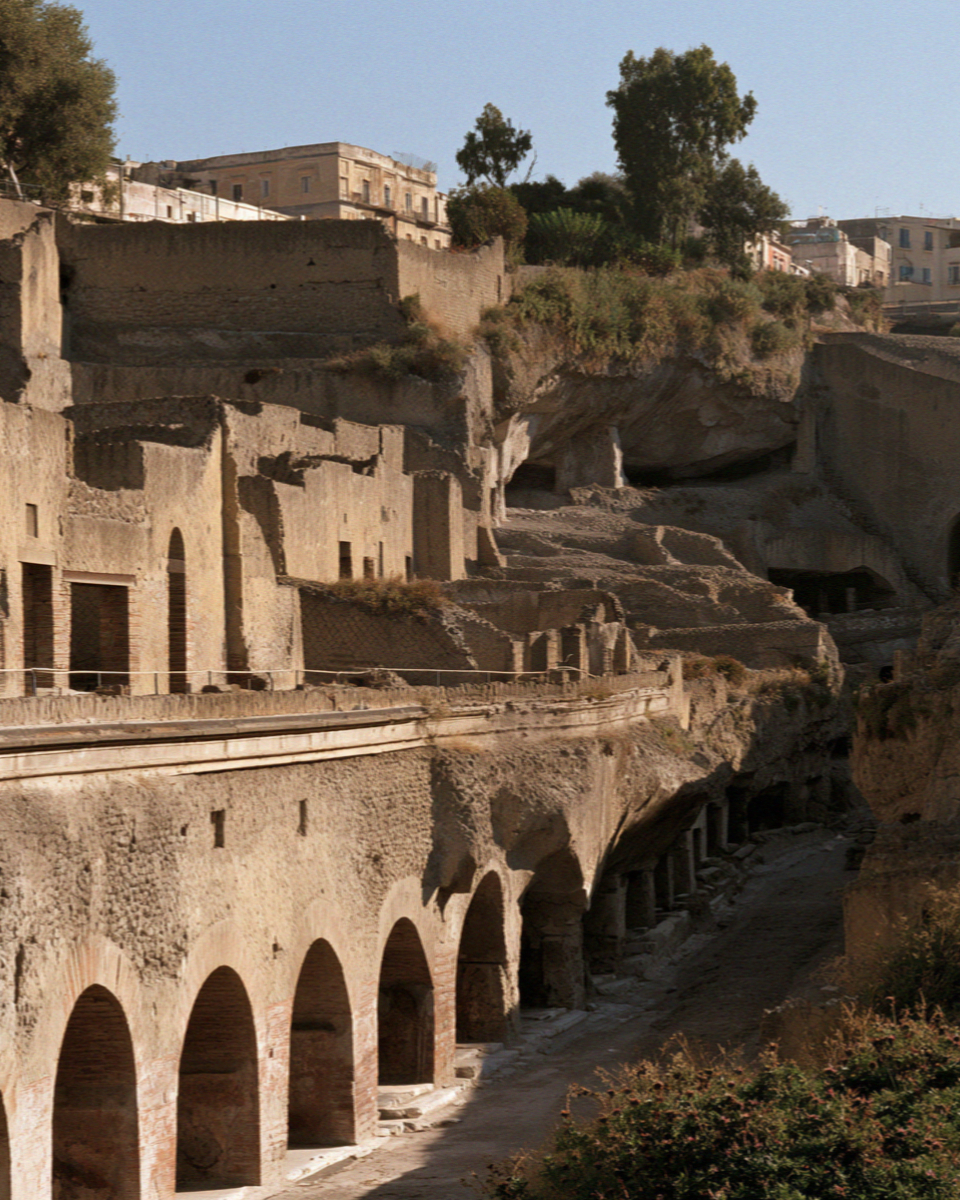
The town is in a pit. The modern streets of Ercolano run along at their own level, ordinary and busy, and then the ground simply falls away and there is a Roman town twenty metres below you, roofs and all, with apartment blocks standing along the far edge looking into it.
That is the first fact about Herculaneum and it explains the second. Pompeii was buried under a few metres of falling pumice. Herculaneum was buried under twenty metres of material that arrived hot and fast and set like concrete. The modern town was built on top before anyone knew what was underneath.
Why it survived differently
Pompeii was crushed. Herculaneum was sealed.
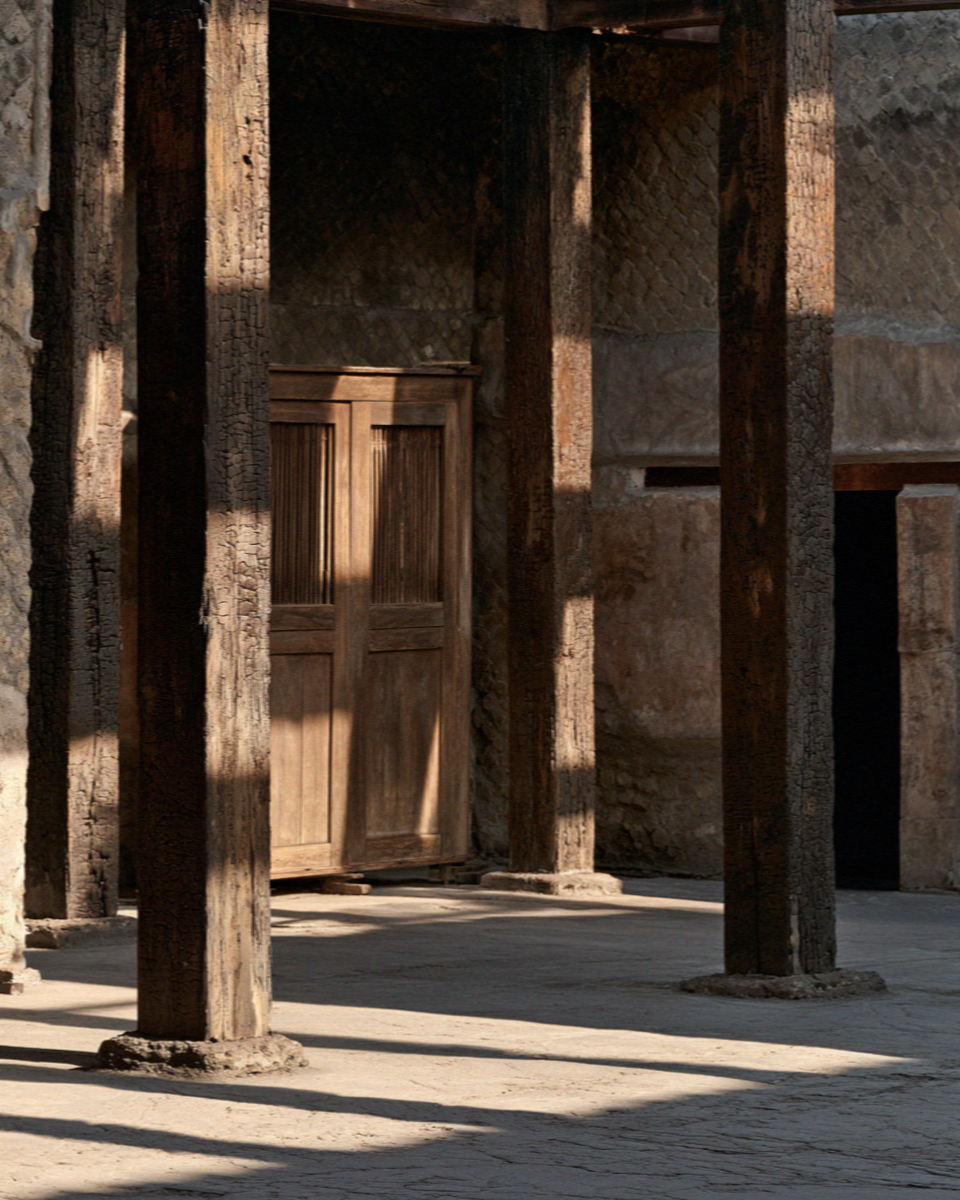
The pyroclastic surges that hit Herculaneum carried temperatures high enough to carbonise organic material instantly rather than burn it. Wood did not turn to ash. It turned to charcoal and stayed exactly where it was.
So Herculaneum has things that do not exist at Pompeii. Roof beams still spanning doorways. A wooden screen. A bed frame. Shop fittings. A carbonised loaf with the baker’s stamp still on it. Upper storeys with their floors intact, so you can look up and see a second-floor window where somebody once leaned out.
At Pompeii you reconstruct rooms in your head from their footprints. At Herculaneum you walk into them.
What it was
A smaller and considerably richer town than Pompeii. Around four thousand people against Pompeii’s ten to twenty thousand, in about twenty hectares against sixty-six.
It sat directly on the coast, which is why the shoreline matters so much here, and it was a resort as much as a working town. Where Pompeii was commercial and busy and full of bakeries and bars and election notices, Herculaneum was where wealthy Neapolitan families kept houses by the sea. The decoration reflects it. The marble is better, the mosaics are finer, and there is more of both still in place.
What to see
The boat sheds. Go here first, before the crowds thin your attention, and be ready.
Along what used to be the waterfront there is a row of stone arches, chambers that opened onto the beach and held boats and fishing gear. When the mountain went, several hundred people ran down to the shore and sheltered in them, waiting for evacuation by sea.
Their remains are still there. Not plaster casts as at Pompeii. Actual skeletons, in the positions they died in, families together.
For two centuries it was assumed Herculaneum had emptied in time, because the excavated houses were free of bodies. They were free of bodies because everybody was down at the water.
The House of the Wooden Partition. Named for exactly what it says: a folding wooden screen, carbonised, still standing between two rooms with its bronze fittings in place. It is the single most improbable object in either town.
The House of the Neptune and Amphitrite Mosaic. A wall mosaic in glass tesserae, colours still saturated, in what was a small courtyard behind a shop. The shop front survives with its wooden shelving.
The Central Baths. Smaller than Pompeii’s, better preserved, with intact floor mosaics and the original roofing over the changing rooms.
The College of the Augustales. Frescoes of Hercules in a well-lit hall, and in a small side room, the skeleton of the caretaker who stayed.
Practical
Tickets are around sixteen euros for adults, under-eighteens free, with the first Sunday of the month free for everyone. Herculaneum is its own archaeological park with its own ticketing, so there is no official combined ticket with Pompeii, whatever the resale sites imply. Anything sold as a Pompeii and Herculaneum combo is two separate tickets bundled by an operator, and it is worth checking the arithmetic before assuming it saves you anything. If you are coming often, the park sells its own season ticket at around thirty euros for one person. Book online in high season, though the queue here is nothing like Pompeii’s.
Hours run roughly half past eight until half past seven from April to October, with last entry an hour and a half before closing, and half past eight until five in the winter months, with last entry at half past three. Closed on the first of January and Christmas Day. Confirm before you travel.
Getting there is the easy part. The Circumvesuviana line from Naples takes about twenty minutes to Ercolano Scavi. From Pompeii it is about fifteen minutes on the same line. From Sorrento, closer to fifty. From the station it is a ten minute walk downhill through the modern town, straight and signposted, and the entrance is at the bottom.
Time needed is two to three hours for a proper look. That is the number that makes Herculaneum so useful: it slots into a day that already contains something else.
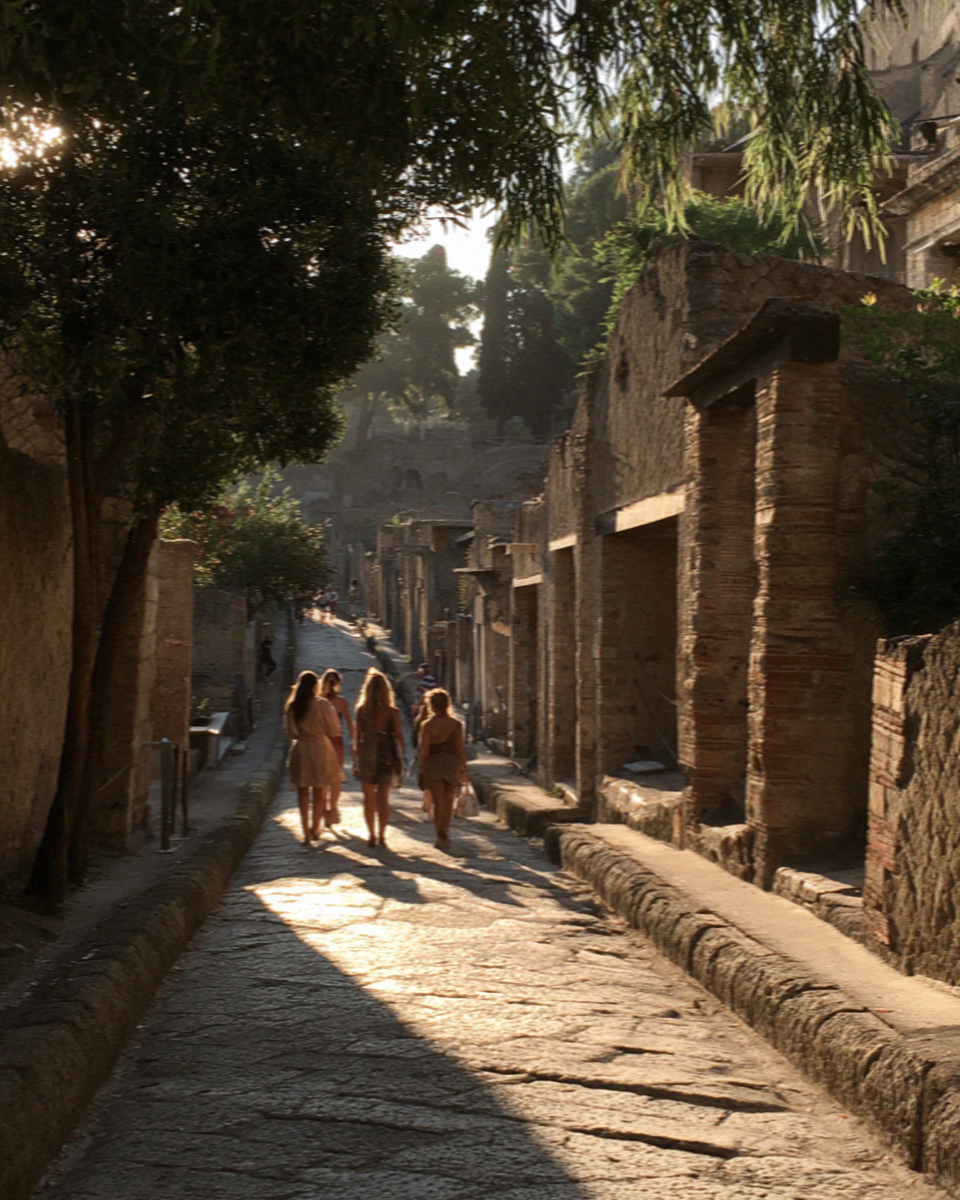
Shade exists here, which after Pompeii feels like a luxury. Surviving upper floors, narrow lanes and modern roofing over the fragile rooms mean you are not permanently in the sun.
When to go
Early or late, as everywhere in Campania in summer, but the pressure is far lower than at Pompeii. A weekday morning in spring or autumn can give you streets with nobody in them.
If you are combining with Vesuvius, Herculaneum is the better base for it. The shuttle up the mountain leaves from Ercolano Scavi station, the same one you arrived at, and the pairing makes a genuinely unhurried day rather than a route march.
A note on how to be here
The boat sheds are a war grave in everything but name.
There is no rope keeping you at a distance and no attendant telling you how to behave. People take photographs. I did not, and I would gently suggest you consider not doing so either, but I am not going to pretend there is a rule about it.
What I would say is this: everyone at Pompeii knows the casts are coming, because the casts are famous. Almost nobody arrives at Herculaneum knowing about the arches. It lands differently for being unexpected, and if you are travelling with children it is worth deciding in advance whether you walk that stretch of shoreline at all.
Frequently Asked Questions
Is Herculaneum worth visiting if I have already seen Pompeii?
Yes, and arguably it is better second. Herculaneum shows you what Pompeii cannot: upper floors, wooden beams, furniture, shop fittings, whole rooms rather than outlines. Having Pompeii’s scale in your head first makes the detail here land harder.
How long do you need at Herculaneum?
Two to three hours covers it thoroughly. Only about four and a half hectares of Herculaneum have been excavated, against roughly forty-four at Pompeii, so it is genuinely walkable at a relaxed pace without missing anything.
How do you get to Herculaneum from Naples?
Take the Circumvesuviana from Napoli Centrale towards Sorrento and get off at Ercolano Scavi, about twenty minutes. From the station walk ten minutes downhill through the modern town to the entrance.
How much does Herculaneum cost?
Around sixteen euros for adults, under-eighteens free, and free for everyone on the first Sunday of the month. Herculaneum is a separate archaeological park from Pompeii and there is no official combined ticket between the two, so budget for both entries independently.
Are there really skeletons at Herculaneum?
Yes. Several hundred people sheltered in the arched boat chambers along the ancient shoreline and died there. Their skeletons remain in place, unlike Pompeii where what you see are plaster casts of voids left in the ash. It is unexpected and it is confronting, and it is worth knowing before you walk down there.
Read also: Pompeii or Herculaneum: Which Should You Visit? | Climbing Vesuvius, and How to Combine It With Pompeii | The Ancient Ruins of Pompeii: Everything You Need to Know