Some links in this guide are affiliate links. If you book through one, this site may earn a small commission, at no extra cost to you. How this works.
Ostuni is not a town with a checklist, and if you arrive determined to tick off monuments you will be finished by lunchtime and faintly disappointed. What it has instead is a whitewashed old town on a hill that is a genuine pleasure to be inside, a cathedral with an exceptional rose window, an olive landscape that most visitors drive straight through, and a coast ten minutes down the road.
Here is what is actually worth your time, roughly in the order I would do it.
What to book before you come
Ostuni is a white town on a hill and the town itself is free, all of it. What is worth booking is the plain underneath it, which is where the olives are and where almost nobody who comes here actually goes.
- An olive oil tasting on the plain. An hour, and it changes how you read the landscape for the rest of your stay. These are some of the oldest cultivated trees in Europe and the groves are in the middle of a slow catastrophe that nobody mentions in the brochures. Taste the oil while the trees are still making it.
- Alberobello and Locorotondo in a day, with brunch. Rated 4.9. The Valle d Itria is the reason to base yourself here rather than on the coast, and doing it without a car means somebody else drives the white roads.
- An organic wine tasting with food. Two hours, in the evening, when the town is too hot to walk anyway.
The whitewashed lanes, the cathedral, the walls and the view out over the olives to the sea all cost nothing at all.
The old town on foot
This is the main event and it is free.
The historic centre is built as a defensive spiral, lanes curling around the hill with staircases cutting between them and arches thrown across the gaps where two houses lean together. There are no straight streets because there was never any use for one. The result is a place you cannot really navigate, only wander, which is exactly why an hour of aimless walking here beats any route I could hand you.
Everything is lime-washed. Thickly, repeatedly, for centuries, until the corners have gone soft and rounded with the weight of it. In shade the walls are cool blue-white and at midday they are hard to look at directly. The shadows come out sharp and faintly blue. Walk it early or late and it is one of the more beautiful hours you will spend in Puglia.
Look for the gaps. Because the town is stacked on a hill above a plain, the wall on one side will simply stop every so often and give you the entire olive country and a line of Adriatic behind it. It happens constantly and it is the thing I remember most.
The cathedral and its rose window
The Concattedrale di Santa Maria Assunta was rebuilt in Gothic style between 1469 and 1495, and its facade is an unusual three-way hybrid: Gothic bones with Romanesque and Byzantine detailing, worked in pale weathered limestone that stands out sharply against the whitewash surrounding it.
The reason to make the walk is the rose window. It is one of the largest in Italy, with twenty-four finely carved rays radiating from the centre, and the stone tracery repays standing still in front of it for a few minutes rather than photographing it and moving on. Late afternoon, when the light comes in at an angle and rakes across the carving, is the best time to see the depth of it.
Visitors report that entry is free. I could not verify current opening hours, so do not build your day around getting inside.
The column of Sant’Oronzo
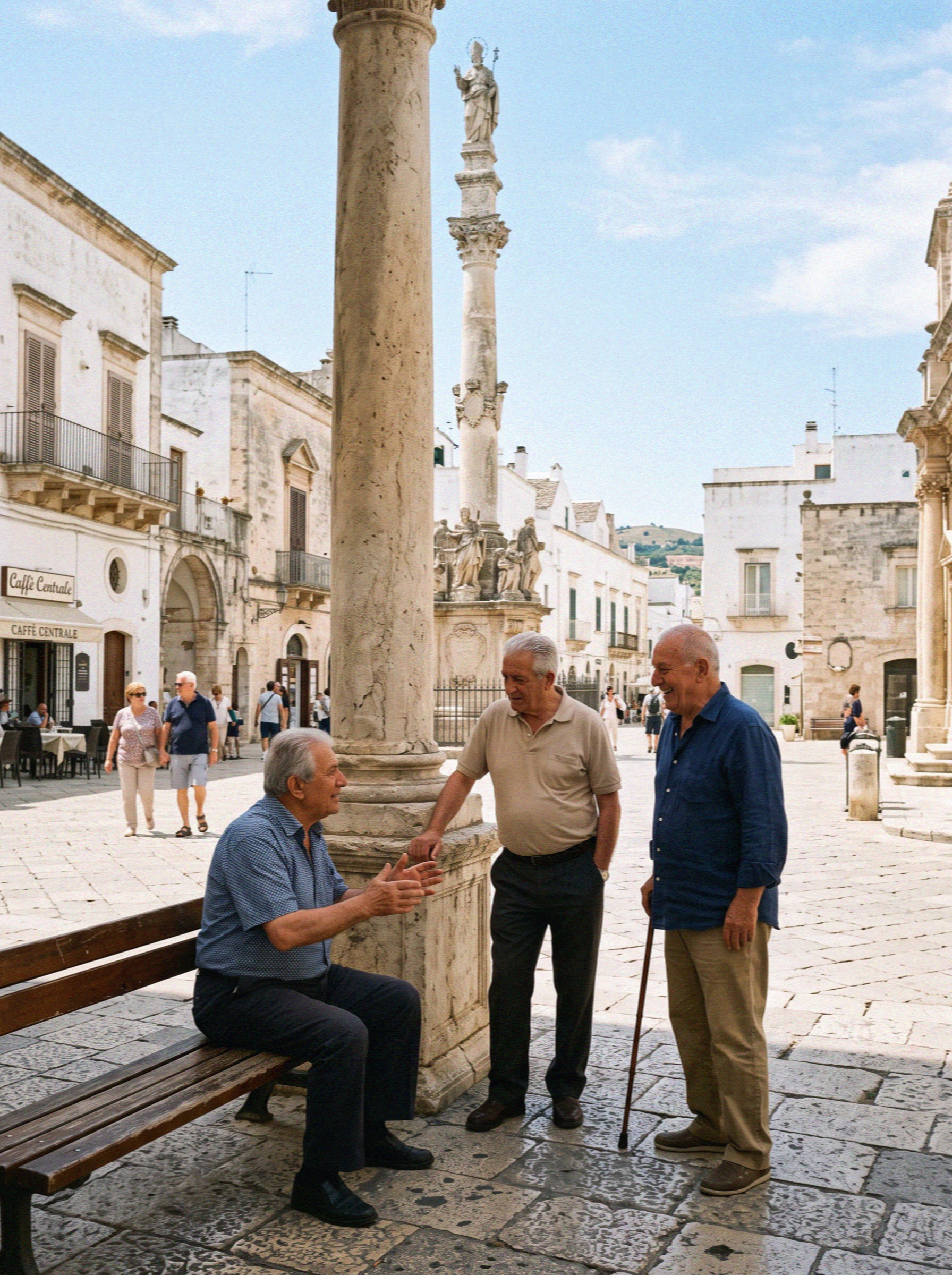
On the square below the old town stands about twenty metres of carved stone column topped by the saint. Sant’Oronzo is credited with carrying Ostuni through the plague in the eighteenth century, and the column is the town’s thank you.
It is also the most useful landmark in Ostuni. When the spiral of the old town has thoroughly lost you, walk downhill until you find the column and you will know exactly where you are.
The gates and the walls
Ostuni kept its Aragonese walls and two of its old gates, Porta Nova and Porta San Demetrio. Walking out through either one delivers the small reliable pleasure of a walled town: the noise drops as you pass under the stone, and then the view opens.
The walk along the outside of the walls, where the ground falls away toward the plain, is worth doing at least once and is best in the last hour of light.
The Diocesan Museum
The Palazzo Vescovile houses the Diocesan Museum, whose collection includes fourteenth century frescoes. It is a small museum and it will not take long. In the middle of a hot afternoon, a cool interior with something worth looking at in it is worth more than it would be in a temperate climate.
Get out into the olive groves
Most people treat the plain below Ostuni as the thing they drive across on the way to the beach. It is the more interesting landscape.
The olive trees here are ancient, and I do not mean a few decades. Many were producing oil centuries ago. They are enormous, hollow, split and rewelded, propped and pruned into shapes closer to sculpture than agriculture, and they run in silver-green rows across red earth between dry stone walls from the foot of the hill all the way to the sea.
Buy oil while you are here, and buy it from an estate or a proper alimentari rather than a souvenir shop in the centre. It is green and peppery with a bitter catch at the back of the throat, and it will spoil supermarket oil for you.
Go down to the sea
Ostuni is not on the coast, which surprises a great many people who booked it expecting to walk to a beach. The town sits seven to eight kilometres inland on its hill.
That said, the coast below is very good, and in summer it is where you should spend the hot middle of the day. Pilone, about six kilometres out, is the dune beach. Costa Merlata is the jagged rocky one with small clear coves. Torre Guaceto, roughly twenty minutes up the coast, is a protected marine reserve and the wild option.
Walk to the viewpoint
The photograph everybody wants of Ostuni is the one taken from outside it, looking back at the whole white mass of the town on its hill. It is about a ten to fifteen minute walk from the centre, and remarkably few visitors bother.
Go at the end of the day. The low sun turns the whitewash faintly gold and then pink, and the town looks exactly as improbable as it should.
Stay for the evening
The single best thing to do in Ostuni is not a thing at all. From about seven the day visitors leave, the town cools, the lamps come on in the lanes, and everybody who lives here comes out into the squares. Find a terrace at the edge of the walls with the plain going dark below it, eat late, and walk the lit lanes afterwards.
If you do only one thing from this list, do that one.
Frequently Asked Questions
What is Ostuni famous for?
Being white. The entire old town is lime-washed, stacked on a hill above an olive plain, and visible from a long way off, which is why it is called La Citta Bianca, the white city. It is also known for the surrounding olive country and its very old trees, and as a base for the Valle d’Itria.
How long do you need to see Ostuni?
The old town takes a couple of unhurried hours on foot. A full day covers the town, the cathedral and a proper lunch. Two days lets you add the coast or the Valle d’Itria without rushing either.
Is the cathedral in Ostuni free to visit?
Visitor reports say admission is free. I was not able to confirm current opening hours for 2026, so check locally on the day rather than planning around a specific time.
Are there beaches in Ostuni itself?
No. The town is on a hill roughly seven to eight kilometres inland and there is no beach within walking distance. The coast is a short drive or bus ride away, with dune beaches at Pilone and Rosa Marina, rocky coves at Costa Merlata and a protected reserve at Torre Guaceto.
What is the best free thing to do in Ostuni?
Walk the old town without a map for an hour, early in the morning or after seven in the evening. It costs nothing, it is the reason the town is worth visiting, and the two ends of the day are when the lanes are cool, empty and properly lit.
Read also: an Ostuni itinerary, the best photo spots in Ostuni, and the complete guide to Ostuni.