Ostuni is small enough to see in a day and good enough to deserve two, and the difference between the two versions is almost entirely about what time you are in the old town.
The town has a rhythm. It is empty and cool and blue-shadowed at seven in the morning, uncomfortably full and uncomfortably hot between about eleven and five, and then it empties again and becomes the best version of itself after seven in the evening. Any itinerary that ignores that gives you the worst hours and none of the good ones.
Here is how I would actually spend the time.
If you only have one day
Come early or stay the night. A day trip that arrives at eleven and leaves at four sees Ostuni at precisely its worst, and a lot of people go home thinking it is a pretty but slightly overrated white town because that is the only Ostuni they met.
Before nine. Get into the old town while it is still cool. The lanes are stone and steep and they hold the night air for a couple of hours, and the light comes in low and sideways so the whitewash is not yet blinding. Do not navigate. Pick an alley going uphill and follow it, take the staircases when you find them, and let the town spiral you toward the top. You will pass through arches thrown between houses, past blue doors and pots of geraniums, and every so often the wall will drop away and hand you the whole olive plain with a strip of Adriatic behind it.
Mid-morning: the cathedral
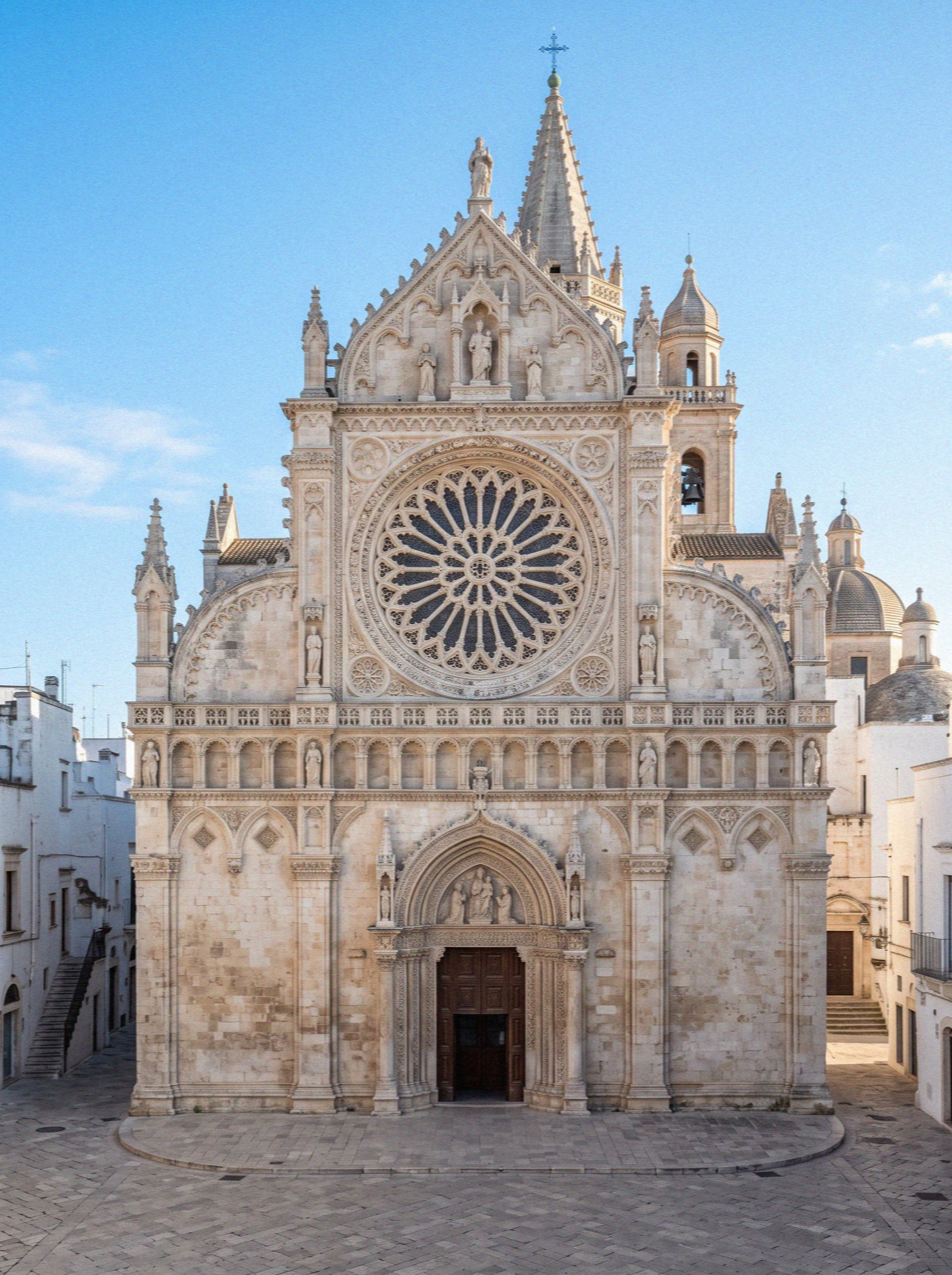
Work your way to the cathedral. The Concattedrale di Santa Maria Assunta was rebuilt in Gothic style between 1469 and 1495 and the facade is a proper hybrid, Gothic structure with Romanesque and Byzantine detail, in pale limestone that reads almost yellow against all that white. The thing to look at is the rose window, one of the largest in Italy, with twenty-four carved rays. Stand back across the little square to take it in whole.
Reports are that admission is free, but I could not confirm current opening hours, so treat going inside as a bonus rather than a fixture of your morning.
Late morning. Down to the Colonna di Sant’Oronzo on the square below, twenty metres of carved stone thanking the saint who is credited with bringing the town through the eighteenth century plague. Then out through one of the surviving Aragonese gates, Porta Nova or Porta San Demetrio, and along the edge of the walls where the ground falls away.
Lunch, then the hot hours. Eat somewhere with shade at about one. Then do what everybody who lives here does between two and five, which is as little as possible. If you have a car, this is the moment to drive down to the coast for a swim. If you do not, find a cool church, a long lunch or a shuttered room and wait it out. Fighting the middle of a Puglian afternoon in August is a losing position.
Evening: dinner with the view
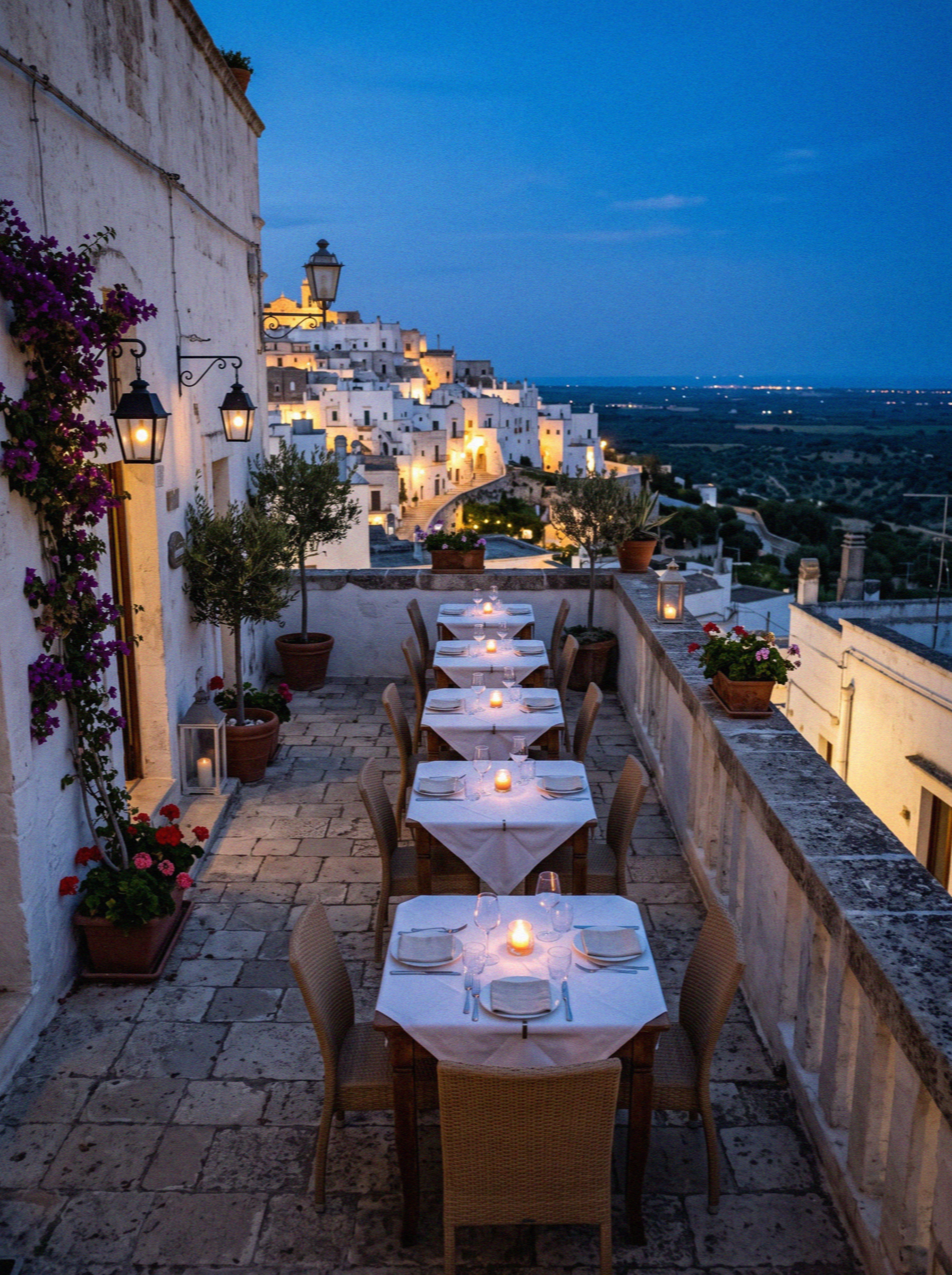
This is the part worth staying for. From about seven the day visitors thin out, the light goes long and gold across the plain, and the white walls take the colour and turn faintly pink and then blue. Get a table on a terrace at the edge of the old town where the ground drops away, so you are eating with the whole plain going dark beneath you and the lights of the coast coming on in a line at the bottom of it.
Eat late. Nothing serious happens in a Puglian dining room before half past eight.
Late: the town after dark

Walk the lanes again afterwards. It is a completely different town under lamplight: the whitewash goes warm instead of blinding, the alleys feel intimate rather than steep, and the people out in them mostly live here. This is the hour that makes the case for Ostuni, and a day tripper never sees it.
If you have two days
The second day is where the region opens up, and you have a real choice to make: the sea, or the Valle d’Itria. Both are good. Trying to do both in one day is how you end up doing neither properly.
Option one: the coast. The beaches are seven to eight kilometres down the hill and they are better than most people expect. Pilone, about six kilometres out, is the dune beach with pale sand and shallow clear water. Costa Merlata is the rocky one, a jagged indented coast of small coves. Torre Guaceto, roughly twenty minutes up the coast, is a protected marine reserve and the wildest of them, with dunes, scrub and an old watchtower instead of beach clubs. Go early, take water shoes for the rocky ones, and come back up the hill for the evening.
Option two: the Valle d’Itria. The white towns inland are close together and easily combined. Alberobello with its trulli, the conical dry-stone houses, is about forty-three kilometres and roughly forty-five minutes by car. From there Locorotondo is nine kilometres and Martina Franca another six, and Cisternino closes the loop back to Ostuni, about thirty-two kilometres and forty minutes. Nothing on that circuit is more than twenty or thirty minutes from the next thing, so two or three towns in a day is relaxed rather than rushed.
A third option, if the sea appeals but you want a town with it: drive up to Polignano a Mare, a cliff town built over sea caves with a pebble cove wedged in a ravine at its centre. It is a very different animal to Ostuni and the pair make a satisfying contrast.
If you have three
Do both of the above and give the third day back to Ostuni itself. Buy oil from an estate rather than a souvenir shop. Walk out to the viewpoint that looks back at the town from across the valley, which is the shot everyone wants and almost nobody bothers to walk to. Have a very long lunch. The town rewards a slow day more than it rewards a thorough one.
What I would skip
Trying to see the old town in the middle of the day in July or August. Driving into the centre, which is a limited traffic zone with fines in the 80 to 100 euro range. And building a tight schedule around the shuttle bus back down to the station, which does not reliably keep to its posted times.
Frequently Asked Questions
Is one day enough for Ostuni?
One day is enough to see it, provided that day includes either the early morning or the evening. A midday-only visit gives you the hottest, fullest and least appealing version of the town. If you can only come for a day, arrive before nine or stay until after eight.
What is the best order to see Ostuni in?
Old town first thing while it is cool and empty, cathedral and square mid-morning, a long lunch, then either the coast or a rest through the hot hours, then dinner on a terrace at the edge of the walls and a walk through the lit lanes afterwards. The town is small, so the order matters more than the distance.
Can you do Ostuni and Alberobello in one day?
Yes. Alberobello is about forty-five minutes by car and the Valle d’Itria towns beyond it are close together. A comfortable day is Ostuni in the morning, then Alberobello, Locorotondo or Martina Franca in the afternoon. What does not work is trying to add the coast to the same day.
Do you need a car in Ostuni?
Not for the town itself, which is walkable and closed to traffic anyway. You need one for the beaches and for the Valle d’Itria. Without a car you can still reach Ostuni by train and shuttle bus and enjoy the old town completely, but the second day becomes harder to fill.
Is Ostuni better in the morning or the evening?
The evening, narrowly. The morning gives you empty lanes and good light for photographs. The evening gives you the town as a living place, with the local passeggiata, the terraces full and the whitewash warm under lamplight. If you have to pick one, stay for the evening.
Read also: the best things to do in Ostuni, the best beaches near Ostuni, and the complete guide to Ostuni.