The usual way to explain a city like this is to reach for patrons and architects and a century of ambition. Lecce has all of that, and none of it is the real answer. The real answer is under your hand when you touch a wall.
The city is built almost entirely from pietra leccese, the local limestone, and pietra leccese is soft. Freshly quarried it can be worked almost like wood, cut and undercut and hollowed out with tools a joiner would recognise, and then it hardens as it sits in the air. That is the whole thing. Carvers here could do in stone what carvers elsewhere could only do in plaster or paint, and they could do it quickly, so they did it everywhere: on churches, on ordinary palazzo balconies, on doorways of houses nobody has written a book about.
Once you know that, the city stops being overwhelming and becomes readable. You are not looking at taste. You are looking at what a material allows. The wider practicalities are in my complete guide to Lecce; this piece is the narrower one, what to look at, what it costs, when the doors are open, and what you are allowed to wear through them.
Why the stone made it possible
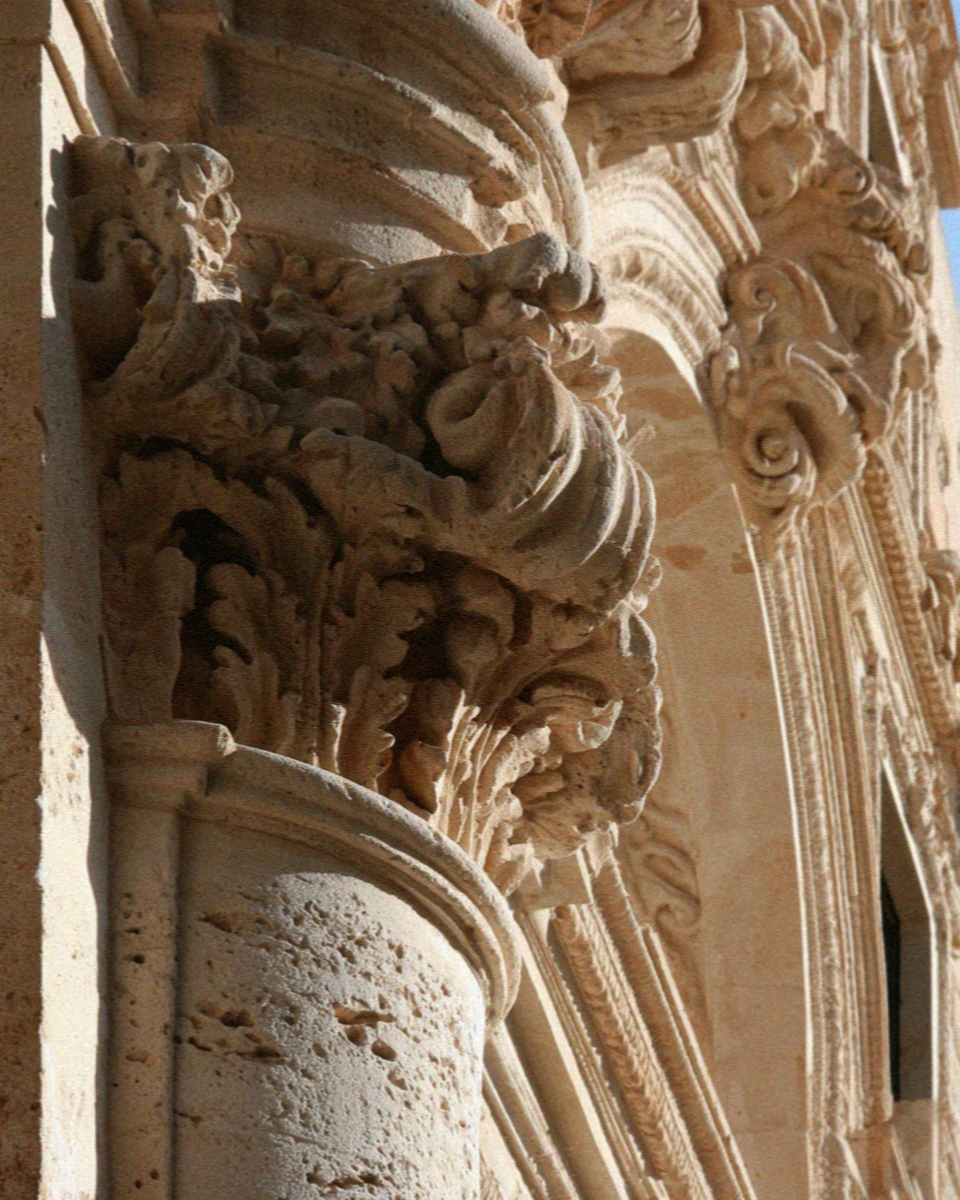
Stand close to any carved surface and look at the shadows rather than the shapes. In harder stone a carver works in relief, and the ornament stays close to the wall because going deeper risks the whole piece. Here the foliage lifts clear of the background, the scrollwork curls back on itself, the faces sit in genuine hollows, and in places you can see daylight behind a carved stem. That undercutting is the local signature, and it is a direct consequence of a soft, even-grained stone.
The same softness is why the city keeps needing repair. Pietra leccese hardens, but it stays porous, and salt air and rain work at it. Some facades have been cleaned to a pale biscuit colour, some are grey and eaten at the edges, and on many buildings you can pick out the newer replacement blocks because they have not yet weathered to match. That is the trade the city made.
Notice too how far the carving travels beyond the famous buildings. The churches get the attention, but the balconies do the real work: brackets shaped into lions, horses, angels and grimacing faces, set at first-floor height along lanes that are otherwise plain. You will walk under a hundred of them. Look up more than feels natural.
The great facade
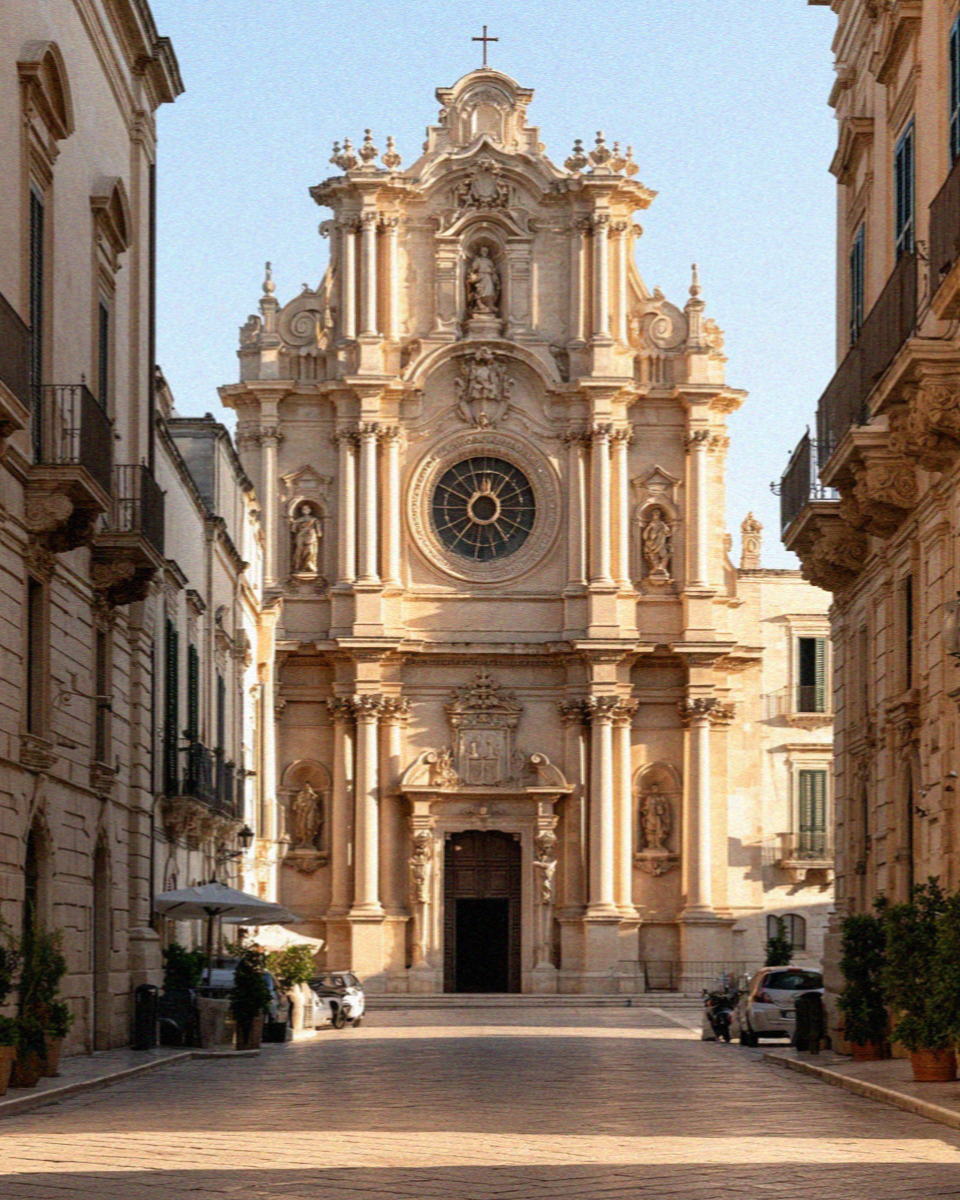
The Basilica di Santa Croce is the one everybody comes for, and unusually, it deserves it. It was begun in 1549 and finished in 1646, so roughly a century of work sits on that front, and the change in taste across those decades is visible if you scan it from the ground up. The lower order is the crowded part: carved animals, grotesques, figures and foliage packed together at the level where people actually see them. Above that comes the great rose window, and above that the composition calms down.
Give it more time than a photograph needs. The detail does not read from across the street or from a phone screen. It reads from about ten metres away, standing still, working across one horizontal band at a time. Late afternoon is kindest, because the light comes in at an angle and the undercutting throws proper shadows; at noon the front flattens and much of the carving disappears into glare.
Beside the basilica is the Palazzo dei Celestini, a former convent in the same idiom but far quieter, worth a minute for the comparison alone. Directly behind both, the Giardini Pubblici Giuseppe Garibaldi, founded in 1830, gives you pines, pavilions, fountains and real shade. On a hot day, plan the basilica and the garden as one stop rather than two.
The rest of what to see
The Duomo sits in a square that has, in effect, one entrance. You come in through a gap between buildings and the space closes behind you, which is why Piazza del Duomo feels like a room rather than a junction, and why it is so much quieter than its size suggests. The campanile is open to visitors, by lift rather than on foot, and on a clear day the view reaches the Adriatic across the flat Salento. It is not covered by the standard combined ticket described below, so it is either its own ticket or the more expensive version of the combined one.
Santa Chiara and San Matteo are the other two churches worth the detour, both small, both on the combined ticket, and San Matteo is the odd one, with a curved front that behaves quite differently from everything around it. The Antico Seminario on Piazza del Duomo gives you a cloister, the chapel of San Gregorio Taumaturgo and the Museo di Arte Sacra, and it holds the main ticket office, which makes it a sensible first stop.
For contrast, walk to the sunken Roman arena in the main square, below street level in the middle of everything and older than all of this by a long way. The Castello di Carlo V, sixteenth century and the largest castle in Puglia, holds the papier-mache museum. Neither needs a day built around it, and both are minutes from where you already are.
The combined ticket, and how to use it
One ticket, called LeccEcclesiae, covers the Duomo and its crypt, the Basilica di Santa Croce, Santa Chiara, San Matteo, the Antico Seminario and the Museo di Arte Sacra. It costs 11 euros full, 5 euros reduced for ages 12 to 17, and 24 euros for a family of two adults with children. There is a dearer version, at 21 euros full, that adds the bell tower.
Buy it at Piazza del Duomo 5 (the Antico Seminario), at Santa Croce, at San Matteo, or online; the offices take cash or card. It is valid for fifteen days with one entry per site, and you do not have to use it in a single push. That matters more than it sounds: take two churches before the heat arrives, stop, and come back for the rest in the evening.
Hours are 9am to 9pm from April to September and 9am to 6pm from October to March, every day, with last admission a quarter of an hour before closing. The long summer evening is a genuine gift here and most visitors waste it. Note that visits are suspended during services and for the fifteen minutes before one begins, so if a door is shut at an odd moment, that is usually why.
If you see 9 euros quoted somewhere, it is out of date. Plenty of guides are still running the old price.
What you are expected to wear
The dress code is written down and it is enforced, so treat it as a planning fact rather than a courtesy: no sleeveless tops, nothing low cut, no shorts, no mini-skirts, no hats. In July and August that is a real constraint when the temperature is in the low thirties, and being turned back at the door of Santa Croce is a miserable way to learn it. I carry a light linen shirt and a long skirt in a bag and change nothing else about how I dress for the heat. Take the hat off at the threshold.
Paper, not stone
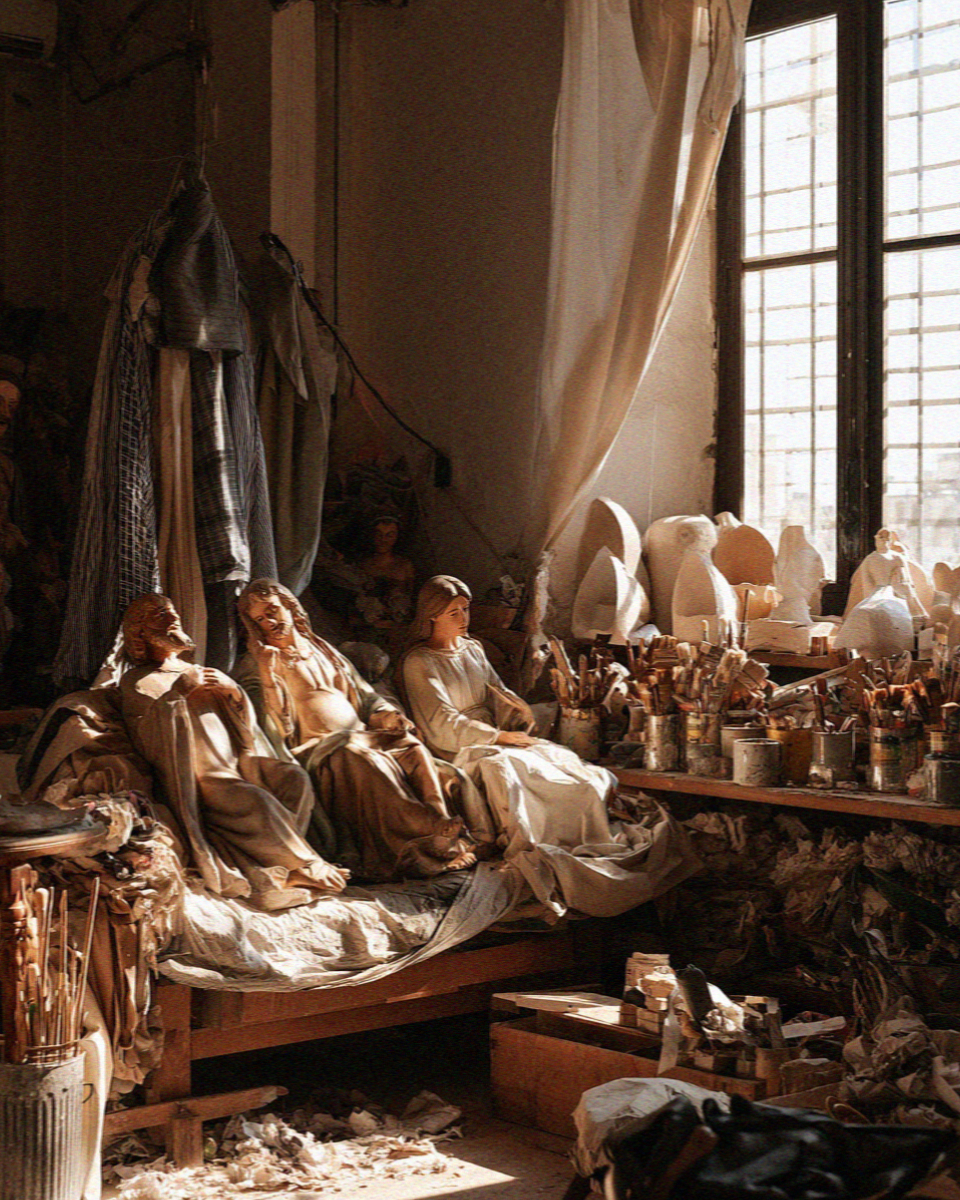
Cartapesta, papier-mache, belongs in this story rather than beside it. Lecce has made it since the 1700s, and the origin is wonderfully mundane: barbers took it up first, because they had the hands for fine work and a supply of waste paper, and slack hours to fill between customers.
It solved the same problem the stone did, from the other direction. Church statuary in stone is heavy and slow. A processional figure in paper and paste, built over a frame and then painted, is light enough to be carried through the streets and cheap enough that a small parish could commission one. Where the limestone let carvers go deep, cartapesta let them go big. The churches you are walking through are full of both, and the pale saint on the side altar is quite often not stone at all.
Workshops still trade in and around the centro storico. Marco Epicochi works on Piazza del Duomo, and Rosaria Pallara has been in a courtyard of a sixteenth-century building a few steps from the cathedral since the early nineties. Some run visitor sessions where you make a piece yourself, which is a good thing to have booked for the flattest part of a hot afternoon. The Museo della Cartapesta, in the old stables of the Castello Carlo V, covers the same ground at a walking pace; the castle opens Wednesday to Sunday and the museum is seen on the guided tour.
Frequently Asked Questions
How long do you need for the baroque of Lecce?
A focused half day covers Santa Croce, the Duomo square and two of the smaller churches on the ticket. A full day adds the campanile, the Museo di Arte Sacra and a cartapesta workshop, with room to stop for two hours when the sun is at its worst.
Is the combined church ticket worth buying?
Yes, if you intend to enter more than one church. At 11 euros for six sites it pays for itself almost immediately, and the fifteen-day validity lets you split the visits across mornings and evenings rather than marching through them in one go.
Can you go inside the churches in shorts?
No. The dress code bans shorts, mini-skirts, sleeveless and low-cut tops and hats, and it is applied at the door. Bring something with sleeves and something that covers the knee, carry it rather than wear it, and put it on before you go in.
When is the best light for looking at the carved facades?
Late afternoon and early evening. The carving is deeply undercut, so it needs raking light from the side to show at all, and at midday the sun comes from overhead and the detail flattens into brightness. From April to September the churches stay open until 9pm, which puts the best hours well within the ticket.
What is cartapesta and where can you see it?
Cartapesta is Lecce’s papier-mache tradition, made since the 1700s and used for church statues where stone was too heavy. You will see it inside the churches on the combined ticket, in the workshops of the centro storico, and in the Museo della Cartapesta inside the Castello Carlo V.
Once the churches are straight in your head the rest of the city arranges itself around them, and the practical layer sits in my complete guide to Lecce. For the order I would actually walk it in, with the amphitheatre and the museums slotted in, see the best things to do in Lecce, and for these facades in the right light rather than merely in the frame, the best photo spots in Lecce has the timings.