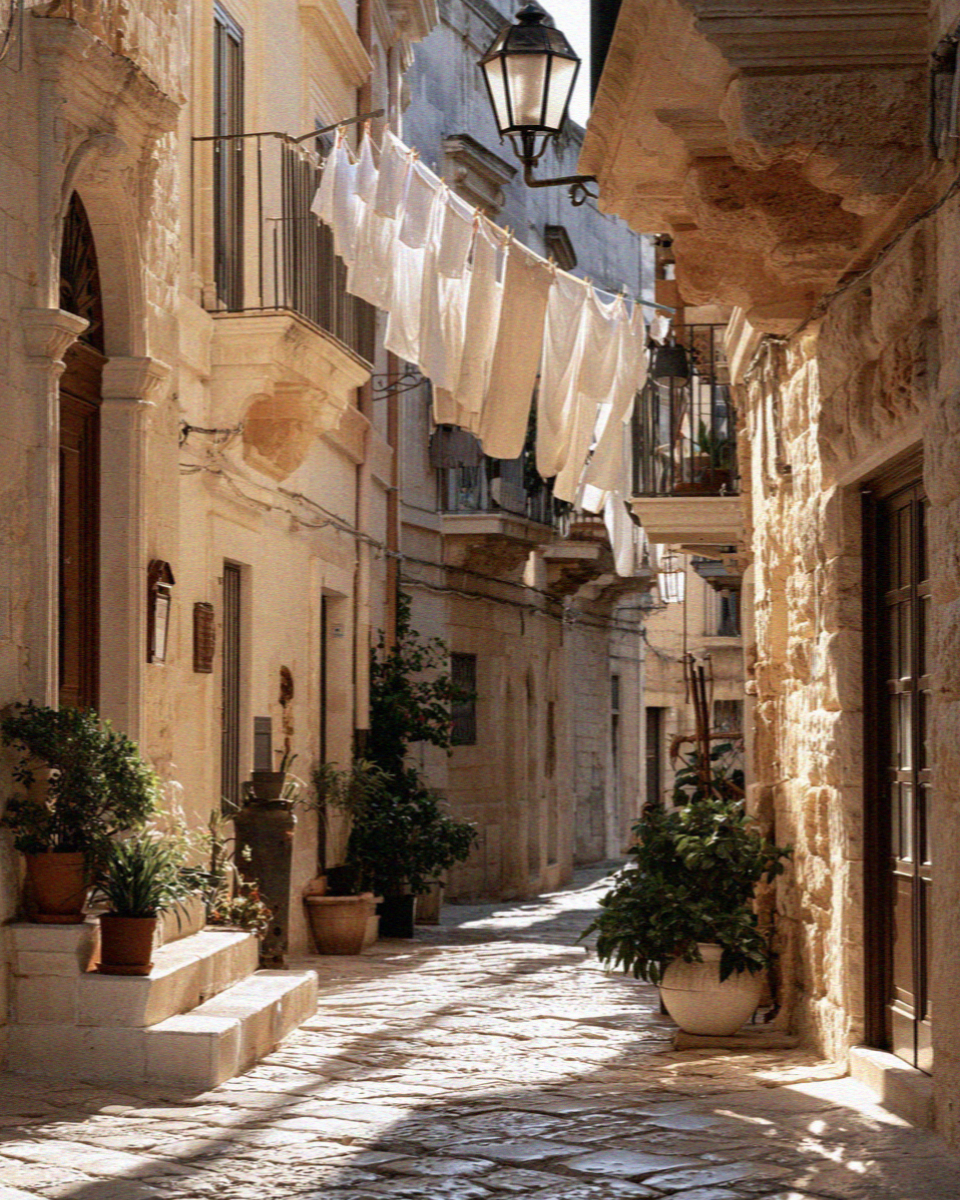
Most guides to photographing Lecce hand you a list of addresses. The addresses are not the difficult part. The old town is small, the best facades sit within a few streets of one another, and you will walk into them whether you plan to or not. What nobody tells you is that the same facade is worth nothing at one in the afternoon and worth the trip at seven in the evening.
The reason is the stone. Pietra leccese, the local limestone the whole old town came out of, is soft when quarried and only hardens later in the open air, which let the masons here cut far further into a wall than masons elsewhere could. The carving is undercut so deeply that leaves and lions and faces stand clear of the surface behind them. Deep carving is made of shadow. Take the shadow away and you take the carving with it.
That is what midday does. With the sun almost overhead the facades flatten into pale cream surfaces with nothing happening on them, while the lanes below fill with a shade no exposure can hold at the same time as the sky. Come back when the sun is low and running sideways across the same wall, and every undercut edge picks up a line of shadow. So this is a guide to when, organised by where. For how the rest of the days fit around those hours, there is the complete guide to Lecce.
The hours that matter
Three windows, and the rest of the day is the gap between them. First light until around nine, when the old town is empty and the shadows lie long down the lanes. The last hour and a half before sunset, which is the one everything else here is arranged around. And the short blue stretch after the sun has gone, when the floodlights come up on the carved fronts and the sky still has colour in it.
Between them, from roughly eleven until five in summer, there is nothing to be done outdoors, and in July and August, with highs between 31 and 34 degrees, there is nothing to be done outdoors for other reasons either. Late April to June and September into October give you kinder light and a longer usable morning.
The enclosed square
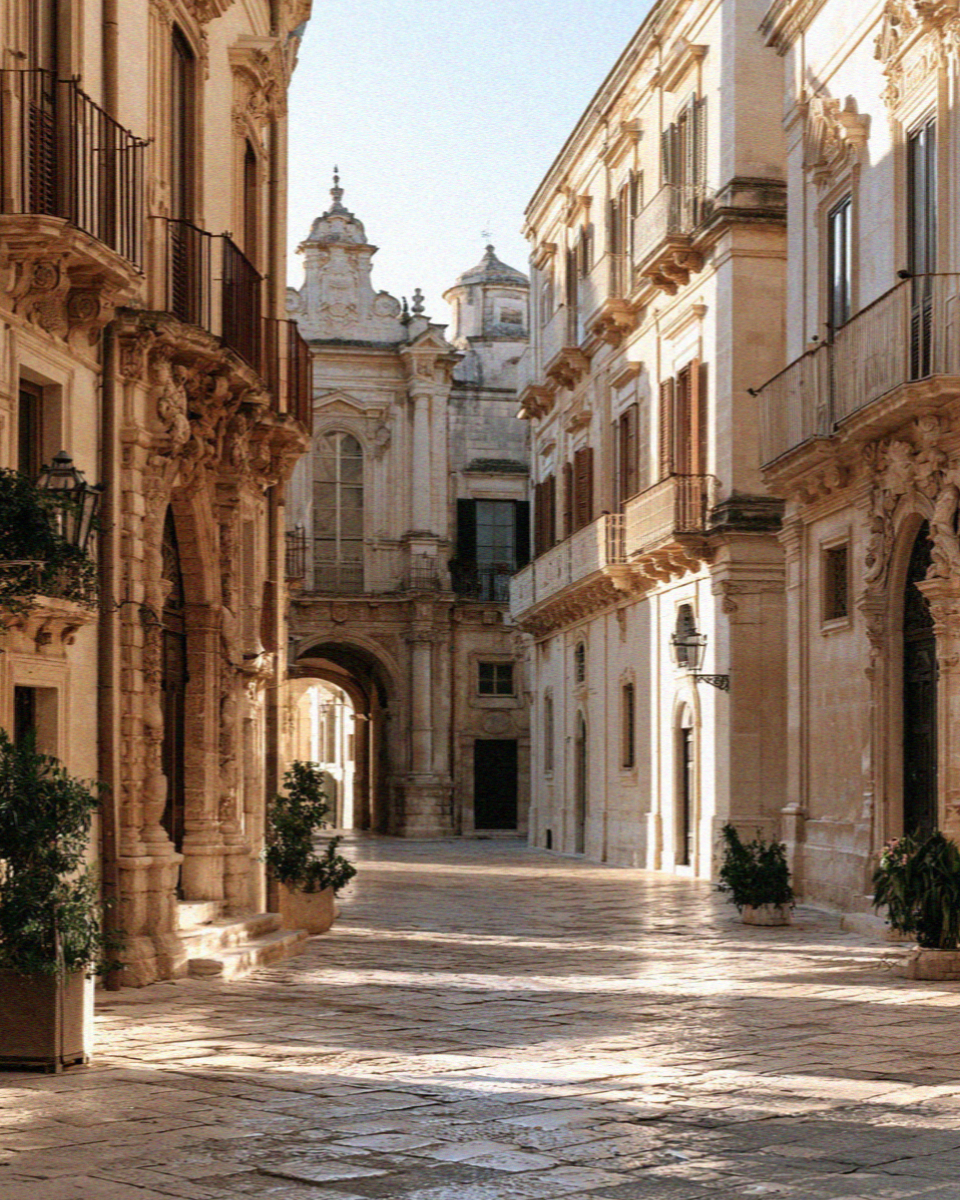
Piazza del Duomo is the one that surprises people. It has effectively one entrance, an arched way in off the street, and once you are through it the square closes behind you. Carved fronts stand on every side: the cathedral, its tall campanile, the Antico Seminario. Because it is walled in, the sun never fills it all at once. A lit edge travels around the sides through the day while everything else waits in shade, so the question is not when to come but which wall you want.
Late in the day is when it pays. In the last half hour the upper storeys catch the low sun and the limestone turns the colour of honey while the paving below has already gone into shadow, and that split is the picture. Early morning gives you something else entirely: cooler, greyer, empty, with the entrance arch as a frame around the far side.
The ticket office for the church circuit is here too, at Piazza del Duomo 5 inside the Antico Seminario, and it is also where the tower ticket is sold, useful if you came for the light and decide to go up.
Look up
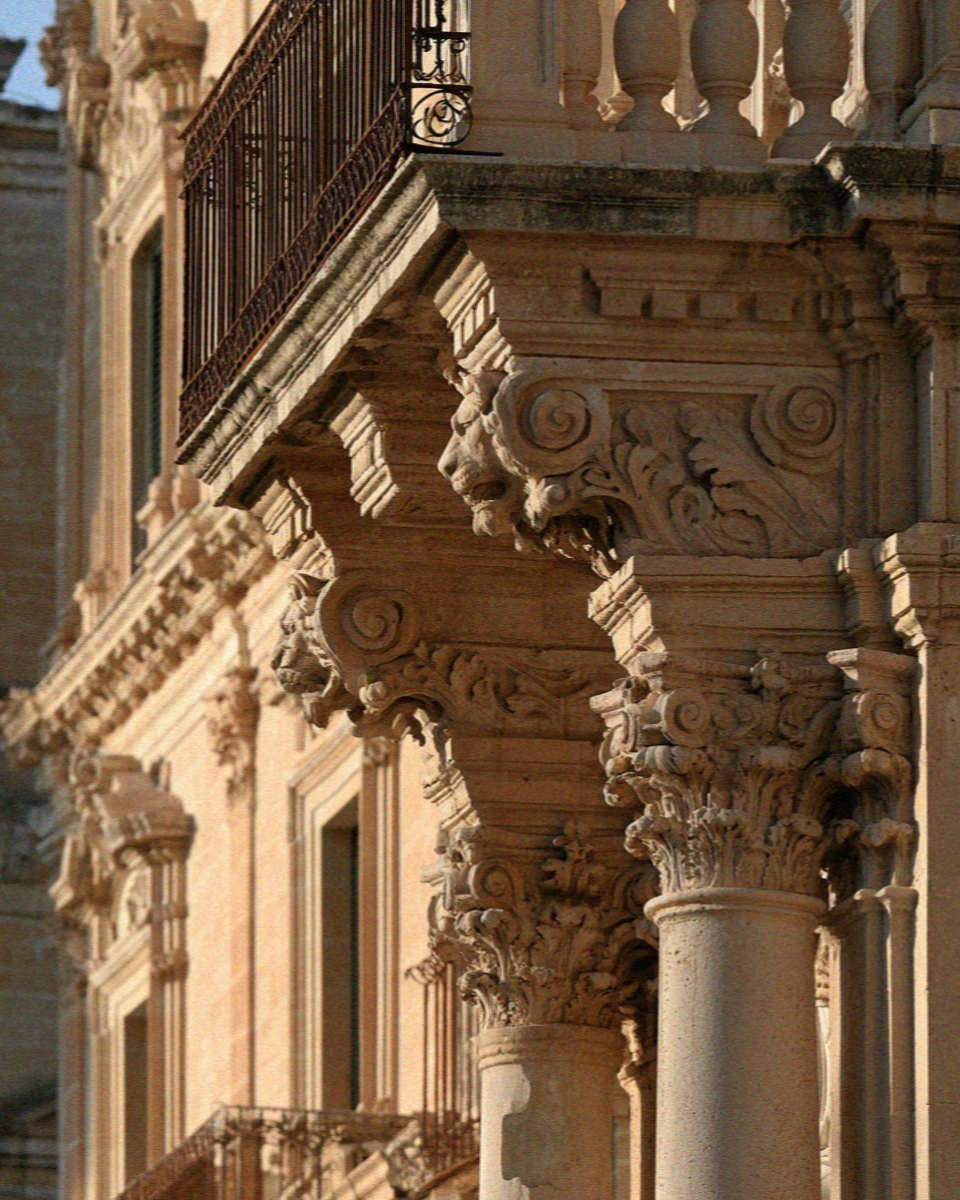
The detail most visitors miss is directly above their heads. Along the lanes the stone balconies are carried on carved corbels: lions, grotesque faces, scrolled foliage, cut deep and set at a height where nobody walking and talking will ever notice them. They are why a second slow lap of the same streets is worth doing.
They are also the strongest argument in the city for raking light. At noon a corbel is a pale lump. In the last hour it is a lion with a face. The same goes for the doorways, the window surrounds and the crowded panels above the arches. If the balcony you want is on a shaded side, take the one opposite instead and come back in the morning, when the sun is on the other side of the sky.
The view from above
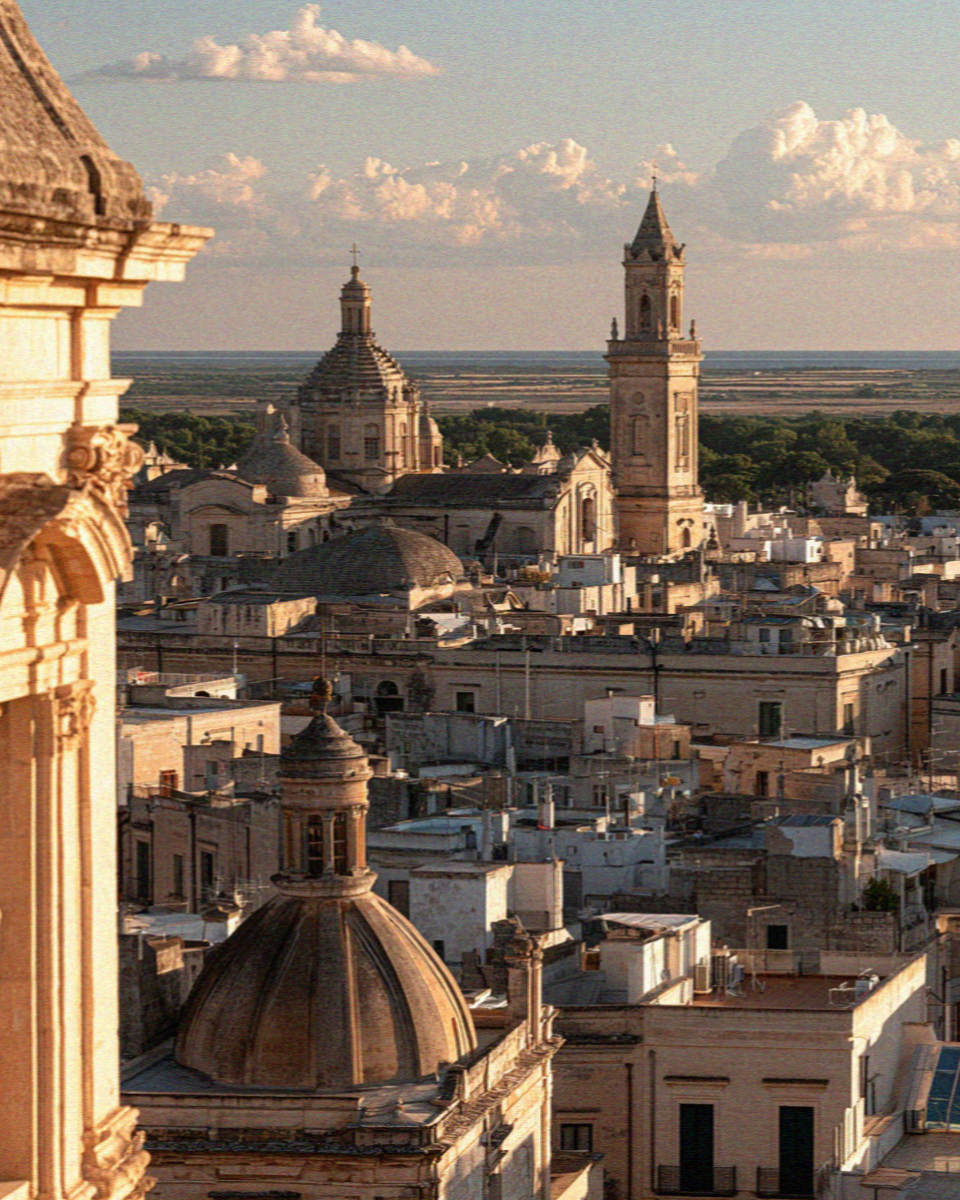
The campanile of the cathedral is open to visitors, and it is the view worth going up for. A lift takes you to the balconies rather than a stair, which is worth knowing if you were putting it off. Lecce sits on a flat plain, so from the top there is nothing between you and the horizon in any direction: warm roofs, terraces, domes and bell towers immediately below, then the Salento running away level to the edge of sight. On a clear day the Adriatic shows.
The tower has its own ticket and is not on the standard combined pass described below, so budget for it separately. From April to September the sites stay open until nine in the evening, last admission fifteen minutes before, so you can be up there for the end of the day. From October to March everything closes at six and the tower shuts before the good light arrives, which pushes you to mid afternoon. At that time of year it is soft enough to work.
Staying inside the walls, a version of the same view comes free from a roof terrace at dusk.
The great facade, and the hour it wants
The Basilica di Santa Croce is the set piece. Begun in 1549 and finished in 1646, its lower order is crowded with carved animals, grotesques, figures and foliage beneath a large rose window. You will not get it to yourself, and you should not settle for the version everyone takes at eleven in the morning.
Watch it across an afternoon and pick your moment as the light comes round. The temptation is to stand back and take the whole front flat on. The better frames are tighter, one band of carving at a time, once the shadows are long enough to lift the figures off the wall. Next door, Palazzo dei Celestini, the former convent, is the same idiom and much quieter, and almost nobody points a lens at it.
The square with an arena in it
Piazza Sant’Oronzo runs on different rules. The Roman amphitheatre sits below street level in the middle of the square, about a third of it uncovered and the rest still under the buildings around it, about a hundred and two metres by eighty-two at full size and put by the ministry that runs it at twelve to fourteen thousand seats, well under the twenty-five thousand most guides repeat. Buried for centuries, dug out from the early 1900s, and still used for performances.
This is the one place in Lecce where hard overhead light helps. You are looking down into a bowl of stone, and a high sun puts a clean shadow under every tier, so the seating reads as seating rather than a grey mass. The square is worth something at exactly the hour the old town has nothing.
Where to go when the light is useless
The middle of a Salento summer day is for shade and interiors. Behind Santa Croce, the Giardini Pubblici Giuseppe Garibaldi, laid out in 1830, has gravel walks, pavilions, fountains and real trees, and the dappled light under them is pleasant to sit in.
Museo Faggiano is the other answer. A family digging to trace a plumbing fault in the early 2000s went down through layer after layer and never stopped, and the house is now a vertical section through Lecce, Messapian at the bottom and everything else stacked above. Entry is 5 euros, open daily 9.30 to 20.00.
A cartapesta workshop is the third. Papier-mâché has been a Lecce craft since the 1700s, taken up first by barbers, who had the hand skills and the waste paper, and used for church statues because it was light and cheap where stone was heavy and slow. The workshops on and around Piazza del Duomo are dim and cluttered and full of half-painted saints, and the window light in them is the softest in the city.
What to wear, and the rule that catches people out
Everything with an interior in this guide runs on the LeccEcclesiae ticket, six sites for 11 euros, less for teenagers and families, with the bell tower sold separately on top. What matters for photography is the fifteen day validity and the single entry at each: the interiors do not have to be done in one afternoon, so you can go up for the last light one day and shoot inside on another.
The clothing rule is the thing that catches people. Bare shoulders, shorts, short skirts and hats are all refused at the door, and on a 33 degree day that is a decision you make in the room rather than on the step.
Frequently Asked Questions
What is the best time of day to photograph Lecce?
The last hour and a half before sunset, without much competition. The carving is cut very deep and only reads in low side light, which flattens away entirely at midday. First light is the other good window, and the blue half hour after sunset works because the floodlights come up while the sky still has colour in it.
Can you climb the bell tower in Lecce, and what can you see?
Yes, the cathedral campanile in Piazza del Duomo, on its own ticket rather than the six-site church pass, and by lift rather than stairs. It runs later than the churches do, to nine at night, which puts the last light of a summer evening comfortably inside it. The city sits on a flat plain, so the view goes uninterrupted over roofs, domes and terraces to the horizon, and on a clear day the Adriatic is visible.
Is Piazza del Duomo really enclosed?
Effectively, yes. One way in, through an arch off the street, and carved fronts on every other side, so no traffic and no passers-by cross it. The light moves around the walls through the day rather than filling the space at once, which is why morning and evening give completely different pictures.
Do I need a ticket for the churches, and is there a dress code?
Yes to both. The LeccEcclesiae pass is 11 euros for an adult, less for teenagers and for families, and it stays live for a fortnight across all six sites. As for the dress code, shoulders and knees have to be covered and hats come off, and it is checked rather than merely posted.
Is summer a bad time to photograph Lecce?
Hard rather than bad. July and August bring highs of 31 to 34 degrees and almost no rain, and the middle of the day is unusable for the facades and unpleasant on foot. The compensation is very long evenings. Late April to June and September into October are easier throughout.
Read also: The Baroque of Lecce on why the stone allows carving this deep and what to look at once you are in front of it, The Best Time to Visit Lecce month by month on heat and crowds, and The Complete Guide to Lecce for the whole city.