Some links in this guide are affiliate links. If you book through one, this site may earn a small commission, at no extra cost to you. How this works.
Nothing on this list needs a car, and nothing needs a booking made weeks ahead. The old town is walkable end to end and most of what you have come for sits within a few streets of the main square, so the constraint is never distance. What it does need is planning around the heat, because in July and August the middle of the day runs to between 31 and 34 degrees and the stone holds it.
So here is what is worth your time, roughly in the order I would do it, with what each costs in money and in hours. The rest of the city is in the complete guide to Lecce, but if you have a day and a half, work down this page.
Fix one thing before you go out: the churches have a rule about clothing and they apply it. Covered shoulders, covered knees, no hat indoors. On a thirty-four degree day that is a real decision about what you put on in the morning.
What to book before you come
Almost everything in Lecce is a facade you can stand in front of for nothing. The exceptions are the parts of the city that are underneath it, and the food, which is the other half of why people come.
- The baroque and the underground, on foot. Ninety minutes above and below ground, and the underground half is the reason to take it. There is a Roman city down there and a great deal of the old town is standing on top of cisterns and crypts you would never find alone. 4.6 from more than fifteen hundred people.
- A pasta class in a fifteenth century courtyard. Orecchiette by hand, which sounds like a cliche until you have watched somebody do four hundred of them in the time it takes you to do nine. Rated 4.7.
- The street food and wine walk. Two hours, and the fastest way to learn what a rustico actually is and where to buy the good one.
The Piazza del Duomo, the Roman amphitheatre in Piazza Sant Oronzo and every church exterior in the city are free to stand in front of for as long as you like.
The Roman amphitheatre
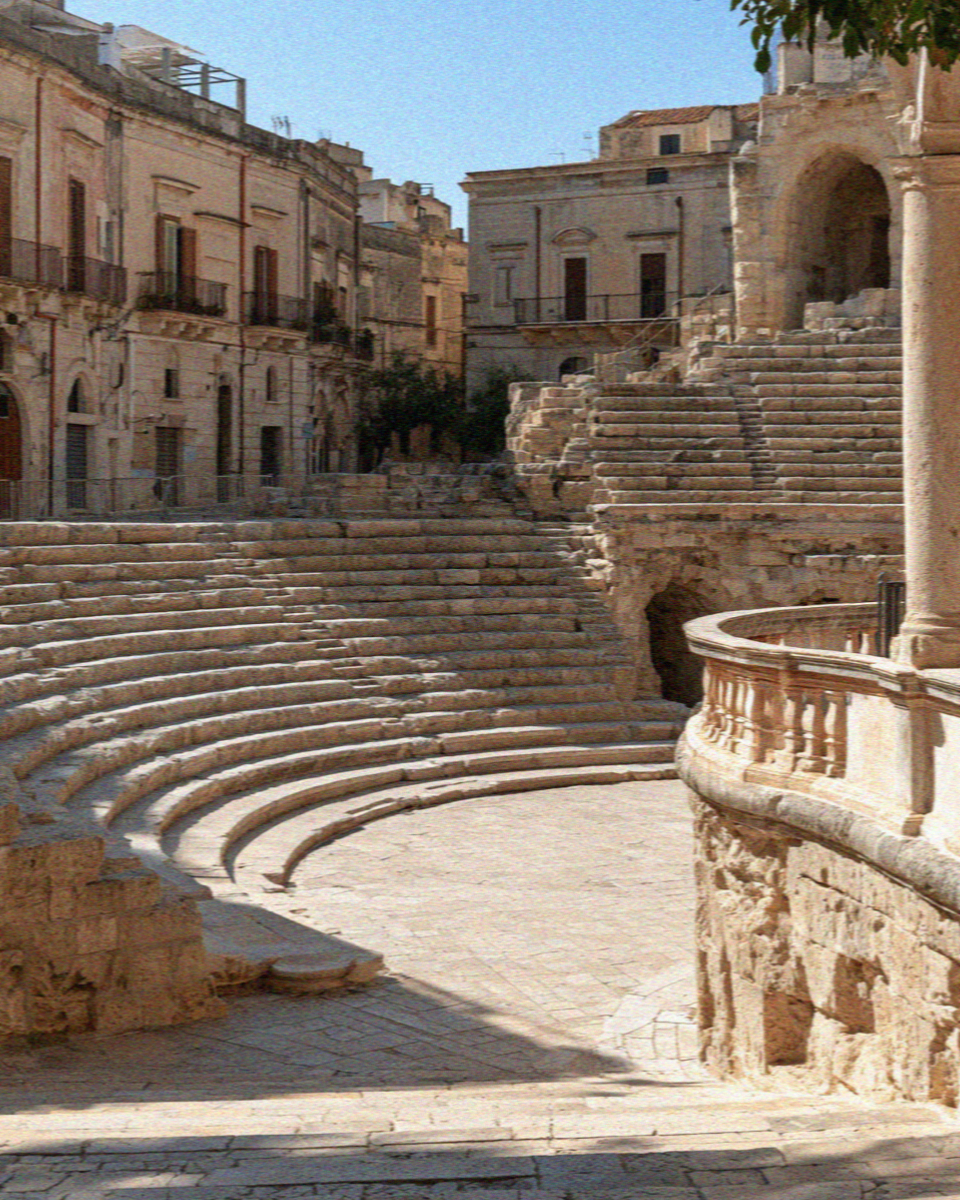
Start here, because you will cross Piazza Sant’Oronzo a dozen times anyway and because it is the thing nobody quite expects. You come around a corner into the main square and the square has a hole in it, and at the bottom of the hole is a Roman arena.
It sits below street level, tiers of worn stone dropping away beneath the modern pavement, with the cafés and shopfronts on the rim looking down. It was buried and forgotten for centuries and only found in the early 1900s, when builders working on the square hit it, which is why the exposure is partial: roughly a third of the structure is uncovered, the rest still under the piazza and the buildings around it. The original measured something like 102 metres by 82, with room for between twelve and fourteen thousand people, which is the figure the ministry that runs it gives. You will see twenty-five thousand quoted in a great many places, including on the spot. It is still used for performances.
It reopened in October 2025 after two years of works, so you can now go down inside it as well as look in from above. Check the hours before you plan around it, because they are narrower than you expect and they move with the season: through the summer it is an afternoon and evening visit rather than a morning one, and it closes on Mondays. Cost in time: ten minutes at the railing, an hour if you go down. Cost in money: nothing from the pavement, a few euros to go in.
The churches on one ticket
This is the single best purchase in Lecce, and most visitors work it out on day two.
LeccEcclesiae puts six doors on one pass: the cathedral with the crypt underneath it, Santa Croce, Santa Chiara, San Matteo, the cloister and chapel of the Antico Seminario, and the Museo di Arte Sacra inside it. An adult pays 11 euros, a twelve to seventeen year old 5, and two adults with children 24 between them. It runs for fifteen days, one entry per site, and the sites can be visited on different days, which is the part people miss. Buy it the first morning and use it in three sessions if the heat says so.
Doors open at nine every day of the week and stay open until nine at night through the April to September half of the year, dropping to a six o’clock close for the winter half, with the last entry a quarter of an hour before either. Visits stop fifteen minutes before a service and during it, so a closed nave is usually that rather than bad luck. Ticket offices: Piazza del Duomo 5 (the Antico Seminario), Santa Croce and San Matteo, cash or card, or online.
The headline is Santa Croce, begun in 1549 and not finished until 1646, roughly a century of work by more than one hand. The facade is the reason people come to Lecce at all: a great rose window, and below it a band so densely carved with animals, grotesques, figures and foliage that it takes several passes to read. Give it longer than you think. Beside it, the Palazzo dei Celestini, the former convent, same idiom but calmer.
Then Piazza del Duomo, the other thing Lecce does that nowhere else quite does. Three of its four sides are built solid and the fourth is a single archway, so nothing crosses it and the noise of the street stops at the threshold. The bell tower takes visitors, on a ticket of its own rather than the six-site pass, and there is a lift rather than a climb. There is nothing high anywhere in the Salento, so the top gives you the whole town at once and, in good weather, a line of Adriatic beyond it.
Cost in time: two hours across the whole ticket in one go, or three shortish visits if you are pacing yourself. Santa Croce alone deserves forty minutes, most of it outside.
Museo Faggiano
Five euros, open daily 9:30 to 20:00, and the best small museum I have been into in Puglia.
A family started digging here in the early 2000s to fix a plumbing problem. They kept going. What they found under their own floor was the city in cross-section: Messapian remains from the fifth century BC at the bottom, then Roman, then medieval walls, cisterns, tombs and frescoes. The museum reports Jewish and Templar insignia among the finds, and I would take the Templar part as its claim rather than settled fact, but the rest is astonishing and climbing up through it is the point.
It is cramped, it involves ladders and low ceilings, and it takes about an hour. It is also indoors and cool, which makes it a good two o’clock in August.
The cartapesta workshops
Cartapesta is papier-mâché, and in Lecce it is not a souvenir trade but a craft going back to the 1700s. Barbers took it up first, having the manual skill, a supply of waste paper and long slack hours between customers.
It caught on because it solved a problem. The churches wanted statuary, and stone was heavy, slow to carve and expensive to lift. Paper was light, cheap and workable. So a good deal of what looks like carved figure work inside Lecce’s churches is not stone at all, which is worth knowing before you look rather than after.
Workshops still trade in and around the centro storico. Ask locally for Marco Epicochi, whose workshop is on Piazza del Duomo, or for Rosaria Pallara, whose place is off a courtyard a short walk from the cathedral. Some run sessions where you make a piece yourself. There is a Museo della Cartapesta inside the castle too, though check its hours locally first.
Cost in time: fifteen minutes to look in and watch, two to three hours if you make something. Looking is free, making is not.
The public garden behind Santa Croce
The Giardini Pubblici Giuseppe Garibaldi sit directly behind the basilica, and almost nobody puts them on a list of things to do in Lecce, which is a mistake in any month with heat in it.
They were founded in 1830 and they look it, in the good way: gravel walks, pavilions, fountains, sculpture, full grown trees throwing proper shade. After an hour in front of carved limestone in direct sun, this is where you go. Free, two minutes from Santa Croce. I spent forty minutes there doing nothing at all and considered it well spent.
The castle, the Roman theatre, and what you can skip
Castello di Carlo V is sixteenth century and the largest castle in Puglia, which sounds more impressive than the visit is. Walk the outside on your way past, and go in for the cartapesta museum or whatever is exhibiting. It opens Wednesday to Sunday, so a Monday plan will not work, and the papier-mâché museum, set up in the old stables, is seen on the guided tour rather than wandered into. Check the day’s times before you go.
There is also a Roman theatre, separate from the amphitheatre and much smaller, with a little museum attached. A twenty minute stop for the other half of the Roman story. Short on time, these two are the ones to drop: the amphitheatre, the church ticket and Museo Faggiano are the core.
The old town on foot
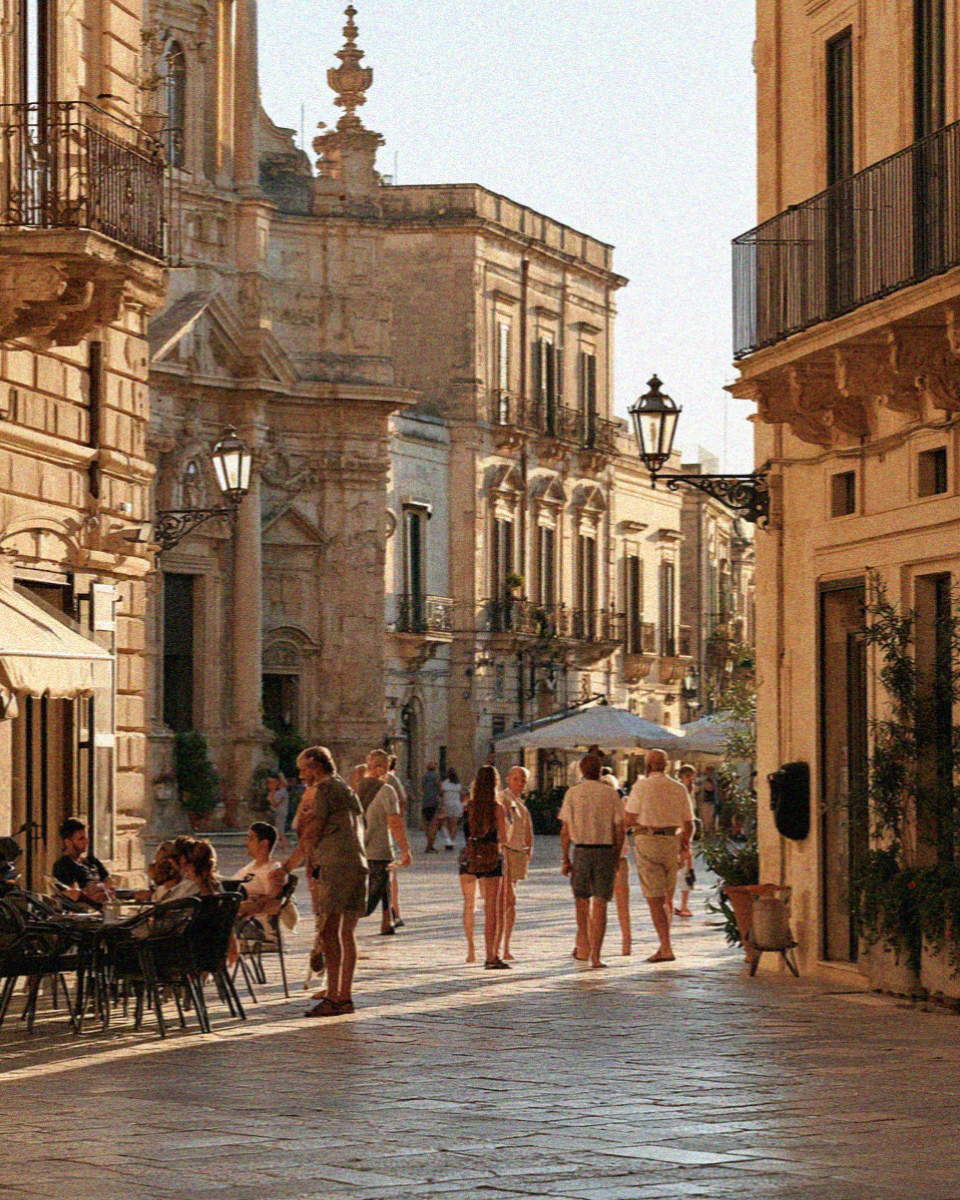
The last thing on this list is not a site at all, and it is the one I would protect most fiercely in your schedule. From around six the old town changes hands. The shops come back up, the squares fill with families and with groups of older men standing in exactly the configuration they stood in yesterday, and the centro storico turns into somewhere people are simply out. Lecce is a provincial capital with a university in it, so none of this is staged. Buy a coffee, or an ice, and walk. Caffè Alvino on Piazza Sant’Oronzo is reckoned to be the oldest café in the city, and it is the address for a pasticciotto, though that is properly a breakfast thing, eaten warm.
Cost in time: two hours, and they are the two you will remember.
The route that works: the arena first thing, Santa Croce and the garden behind it, then Piazza del Duomo, Museo Faggiano at the worst of the sun, the workshops late, the streets from six. You will pass the same three corners repeatedly. That is how you start recognising the place.
Frequently Asked Questions
How many days do you need in Lecce?
The sites on this list fit into a long day, and a day and a half does it comfortably. Two nights is the right stay if you want the evenings as well as the sights, three if you also intend to reach the coast.
Is the LeccEcclesiae ticket worth buying?
Yes, and buy it first thing. Eleven euros gets an adult into all six sites, a twelve to seventeen year old pays five, and two adults with children pay twenty-four between them. The bell tower is not included and is sold separately. The reason to buy early is the fortnight of validity and the one visit per site: the churches can then be spread across mornings instead of marched through in one hot stretch.
How much does the Roman amphitheatre cost to see?
Nothing, if you are looking at it from the square. It sits below street level in the middle of Piazza Sant’Oronzo and you can see a great deal of it over the railing from the pavement. Going down inside costs a few euros, and has only been possible again since it reopened in October 2025, so plenty of guides still tell you the rail is all there is. Check the hours, though: they are seasonal, they lean towards the afternoon and evening in summer, and the site closes on Mondays.
What is there to do in Lecce in the middle of the day in summer?
July and August highs run to around 31 to 34 degrees and it does not let up much. Museo Faggiano is indoors, cool and takes about an hour for 5 euros. The churches stay open to 9pm from April to September, so push them later. The Giardini Pubblici Giuseppe Garibaldi are free, shaded and two minutes from Santa Croce.
Do I need to cover up for the churches?
Yes, and it is checked rather than merely suggested. Nothing sleeveless, nothing low cut, nothing above the knee, and the hat comes off. Plan the outfit around it in the morning, because there is no comfortable way to fix it at the door of Santa Croce at two in the afternoon.
If you want the stone itself explained, and why a city this far south ended up carved like this, that story is in the baroque of Lecce. To see how the above slots into real days around the heat, follow a Lecce itinerary, and for everything else start at the complete guide to Lecce.