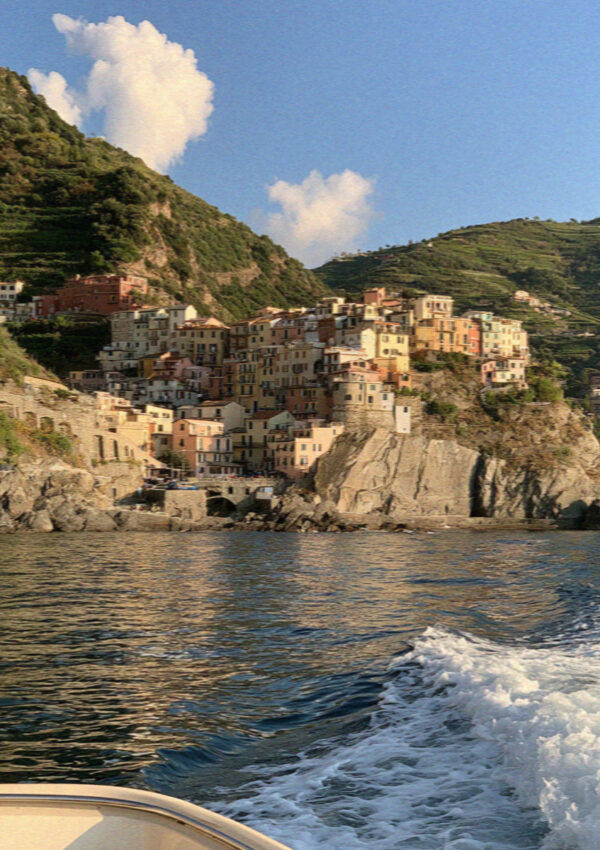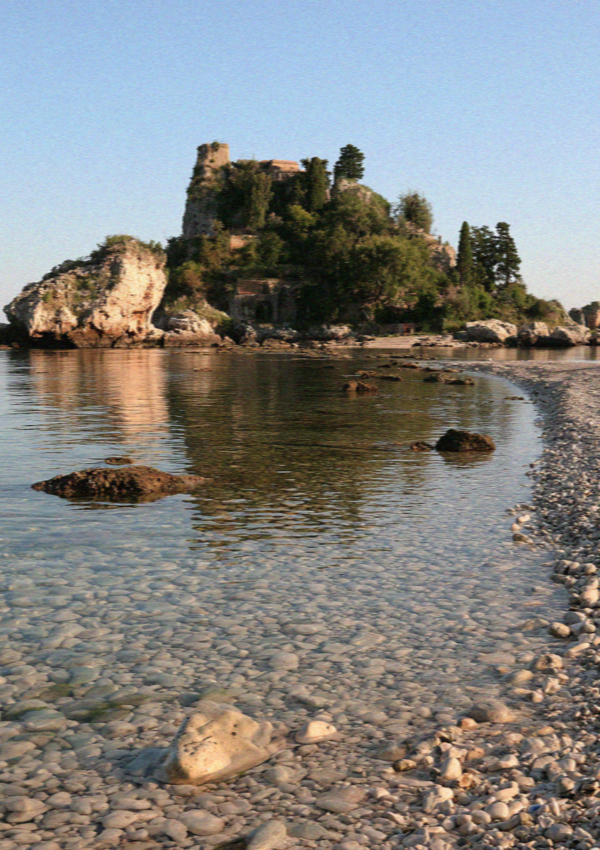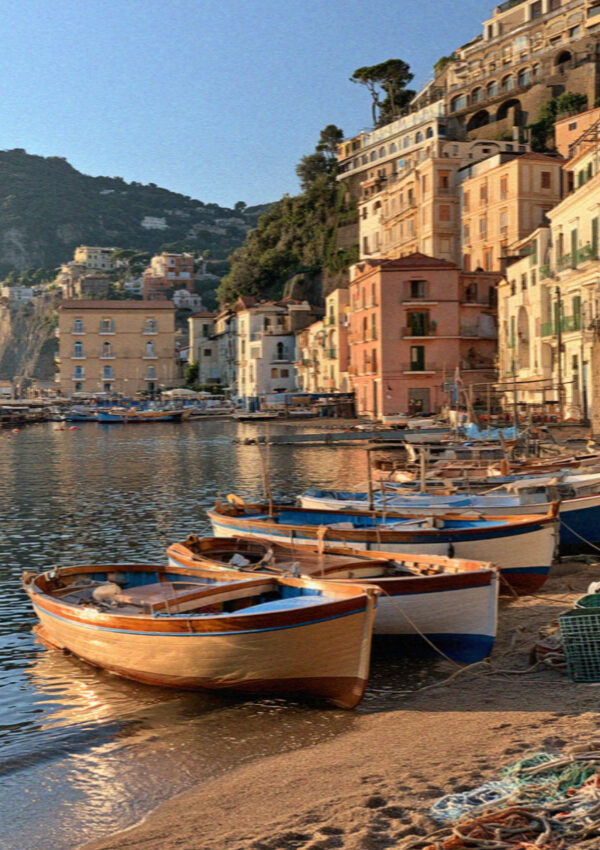
No quantity of turquoise photographs filed under the name of this city will change the fact that it has no beach of its own. The city sits in the middle of the flat Salento plain, and the closest water, at San Cataldo, is a drive of twenty minutes or so. Start from that fact, because a good many people book a room in the old town, pack for swimming, and discover on the first morning that reaching the sea is a small logistical exercise rather than a walk downhill.
The compensation is that Lecce is not near one coast, it is near two. The Salento is the heel of Italy and it is narrow, so the Adriatic lies to the east and the Ionian to the west, and both are close enough to decide over breakfast. That is the real reason the city works as a place to sleep while you swim elsewhere, and it is one of the things I set out in my complete guide to Lecce. The two seas do not look alike or feel alike underfoot, and choosing between them is mostly a question of what you want the water to do.
One warning before the geography, because it is the thing most likely to spoil a day: the Grotta della Poesia has changed, and almost every guide and pin you have seen about it is out of date. Read that section below before you drive out there.
The Ionian side
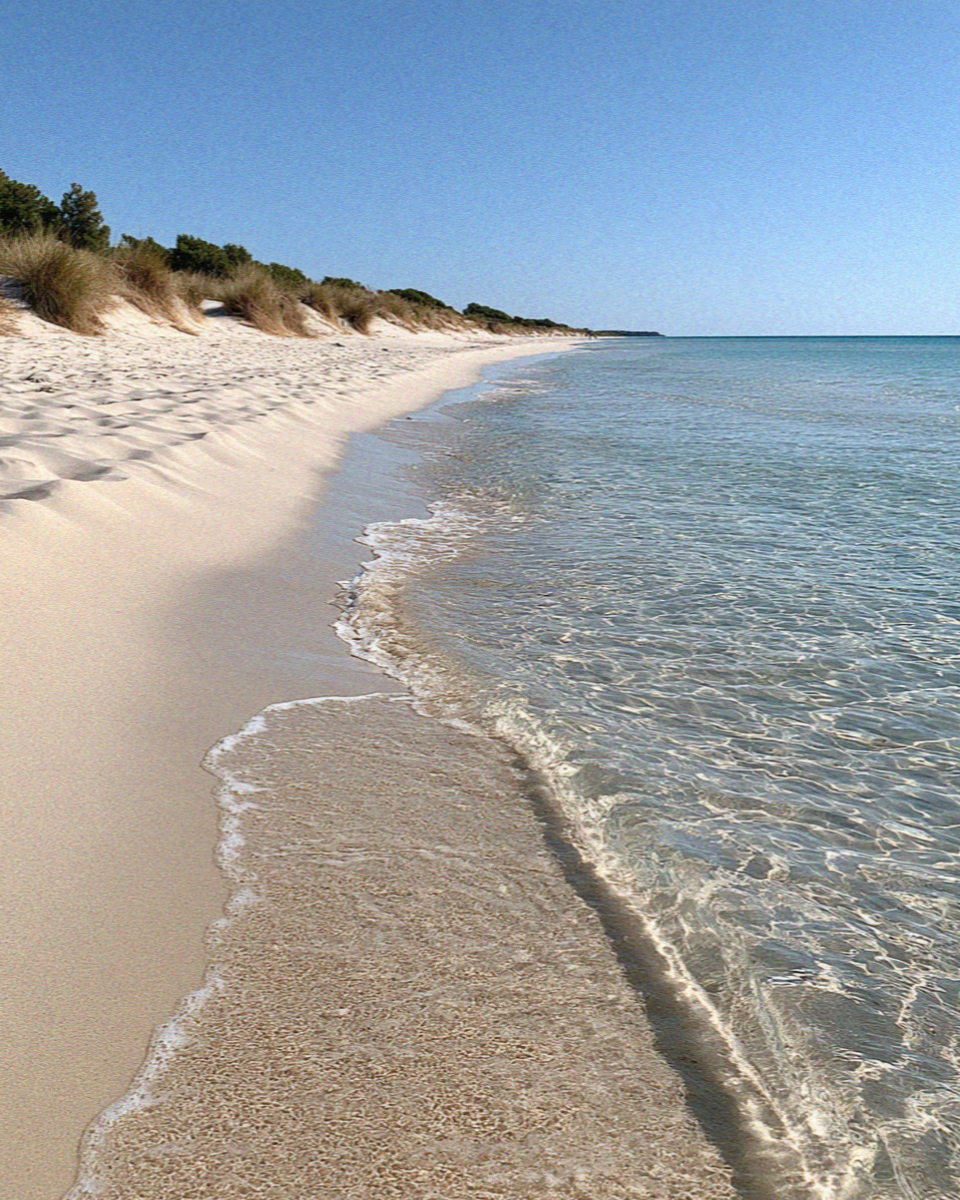
West of Lecce the sea is pale, shallow and slow to deepen. The sand is fine and light-coloured, the dunes behind it are low and held together with marram grass, and you can walk a long way out before the water reaches your waist. It is the side to choose with small children, with anyone nervous in water, or on a day when you want to lie in the shallows rather than swim.
Punta Prosciutto and Torre Lapillo are the two names to know first. Both sit in the comune of Porto Cesareo, and both fall within the Palude del Conte e Duna Costiera regional park, which is why the dunes behind the sand are intact rather than built over. Torre Lapillo is about forty minutes from Lecce. Porto Cesareo itself, a little further along, is the family option: shallow, sheltered and busy in the way a resort town is busy, with everything you need a few streets from the water.
Further south, Pescoluse is the one marketed everywhere as the Maldives of Salento. The marketing is annoying and the water is remarkable: very fine sand, very shallow, a long band of pale blue before it turns properly blue. It is around an hour’s drive, as is Torre Mozza nearby, so it is a whole-day decision rather than a spontaneous afternoon.
Around Gallipoli the Ionian gets livelier: Baia Verde is the big sandy stretch with the clubs and the crowds, Punta della Suina sits on a low rocky point with pines behind it, and Lido Pizzo is quieter again. Different from all of them is Porto Selvaggio, a pine forest running down to a rocky cove with no sand at all. You leave the car and walk in through the trees, which puts off enough people to keep it calm, and get into the water off the rocks.
The Adriatic side
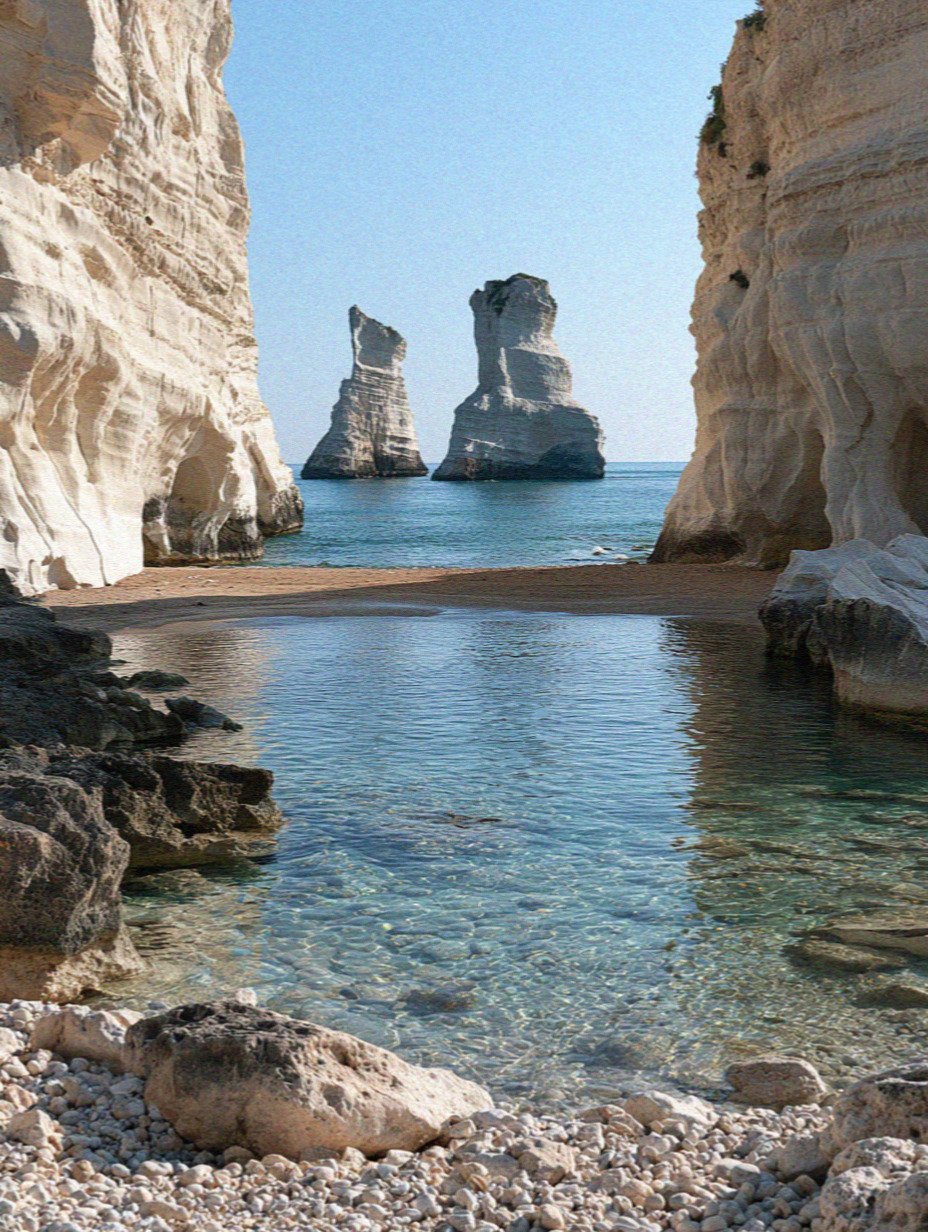
East of Lecce the coast is harder. Low white limestone, sudden drops, sea stacks standing offshore, and water that goes deep and dark blue quickly. Better to look at, and better to swim in, in the sense that you are actually swimming rather than wading.
San Cataldo is the closest of all of them and it is Lecce’s own seaside, which gives it its character: this is where the Leccesi go after work in July, not where tour buses stop. It is not the prettiest beach in the Salento and nobody there pretends otherwise. It is the one you can reach in twenty minutes when the city is at thirty-three degrees and you simply need to be in the sea.
Torre dell’Orso is the one most families settle on, and also about twenty to thirty minutes out. It is a proper sandy bay set between low cliffs, with the two limestone stacks known as the Due Sorelle standing at one end of it. Torre Sant’Andrea, just along the coast, is the same geology taken further: arches, stacks and rock platforms, more a place to swim off the rocks and look at the shapes than to lay out a towel.
Baia dei Turchi, up near Otranto, is backed by pine forest and reached on foot from the parking area through the trees. The walk is short and filters the crowd a little, which on this coast in August counts for something.
The one you cannot swim in
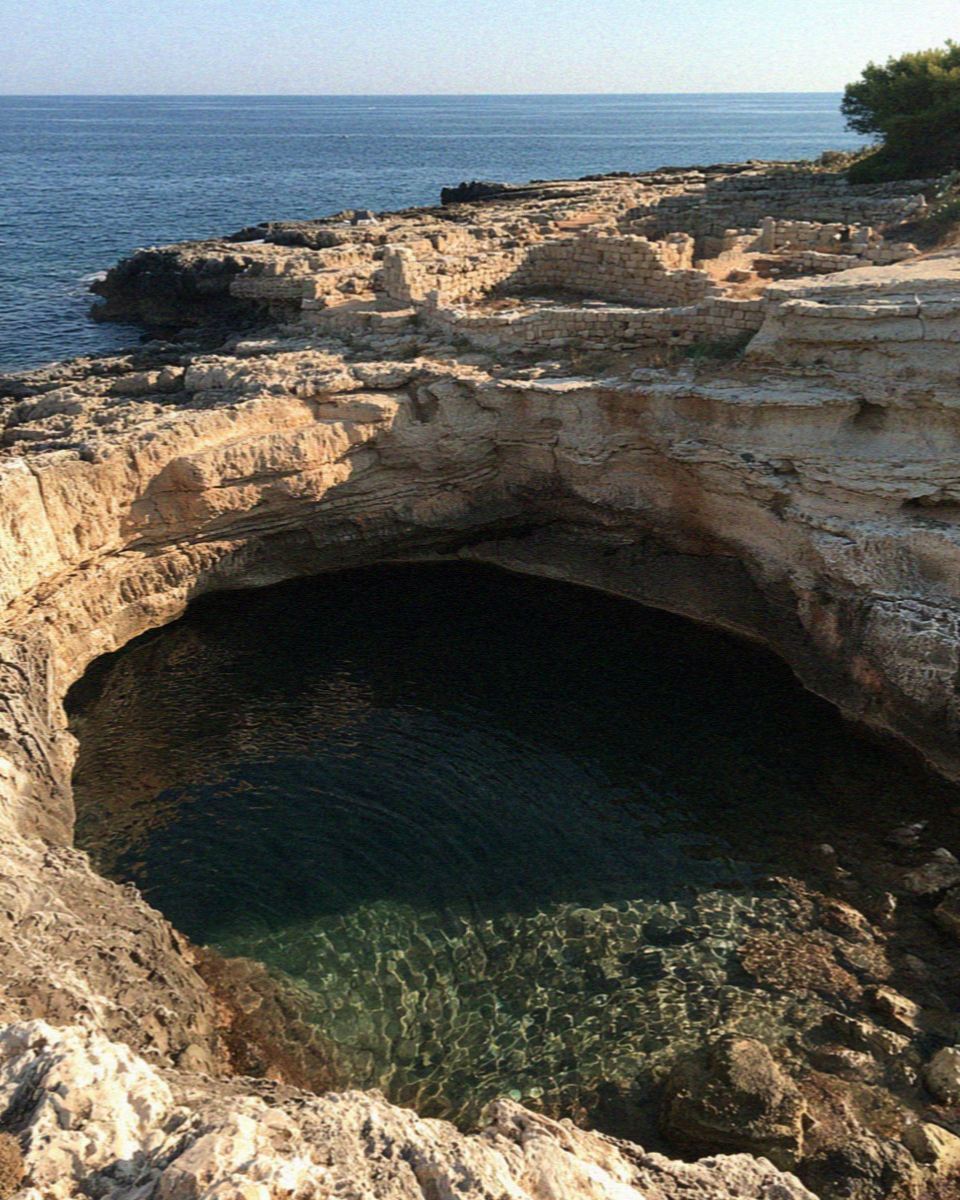
Roca Vecchia, and the Grotta della Poesia inside it, is the image that sells the Salento: a near-perfect circular sinkhole in the limestone, open to the sea through a low arch, with people flinging themselves into it from the rock. You have seen the photographs. They are still everywhere.
You cannot do that any more, and I want to be plain rather than diplomatic about it, because a drive out there on the wrong assumption is a wasted morning.
Since 18 July 2026 the Roca Vecchia archaeological area, which covers both the Grotta della Poesia Grande and the Piccola, has been ticketed. Entry is 5 euros for non-residents, free if you live in Melendugno, and in August and September the site opens daily from nine until seven. Swimming, bathing and diving are prohibited. The prohibition itself is not new, it has stood since 2019 under municipal order and was widely ignored, but from the summer of 2026 it is actively enforced: there is signage throughout the site, and the rock-cut ways down to the water are off limits. Buying a ticket does not buy you a swim, and the people running it say so in as many words.
One caveat on the dates. The ticketing was brought in for the 2026 summer season and is set to run to the end of September, with the stated intention of making it year-round. If your trip falls outside the summer, check what is open before you drive out.
The reasons given are managing visitor numbers, protecting the limestone cliffs, protecting the millennia-old inscriptions carved into the rock and the medieval remains around them, and the risk of the crag collapsing. Whatever you make of that, it is the situation on the ground, and there is no clever way around it.
So treat Roca Vecchia as a place you go to look at, and it is worth looking at: the cut stone and the inscriptions are extraordinary, and the sinkhole is as strange from the rim as it is in any photograph. Go early, pay the five euros, walk the site, and plan your actual swim somewhere else. Torre dell’Orso and Torre Sant’Andrea are both a short drive away on the same coast.
Getting there, which means a car
A car is effectively required, and I would rather say that plainly than dress it up. Nearly every stretch of sand on this page sits at the end of a road with no bus worth planning around, and once you see how close together they are you will want to take two in a day, which without keys is simply not on. Trains exist in the Salento, the FSE lines run to Gallipoli in about an hour and twenty and to Otranto in about an hour and forty, but they get you to towns rather than to sand. The full picture is in my guide to getting to Lecce and around the Salento.
Nothing on this page is far. San Cataldo, Torre dell’Orso, Torre Lapillo and Porto Cesareo are all between twenty and forty minutes from the city, and the furthest, Pescoluse and Torre Mozza, about an hour. Crossing from one sea to the other takes less time than you expect, which is the whole advantage of sleeping in the middle.
Somewhere to leave the car is a few euros in summer and rarely close to the sand. By eleven on an August Sunday the last spaces are a long way back along the road, so the earlier you set out the shorter that final stretch with the cool bag will be.
Lidos and free beaches
Most of these places offer both. A lido rents you a sunbed and umbrella on a groomed section of sand with a bar behind it, and beside it there is usually an unmanaged stretch where you can put a towel down for nothing. I will not quote you a price for a sunbed: a set costs meaningfully more in August than the same set costs in June, and the figure moves by beach and by season in a way no article can pin down honestly. Ask at the desk and decide there.
What is worth knowing is that the unmanaged stretches fill first at the near beaches and last at the far ones. If you want space without paying for it, drive further and arrive earlier.
Frequently Asked Questions
Does Lecce have a beach?
No. Lecce is an inland city on the Salento plain and has no coastline of its own. The nearest sea is at San Cataldo, roughly twenty minutes away by car, and the rest of the coast on both sides sits between twenty minutes and an hour out.
Can you still swim at the Grotta della Poesia?
No. Swimming, bathing and diving are prohibited and, since 18 July 2026, actively enforced, with signage on site and no authorised way down to the water. The Roca Vecchia archaeological area is now ticketed at 5 euros for non-residents, which covers the whole site, the ancient settlement and the medieval citadel as well as the two caves. It remains well worth visiting to see, but go expecting to look rather than to get in.
Adriatic or Ionian, which should I choose?
Choose the Ionian, to the west, for pale fine sand, very shallow water and calm conditions, which suits children and lazy afternoons. Choose the Adriatic, to the east, for clearer, deeper water, limestone cliffs and sea stacks, which suits real swimming and better scenery. Both are within an hour of Lecce.
Do I need a car for the beaches near Lecce?
Effectively yes. Most beaches have no practical public transport, and visiting more than one in a day is only realistic by car. FSE regional trains reach Gallipoli in roughly an hour and twenty and Otranto in roughly an hour and forty, but deliver you to a town rather than a stretch of sand.
Which beach is closest to Lecce?
San Cataldo, on the Adriatic, at around twenty minutes. It is the city’s own local seaside rather than a postcard beach. For something prettier, Torre dell’Orso on the same coast is around half an hour, and Torre Lapillo on the Ionian about forty minutes.
Once you have the coast sorted, the rest of the region opens up in the same way, and the towns worth a full day of their own are gathered in my guide to the best day trips from Lecce. Timing matters more here than almost anywhere, so it is worth reading the best time to visit Lecce before you book, and everything else about the city, where to sleep, what to eat and how the old town actually works, is in the complete guide to Lecce.