There is one fact that decides this question and almost every guide buries it under a list of hotels.
The beaches are public. Every one of them, including the beaches directly in front of the most expensive hotels on the coast. Italian shoreline law does not make exceptions for consortia, and nobody at the bottom of the path is checking where you slept.
So the question is not which hotel gets you the good water. It is how far you are willing to drive to it in the morning, and what you would rather spend the money on.
The famous ones
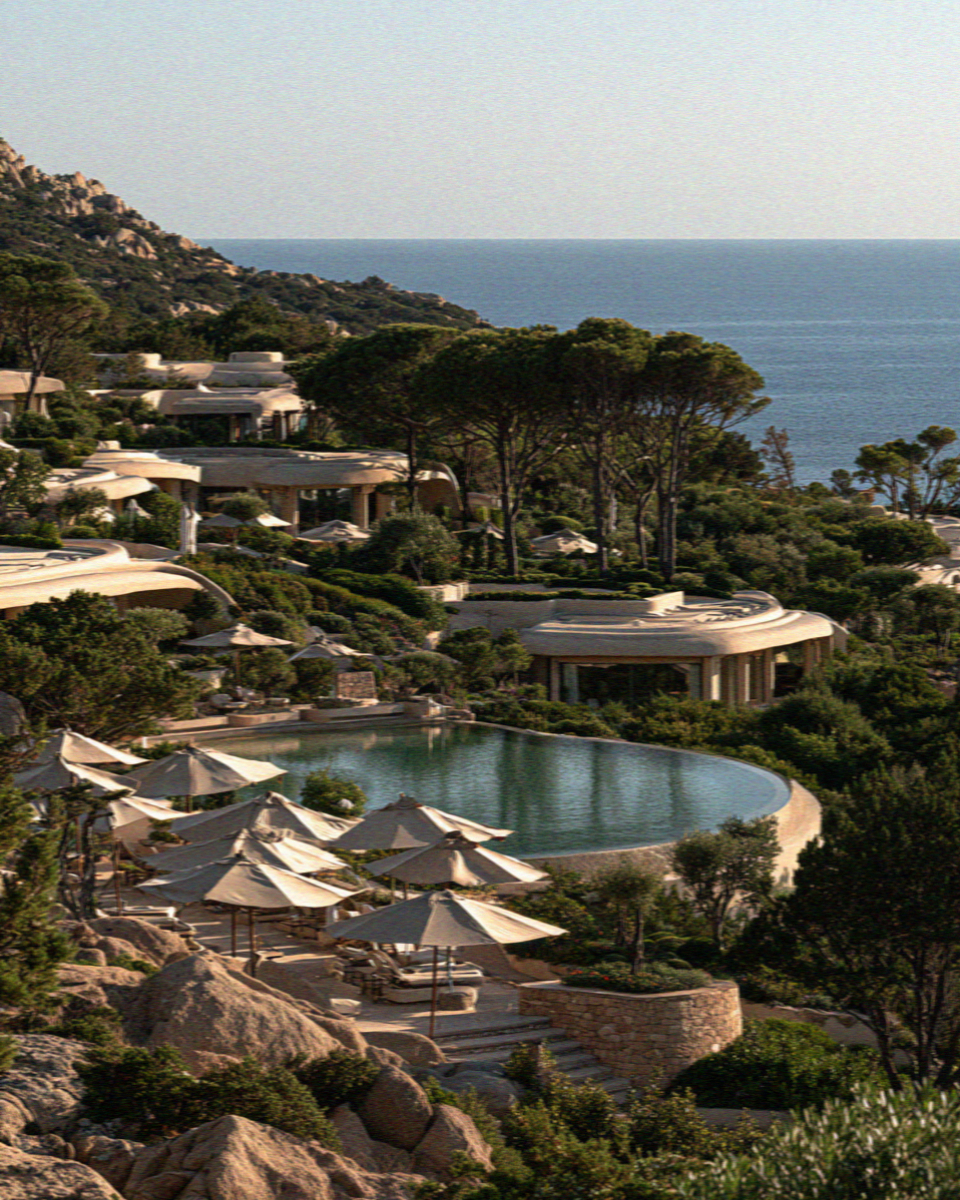
Four hotels were built in the sixties by the architects who wrote this coast’s rulebook, and they are still the reference points: Cala di Volpe, Pitrizza, Romazzino and Cervo.
They are properly good. Not merely expensive: the architecture is the thing, all curved render and rough stone stepped down through juniper so that the buildings barely rise above the scrub, with the sea appearing through gaps rather than in one wide sweep. Cala di Volpe in particular is a real piece of design rather than a hotel with a nice view.
In August they run into the thousands per night. The figure quoted around the coast for a peak-season room in the four is somewhere between €2,500 and €4,000, and while I would not swear to the top of that band, nothing I saw suggested it was an exaggeration.
One practical note that will save somebody a wasted booking attempt: Pitrizza has gone to LVMH’s hotel arm and is closed for a full rebuild, due to reopen under the Cheval Blanc name with a relaunch currently pointed at 2027. Confirm the position before you plan a trip around it.
Below the famous four there is a solid tier of five-star and good four-star hotels along the coast proper, in the €400 to €900 range in high season, which is the bracket most people who stay actually stay in.
The cheaper bases inland

This is where the useful advice is.
Baja Sardinia, ten minutes north of Porto Cervo, is the sensible first answer for most people. A proper small resort town with a beach, restaurants at normal prices, and the sunset bars on the rocks a few minutes away. Rooms sit at maybe a third of coast prices and you are ten minutes from everything.
Cannigione, on the sheltered gulf, is a working town with a harbour and families in it, cheaper again, with an excellent position for the boat trips north and a calm shallow beach that is genuinely better for small children than anything on the exposed coast.
Porto Rotondo, south toward Olbia, is Porto Cervo’s smaller and quieter sibling. Also purpose-built, also handsome, less expensive, and closer to the airport.
San Pantaleo is my own preference and the one I would take again. It is inland, fifteen minutes from the coast, a village of granite houses sitting directly under a set of jagged granite peaks, with an artists’ community that has been there since the seventies and a Thursday market worth staying for. It is quiet at night in the way the coast is not, it is markedly cheaper, and the drive down to the beaches in the morning is one of the better drives on the island.
Golfo Aranci and Olbia are the cheapest options and they are perfectly reasonable if the budget is the binding constraint. Olbia is a real town with a real life in it and rooms at normal Italian prices. You will drive thirty-five to forty-five minutes to the good bays, each way, every day.
Villas and apartments are how a large share of visitors do this coast, and for four or more people they are usually the best value available, particularly inland. Book early; the good ones go in winter.
What a room actually gets you

Be clear-eyed about what the premium buys, because it is not the water.
It buys a position, which mostly means a short walk to a beach rather than a drive and a car park. It buys a pool, which matters more than you think at two in the afternoon in August when the sand is unwalkable. It buys a terrace with a view of the bay, and on this coast the views are exceptional. And at the top end it buys service of a standard that is genuinely rare.
It does not buy a better beach, a private beach, or earlier access to anything.
The one thing I would pay for, if I were choosing where to spend, is a pool and a terrace at a mid-range place inland or in Baja Sardinia, rather than a small room on the coast proper. The middle of the day here belongs to the shade, and having somewhere good to spend it changes the whole rhythm of the week.
Where to stay for what
First trip, no strong preference: Baja Sardinia. Close to everything, priced sanely, has an evening.
Families with small children: Cannigione. The gulf water is shallow and calm, the town is normal, the prices are survivable.
A couple who want quiet: San Pantaleo. Inland, cool at night, cheaper, and the best village on this side of the island.
Boats and nightlife: Porto Cervo or immediately around it, and accept the price.
Tight budget: Olbia, and treat the driving as part of the deal.
The practical points
Get a car. There is no useful public transport to the beaches from any of these bases, and a hotel without parking is a genuine problem here. Check that yours has it. The full transport picture is in how to get to the Costa Smeralda.
Book early for July and August, and expect minimum-stay requirements of three to seven nights at the better places in peak weeks.
Check the closing date. This is a seasonal coast and a great deal of it shuts from late October, including hotels; see the best time to visit for how fast that happens.
And if you want the arithmetic rather than the recommendations, what the Costa Smeralda actually costs works a whole week through at three different budgets.
Frequently Asked Questions
Where is the best place to stay on the Costa Smeralda?
Baja Sardinia for most first-time visitors: ten minutes from Porto Cervo, a beach of its own, restaurants at normal prices and rooms at a fraction of coast rates. San Pantaleo inland is better value again and quieter. Porto Cervo itself is the most convenient and by far the most expensive.
Do you need to stay on the Costa Smeralda to use its beaches?
No. Every beach on this coast is public, including those in front of the famous hotels, and there is no restriction on who walks down to them. Staying inland or in a nearby town costs far less and puts you on the same sand each morning, at the price of a drive and a parking fee.
How much is a hotel on the Costa Smeralda?
The four historic hotels run into the thousands per night in August, with figures of €2,500 to €4,000 commonly quoted. Good four and five-star hotels on the coast sit around €400 to €900 in high season. Inland and in nearby towns such as Cannigione, San Pantaleo and Olbia, rooms fall to normal Italian prices.
Is Cala di Volpe or Pitrizza better?
Cala di Volpe is the more remarkable building of the two and the more sociable hotel. Pitrizza is quieter and more private. The question is moot for now, since Pitrizza is closed for a full rebuild ahead of a relaunch as Cheval Blanc, currently pointed at 2027, so check its status before planning around it.
Where should families stay on the Costa Smeralda?
Cannigione. It sits on a sheltered gulf with calm shallow water that suits small children far better than the exposed bays, it is a real town rather than a resort, prices are reasonable, and it is well placed for the boat trips north to the archipelago.
Read also: The Best Beaches on the Costa Smeralda | What the Costa Smeralda Actually Costs | The Complete Guide to the Costa Smeralda