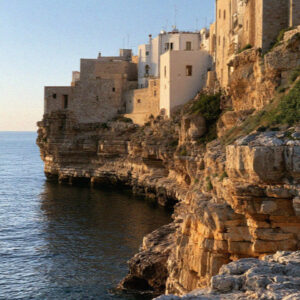
The best photo spots in Polignano a Mare are not a secret, which is the whole problem. Half of Puglia’s tourist photography comes out of this one town, a white cliff town built over sea caves with a turquoise cove in a ravine at its centre, and every good vantage point has a queue on it by mid-morning. Here is where to stand, and far more importantly, when.
The rule that matters more than the locations
Every spot on this page is transformed by the hour you visit it.
Between roughly ten and five in season, the famous viewpoints have thirty to forty people on them, and the light is hard, flat and directly overhead, which is the worst light for white buildings and turquoise water.
Before half past eight, the same places are empty and the light comes in low and sideways down the lanes.
After six, they are empty again and the stone goes warm.
If you take nothing else from this guide: the locations are ordinary knowledge, and the timing is the entire skill.
From the old bridge
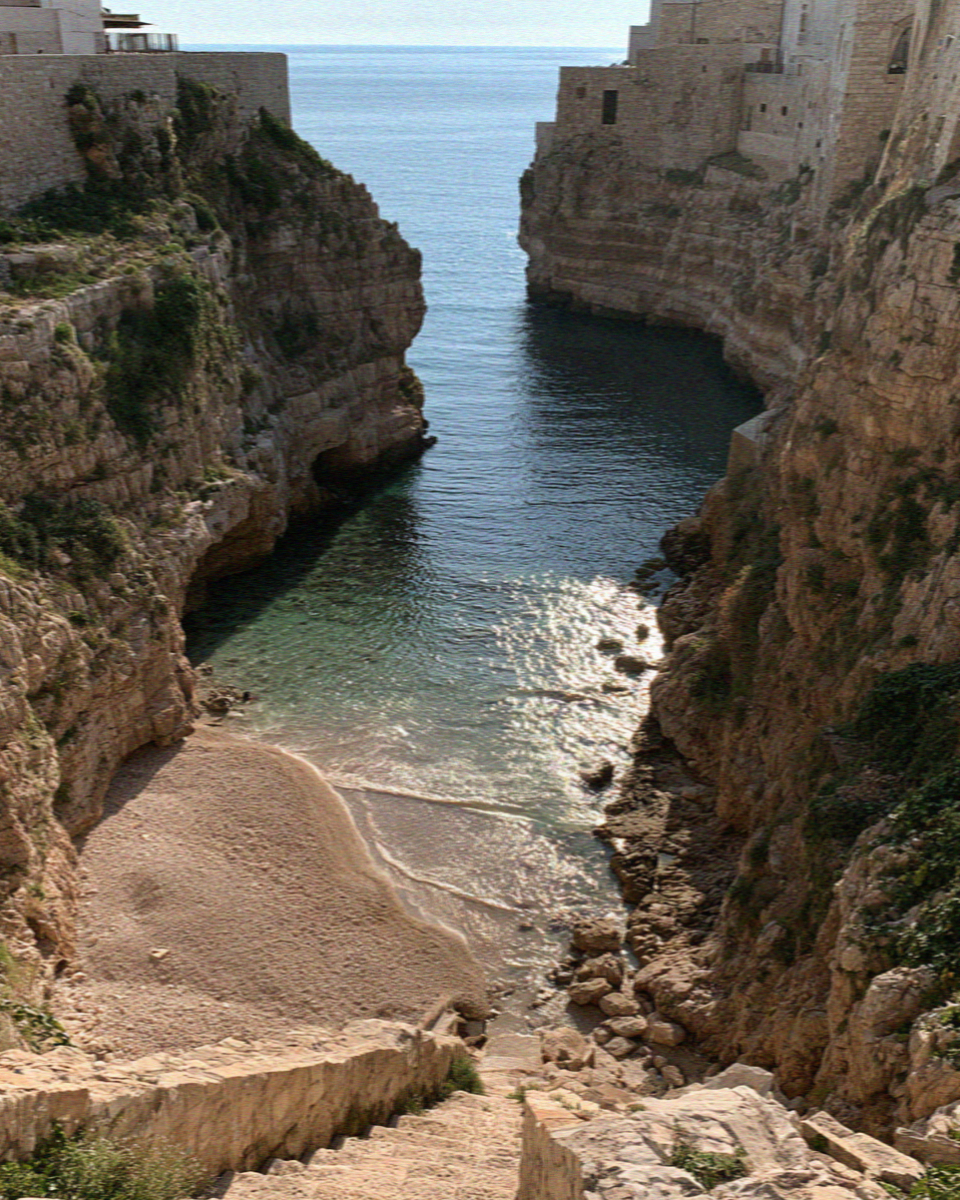
The Ponte Borbonico, the bridge over the ravine, gives you the shot everyone knows and it earns its fame.
You are looking straight down into Lama Monachile, the pebble cove wedged between two vertical limestone walls, with the gap opening to the Adriatic beyond and the white town stacked on either side.
When: first light. By nine the parapet is three deep and the sun is coming straight down into the ravine, which flattens the water.
How: the shot works because of the frame the two cliff walls make, so give yourself room at the edges rather than filling the frame with cove. Both ends of the bridge give slightly different angles and the less obvious end is usually free.
The cliff terraces
The town keeps putting balconies over open sea, and they are all good.
Terrazza Santo Stefano is the named one, a small whitewashed platform with nothing in front of it but water and a big drop. It gives you clean horizon, white rail, blue everything.
But the better photographs are usually on the terraces nobody has named, which you find by walking a lane you have not walked and following it toward the sound of water. There are several. They are all empty at eight in the morning.
When: early for empty, or the last hour of light for warmth on the render. Midday is the one to avoid, because white walls under a vertical sun blow out.
The painted verses
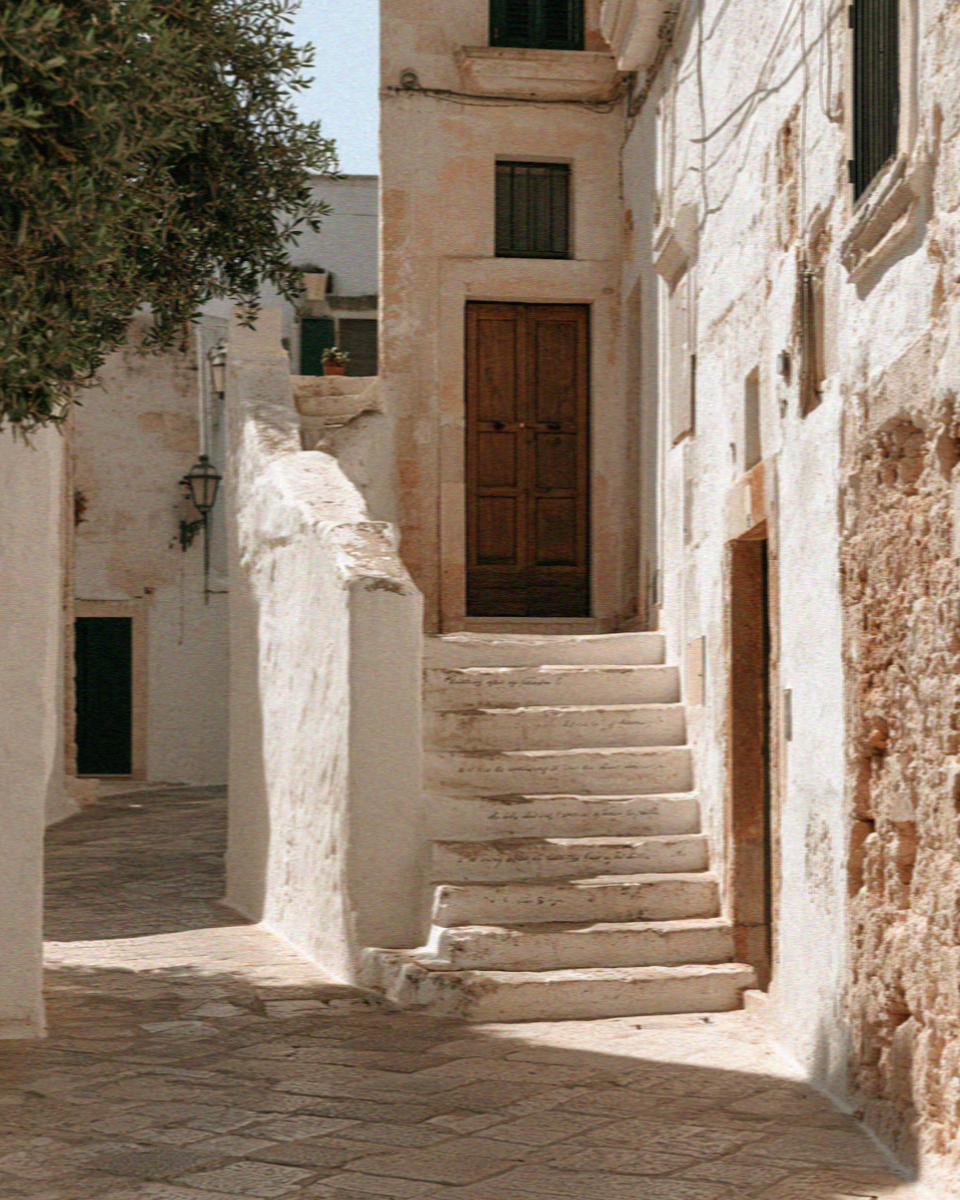
This is the detail shot, and it is the one that makes a set of Polignano photographs look like somebody actually walked the town rather than stood on the bridge.
A local poet who signs himself Guido il Flâneur has painted lines of Italian verse onto doors, walls and steps across the historic centre for years. They are thickest along Via Commedia delle Mura, and the street has been quietly turned into a photo queue by them.
When: soft shade, any time of day. This one does not need the golden hour, it needs an absence of people, so early is still better.
How: get low and close. Shot from standing height it reads as graffiti. Shot from a metre away it reads as what it is.
The alleys of the centro storico
Narrow, white, worn stone underfoot, and constantly opening onto blue.
The best alley shots here work on the contrast between the corridor and the exit: a dark narrow lane with a rectangle of sea at the end of it. Look for lanes running east toward the water and shoot down them.
When: early morning, when low sun comes down the lanes lengthwise and throws long shadows across the render. In the middle of the day the alleys are just white and shadowless.
From the water
The single most underrated angle in this town, and the one almost nobody has.
Almost every photograph of Polignano is taken from inside Polignano. The view from a boat, looking back at houses hanging over an undercut cliff with sea caves opening beneath them, is the one that actually explains the place, and you can only get it by going out on the water.
Take one of the boat trips from Cala Ponte Marina and shoot back at the town. Morning gives you the light on the facades and a calmer sea. Full details are in the boat tour guide.
The statue, and being honest about it
Domenico Modugno stands three metres tall in bronze on the seafront with his arms flung wide, and there is a permanent queue of people posing beside him with their own arms up.
It is not a subtle photograph and it is not trying to be. It is a fun one, and this is a town that put a singer on its seafront, so lean in.
Practical notes
Shoes with grip. The old town limestone is polished to a shine by centuries of feet and it is properly slippery, especially when damp.
Lens. A wide is essential for the alleys and the bridge. A short telephoto is useful from the water and for compressing the layers of white buildings on the cliff.
Weather. Overcast is not a disaster here. Grey light on white stone and a moody Adriatic is a real look, and it is the only version of the town with no crowds at all.
Respect the drops. Some of the best angles are on unfenced rock above real height. No photograph is worth going over the edge for, and people have.
Respect the residents. Those white lanes are somebody’s front doorstep, and the town has had a great deal of camera pointed at it in the last decade.
Frequently Asked Questions
Where is the famous Polignano a Mare photo taken from?
The Ponte Borbonico, the old bridge over the ravine, looking straight down into the Lama Monachile cove between the two cliff walls. It is the image most people have seen of the town. Go at first light, because by nine in the morning in season the parapet is several people deep.
What time of day is best for photos in Polignano a Mare?
Before half past eight in the morning or after six in the evening. The famous viewpoints are empty at both ends of the day, and the low light suits white buildings and turquoise water far better than the flat overhead sun of the middle hours.
Is Polignano a Mare good for photography?
Very. It is a white town on an undercut limestone cliff over an unusually clear sea, with a ravine and a pebble cove in the middle of it, poetry painted on the steps and terraces that appear without warning at the ends of alleys. The only real difficulty is how many other people are photographing it at the same time.
Where can you photograph Polignano a Mare from the sea?
On any of the boat tours out of Cala Ponte Marina. Shooting back at the town from the water is the angle almost nobody has, and it is the one that shows what the place actually is, houses hanging over a hollow cliff full of sea caves. Morning gives better light on the facades and calmer water.
Read also: The Best Things to Do in Polignano a Mare | The Best Time to Visit Polignano a Mare | The Complete Guide to Polignano a Mare