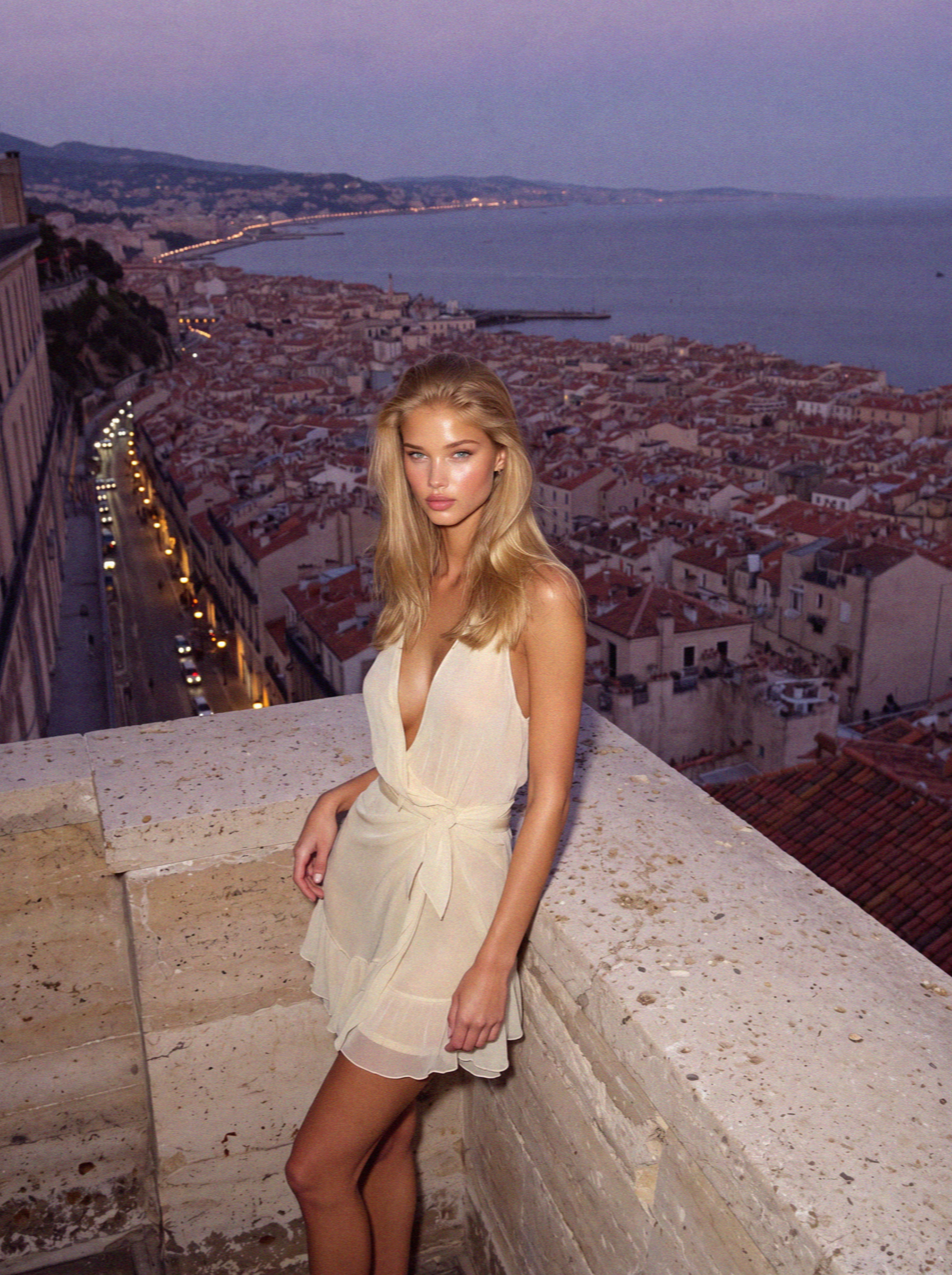
Nobody flies to Sardinia to see Cagliari. They land here and they are driven away, north, to the coast that was built to be photographed.
I stayed.
The city is on a ridge of limestone and everything about it follows from that. You go up or you go down. There is no third direction. In the first hour I climbed the same set of steps twice because I had misunderstood where I was, and by the top of the second climb I had stopped pretending I was going to be elegant about it.
At the top there is a terrace, and from the terrace you can see the whole gulf: the salt pans, the long pale line of the beach, and the sea going flat and metallic in the heat.
The lights came on underneath me while I was still standing there, in a city I did not know at all.

The stone gives the heat back after dark. You feel it come up through the soles of your feet at ten at night, hours after the sun has gone, and it changes how the evening works. Nothing happens here before eight. Then everything does at once.
On the second day I took the bus to the beach, which is a sentence I have not been able to write about any other capital city.
Fifteen minutes. A euro and a half. And then eight kilometres of pale sand with the water so shallow you can walk out until the city is small behind you and still be standing.
Everyone was there. Not tourists. Office clothes folded on towels, three generations of one family under an umbrella, boys throwing a ball with the seriousness of professionals, a woman swimming a slow methodical crawl parallel to the shore as though she does it every evening, which I suspect she does.
Behind the beach there are the salt pans.
I did not know about them. Nobody had told me, and none of what I had read had thought them worth the paragraph. You get off the bus one stop early, walk ten minutes past some unremarkable buildings, and there is a gate, and beyond the gate there is water in shallow rectangles the colour of weak tea, and standing in it, several hundred flamingos.
They are absurd. I had only ever seen them in the singular, in zoos, looking embarrassed. In these numbers they are something else. They feed with their heads upside down in the shallows and they move all together without any signal I could see, and when a few of them opened their wings the underside was a red I was not ready for.
Free. Open from dawn until dusk. Fifteen minutes from a medieval cathedral.
I went back the next evening and stayed until the light went.

The salt is the thing I keep coming back to.
They made salt here for centuries, industrially, in those pans. It was work, and hard work, and the pink of the water is the algae the brine shrimp eat and the shrimp are what the flamingos eat and the flamingos are pink for the same reason. So the birds are the colour of the industry. The most decorative thing in the city is a by-product of its least decorative one.
I like that more than I can properly explain. It is the opposite of the coast up north, where the beauty was designed and installed and is maintained at considerable expense.
Here nobody planned any of it. They dug salt, and three hundred years later there are flamingos on a bus route.
In the museum, up at the top of the hill, there are small bronze figures the size of a hand. Archers, wrestlers, shepherds, a woman holding what might be a child or might be a bowl. They were made three thousand years ago by people who left no writing at all, so the figures are the only account that civilisation gave of itself, and it chose to record ordinary people doing ordinary things.
I stood in front of a case of them for a while.
My father would have liked them. He would have wanted to know how they were cast, and whether the alloy was local, and he would have found the answer before we left the building.

I ate late, down in one of the narrow streets by the port where the tables come out and fill the whole width of the road. Fregola with clams. A carafe of something cold and white and slightly bitter.
The couple at the next table were arguing about a car, cheerfully, at length, with the whole street as an audience and no self-consciousness whatsoever.
Afterwards I walked back up. Of course I did. There is no third direction.
Halfway there is a set of stone steps in a lane with one iron lamp, and I sat on them for a while and took a shoe off, and the stone under me was still warm from a day that had ended four hours earlier.
The city was making its noise below and the gulf was black beyond it and somewhere out on the salt pans, in the dark, several hundred flamingos were standing in six inches of water doing whatever it is they do at night.
I have been to the parts of this island that were designed for me.
This was better.
V.
The next day I took the city bus out to the beach and found the flamingos, which is in the bus goes to the flamingos.