The best day trips from Amalfi are the ones you can begin without a plan and without a car, because the town hands you two departure points and asks nothing else of you. There is the harbour, where the ferries pull in and out from April to October, and there is the little bus square just behind it, where the orange SITA buses grind up towards the high villages. Between the two you can reach almost the entire coast, and a fair slice of the world beyond it, and be home for dinner. Amalfi is not the most beautiful town on this shore, but it may be the most usefully placed, and that is a quiet luxury of its own.
Why Amalfi Is the Ideal Base
Stay in Positano, and you are lovely but stranded, forever climbing steps to catch a bus that is already full. Stay in Ravello, and you are serene but seven hundred metres above the sea, committed to switchbacks every time you want to swim. Amalfi sits in the middle of the coast, at sea level, with both a working harbour and the SITA terminus in the same few hundred metres. From here Positano is west and Salerno is east, and everything you might reasonably want to see in a week sits within a short boat or bus ride of your morning coffee. My complete guide to Amalfi covers the town itself; this piece is about leaving it, gently, and coming back.
Plan Your Visit to the Amalfi Coast
A few things I booked and loved. These help support the blog, at no cost to you.
- Where I stayed: search Amalfi Coast hotels
- Boat tours and Amalfi Coast tickets
- Stay connected: get a travel eSIM
This section contains affiliate links. If you book through them I may earn a small commission, at no extra cost to you.
Positano
The ferry west takes about forty minutes and costs from around eight euros, running several times a day through the season. The trick with Positano is timing, because it is a town that changes character by the hour. Take an early boat and arrive before ten, while the vertical streets are still cool and half asleep. Walk down through the tiers before they fill, then take an early lunch in the upper streets where the prices are kinder and the views are the same. Spend the hot middle of the day swimming from Spiaggia Grande, and take the late-afternoon ferry back as the light turns to gold and the whole town glows behind you like a coal. That is the correct Positano day, and my complete guide to Positano has the rest of it.

Ravello
From the bus square, the orange SITA bus climbs for about forty-five minutes up the switchbacks, several times daily. Ravello asks for a full day, not an afternoon, because it sits seven hundred metres above the sea and rewards you for staying up there. Give the morning to the gardens of Villa Rufolo, which look out over a drop so sheer it seems staged. Take a long lunch. Give the afternoon to Villa Cimbrone, and walk out to the Terrace of Infinity when the light has softened and the coach parties have gone. Then make the descent in the early evening, when the sea below has turned to pewter.

There is a stillness to Ravello that the coast towns cannot offer, and it is worth the climb. My complete guide to Ravello explains where to eat and how to time the villas.

Capri
The fast ferry or hydrofoil leaves the harbour and reaches Capri in about forty minutes, from around twenty-one euros. I will say it plainly: Capri is better as a day than as an overnight. The island empties in the evening and fills again by mid-morning, so a day trip lets you use its best hours and skip its most expensive ones.
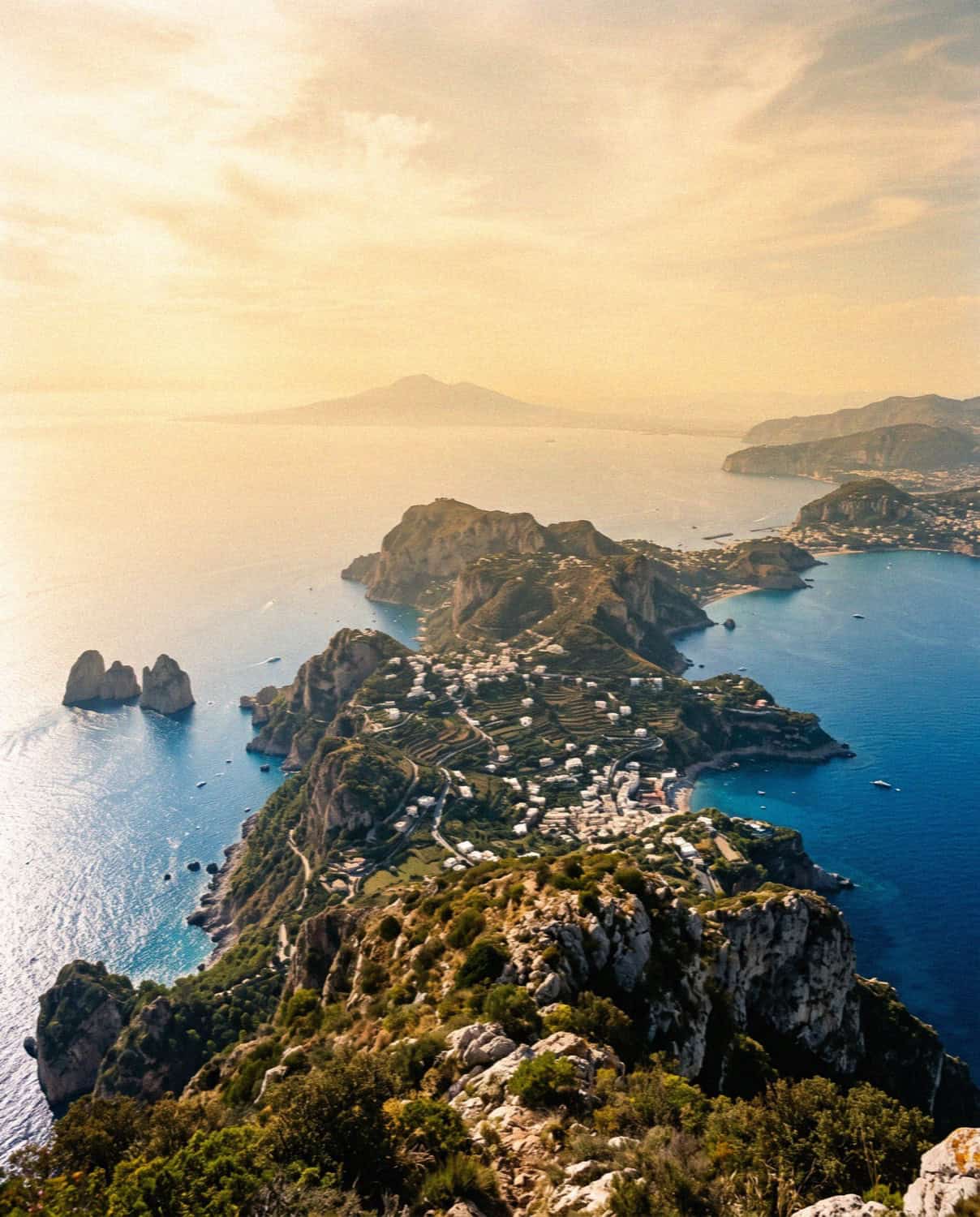
Do not linger in the crowded Marina Grande. Go straight up to Anacapri, the quieter, higher town, and ride the single-seat chairlift to the summit of Monte Solaro, where the whole bay lies open beneath you. Have lunch on a terrace, then walk down rather than take the bus, through gardens and past white walls, and catch the late-afternoon boat home. My complete guide to Capri has the walk in detail.
Atrani
Some day trips barely qualify as journeys. Atrani is ten minutes on foot east around the headland, or five minutes by bus, and it is the smallest town on the coast. Go in the morning, before the sun climbs overhead and floods the piazza. There is a calm little beach, a handful of tables, and a square that feels entirely unbothered by the century it finds itself in. I go there when I want the Amalfi Coast without the coast’s noise. My complete guide to Atrani is a love letter to exactly this.
Minori and Maiori
Head east by ferry or SITA bus and in fifteen to twenty minutes you reach the twin towns of Minori and Maiori, which most visitors never think to try. Minori has the best sandy swimming beach within easy reach of Amalfi, gentle and shallow and made for an afternoon of doing nothing. Maiori, its larger neighbour, has a long seafront promenade and a relaxed, cheaper beach-club culture that feels a world away from the western coast’s prices. This is where I come for a proper local lunch and a full afternoon of swimming for a fraction of what Positano would charge. My complete guide to Maiori and Minori has the beaches and the pasticcerie.
Cetara
About forty minutes east lies Cetara, a working fishing village that has not rearranged itself for anyone. It is famous for tuna, and for colatura di alici, the amber anchovy extract descended directly from the Roman garum that once seasoned the whole empire. There is little to do here but eat, and that is the point. Come for lunch, order whatever the anchovies have touched, and watch a town that still earns its living from the water. It is quiet, it is real, and there are few tourists to break the spell.
Pompeii
This is a long day, and it is worth every hour. Take the ferry or bus to Salerno, then the Circumvesuviana regional train towards Naples, roughly two hours each way. Allow at least four hours on the site itself, and ideally give it a whole day: leave Amalfi by eight in the morning, and you can be back by seven in the evening. It is a great deal of transport for one destination, but there is no other place where an entire Roman city stands waiting for you to walk its streets. A long day, then, and an irreplaceable one. My complete guide to Pompeii tells you which houses to prioritise and how to avoid the worst of the heat.

Paestum
If you have already seen Pompeii, or if crowds exhaust you, go further south to Paestum instead. From Salerno the train takes about thirty to forty minutes, and at the end of it stand three of the best-preserved Doric temples anywhere in the world, honey-coloured and almost alone in their meadow. Paestum is far quieter than Pompeii, and there is something profound about having the Greek world nearly to yourself on a warm afternoon.
Frequently Asked Questions
Can you do a day trip to Capri from Amalfi?
Yes, and I would argue it is the best way to see the island. The fast ferry from Amalfi’s harbour takes about forty minutes and costs from around twenty-one euros, running through the season from April to October. Go early, spend your day around Anacapri and Monte Solaro, and take the late-afternoon boat home before the prices and the crowds settle in for the evening.
How do you get from Amalfi to Positano?
The simplest way is the ferry, which runs west from Amalfi’s harbour in about forty minutes for around eight euros, several times a day in season. The SITA bus also makes the trip, though the coast road is slow and often crowded. I nearly always choose the boat, both for the ease and for the view of Positano rising from the sea as you approach.
Is Amalfi a good base for day trips?
It is arguably the best base on the whole coast. Amalfi sits at sea level in the middle of the shore, with a ferry harbour and the SITA bus terminus within a few hundred metres of each other. From that one point you can reach Positano, Capri, Ravello, the eastern beaches, and even Pompeii, all without ever needing a car.
That, in the end, is what Amalfi gives you: not the grandest rooms or the most photographed beach, but a doorstep from which the entire coast is a short journey away. Spend your week going out in the morning and coming back at dusk, and you will know this shore far better than someone who never left their beautiful cliffside terrace. When you are ready to plan the town itself, my complete guide to Amalfi and my notes on how to get to Amalfi will see you the rest of the way there.