Getting to Corfu is easier than for most Greek islands: it has its own international airport on the edge of town, and the mainland is only an hour or so away by ferry. Getting around it is the part that needs thought, because the island is bigger, greener and steeper than it looks on a map.
This guide covers both: flying in, the ferries from the Greek mainland and from Italy, the buses, driving, taxis, and the short hops on to Paxos and Albania. For everything else about the island, see my complete guide to Corfu.
Flying in
Corfu’s airport, code CFU, sits right on the edge of Corfu Town beside the lagoon, about 2 to 3.5 km from the centre depending on where in town you are going.
In summer there are direct flights from much of Europe, many of them seasonal. Outside the summer months the direct routes thin out, and connecting through Athens is the usual answer, so check the season before you plan around a particular route.
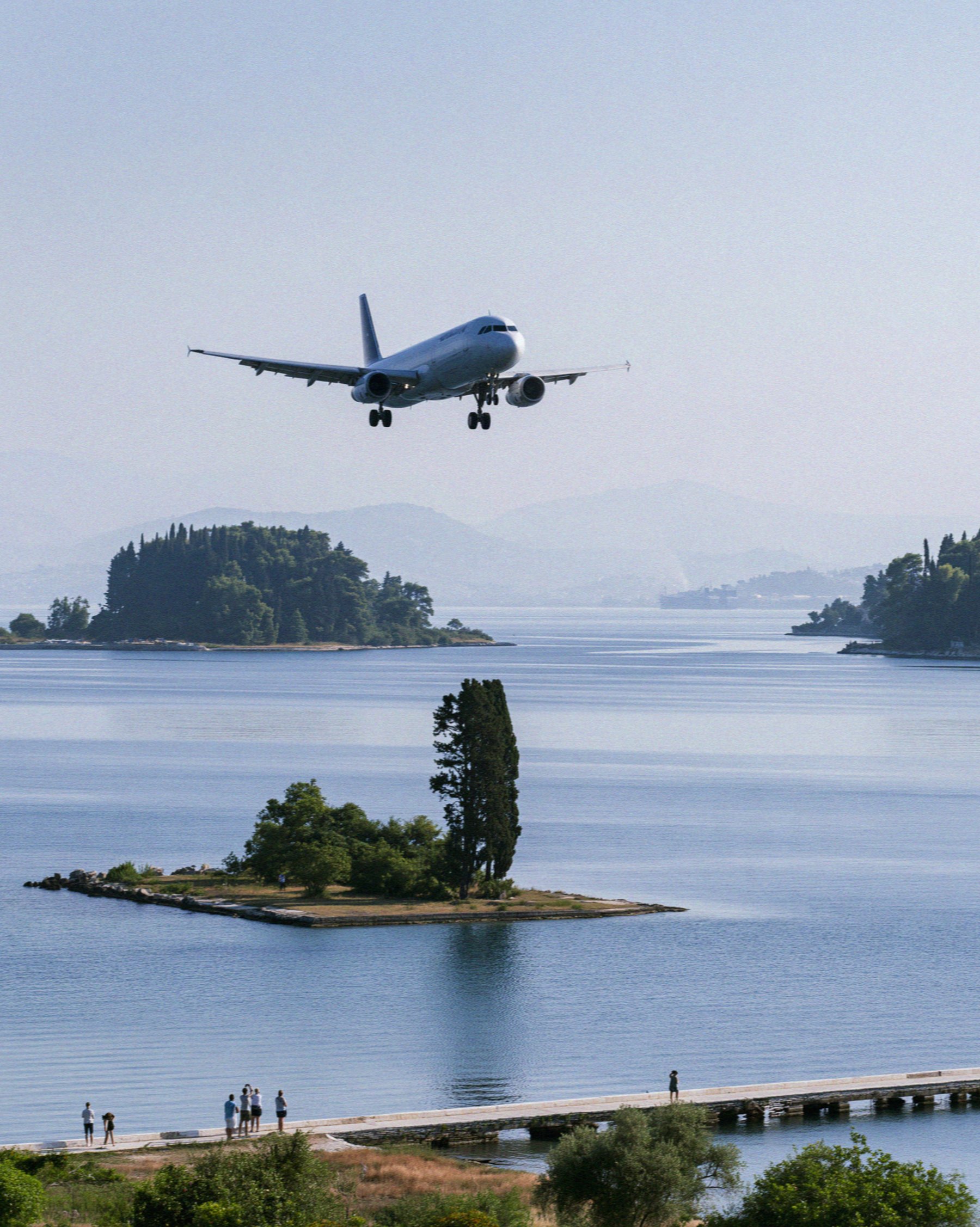
The landing. If you can, sit on the side of the plane facing the town. The approach comes in low over the lagoon, past the little monastery of Vlacherna on its causeway and Mouse Island beyond it, and seems to skim the water just before the runway. I landed that way in September and had my face against the window for the last minute. From the ground, at Kanoni, you can watch the planes come in directly overhead; the causeway from Kanoni to Perama sits right under the flight path.
From the airport into town
By bus. The blue urban bus, line 15, runs from the airport to San Rocco Square, the town’s main bus hub, and on to the port. The fare is 1.70 EUR paid to the driver, or a little less, around 1.10 to 1.20 EUR, if you buy the ticket before you board. Buses run roughly every 30 to 60 minutes, and there is no late-night service, so if you land in the evening do not count on it.
By taxi. Corfu’s taxis are dark blue. Into town costs about 15 EUR by day and about 20 EUR at night, and takes under ten minutes. Agree the fare before you set off if you are going further than the town.
To the resorts. A taxi or pre-booked transfer is the practical answer. The resort buses leave from a different station in town, and with luggage the change is a nuisance.
By ferry from Igoumenitsa
Igoumenitsa is the port on the Greek mainland opposite Corfu, and the crossing is short and frequent: about 1 hour 10 minutes to 1 hour 30 minutes, with many sailings a day. The main local operators are Kerkyra Lines and Kerkyra Seaways.
Foot passengers pay from about 5 to 8 EUR on the local boats. A car costs extra. The boats arrive at the port of Corfu Town, which the line 15 bus serves.
Lefkimmi. Some boats run from Igoumenitsa to Lefkimmi in the south of the island instead. This is handy only if you are staying in the south; otherwise the drive up to town undoes the time saved.
It is also the route for anyone driving from Athens or elsewhere on the mainland.

By ferry from Italy
Arriving from Italy by sea is slower, and a lovely way to come.
Brindisi is the shortest crossing, at about 7 hours. Bari takes about 9 hours. Ancona and Venice are much longer, with Venice taking up to about 25 hours, so those are really overnight voyages with a cabin rather than a crossing.
Timetables change through the year and thin out in winter, so check your dates before you build a trip around a sailing. If you are bringing a car, book early in high summer.
The buses
Corfu has two separate bus systems, and the tickets are not interchangeable.
The blue buses are the urban network around Corfu Town and the villages close to it, run from San Rocco Square. Useful lines include 15 (airport, San Rocco and the port), 2a from the Liston to Kanoni, 6 to Benitses and 10 to the Achilleion at Gastouri. Fares are low, a little higher for the outer zone. (At the Achilleion you can see the gardens only: restoration has kept the palace shut since 2021, and the work is now due to finish in June 2029.)
The green KTEL buses are the island’s intercity network. They leave from the intercity station, about a fifteen-minute walk from the centre, or reachable on the line 15 bus. Buy the ticket at the station or on board; blue bus tickets do not work. Lines include:
- A2 to Sidari
- A4 to Kassiopi
- A6 to Arillas
- A20 to Afionas
- A9 to Paleokastritsa
- B10 to Agios Gordios
- B17 to Glyfada (B19 stops at the junction above it)
Fares are a few euros; to Paleokastritsa, for example, expect something in the region of 2.30 to 3.50 EUR, depending on the season. Timetables change, sometimes week to week in high season, so check the current one rather than an old printout. And tell the driver where you want to get off.
What the buses do well: the main resorts and beaches. What they do not: the hill villages, Old Perithia, Mount Pantokrator and the wilder coves. For those you need a car.
Hiring a car and the roads
For most visitors, a car is worth it. It is the only practical way to reach the north-east coves, the west coast beyond the resorts and the hill villages, and it lets you go early and avoid the crowds.
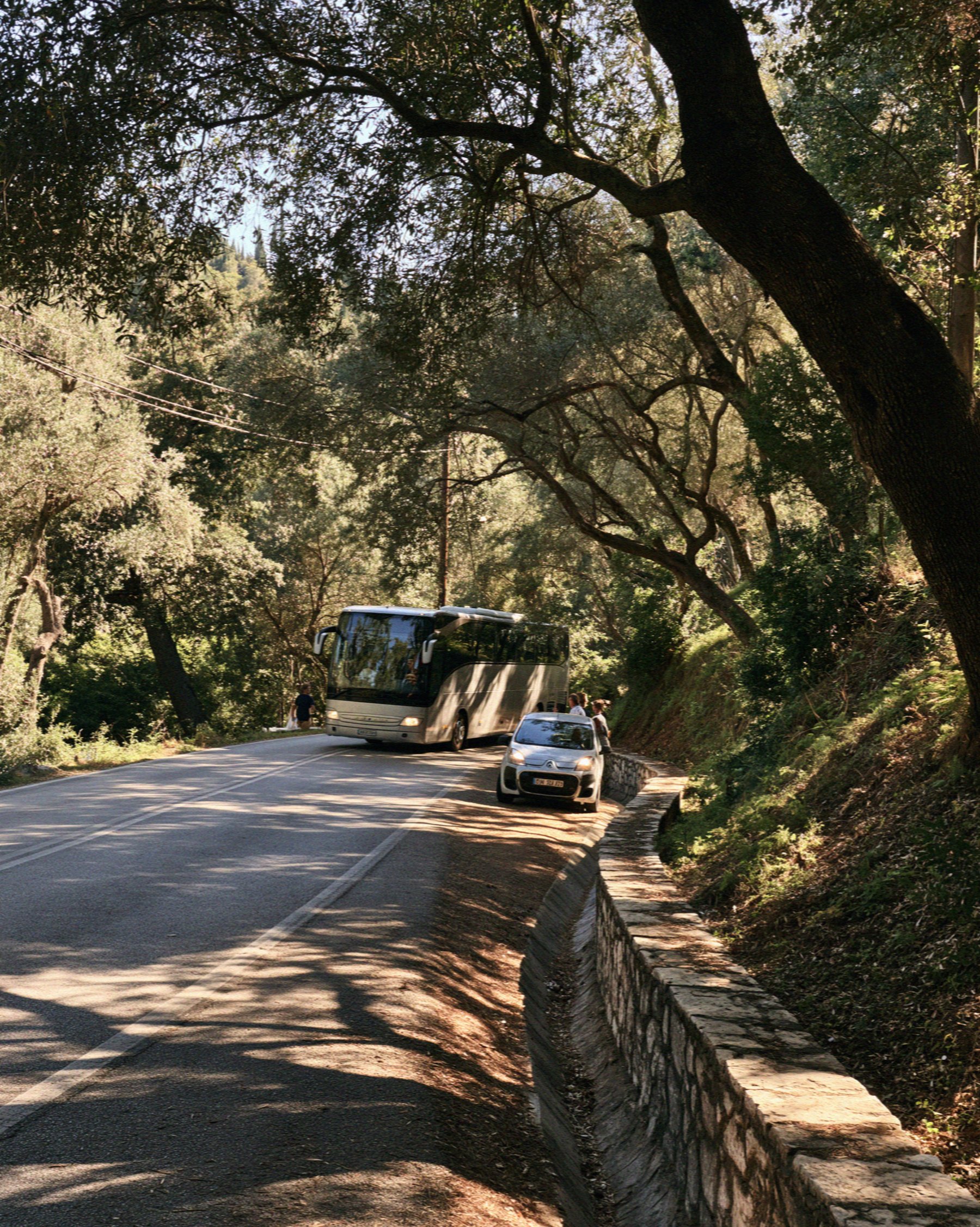
The roads. Corfu’s roads are narrow, winding and, once they leave the coast, steep. On the mountain roads, the buses take the crown of the road on bends, because they have to. So take the inside line, slow down early before every blind corner, and use the horn on the tightest ones. The lanes down to small beaches can be very steep, and some are barely wider than the car.
Distances. The island is up to about an hour across. That sounds little, but crossing it twice in a day uses up the best hours. Pick one coast per day.
Choosing the car. Take the smallest one that fits your party; the village lanes and beach car parks are tight.
In town. The Old Town is a place for walking, not driving. If you are staying there, ask your hotel where to leave the car.
My own longest drive was up into the hills towards Old Perithia and Pantokrator, and it is a road to take slowly in both directions.
Taxis and transfers
Taxis are dark blue and easy to find at the airport, the port and the ranks in town.
For longer journeys to the resorts, agree the fare before you get in. If you are arriving with luggage to a villa or a hotel on the coast, a pre-booked transfer is simpler: someone is waiting, the price is fixed, and nobody has to explain where a house in an olive grove is.
Without a car, a taxi is also the answer for an evening in the Old Town from a resort. Ask for one to be ordered back; outside town, cars are not always waiting.
Getting to Paxos and Albania
Paxos. The little island south of Corfu can be reached two ways. Scheduled ferries leave the port in Corfu Town for Gaios on Paxos: hydrofoils take about 55 minutes and conventional boats about 1 hour 20 minutes to 1 hour 45 minutes, with one-way fares roughly in the 20 to 30 EUR range. Some seasonal boats leave from Lefkimmi in the south, which is a shorter crossing. Book ahead in July and August, especially the morning fast boats. The other way is a day cruise, which also takes in the Blue Caves and a swim off Antipaxos; those are covered in the Corfu boat tours guide.
Albania. Saranda, on the Albanian coast across the strait, is about 30 minutes away by fast boat from Corfu Town, or about an hour on the slower ferries. Tickets are roughly 19 to 30 EUR one way, and the timetable is busiest between May and October. You need your passport. Albania is one hour behind Greece, which matters for the return boat. From about mid-November the timetable no longer allows a same-day return.
From Saranda, Butrint, the ancient city on the UNESCO list since 1992, is a short drive away. If you would rather not arrange it yourself, a full-day organised trip takes care of the boat, the border and the transport. Both islands and Albania are covered in full in the best day trips from Corfu.
Once you are on the island, the question becomes where to sleep, and that decides most of what follows. Where to stay in Corfu compares the bases, my Corfu itinerary shows how the driving fits into a few days, and the complete guide to Corfu has everything else.
Frequently Asked Questions
How do you get from Corfu airport to Corfu Town?
Take the blue line 15 bus to San Rocco Square and the port, for 1.70 EUR paid on board, or a taxi, for about 15 EUR by day and 20 EUR at night. The taxi takes under ten minutes. The bus runs every 30 to 60 minutes and not late at night.
How long is the ferry from Igoumenitsa to Corfu?
About 1 hour 10 minutes to 1 hour 30 minutes, with many sailings a day. Foot passengers pay from about 5 to 8 EUR on the local boats; cars cost extra.
Is it worth hiring a car in Corfu?
Not for Corfu Town or the main resorts, which the buses reach. For the north-east coves, the hill villages, Old Perithia and Mount Pantokrator, a car makes a very large difference.
Can you take a ferry from Italy to Corfu?
Yes. Brindisi is the shortest crossing, at about 7 hours, and Bari takes about 9. Ancona and Venice are much longer, with Venice up to about 25 hours.
Can you visit Albania from Corfu in a day?
Yes, for most of the year. Fast boats reach Saranda in about 30 minutes, and Butrint is a short drive beyond. Bring your passport, remember Albania is one hour behind, and note that from about mid-November a same-day return no longer works.
Read also: Where to Stay in Corfu: Choosing Your Base | The Best Day Trips from Corfu | Victoria’s Complete Guide to Corfu