The crossing from Mykonos takes about forty minutes, and for most of it there is water, the noise of the engine, and a man near the bow explaining something to his son with both hands.
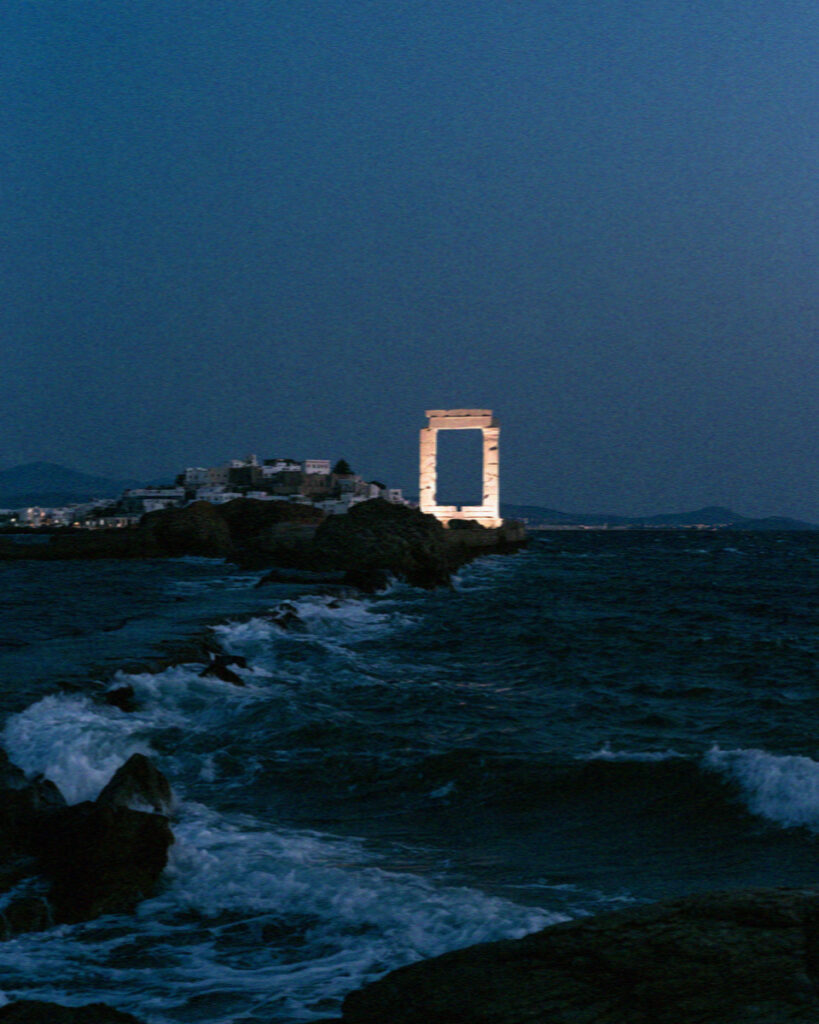
Then Naxos comes up on the port side, and what you see before the town is a single marble doorway standing on a rock in the harbour with the sea showing straight through the middle of it.
It is called the Portara.
Somebody began a temple here around 530 BC, to Apollo, or to Dionysus depending on who you ask, and then stopped. The doorway is all that was ever finished: three pieces of island marble, the lintel alone something like twenty tonnes, set on the little islet of Palatia which a causeway joins to the town in a two-minute walk.
Everything else that was quarried for it went into other buildings over the centuries.
People took the temple away in pieces and left the entrance because the entrance was too heavy to move.
I went out to it before I found my room, carrying a bag that was much too full, and I was not the only one. There were perhaps thirty of us out on that rock, all pointing cameras at a rectangle of nothing.
It should have been ridiculous.
It was not.
I have thought about why.
A doorway frames whatever is behind it, and what is behind this one is the whole Aegean and, on a clear afternoon, the low grey shape of Delos on the horizon, which is where Apollo was supposed to have been born.
Whoever set those stones set them facing his birthplace.
They got that part right and then ran out of whatever it takes. Money or nerve or time.
And somehow the unfinished thing has outlasted every finished thing around it.
The town behind the harbour is a different problem entirely.
Naxos Chora has a Venetian walled quarter called the Kastro, built after 1207 when a Venetian called Marco Sanudo turned up and declared himself Duke of the Archipelago, which is the sort of job title you can only give yourself.
The lanes inside it are vaulted in places, so you walk from bright glare into cool shadow and out again, and the surface underfoot changes from paving to worn marble without warning.
I got lost twice on purpose and once by accident, which is a different feeling.

The marble is the thing nobody tells you about Naxos.
It is everywhere, and not as monument.
It is the doorstep, the windowsill, the chipped step outside a shop selling sponges, a slab propped against a wall waiting to be something.
There are ancient quarries in the hills where half-finished statues are still lying where they cracked, and I am going up there this week.
A mason had his workshop open on the lane behind the cathedral and the floor was white with dust, fine as flour. The whole place smelled faintly of stone and cut water.
I stood in the doorway longer than was polite.
It reminded me of rosin, which is not an obvious comparison, but anybody who has spent a morning practising in a small room will know the particular way a fine pale dust settles on everything and refuses to be tidied away.

Then I did what you do.
I put the bag in the room and walked the five kilometres out to Agios Prokopios and got in the sea.
The sea in the first week of October is warmer than it has any right to be, warmer certainly than the air by six in the evening. The beach is long and pale and shelves so gradually that you walk out and out before it takes your weight.
I swam until my arms complained and then floated on my back and listened to the water move past my ears, which is the only sound I know that is genuinely nothing.

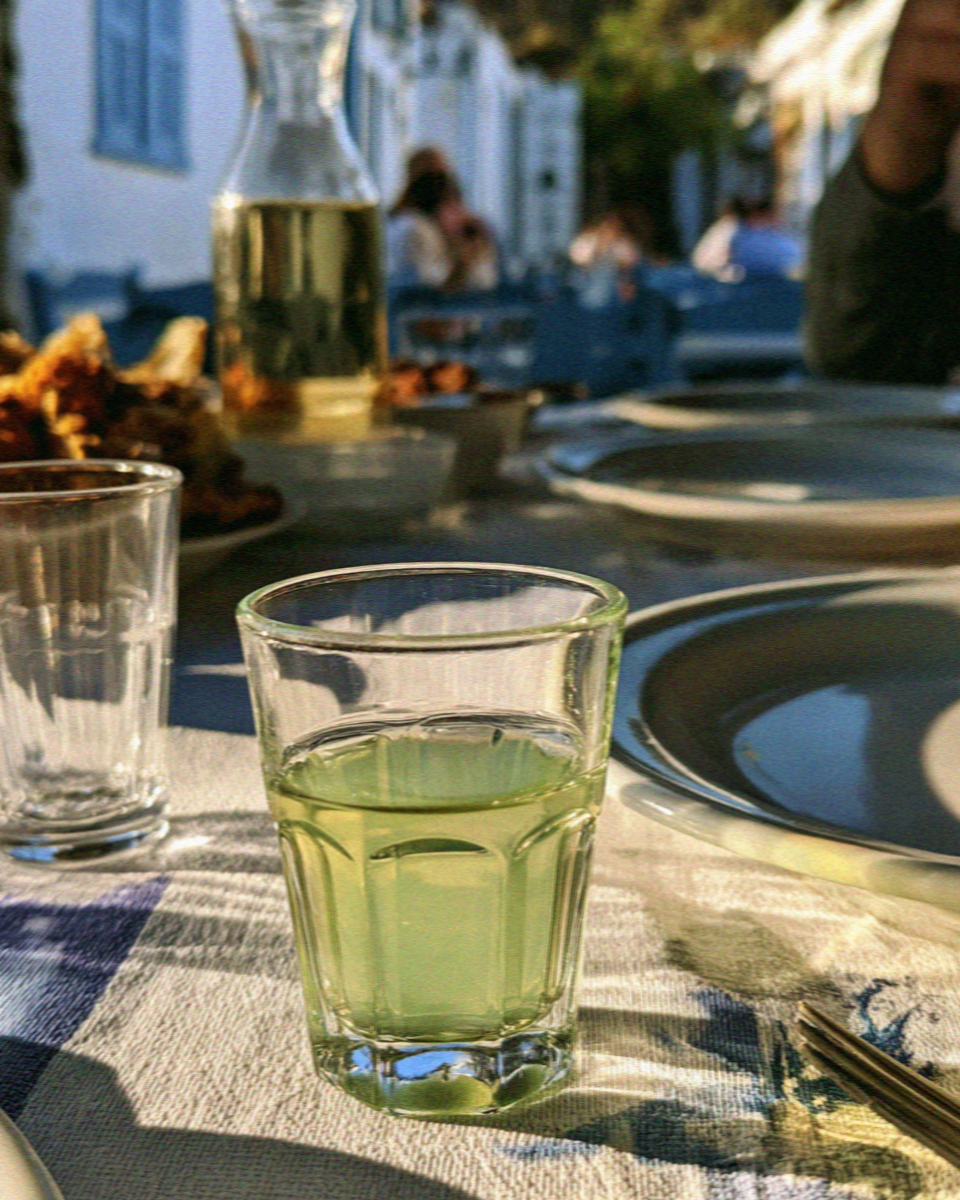
In the evening a woman at the next table explained kitron to me, unprompted and at some length.
It is a liqueur made here from the leaves of the citron tree rather than the fruit, three strengths, green and yellow and clear, and she was firm that the green is the only one worth drinking.
She was also firm that Naxian potatoes are better than any other potatoes in Greece and that I would understand this tomorrow.
Her husband looked at the sea throughout and contributed nothing.
I drank the green one.
It tasted like lemon leaves and worked exactly as intended.
I had a ferry booked onward for Thursday.
I have moved it.
I want to see the quarries, and I want to walk up Mount Zas, which is a thousand and four metres and the highest point in the Cyclades, and I want to be in the Kastro at the hour when the shops put their lights on.
None of that fits into two days.
The doorway is lit at night.
I can see it from where I am writing this, a bright rectangle with nothing behind it but dark water, and I still cannot decide whether that is a monument to ambition or to giving up.
V.