
Here is the difficulty with Pompeii, and it is not a difficulty you have at most ruins.
The site is enormous, largely unlabelled at the level of detail that matters, and almost entirely legible only if you already know what you are looking at. A Roman house presents as a series of rooms off a courtyard. Which room was for receiving clients, which was the dining room angled to catch the evening, which was where the household shrine stood, what the hole in the floor was for, why the shop at the front opens onto the street but connects to the house behind it: none of that is written on the wall.
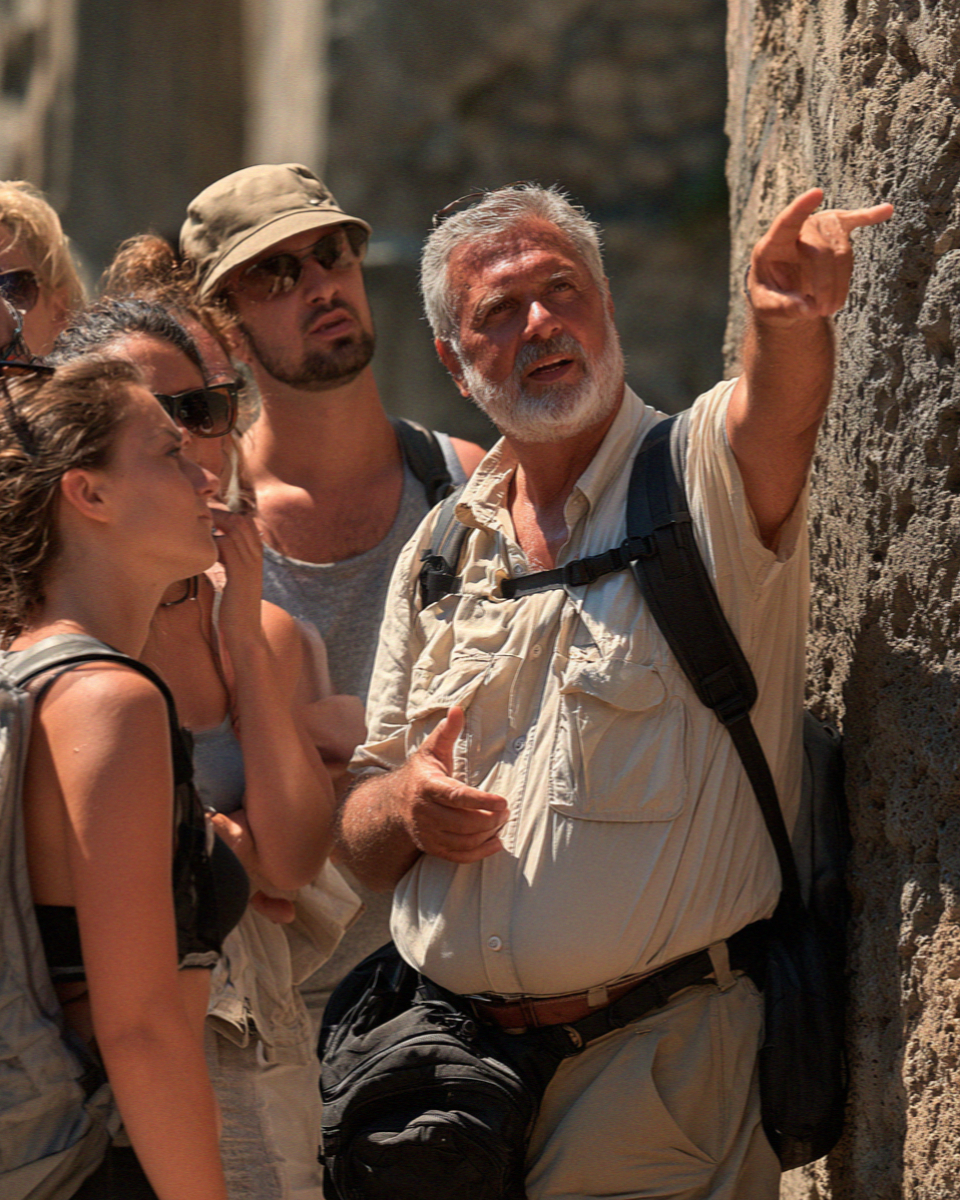
You can walk past forty houses and see forty sets of rooms. Or somebody can spend six minutes on one house and you will read every house after it differently.
That is what a guide is for. Whether you need one is a separate question.
The case for a guide
Pompeii is a place where knowledge changes what you see, more than at almost any other site.
The stepping stones in the street are a good small example. Everyone photographs them. Rather fewer people know the gaps between them were sized so cart wheels could pass, that the street surface below was where water and waste ran, or that you can read the traffic direction of a Roman street from which stones are worn.
Multiply that by an entire city and you understand the argument.
A good guide also solves the routing problem. Sixty-six hectares with a paper map and no phone signal is a genuinely confusing place to be. Guides walk a sequence that builds, rather than the wandering loop most people end up doing.
And they get you into things. Guided groups often have access to houses that rotate their opening, and know which are actually open today rather than which are on the map.
The case against
Pace. A guided tour moves at the speed of its slowest member and stops where the guide stops. If you are the sort of person who wants to stand in one room for ten minutes because the light is doing something, a group will frustrate you.
Volume. Two hours of continuous information is a lot, and most people retain a fraction of it. There is a version of the guided visit where you learn a great deal and experience very little.
Quality is a lottery. The good ones are archaeologists and they are extraordinary. The ones touting at the gate are not always that, and the difference between the best and worst guided experience at Pompeii is enormous.
Cost. Entry is around twenty euros for the ancient city. A guided visit with an archaeologist is sold by private operators, not the park, and typically lands somewhere between forty and sixty per person with the ticket bundled inside. Not prohibitive, but multiply it by four and it becomes a real decision.
The middle options, which most people should take
There are two, and the park sells one of them itself.
The park’s own thematic itineraries. Roughly ninety minutes, eight euros on top of your entrance, on a set theme such as civic Pompeii or daily Pompeii. This is the cheapest way to get real interpretation from someone who works for the site rather than for a booking platform, and it is short enough that you still have most of the day to yourself afterwards. It is also the option almost nobody knows exists, because it is not what the resale sites are selling.
An audio guide. The park no longer bundles one into an entry ticket, so this now means either renting a device at the site or, far more commonly, using one of the app guides on your own phone with headphones. Budget a few euros rather than a few tens.
Either way you get the interpretation without the pace problem: you stop when you want, skip what bores you, and stand in the tepidarium for as long as you like.
For a first visit by someone who reads signs and likes their own company, this is the right answer far more often than either extreme.

How to choose, honestly
Take a guide if it is your first visit and you know little about Roman life, if you are short on time and want a shaped route rather than a wander, if you are travelling with teenagers who will engage with a person and not with an app, or if you have a real interest in the archaeology and want somebody to ask questions of.
Go alone with audio if you have read anything at all about Pompeii, if you value stopping when you want to stop, if you are travelling with a small child whose schedule will not survive a fixed group, or if you have been before.
Go alone with nothing if you have been before and you want the place rather than the information. There is a real pleasure in walking Pompeii with no commentary at all, and I would recommend it, but not the first time.
What to read instead, if you would rather do neither
If the idea of both a group and an earpiece puts you off, an hour of reading beforehand does most of the same work.
You do not need scholarship. You need four things in your head before you walk in, and they are these.
How a Roman house was arranged. Entrance corridor, then a central hall open to the sky with a shallow basin under the opening to catch rain, then rooms off it, then usually a colonnaded garden behind. Once you have that shape, every house on the site resolves into it, and the variations start to mean something.
What the street furniture is for. The raised blocks are crossings. The gaps are wheel width. The channels carried water and waste. The fountains at junctions were the water supply for everyone who did not have it piped.
Who lived here. Not emperors. A prosperous provincial town of somewhere around ten to twenty thousand people: bakers, fullers, innkeepers, garum merchants, and a wealthy class who decorated hard because they were newly rich. The showiness is the point.
What happened, in what order. Tremors for days beforehand. Many people left. Then hours of falling pumice, roofs collapsing under the weight, and only afterwards the surges that killed those who had stayed. The sequence explains what you see: crushed upper floors, and casts of people who died above the pumice layer rather than beneath it.
That is genuinely enough. With those four things, an unguided visit stops being a walk past broken walls.
If you do take a guide
Book a small group or a private one. The difference between a group of eight and a group of thirty is the difference between asking questions and following an umbrella.
Book an archaeologist if the option exists. It usually costs a little more and it is a different experience.
Book in advance rather than at the gate. The people selling tours in the piazza outside are a mixed proposition, and you have no way to assess them in the ninety seconds you have.
Two hours is the standard length and it covers the highlights. It does not cover the site. Plan to stay on afterwards and walk the quieter parts yourself, which is when the tour pays off, because you will now be able to read what you are looking at.
That last point is the one worth carrying: the best value in a guided tour at Pompeii is not the two hours of the tour. It is the two hours after it.
Frequently Asked Questions
Do you need a guide for Pompeii?
You do not need one, but Pompeii rewards interpretation more than most sites because so little is explained on the ground. A first-time visitor with no background in Roman life will get considerably more from a guide or an audio guide than from walking it cold.
Is an audio guide enough for Pompeii?
For most people, yes. An app guide on your own phone costs a few euros and gives you the interpretation while letting you set your own pace. Worth knowing too that the park runs its own ninety-minute thematic itineraries for eight euros on top of entry, which is the best-value guided option at Pompeii and the one fewest visitors have heard of.
How much does a guided tour of Pompeii cost?
Entry itself is around twenty euros for the ancient city and twenty-five with the suburban villas. Guided tours are run by private operators rather than the park, and a small-group visit with an archaeologist usually falls between forty and sixty per person with the ticket included. Private guides cost more. The park’s own thematic itineraries, at eight euros plus entry, sit well below all of it.
Should I book a Pompeii guide in advance or at the gate?
In advance. Guides selling tours outside the entrance vary widely in quality and you have no way to judge them on the spot. Booking ahead also lets you choose a small group or an archaeologist-led visit.
How long is a typical guided tour of Pompeii?
Around two hours, covering the Forum, the main street, a couple of houses and the baths. That is the highlights rather than the site, so plan to stay on afterwards and walk the quieter areas yourself, which is when the tour earns its money.
Read also: How to Visit Pompeii: Tickets, Entrances and Skipping the Queue | How Long Do You Need in Pompeii? | The Ancient Ruins of Pompeii: Everything You Need to Know