There is only one decision that matters in Taormina, and it is not which hotel.
It is up or down. The old town sits two hundred metres above the sea, the beaches are at the bottom, and a cable car joins them. Staying at the top and staying at the bottom are two different holidays in the same postcode, and choosing wrong is the thing people regret.
Here is the honest version of both. The wider planning is in my complete guide to Taormina.
Staying in the old town
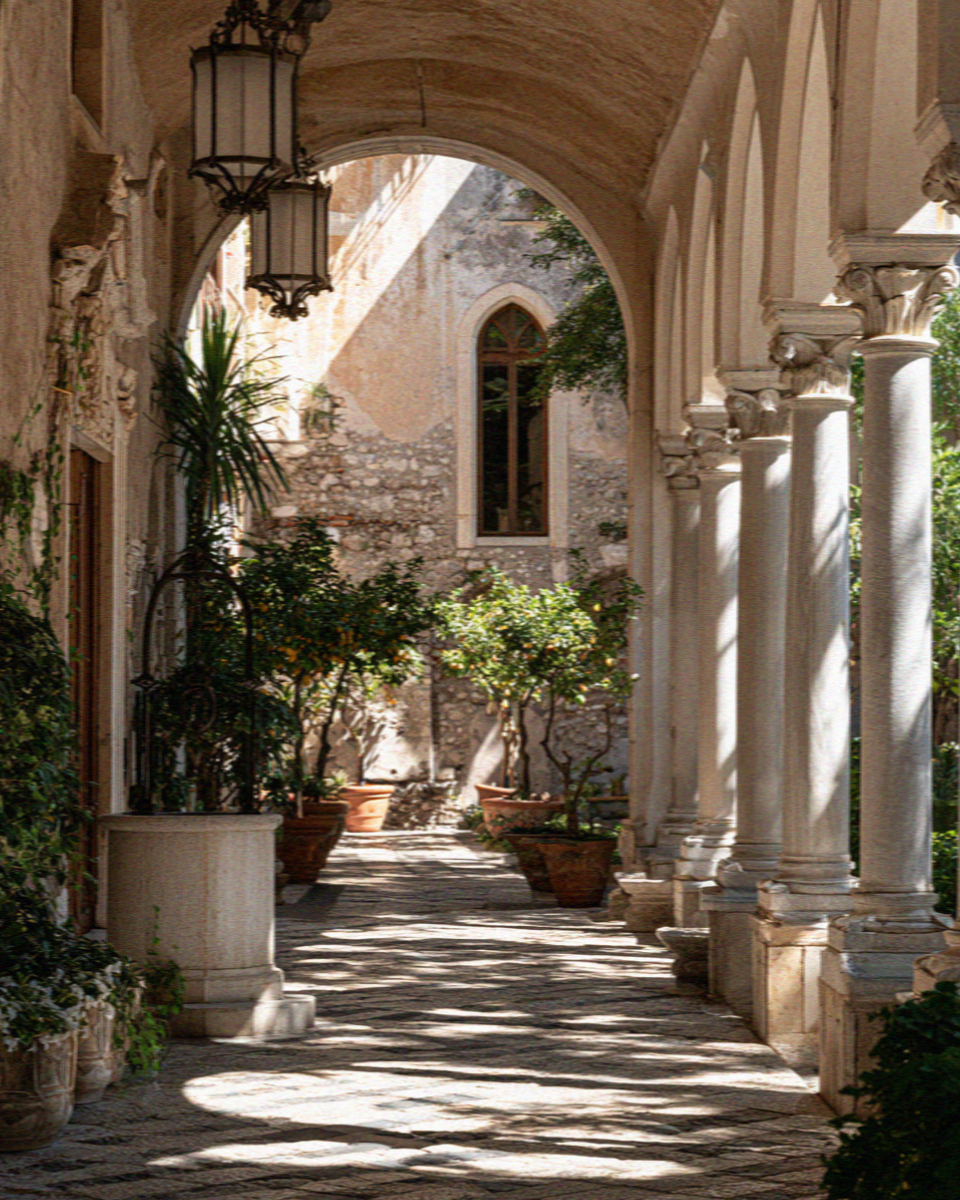
This is the atmospheric choice and, for a first visit, usually the right one.
You get the theatre ten minutes’ walk away, the lanes, the shops, dinner at nine and the passeggiata outside your door. You get views over the coast from breakfast. You get to come back to the room in the middle of the day when the heat is bad.
What you do not get is a beach. Every swim involves the cable car, a bus or a taxi.
And you get steps. Taormina is built on a slope. Lanes turn into staircases without warning, and the pretty places are usually the ones with the most of them. Before booking, ask the property two questions: how far is it from where a taxi can stop, and how many steps. Good places answer plainly.
The grand end of this is remarkable. There is a fourteenth-century convent turned into a Four Seasons, with a cloister, an old well and lemon trees in the courtyard, and there is an 1873 grand hotel sitting directly beside the theatre with a literary terrace people have been drinking aperitivo on for a hundred and fifty years. Both are expensive, both are genuinely special, and both book out six to nine months ahead for July and August, partly because a television series was filmed at one of them and demand has not come back down since.
Below that there is a good middle band: small hotels in converted townhouses, and B&Bs up staircases with roof terraces that cost a fraction and see the same volcano.
Staying down at the water

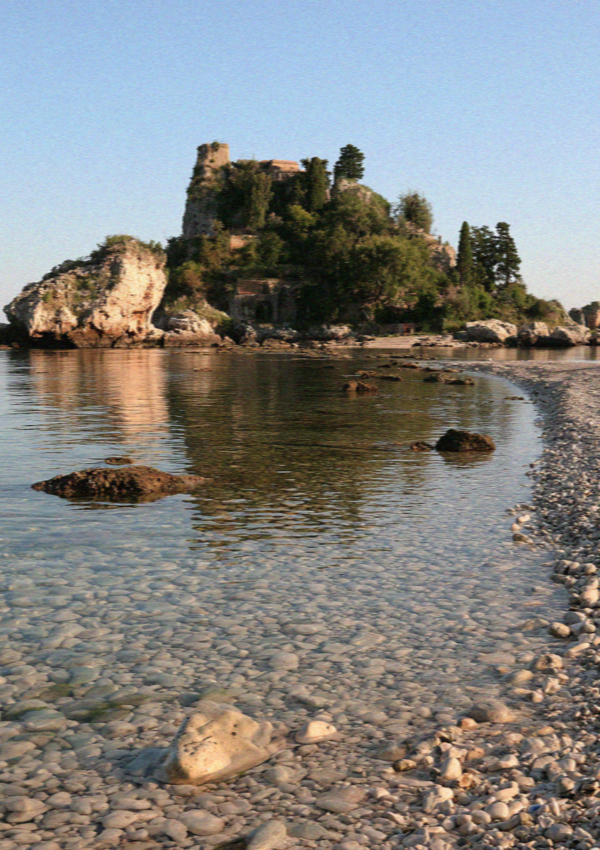
Mazzarò, Isola Bella and Spisone sit at the bottom of the cliff, and Giardini Naxos runs along the coast beyond.
You swim off the doorstep. You get a terrace over the water rather than over the roofs. In August you are twenty degrees more comfortable at four in the afternoon than anyone in the old town.
The trade is that the evening requires effort. Dinner in the old town means the cable car up and back. In summer that is easy, because it runs until roughly half past one in the morning. In winter it stops around eight, which changes everything.
Worth knowing: the beaches down here are pebble, not sand. Very clear water, steep cliffs, smooth grey stones. If your picture of a beach holiday involves sand, look at Giardini Naxos instead, which is a proper long golden beach with the volcano visible down the shore, or Letojanni north of it, which is quieter.
Giardini Naxos, and why people end up there
It is a separate town along the bay, and it is the value option without being a compromise.
Sand rather than pebbles, a long seafront, far more choice at every price, and prices maybe a third below Taormina for the same standard. It has its own restaurants and its own evening, and the bus or a taxi gets you up to Taormina in fifteen or twenty minutes.
It is less beautiful than Taormina. It is much better for families, for longer stays and for anyone who wants to swim properly rather than photograph a cove.
What to ask before you book
Where can a taxi actually stop, and how far is the walk from there. In the old town this is the whole question.
How many steps, and is there a lift. Many buildings have neither.
Is there air conditioning, and does it work in August. In old stone buildings this varies enormously.
How far to the cable car station, if you are staying up and intend to swim.
Does the room face the sea or an internal lane. In a tightly packed hill town the difference between a view room and a non-view room is the entire experience, and the price gap is usually justified here in a way it often is not elsewhere.
Which one for whom
First visit, two or three nights, no small children: old town. The evening is what you came for.
Beach holiday, a week, hot months: down at the water, or Giardini Naxos.
Families: Giardini Naxos, almost every time. Sand, space, level ground, and prices that let you stay longer.
Photographers: old town, high up, facing south along the coast so you get the volcano.
Winter: old town, because the cable car stops early and the seafront half of the resort largely closes.
The view room question, and when it is worth it
In most Italian towns I would tell you to skip the view supplement and spend the money on dinner. Taormina is the exception.
The reason is what the view actually is. You are two hundred metres up on a cliff facing east and south, so a sea-facing room gives you sunrise straight out of the water, the whole curve of the bay, and Etna down the coast. It is not a slice of blue between two buildings. It is the entire reason the town became a resort in the nineteenth century.
The rooms facing the other way look at a stone lane a few metres across, and some of them get very little daylight at all.
So here the supplement usually is worth paying, and if it is not in budget, the better move is to drop a category of hotel and keep the view rather than the reverse.
One caveat. A terrace is worth more than a window here, because the evenings are long and warm and you will use it. Ask specifically whether the room has usable outdoor space or just a French window, since listings blur the two.
A note on air conditioning and old buildings
Worth asking directly, because Taormina’s most characterful buildings are its oldest.
Converted convents, medieval townhouses and nineteenth-century villas were built with thick stone walls and small windows, which handles heat far better than modern construction but does not handle it perfectly in August. Retro-fitted air conditioning in a listed building is often modest, and in some rooms it is a single unit doing more work than it can.
If you are coming in July or August, ask whether the room has air conditioning, whether it is in the bedroom itself, and whether the windows open. Cross-ventilation at night matters here as much as the unit does.
Read also: the best beaches near Taormina, the best time to visit Taormina, and my complete guide to Taormina.
Frequently Asked Questions
Should you stay in Taormina town or by the beach?
The old town if you want the theatre, the lanes and the evening, and you do not mind a cable car ride to swim. Down at the water if swimming is the point of the trip. In summer the cable car runs until about half past one in the morning, which makes staying at the beach far more workable than it sounds.
Is Taormina expensive to stay in?
It is the most visited town in this part of Sicily and prices accordingly, though it sits below the Amalfi Coast. The famous hotels are genuinely expensive and book six to nine months out for July and August. Giardini Naxos along the bay runs roughly a third cheaper for a similar standard.
Are the beaches in Taormina sandy?
No. Isola Bella, Mazzarò and Spisone are pebble beaches with very clear water and cliffs behind them. For sand you want Giardini Naxos, which is long and golden with the volcano visible down the coast, or Letojanni to the north.
Is Giardini Naxos a good place to stay?
Yes, particularly for families or longer stays. It has the sand, the space, level ground, its own restaurants and prices well below Taormina, and it is fifteen to twenty minutes up to Taormina by bus or taxi. It is less beautiful, and it is much more practical.
How many steps are there in Taormina?
Enough that it is a real booking question. The old town is built on a slope and lanes turn into staircases without warning, often with no lift at the other end. Ask any property how far it is from where a taxi can stop and how many steps are involved before you commit.