There is one thing to know before anything else, and it is the thing that turns people away at the barrier every week.
You cannot buy a ticket for the crater at the crater. There is no ticket office on the mountain. Access to the Gran Cono is by pre-booked timed entry only, bought online in advance through the park’s own platform. Tickets are released about a month ahead in small batches, roughly fifty per ten-minute slot, and they sell out in high season. If you drive up on a whim in July you will get as far as the car park and no further.
There is one thin lifeline, and it is worth knowing rather than relying on: a further handful of tickets is released half an hour before each slot, and those can only be bought over the wifi network at the entrance. That is a last resort, not a plan.
The entry itself is cheap, around ten euros plus a booking fee, with a reduced rate a little under that. The cost of Vesuvius is never the ticket. It is the getting there and the not having booked.
I am starting with that because the mountain is visible from everywhere in Pompeii, and looking at it all day tends to produce exactly that whim.
What the climb actually is
Less than people imagine, and that is not a criticism.
You do not climb Vesuvius from the bottom. A road takes you to a car park high on the cone, and from there a wide gravel path switchbacks up to the rim. The walk is twenty to thirty minutes at an unhurried pace, on loose grey volcanic gravel with a rope handrail on the drop side.
It is not technical and it is not long. It is, however, all uphill, at altitude, in full sun, on a surface that gives slightly under every step. People in unsuitable shoes have a miserable time. People who assume it is a stroll because it is short arrive at the top redder than they expected.
Once you are up, you get around an hour and a half at the rim. That is generous. Most people use forty minutes of it.
What you see
A grey bowl, several hundred metres across, with sides of loose rust and ash and yellow sulphur staining, and steam coming out of vents in the rock in thin threads.
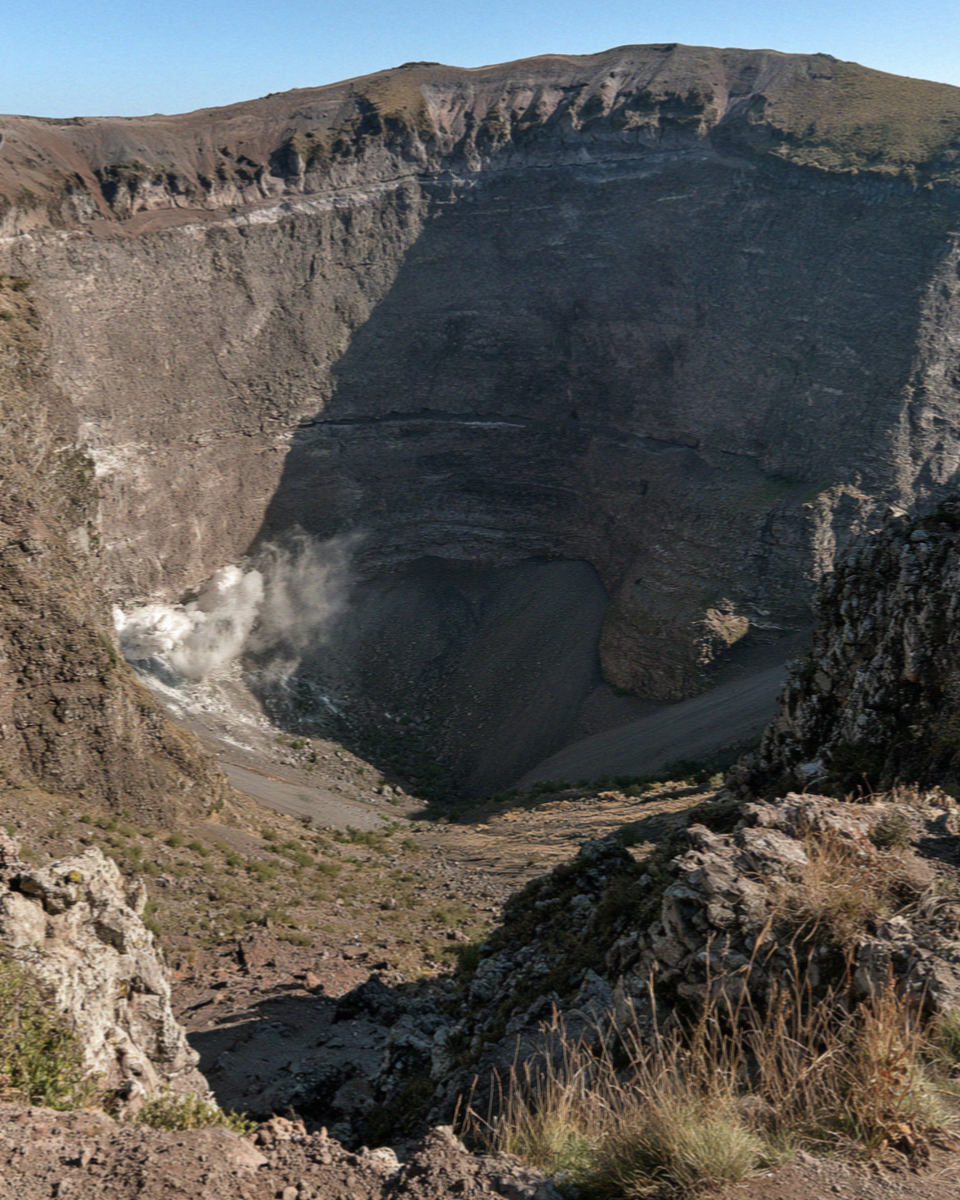
It is not beautiful in the way the bay below it is beautiful. It is bare and industrial and slightly ugly, and that is precisely why it works. You have spent the morning in a city this thing erased. Now you are standing on the rim of it looking into the throat, and the ground is warm, and there is sulphur in the air.
The view outward is the other half. On a clear day the whole Bay of Naples lays itself out below: the city sprawling north, Sorrento on its peninsula, Capri floating off the end of it, and the coast running south. You can see, in one sweep, roughly three million people living inside the hazard zone of the mountain you are standing on.
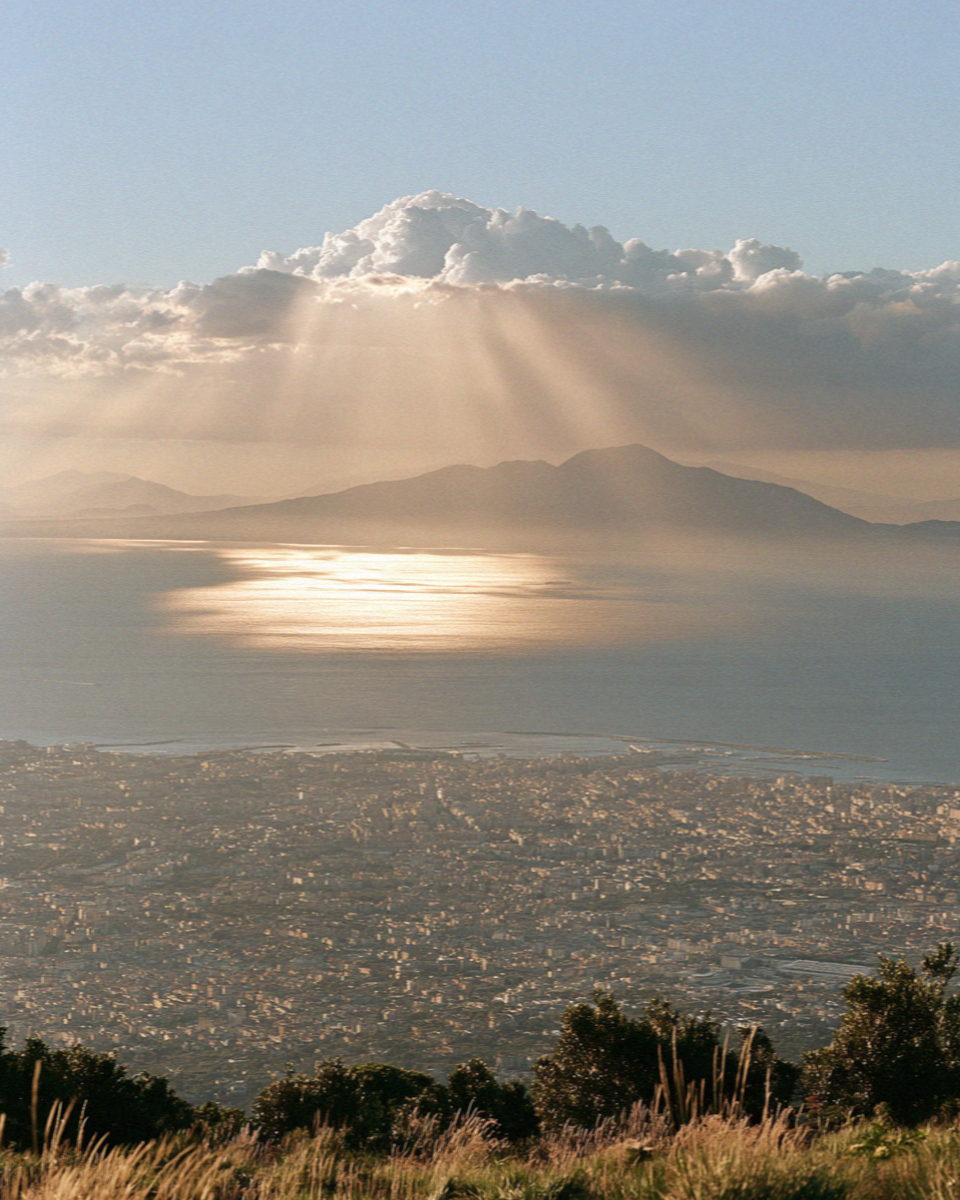
That is the thought you take home. Not the crater. The arithmetic.
Booking it properly
Book online, in advance, for a specific time slot. Entry is capped and released in small groups every few minutes. Two or three days ahead is the minimum in summer; a couple of weeks is more comfortable.
Arrive inside your window. The slot is enforced. Turning up more than half an hour late can mean being refused entry with no refund, which is a bad end to a good day.
Pick your slot with the light and the heat in mind. Early morning is cooler and clearer. Cloud tends to build over the summit through the afternoon, and a slot at two o’clock in August can mean climbing in full heat to look at fog. If you want the bay view, go early.
Check the mountain is open. The park closes the crater path in high wind, storms and occasionally snow, sometimes at short notice. It is worth a look at the forecast the night before.
Getting there from Pompeii
This is the part that makes the combination work, and it is easier than most people assume.
A bus service runs from Pompeii up to the Vesuvius car park, picking up at the Piazza Anfiteatro entrance, at the Villa dei Misteri Circumvesuviana station and at Porta Marina. The journey up takes roughly an hour, most of it climbing through the national park on a road with a lot of hairpins.
From Ercolano there is an equivalent shuttle from the Ercolano Scavi station, which is the shorter approach and the one to use if you are pairing the mountain with Herculaneum rather than Pompeii.
Driving works too, and there is parking at the top, but the road is narrow, busy in season, and the parking fills. On balance the bus is less trouble than the car.
Building the day around it
Pompeii in the morning, Vesuvius in the afternoon. This is the standard shape and it is standard because it works. Gates at nine, four hours in the ruins, out by one, bus up, crater slot mid-afternoon, back down by early evening. It is a long day and a satisfying one.
The weakness is that afternoon summit cloud, and the fact that you climb a volcano on tired legs.
Vesuvius first, Pompeii after. Less common and arguably better in summer. An early crater slot gives you the clear view and the cool air, you are down by late morning, and you arrive at Pompeii in the afternoon when the coach parties are thinning out. The cost is that you hit the ruins in the hottest part of the day.
Herculaneum and Vesuvius. The best pairing of all if you only have one day and do not mind skipping Pompeii. Herculaneum takes two to three hours, the shuttle leaves from the same station, and the two together make a genuinely relaxed day rather than a forced march.
Do not attempt all three. Pompeii, Herculaneum and the crater in one day is theoretically possible and practically wretched. Something gets rushed, and it is usually the thing you travelled for.
Practical notes
Wear proper closed shoes with a sole that grips. The gravel is loose and it gets into everything.
Take a layer. It is meaningfully colder and windier at twelve hundred metres than at the car park, and considerably colder than in Pompeii.
Take water. There is a kiosk near the top but it is a captive market and the queue is long.
There is no shade on the path at all.
The last thing: the mountain last erupted in 1944, it is classed as dormant rather than extinct, and the scientific consensus is that it will erupt again on a timescale nobody can name. Standing on the rim reading that on a sign, with Naples spread out below, is the single most effective history lesson available in Campania.
Frequently Asked Questions
Do you need to book Vesuvius tickets in advance?
Yes, and this is the most important thing on this page. Crater access is by timed slot booked online, tickets are not sold at the gate, and slots sell out in high season. Book at least two or three days ahead in summer.
How hard is the walk to the Vesuvius crater?
Short but not effortless. It is twenty to thirty minutes uphill from the car park on loose volcanic gravel with no shade. There is nothing technical about it, but you want proper shoes and you should not treat it as a stroll in August heat.
How do you get to Vesuvius from Pompeii?
A bus runs up to the car park from the Piazza Anfiteatro entrance, the Villa dei Misteri station and Porta Marina, taking around an hour. From Ercolano there is a shorter shuttle from the Ercolano Scavi station.
Can you do Pompeii and Vesuvius in the same day?
Comfortably. Pompeii from opening until early afternoon, then the bus up for a mid-afternoon crater slot. If you want the clear bay view, consider reversing it and taking an early slot on the mountain instead, since cloud often builds over the summit later in the day.
Is Vesuvius worth it if I have already seen Pompeii?
If you have never stood on the rim of an active volcano, yes. The crater itself is bleak rather than pretty, but seeing the mountain from the inside after seeing what it did, with three million people living below you, reframes the whole day.
Read also: The Pompeii Day Trip: From Naples, Sorrento, Rome and the Amalfi Coast | Pompeii or Herculaneum: Which Should You Visit? | The Ancient Ruins of Pompeii: Everything You Need to Know