Matera has one problem as a subject, and knowing it in advance is most of the job: the town cannot be photographed from inside itself.
Stand anywhere in the Sassi and you are too close and too low. What you can see is a wall, a lane, a doorway. The stacked shape that makes the place famous only assembles from across the ravine, or from a handful of terraces at the right height. So the list below is really a list of six positions and the hour each one wants.
The rest of the planning is in my complete guide to Matera.
1. The view from the other side
Hour: the last ninety minutes of daylight, or the first hour after dawn.
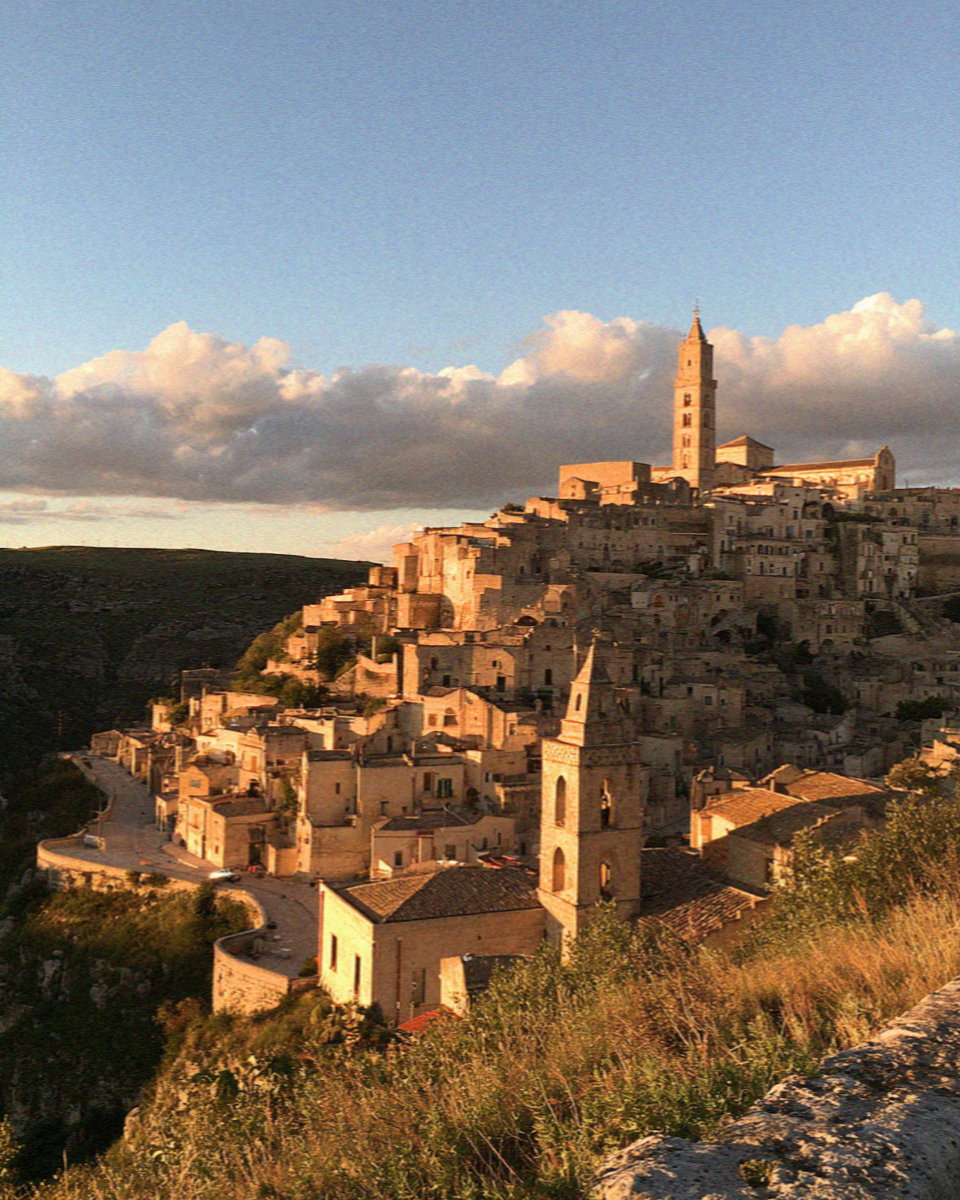
Every photograph of Matera you have ever seen was taken from the far rim of the gorge, on the Murgia plateau. From there the whole town stacks up in one frame, the ravine drops away in shadow beneath it, and low sun rakes across the tiers and separates them.
You reach it on foot by descending into the ravine, crossing a suspension footbridge and climbing the far side, roughly four kilometres round trip and about ninety minutes. Or you drive round in fifteen.
For evening light you want to be in position early, since the sun goes behind the plateau you are standing on and the town holds light for a while after you have lost it. The walk detail is in the Belvedere and the Murgia park.
2. The terraces on the Barisano side
Hour: dusk, and the twenty minutes after it.
The restored half of the Sassi has a series of terraces and belvederes looking back across the district. They are level, easy to reach, and they are where you want to be when the lights come on.
What happens at dusk here is unusual enough to plan around. Because the houses are stacked, the lights do not come on along a street. They come on up a wall, tier after tier, hundreds of small warm openings in what is essentially a cliff, with the gorge going completely black below.
3. Sasso Caveoso at first light
Hour: the first hour after sunrise.
The rougher southern half, before anybody is up. Shutters down, no people, and long hard shadows cutting diagonally across pale stone.
This is where you get the photographs that are about texture rather than panorama: worn steps, an open cave mouth, a rusted iron ring, a lane narrowing into shade. It is also the only time you will have it to yourself.
4. The doorways

Hour: any time with strong side light.
Once you notice the doorways you will not stop. They are cut straight into the rock face, the surrounds worn round at the edges by centuries of hands and shoulders, some with iron rings, some bricked up, some opening onto nothing at all.
Shoot them tight. This is the detail work that makes a Matera set feel like a place rather than a postcard, and it is the sort of frame that carries the whole story of the town in one image.
5. The Civita from below
Hour: late afternoon.
The rock spur between the two Sassi, seen looking up from either side, gives you the vertical version of the town: houses on houses on rock, with the cathedral tower on top of the whole stack.
It is the best answer to the problem of photographing Matera from inside it, because looking up works when looking across does not.
6. After dark, from the ridge

Hour: an hour after sunset, and it wants a tripod.
Once full night arrives, the ravine disappears entirely and the town becomes a floating grid of warm windows in blackness. Blue hour gives you sky as well as lights, which is generally the better photograph; true night gives you the stranger one.
7. The frames the films already found
Matera has been shot as ancient Jerusalem so often it is nicknamed cinema’s Little Jerusalem, and the locations scouts got there long before any of us did. Their choices are worth borrowing, because they were made by people with time and a budget.
The lanes of Sasso Caveoso carried the procession of the cross in The Passion of the Christ, and the rock church of San Nicola dei Greci held the Last Supper. Ben-Hur used the town as Jerusalem outright, Wonder Woman used it for Themyscira, and No Time to Die ran an Aston Martin through it.
What they all share is the same instinct: shoot the town from slightly below, so the tiers stack up the frame and the horizon disappears. Stand in a lane and look up rather than along, and you get the shot that reads as a whole civilisation rather than a street.
A note on photographing people’s houses
Three thousand people live in the Sassi, and this is the thing most guides leave out.
The lanes are not a site, they are addresses. Doorways that photograph beautifully are front doors, and the small courtyards off the steps are somebody’s yard. In the early morning, when the light is best, you are also walking past open doors at breakfast time.
Shoot the architecture freely and the interiors sparingly, ask before you photograph a person, and step out of a doorway when somebody needs to use it. It costs nothing and it is the difference between a photographer and a nuisance.
Practical notes
Light direction matters more than usual here. The two Sassi face opposite ways, so one of them is always in flat light while the other is not. Broadly: Caveoso in the morning, Barisano in the evening.
The stone is very bright. Expose for the highlights or the pale limestone will blow out and take the texture with it, which is the whole reason you are photographing the place.
Wear proper shoes. The paving is polished stone worn smooth over centuries, and it is treacherous in the wet, particularly if you are moving fast at dusk to catch light.
And in July and August, forget the middle of the day. The light is flat and vertical, there is no shade to shoot from, and the heat holds from about nine until six. Shoot early, shoot late, sleep in between.
Read also: the Sassi of Matera, the best time to visit Matera, and my complete guide to Matera.
Frequently Asked Questions
Where is the classic view of Matera taken from?
From the far rim of the gorge, on the Murgia plateau opposite the town. It is the only position from which the whole stacked shape of the Sassi appears in one frame. Reach it on foot in about ninety minutes round trip, or drive round in roughly fifteen minutes.
What is the best time of day to photograph Matera?
Early morning and the last hours of daylight, plus dusk. Sasso Caveoso works best in the morning and Sasso Barisano in the evening, because the two districts face opposite directions. Midday light is flat and, in summer, unbearable.
Can you photograph the Sassi from inside the Sassi?
Only in detail. From within the district you are too close and too low for the famous view, so shoot doorways, steps, textures and the Civita seen from below. The panorama needs the far rim of the ravine or a terrace at height.
Do you need a tripod in Matera?
Only for the night shots. The town lit after dark, seen from a ridge or terrace, is the one photograph here that genuinely benefits from one. Everything else is comfortably handheld.
What should you wear for photographing Matera?
Proper shoes above everything. The paving is polished limestone worn round by centuries of feet, it is slippery when wet, and most of the good positions involve stairs. In summer, add water and a hat, and plan to be out early rather than at midday.