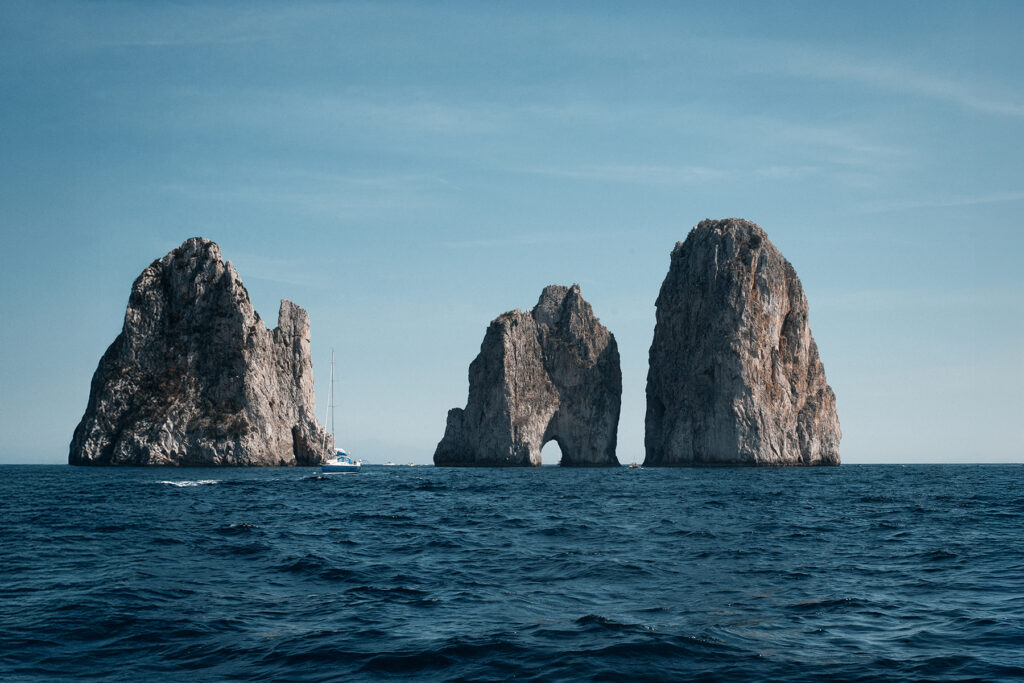
Capri is small enough to walk across and rich enough to fill a week, which is the lovely problem of the island. It packs sea caves, clifftop gardens, a chairlift to the sky and one of the most famous little squares in Italy into a few square kilometres. Here are the things actually worth your time in Capri, roughly in the order a good day falls into, so you can build a visit that hits the icons without spending it all in queues.
What to book before you come
Capri is an island with a coastline that is the whole point of it, and you cannot see that coastline from the town. Everything I would spend money on here happens on the water. Book the boat before you book anything else, and book it for the morning: the Blue Grotto shuts the moment the swell picks up, and the afternoon queue of tenders outside it is a small purgatory.
- Around the island, with the Blue Grotto. The whole coast in one run: the Faraglioni, the arches, the caves the ferries never go near. If you do one thing on Capri, this is it.
- A three hour private boat, with the Blue Grotto. The difference is that you stop where you want and swim when you want, and you are not sitting on a bench behind forty other people. On an island this expensive it is a smaller premium than you expect.
- A small group grotto cruise, with swimming and limoncello. 4.7 from over eight hundred people. The good middle option, and the one I would take with a group of friends.
- Capri and Anacapri on land, small group. For the half of the island that is not the sea. Anacapri is a different place entirely from the Piazzetta, quieter and steeper, and most day trippers never get up there.
- From Sorrento, the full day with transfers. 4.9 from nearly two thousand people. If you are staying on the mainland this removes the ferry queue at Marina Piccola, which in August is the thing that eats your day.
The walk to the Arco Naturale, the Via Krupp when it is open, the gardens of Augustus for a euro or two, and the whole of Anacapri on foot are as close to free as this island gets.
Start in the Piazzetta
Officially it is the Piazza Umberto I, but nobody calls it that. La Piazzetta is Capri’s living room, a tiny square of café tables under a clock tower where the whole island seems to pass through at some point. A coffee here in the morning or an aperitivo in the early evening, watching the crowd, is one of those small Capri rituals worth the inflated bill. From here the smart shopping streets and the paths to the gardens all fan out.
Plan Your Visit to Capri
A few things I booked and loved. These help support the blog, at no cost to you.
- Where I stayed: search Capri hotels
- Blue Grotto and Capri boat tickets
- Stay connected: get a travel eSIM
This section contains affiliate links. If you book through them I may earn a small commission, at no extra cost to you.
The Gardens of Augustus and Via Krupp
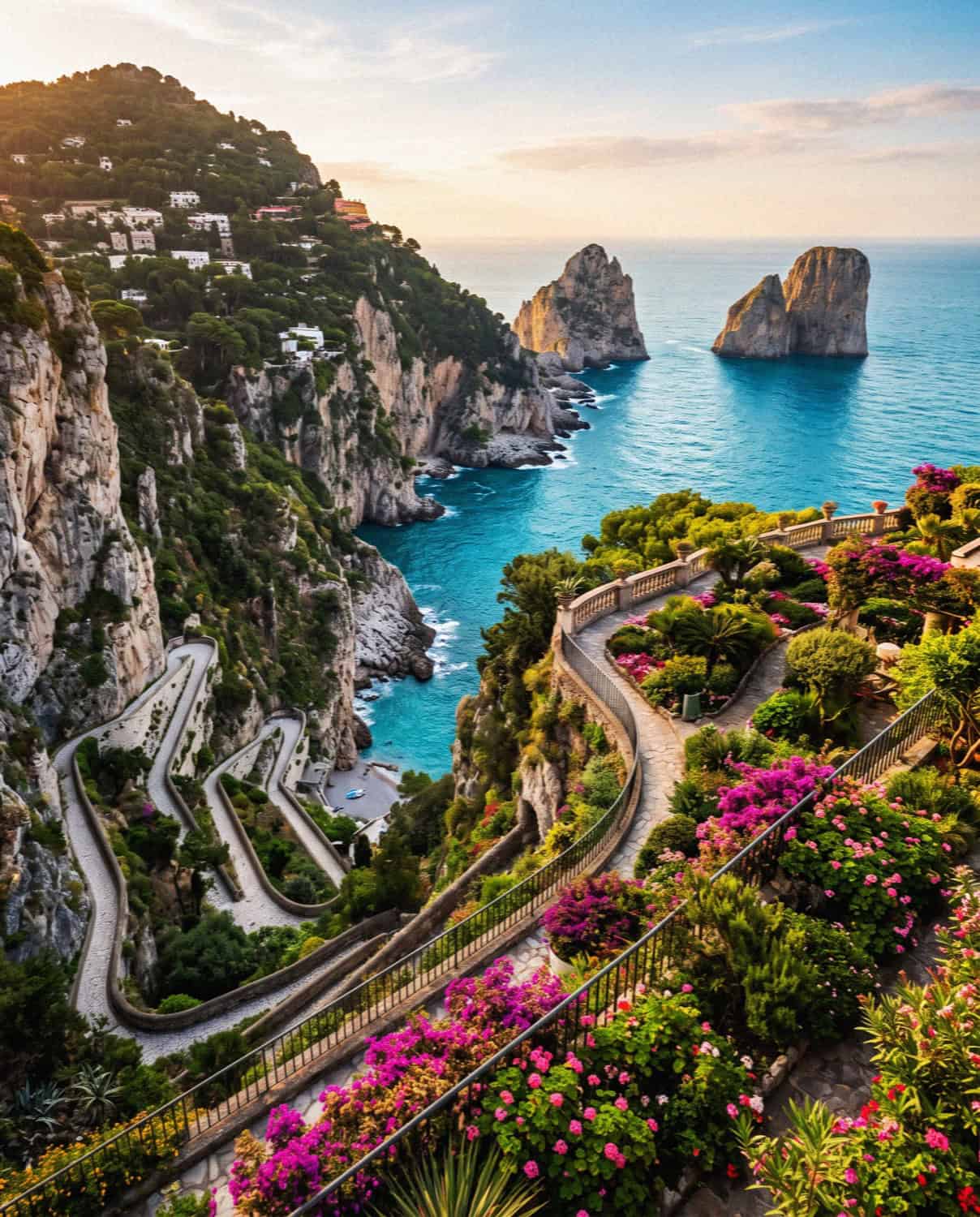
A five-minute walk from the Piazzetta, the Gardens of Augustus (Giardini di Augusto) are a series of flowered terraces with the single best free-ish view on the island: the Faraglioni sea stacks on one side, and the switchbacking ribbon of Via Krupp dropping to the sea on the other. Entry is a token €2.50 from a self-service machine (card or QR only, no cash), and children under 12 go free. Come early morning or late afternoon for soft light and thinner crowds. Via Krupp itself, the dramatic hairpin path carved into the cliff, is often closed for rockfall risk, but even seen from above it is one of Capri’s defining images.
The Faraglioni
Capri’s three limestone sea stacks, the Faraglioni, are the island on every postcard. You can admire them from the Gardens of Augustus, walk down toward them past the beach clubs, or, best of all, take a boat that threads through the natural arch in the middle one, which is said to bring luck to couples who kiss as they pass. Seeing them from the water, rising sheer and golden out of impossibly blue sea, is the moment most people fall for Capri.
The Blue Grotto
The Blue Grotto (Grotta Azzurra) is the island’s most famous single attraction: a sea cave where sunlight entering underwater lights the whole cavern an electric blue. It is genuinely beautiful and genuinely a production, involving a transfer boat, a tiny rowboat, a five-minute visit and often a long wait. It has its own guide because it deserves the planning; in short, go early, bring cash, and accept the queue is part of the deal.
Anacapri and Monte Solaro
The island’s quieter, higher village, Anacapri, is a different mood entirely: whitewashed lanes, fewer crowds, and the departure point for the Monte Solaro chairlift, which lifts you in about 13 minutes to the island’s highest point and a 360-degree view over the Faraglioni, the Bay of Naples and, on a clear day, Vesuvius. Also in Anacapri is Villa San Michele, the exquisite former home of Swedish doctor Axel Munthe, with columned gardens and a famous sphinx looking out to sea.
Get on the water
However you spend your day, spend some of it on a boat. A tour around the island shows you Capri the way it is meant to be seen: the Faraglioni arch, the Green Grotto and White Grotto, hidden coves and the villas clinging to the cliffs. Half-day and private options leave from Marina Grande, and combining a circuit with a swim stop is, for me, the highlight of any Capri visit.
Swim at Marina Piccola
When the heat builds, Marina Piccola is the classic swim: a pebbly cove on the south side with the Faraglioni framed right in front of you. Go in the morning, because the sun slips behind the headland by mid-afternoon and the good spots fill fast. There are beach clubs with sunbeds for hire and a free public stretch between them.
Walk out to Belvedere di Tragara and the Pizzolungo
For a longer, quieter Capri, walk out from the Piazzetta along Via Tragara to the Belvedere di Tragara, a panoramic terrace looking straight down onto the Faraglioni. From here the Pizzolungo path continues around the south-eastern cliffs, passing the startling red cube of Casa Malaparte perched over the sea, one of the most famous modernist houses in the world. The full loop takes around an hour and a half and delivers view after view with a fraction of the Piazzetta’s crowds. It is my favourite walk on the island.
The Certosa di San Giacomo
Tucked below the Gardens of Augustus, the Certosa di San Giacomo is a 14th-century Carthusian monastery, later a prison, now a serene complex of cloisters and gardens housing a small museum of moody paintings by the German artist Diefenbach. Entry is only around €6 (with a combined ticket for the Certosa and the Gardens of Augustus often available, and free on the first Sunday of the month), and it opens roughly 10am to 7pm in high summer, closed Mondays. It is calm, cool, and gloriously uncrowded compared with the streets outside, a lovely place to escape the midday heat and see a different, older side of Capri.
Eat where Capri has always eaten
Part of the pleasure of Capri is a long, unhurried lunch or dinner.

In Capri town, Aurora on Via Fuorlovado is the island’s oldest restaurant, run by the same family for generations and famous for its thin, blistered “pizza all’acqua”; it is the see-and-be-seen table. Down toward Marina Grande, Da Paolino serves dinner beneath a canopy of lemon trees from May to October, one of the most romantic rooms in Italy. And the dish to order anywhere is the one born here: a Caprese salad of buffalo mozzarella, tomato and basil, followed by a torta caprese, the island’s flourless chocolate-and-almond cake.
Frequently Asked Questions
What is Capri most famous for?
The Faraglioni sea stacks, the Blue Grotto sea cave, the glamorous Piazzetta and its designer shopping, and clifftop views from the Gardens of Augustus and Monte Solaro.
How many days do you need in Capri?
You can see the headline sights in a single well-planned day, but one or two nights lets you enjoy the island in the quiet evenings after the day-trippers leave, which is when Capri is at its best.
Is the Blue Grotto worth it?
For many people, yes, for the sheer strangeness of the glowing blue water, but it involves a transfer, a rowboat and often a one to two hour queue. Go early and treat the wait as part of the experience.
How much are the Gardens of Augustus?
Just €2.50, paid by card or QR at a self-service machine (no cash), with children under 12 free. It is the best-value view on the island.
Do you need to book things in Capri in advance?
The Gardens and the chairlift you can simply turn up for. Boat tours and the Blue Grotto are best done early in the day; popular restaurants and beach clubs in peak summer are worth reserving.
Planning the wider island? See my complete guide to Capri for getting there, where to stay and how to pace it.
Read also: Visiting the Blue Grotto | The Best Photo Spots in Capri | The Complete Guide to Capri