Naples wears its heart on the outside. There is no polite distance here, no glass between you and the city; you are simply in it, in the noise and the faith and the football and the fried dough, and it is one of the most thrilling places I have ever spent a day. It is also, quietly, one of Italy’s great treasure houses, stacked with art and ruins and Baroque churches most visitors never reach. Here is what I would not miss, from the marble that will stop your breath to the alley of the Christmas saints.
What to book before you come
Naples itself you walk, and the walking is free and better than anything you could pay for. What you book here is everything within an hour of the city, which is an extraordinary amount: a buried Roman town, a live volcano and one of the great coastlines, all reachable and back before dinner.
- Pompeii and Vesuvius in one day, with lunch. 4.8 from over eight and a half thousand people. Doing both on your own means two trains, a bus up the mountain and a lot of standing about; doing them together is the single best day out of Naples.
- Sorrento, Positano and Amalfi, small group. Nearly eighteen thousand ratings at 4.8, which makes it one of the most booked day trips in Italy. The Amalfi Drive is not a road to drive yourself the first time.
- The street food walk. 4.9 from over five and a half thousand people. Naples invented pizza and fried almost everything else, and a guide is the difference between eating well and eating what is nearest the station.
- Naples Underground. Forty metres down into Greek cisterns and wartime shelters, directly under the streets you have been walking. Book it, because the timed English tours fill.
- Pompeii alone, with ticket, guide and transfer. If you have already done Vesuvius or have no appetite for a volcano in August, this is the shorter version. Pompeii unguided is a very large amount of unlabelled brick.
Spaccanapoli, the Lungomare, the Quartieri Spagnoli and every church door you push open on the way cost nothing. The Veiled Christ at the Cappella Sansevero costs a few euros and is worth every one of them.
Walk Spaccanapoli and the Historic Centre
Start where the city starts: Spaccanapoli, the long, dead-straight street that slices the old town in two. Walking it is the single best thing you can do in Naples, because everything happens along and around it. The lanes are barely a few metres wide, hemmed in by towering tenements strung with washing, opening suddenly onto a piazza or a church or a shrine glittering with candles. This is the UNESCO-listed historic centre, a maze of Greek and Roman ruins, medieval churches and Baroque palazzi all layered on top of one another and thoroughly, gloriously lived in. Do not over-plan it. Get lost, follow the noise, and let it happen to you.
Plan Your Visit to Naples
A few things I booked and loved. These help support the blog, at no cost to you.
- Where I stayed: search Naples hotels
- Pompeii, museums and Naples tickets
- Stay connected: get a travel eSIM
This section contains affiliate links. If you book through them I may earn a small commission, at no extra cost to you.
See the Veiled Christ
If you see one thing in Naples, make it this. Inside the small Cappella Sansevero, near Piazza San Domenico Maggiore, lies the Cristo Velato, the Veiled Christ, carved from a single block of marble by Giuseppe Sanmartino in 1753. Christ lies beneath a veil so fine, so translucent, that no one has ever quite been able to explain how it was done in stone; you can see the body through the marble cloth, every fold and hollow of it. People fall silent in front of it. It is one of the greatest sculptures on earth, and it is here, in a quiet chapel down a Naples side street. Book a timed ticket ahead, because the chapel is tiny and demand is high.
Go Underground
Beneath the roaring city lies a silent one. Napoli Sotterranea, Underground Naples, takes you some forty metres down through the tunnels and cisterns of the ancient Greek and Roman aqueduct, carved out of the soft tufa on which the city stands. Down there, all sense of time falls away, and in places you emerge into the remains of a Greco-Roman theatre reached, extraordinarily, through a trapdoor beneath an ordinary apartment. It is cool, strange and unforgettable, and it makes you understand that Naples is a city built on top of itself many times over.
Wander San Gregorio Armeno

There is a single narrow lane in the old centre where it is Christmas all year round. Via San Gregorio Armeno is lined with the workshops of the presepe makers, the artisans who craft Naples’s famous nativity scenes, and it spills over with tiny hand-painted figures, shepherds and kings and, in true Neapolitan style, caricatures of footballers and politicians alongside the Holy Family. Even in high summer it is magical, and it is one of the most Neapolitan places in the whole city.
Climb to San Martino for the View
Take the funicular up to the Vomero hill and you reach the Certosa di San Martino, a magnificent Baroque monastery that has looked down over the bay since the fourteenth century. Its terraces give you the finest view in Naples: the terracotta rooftops tumbling down to the sea, the whole sweep of the gulf, and Vesuvius rising beyond, with Capri and Ischia floating on the horizon on a clear day. Inside is a jewel-box of Baroque art and one of the world’s great collections of nativity scenes. Next door, the star-shaped fortress of Castel Sant’Elmo gives an even higher, three-hundred-and-sixty-degree panorama. Come toward the end of the day and stay for the light.
Piazza del Plebiscito and the Waterfront
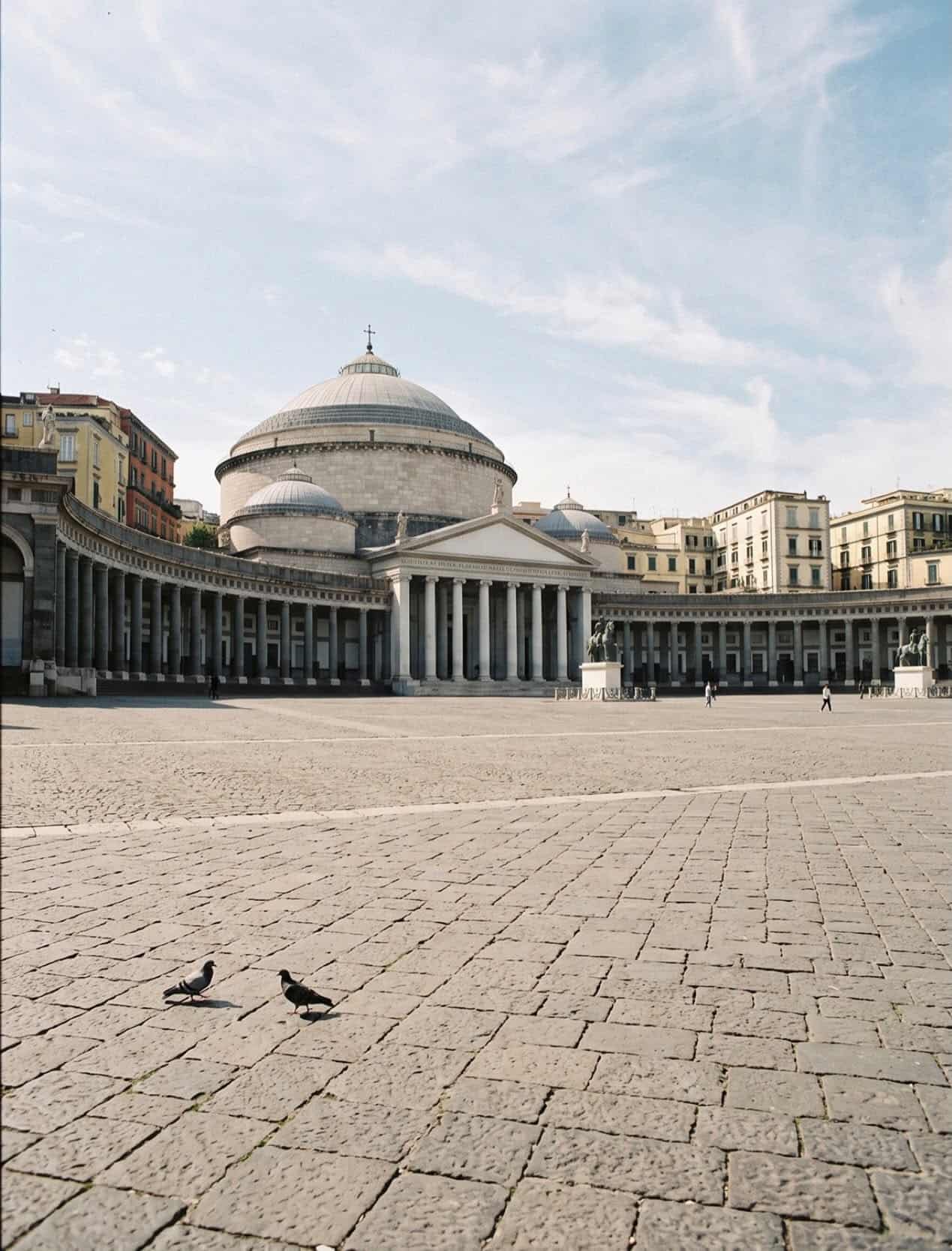
Down at sea level, Naples turns grand. Piazza del Plebiscito is the city’s great ceremonial square, sweeping and colonnaded, flanked by the Royal Palace and the domed church of San Francesco di Paola. From here it is a short walk through the glass-roofed Galleria Umberto I, a nineteenth-century shopping arcade of soaring iron and glass, and on to the seafront. Stroll the Lungomare, the waterfront promenade along Via Caracciolo, out to the Castel dell’Ovo, the ancient egg castle sitting on its little island, with Vesuvius across the water. At sunset it is one of the loveliest walks in Italy.
The National Archaeological Museum
If you are going to Pompeii, come here too, ideally first. The Museo Archeologico Nazionale, the MANN, holds the greatest treasures dug from Pompeii and Herculaneum, the mosaics and frescoes and everyday objects that bring the buried cities to life, along with the extraordinary Farnese collection of ancient sculpture. Seeing the finest finds here and then walking the ruins themselves is the way to truly understand what was lost.
The Quartieri Spagnoli

For the beating, everyday heart of Naples, plunge into the Quartieri Spagnoli, the tight grid of lanes climbing the hillside above Via Toledo. It is loud and washing-strung and utterly alive, and somewhere in it you will find the great Maradona mural, a shrine to the footballer the city still worships as a saint. Have a coffee, buy a snack, and simply be in it.
My Advice
Give Naples at least two full days, and do not try to see everything; the city is not a checklist, it is an atmosphere. Spend one day deep in the historic centre, the Veiled Christ, the underground, San Gregorio Armeno, lunch on Via dei Tribunali, and one day higher and wider, San Martino for the view, Plebiscito and the waterfront, the museum. And leave time simply to sit in a piazza with an espresso and watch the most theatrical city in Italy go by.
Frequently Asked Questions
What are the top things to do in Naples?
Walk Spaccanapoli and the historic centre, see the Veiled Christ in the Cappella Sansevero, go into Underground Naples, wander the nativity workshops of San Gregorio Armeno, climb to the Certosa di San Martino on the Vomero hill for the view, and stroll Piazza del Plebiscito and the Lungomare waterfront. The National Archaeological Museum is essential if you are visiting Pompeii.
Is the Veiled Christ worth seeing?
Absolutely; it is one of the greatest sculptures in the world and the single thing I would not miss in Naples. Carved from one block of marble in 1753, it shows Christ beneath a veil so fine you can see the body through it, an effect no one has ever fully explained. Book a timed ticket for the small Cappella Sansevero in advance, as it is very popular.
How many days do you need in Naples?
At least two full days to do the city justice, one for the historic centre and one for the hilltop views, the grand squares and the waterfront. If you also want to fit in day trips to Pompeii, Vesuvius or Capri, give yourself three or four days and use Naples as your base.
What is the best view in Naples?
The terraces of the Certosa di San Martino and the neighbouring Castel Sant’Elmo, high on the Vomero hill, give the finest views over the rooftops, the whole Bay of Naples and Mount Vesuvius, with Capri and Ischia beyond on a clear day. The Lungomare waterfront, with Castel dell’Ovo and Vesuvius, is the best spot at sunset.
Is Naples historic centre safe to explore?
Yes, the historic centre is lively rather than dangerous, and exploring it on foot is the highlight of any visit. As in any big, busy city, keep your bag zipped and close, be a little more careful around the crowded station area and on the Circumvesuviana, and do not flash valuables. Treated with normal street sense, the centre is a joy.
Read also: Where to Eat in Naples | The Best Photo Spots in Naples | The Complete Guide to Naples
V.