The cove fills by nine.
I was told this twice before I came, and I believed neither of them, because people exaggerate about crowds the way they exaggerate about heat, mostly to make you grateful for the advice afterwards. So I went down at half past seven expecting to feel slightly foolish, and stood on the bridge over the ravine in the last of the cool with almost the whole thing empty beneath me.
Lama Monachile.
A short cove of grey pebbles wedged between two limestone walls that go up almost straight, and a strip of water at the bottom so clear it looks shallow until somebody swims across it and you understand the scale.
There were four people down there.
One of them was already in.
I have seen photographs of this place. Everybody has. What the photographs do not tell you is that it is small.
Not disappointingly small. Small the way a room is small, so that standing above it you feel you are looking into something private rather than at something famous.
By nine there were perhaps two hundred people.
They were right, both of them. I was wrong. And I would go down at half past seven again tomorrow.
The stairs are stone and worn smooth in the middle by everyone who has ever come down them. The pebbles are not the polite kind. Bring the ugly rubber shoes. Vanity is not worth twenty minutes of picking your way into the Adriatic like a heron.
The water was cold for about four seconds and then it was not.
I swam out to where the cove opens and turned around, which is the thing to do and the reason to be early.
From the water the town is directly above you, white and ochre houses built right to the lip of the cliff, their balconies hanging over nothing, the old bridge behind them and the light coming down the ravine in one long slot.
Nobody built any of this to be looked at from below.
The sea simply got the better view by accident.
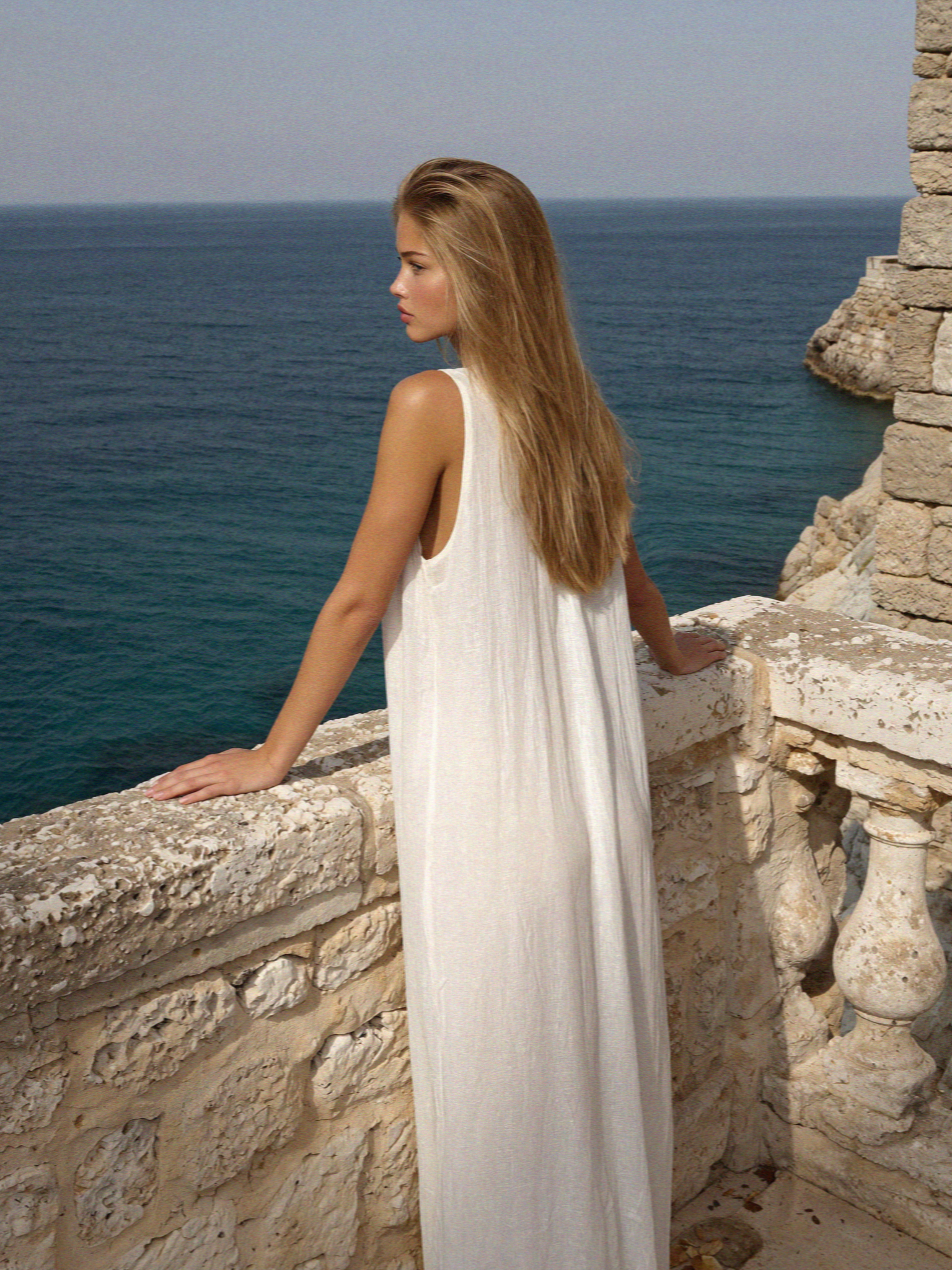
Afterwards I sat on the low wall above the cove with my hair wet and let the stone do its work.
Limestone holds the morning. By ten it is properly warm, warm the way a body is warm, and you can put both palms flat against it and feel the heat come up through your hands.
My grandmother’s coast is made of the same sort of rock. Different sea, different country, but the same white cliffs dropping into water that colour, the same pines finding a way to grow out of almost nothing.
I had not expected Puglia to rhyme with the south of France.
It does, in the stone.
I stayed there for a while thinking about nothing in particular, which is not true, and is as much as I want to write down.
Then the day started properly and I went up into the town.
You enter the old town through the Arco Marchesale, once one of the principal ways through the walls. There is a moment passing underneath it when the noise drops.
Every walled town has this moment.
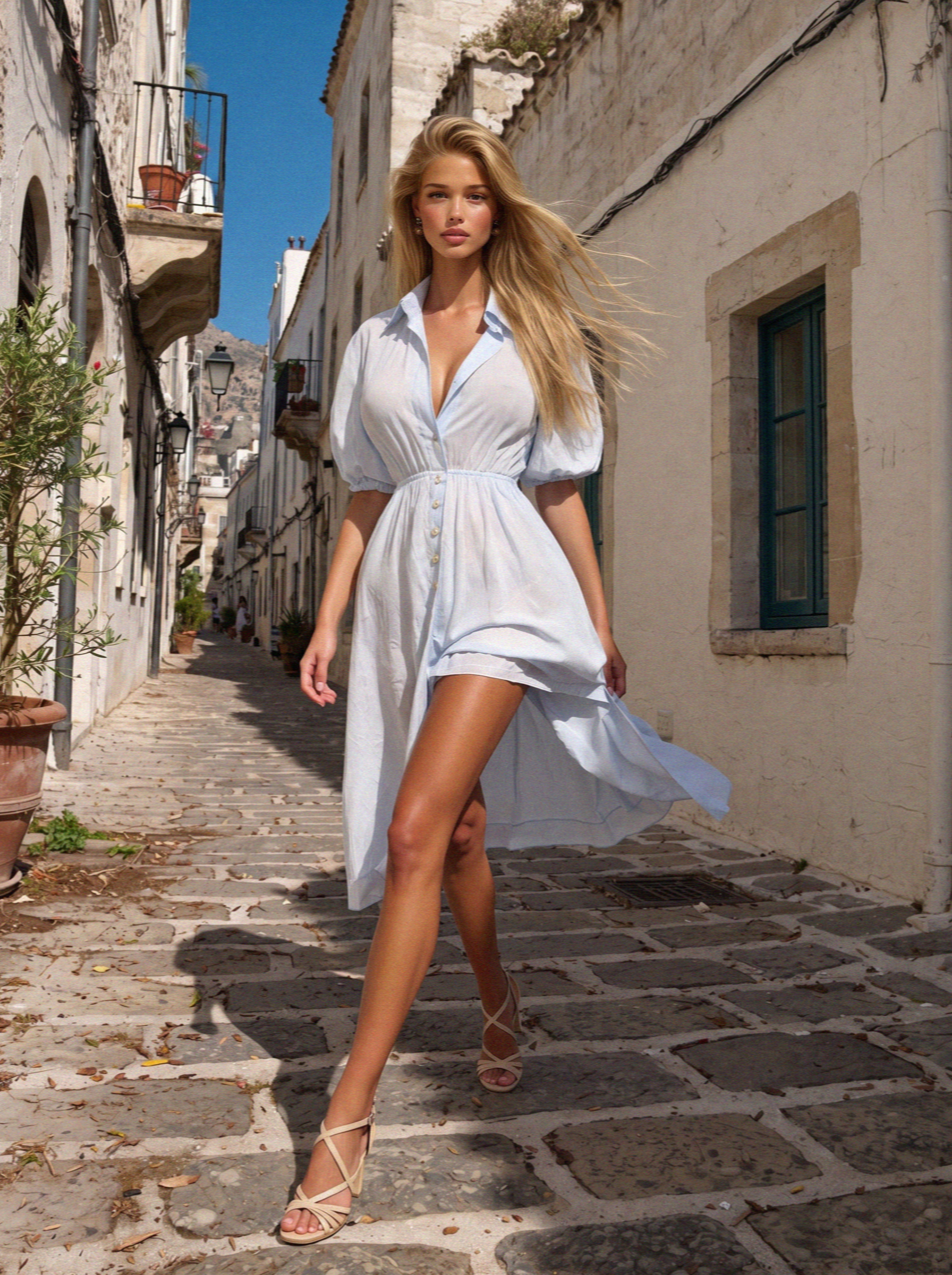
Polignano‘s is shorter than most because the town is not big, and then you are through and inside a white maze that seems designed to lose you gently.
It is all whitewash and blue shutters and stairs going up to doors that have no business being where they are. Cats. Laundry. A woman on a first floor watering something and not looking at anybody.
And then, on a step, a poem.
There is a man here who paints verses onto the walls and stairs of the old town and signs himself Guido il Flâneur. They gather along Via Commedia delle Mura, and once you have noticed one you start finding them everywhere, on risers and lintels and the flat of a wall beside a door.
Short things.
Handwritten.
Mostly in Italian.
I read four of them and understood three and a half.
I am not going to translate the one I liked.
It was not written for me. It was written for the step, and I have a growing conviction that some of the things worth keeping from a place are the ones you decline to explain afterwards.
For coffee you go to Piazza Garibaldi, to Mario Campanella’s, which trades under the marvellous name Il Super Mago del Gelo.
The Great Wizard of Ice.
This is where the caffè speciale was invented, and it is still what you should order. Espresso, cream, amaretto and lemon zest, served warm in a glass rather than a cup.
It should be far too much.
Lemon and almond and coffee and sugar, all at once, at eleven in the morning.
It isn’t.
The lemon cuts through everything and the glass stays warm in your hand, and I had two, which I am told is not done.
I did not care.
On the seafront there is a bronze man with his arms flung open, three metres of him, caught somewhere in the middle of a song.
Domenico Modugno was born here.
He sang the one about flying, painted blue in the blue, the song everybody seems to know even when they know almost none of the words.
I stood in front of him for a while feeling perfectly ordinary about it, which I think is the correct response to a three-metre statue of a man singing.
The evening belongs to the terrace.
Terrazza Santo Stefano is a flat stone shelf out on the cliff with nothing in front of it but open sea, and towards the end of the day the town seems to drift there.
Not tourists especially.
The town.
Couples. Three generations of one family. Boys being loud in the particular way boys are loud when they very much want to be overheard.
The water below goes from turquoise to green to a dark blue that is nearly black, in that order, over about forty minutes. Then the cliffs turn the colour of the inside of a shell and hold it for a while, and then it is night and the lights begin coming on along the seafront and in the houses stacked above the cove.
I ate late and badly and happily.
Standing up at first and then sitting, raw fish and lemon and a glass of something cold and local that I could not identify and did not ask about.
Below the terrace the sea kept going in and out of the caves.
You hear it before you understand what you are hearing.
A low knock, then a long draw, then quiet.
Then the knock again.
The whole cliff breathing on a slow count while the town eats above it.
I have been in a great many beautiful places this year, and I am beginning to be able to tell the difference between a town that is beautiful and a town that is beautiful and entirely uninterested in whether you noticed.
Polignano is the second kind.
It goes about its evening. The cliffs do their trick with the light and nobody down there looks up.
Tomorrow, the boats and the caves, and the long slow business of getting into water from something that is moving.
Tonight the cove will empty again.
And tomorrow morning, before nine, it will belong to four people for a little while.
V.