The best things to do in Assisi are not a checklist to race through, they are a slow unspooling of one small pink-stoned town on the flank of Monte Subasio. I have come back more than once, and every time the place rearranges my priorities: a fresco I meant to glance at holds me for an hour, a lane I meant to skip becomes the memory I keep. This is my honest shortlist, the things I would actually send a friend to do, with the practical details that make a day here run smoothly. If you want the wider picture, start with my complete guide to Assisi and then let this be your doing list.
What to book before you come
Assisi is unusual on this site in that its greatest thing is free. Entry to the Basilica costs nothing and always has. What a guide buys you here is not access, it is the ability to read a wall.
- The walking tour with the Basilica of St Francis. Two and a half hours, 4.8 from over three hundred people. The Giotto cycle in the upper church is twenty eight panels telling one story in order, and without somebody to point that out most people walk it backwards and leave puzzled.
- The city highlights and the Basilica together. The same idea with more of the town attached, which suits a single day here better than the Basilica alone.
- A cooking class with local food and wine. For the evening. Umbria is the quieter kitchen next to Tuscany and it is better than it is given credit for.
The Basilica itself, San Damiano, the Piazza del Comune and the walk up to the Rocca are all free. Photography is not allowed inside the upper church, and it is enforced.
Basilica di San Francesco
Everyone comes for this, and everyone should. The Basilica of St Francis is two churches stacked together: the bright Gothic Upper church, a single soaring nave lined with Giotto’s twenty-eight-scene “Legend of St Francis,” and the dark, low Romanesque Lower church, thick with Cimabue, Simone Martini and Pietro Lorenzetti, with the saint’s tomb in the crypt below. Entry is free. There is a dress code that is genuinely enforced, so cover shoulders and knees, and there is no photography inside, which protects the frescoes and, I think, protects the hush too. The Upper church runs roughly 08:30 to 18:00 in winter and a little later in summer; the Lower church and tomb open earlier, from about 06:00. Go at opening or in the late afternoon to sidestep the tour buses. It deserves an hour or two rather than a rushed twenty minutes, and because there is so much to say, I have given it its own basilica of San Francesco guide.
Plan Your Visit to Assisi
A few things I booked and loved. These help support the blog, at no cost to you.
- Where I stayed: search Assisi hotels
- Tickets and things to do in Assisi
- Rent a car to explore the area
- Stay connected: get a travel eSIM
This section contains affiliate links. If you book through them I may earn a small commission, at no extra cost to you.
Basilica di Santa Chiara and the San Damiano crucifix
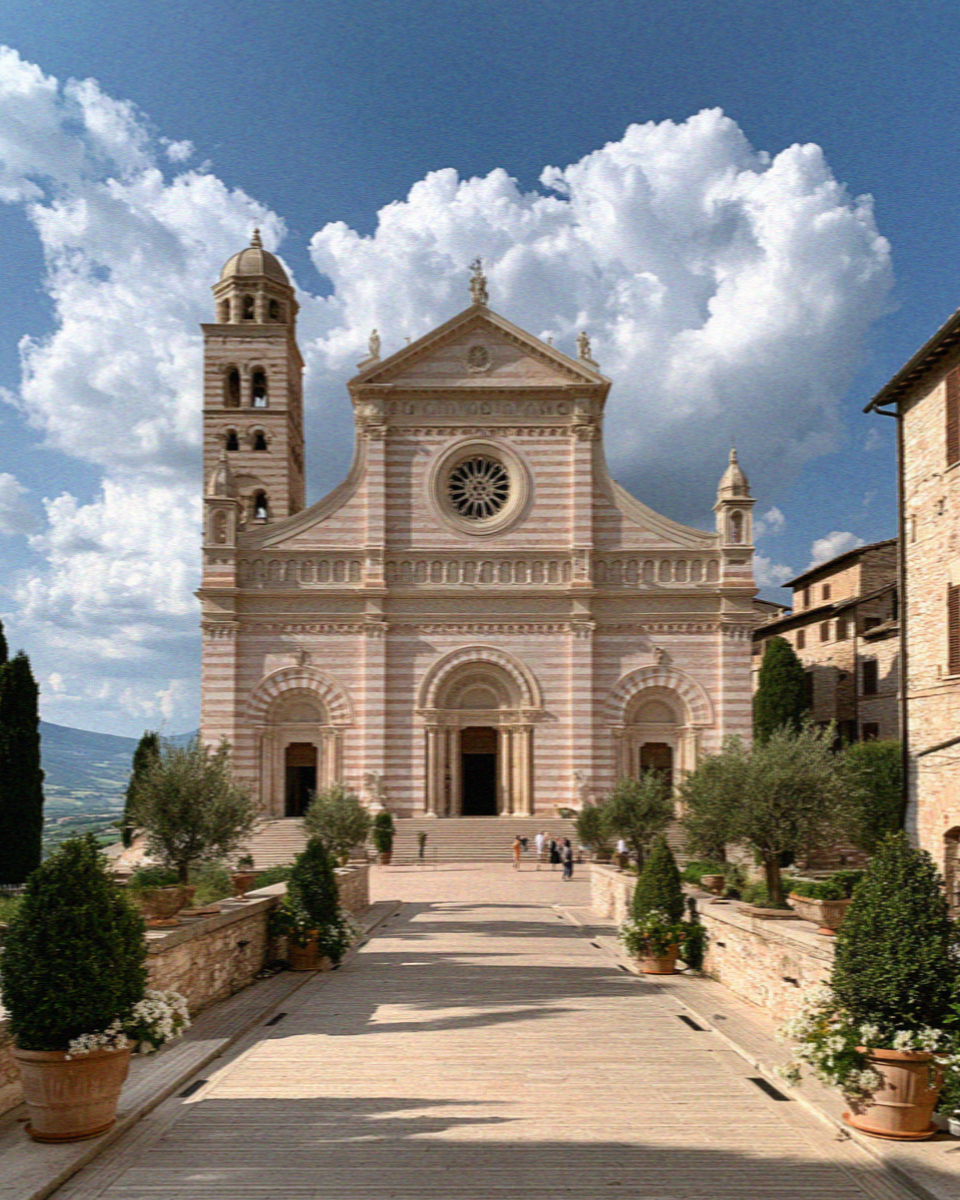
At the other end of the main axis stands Santa Chiara, dedicated to St Clare, and I love it almost more than its famous neighbour. The facade is banded pink and white, braced by great flying buttresses, and the terrace out front gives you one of the softest valley views in town. Inside, in the Oratorio del Crocifisso, hangs the original twelfth-century San Damiano Crucifix, the very cross that is said to have spoken to Francis and told him to repair the church. St Clare’s tomb lies in the crypt below. Entry is free. In summer it opens roughly 09:00 to 12:00 and 14:00 to 19:00, and in winter it opens earlier, around 06:30. Sit a while on the terrace; the light here at the end of the day is a quiet marvel.
Piazza del Comune and the Temple of Minerva
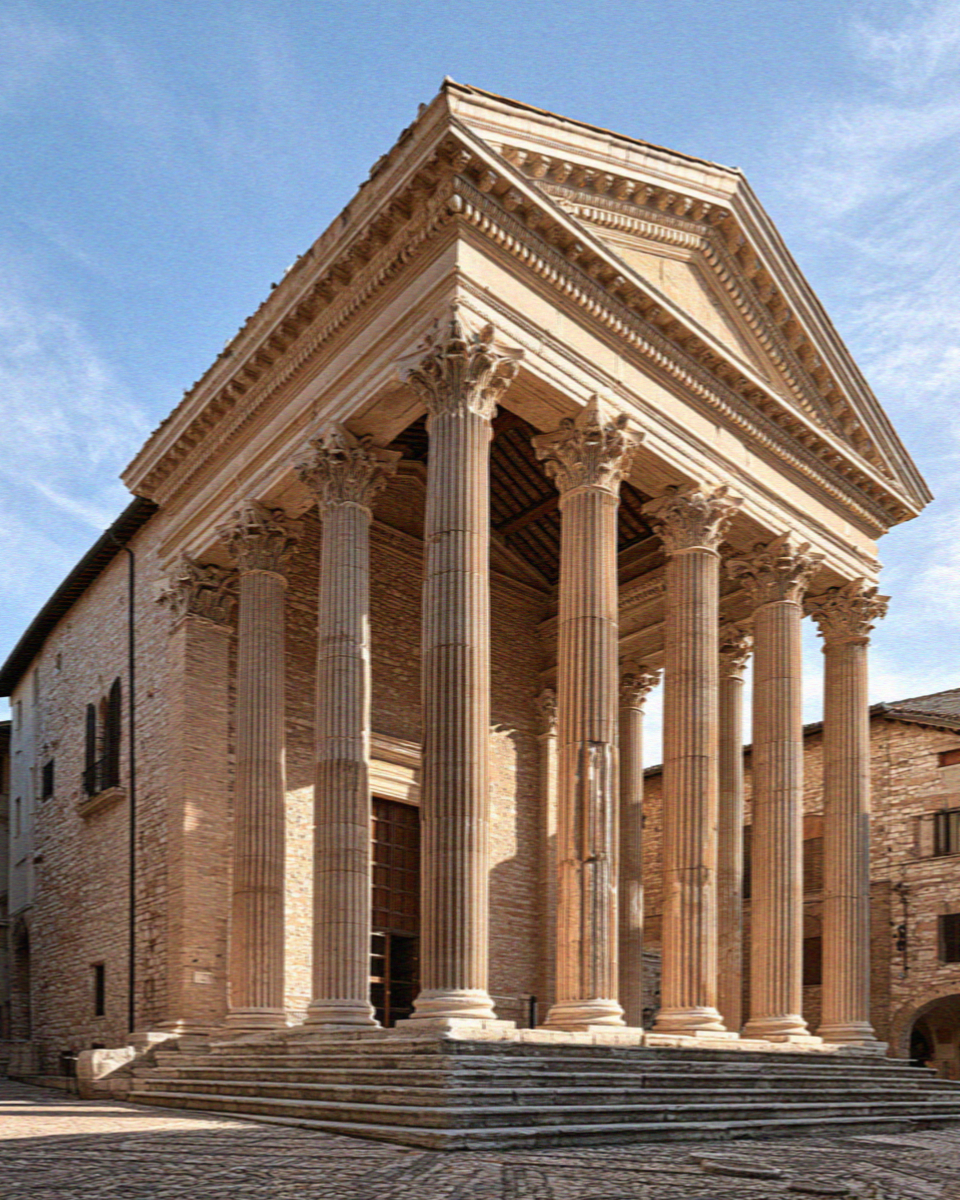
The heart of Assisi is Piazza del Comune, laid over the old Roman forum, and its show-stopper is the Temple of Minerva. This is a first-century BC Roman temple with six intact Corinthian columns, absorbed centuries ago into the church of Santa Maria sopra Minerva, so you step off a medieval square straight through classical antiquity. Entry is free. The cafes and aperitivo terraces on the square face those columns, which makes this the obvious place to pause, order something cold and simply watch. Come early in the morning if you want the piazza to yourself before the day fills it; that first hour of light on the temple front is the town at its most composed, and if you care about photographs it is one of my favourite frames, covered more fully in my best photo spots in Assisi.
Rocca Maggiore
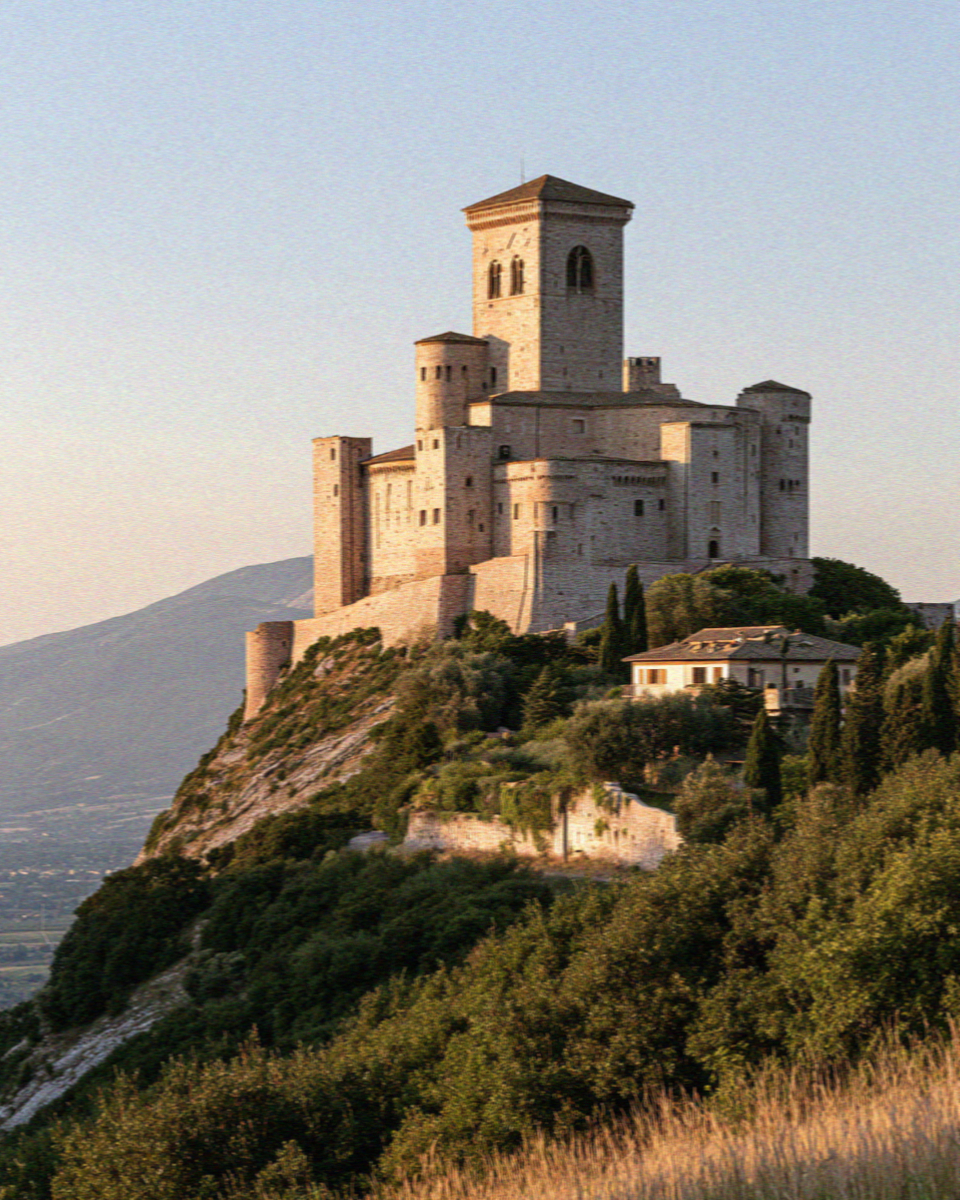
Climb. The Rocca Maggiore is the hilltop fortress crowning the town, and the reward for the steep uphill walk is a near-360 sweep over the rooftops, the Basilica and the whole valley reaching toward Perugia and Spoleto. A ticket is around EUR 8 full, about 6 reduced, and there is a combined civic ticket for roughly EUR 10 that folds in other sites; I would confirm the current price on arrival, as these are band figures that shift with the season. Hours are seasonal too, longer in high summer (around 10:00 to 20:00 in June to August), shorter in winter, and it closes on 25 December. Wear proper shoes for the gradient. Even if you do not go inside, the terrace approach gives you the classic shot of the Basilica set against the valley, best in the afternoon.
Eremo delle Carceri
If you do one thing beyond the obvious, make it this. The Eremo delle Carceri is a forest hermitage about 4 km up Monte Subasio, built around the grotto where Francis withdrew to pray, and it is the most contemplative corner in the whole area. Entry is free. You can drive or take a taxi, with parking on site, or walk up on a steep path of roughly one to one and a half hours from Porta Cappuccini; there is no regular city bus, so plan the transfer. In summer it opens around 06:15 to 19:00 with a midday closure roughly 12:45 to 14:30. The holm oaks, the birdsong, the sheer quiet after the crowds below: this is the Assisi people forget to tell you about, and it is worth the effort.
San Damiano
Just below the walls sits San Damiano, the small convent and church where the crucifix first spoke to Francis, where St Clare and her Poor Clares made their home, and where Francis is said to have composed the Canticle of the Creatures. It is atmospheric and blessedly uncrowded, all worn stone and shaded cloister. Entry is free. It is a 15 to 20 minute downhill walk from Porta Nuova, or you can take the local bus or drive to the car park. The church opens roughly 06:15 to 12:00 and 14:00 to 19:45. Come here when the main basilicas feel too full; the silence does something the grand spaces cannot.
Santa Maria degli Angeli and the Porziuncola
Down in the valley, near the train station, rises the huge Baroque Basilica of Santa Maria degli Angeli, and it holds a small miracle inside its vast nave: the Porziuncola, the tiny chapel Francis restored with his own hands, now sheltered beneath the great dome. Nearby is the Cappella del Transito, the cell where he died. Entry is free, though the Porziuncola museum is ticketed. It is about a five-minute walk from Assisi station, which makes it the natural first or last stop if you arrive by train. Opening is roughly 07:30 to 12:30 and 14:30 to 19:00. Standing inside something so grand built purely to protect something so small tells you almost everything about this place.
Wandering the vicoli
The truth is that my favourite thing to do in Assisi is nothing in particular. The town is compact and end-to-end walkable in twenty-odd minutes, but it is steep and cobbled, threaded with vicoli, the narrow arched lanes that climb between houses hung with geraniums. Get deliberately, happily lost. In the pale limestone light of late afternoon and again at twilight, when the lamps come on, these lanes are pure enchantment, and they cost nothing. Wear good shoes for the gradients and the stairs. If you want to string all of this into a sensible route rather than crisscrossing the hill, my Assisi itinerary sets it out day by day.
Frequently Asked Questions
How many days do you need in Assisi?
One full day covers the essentials: the two basilicas, Piazza del Comune and the Temple of Minerva, and a wander through the lanes. But I would give it two, so you have time for the Eremo delle Carceri and San Damiano without rushing, and an unhurried aperitivo on the square as the light goes gold.
Is Assisi expensive to visit?
Not really. The three great sights, the Basilica of San Francesco, Santa Chiara and Santa Maria degli Angeli, are all free, as are San Damiano and the Eremo delle Carceri. The main paid attraction is the Rocca Maggiore at around EUR 8. Your real spending here is on food, wine and a bed.
What is the best thing to do in Assisi?
If I had to choose one, it is the Basilica of San Francesco for the Giotto and Cimabue frescoes, which are among the most important in Italy. But the thing that stays with me longest is the walk up to the Eremo delle Carceri, where the forest and the silence give you a different Assisi entirely.
There is far more to a stay here than a list of sights, so let this doing list sit alongside my complete guide to Assisi for the wider view, my dedicated basilica of San Francesco guide for the frescoes in full, my Assisi itinerary to string it all into an easy route, and my best photo spots in Assisi for the frames worth slowing down to catch. Do a little, look hard, and let the town do the rest.