Assisi is one of those hill towns that seems built to be photographed, all pale limestone and pink Subasio stone stacked up a green mountainside, glowing at the end of the day. I have carried a camera up and down these lanes more times than I can count, and the honest truth is that the best pictures here are not about gear, they are about timing and knowing which way the light falls. This is my working list of the photo spots I return to, and crucially, when to be at each one. If you want the wider context, I have gathered everything into my complete guide to Assisi, but this page is purely about where to point the lens.
One thing to say clearly at the start: photography is not allowed inside the Basilica of San Francesco. The ban protects Giotto’s and Cimabue’s frescoes, and it is enforced. So everything below is about exteriors, streets and views. Happily, that is where Assisi is at its most photogenic anyway.
Rocca Maggiore and Its Terrace
The hilltop fortress is the single best vantage point in Assisi, full stop. From the Rocca Maggiore and its terrace you get a roughly 360-degree sweep over the terracotta rooftops, the Basilica anchoring one end of town, and the Spoleto valley rolling away toward Perugia. The climb is steep, a proper uphill walk on cobbles, so wear real shoes and take water in summer.
For the picture, late afternoon is your friend. The town faces broadly southwest, so as the sun drops the whole tumble of roofs warms up and the shadows lengthen across the valley. Entry is around EUR 8 (a little less reduced, or around EUR 10 for the combined civic ticket), and hours are seasonal, roughly 10:00 to 20:00 in high summer and shorter in winter, so confirm on arrival. Even if you skip the interior, the terrace and the approach path give you the shot. Go up an hour or so before sunset and stay for the change of light.
Plan Your Visit to Assisi
A few things I booked and loved. These help support the blog, at no cost to you.
- Where I stayed: search Assisi hotels
- Tickets and things to do in Assisi
- Rent a car to explore the area
- Stay connected: get a travel eSIM
This section contains affiliate links. If you book through them I may earn a small commission, at no extra cost to you.
The Basilica Framed Against the Valley
The image everyone half-remembers of Assisi is the great white bulk of the Basilica of San Francesco riding above its arcaded buttresses with the valley falling away behind it. You get this classic composition best from the higher ground near the Rocca and along the paths on that side of town, where the church reads as a whole shape against the fields rather than something you are standing underneath.
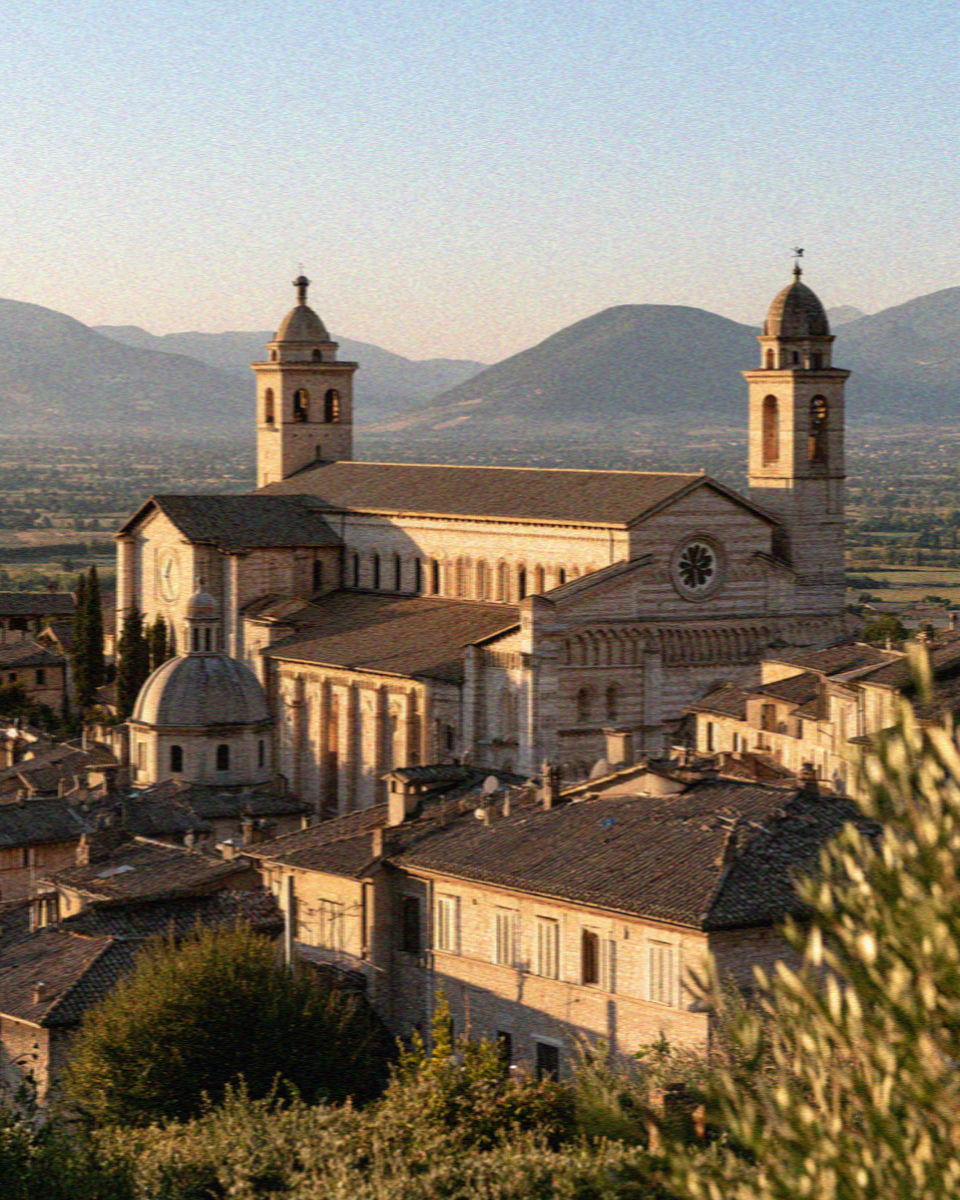
Time this for golden hour. Because the Basilica complex faces southwest, the front and flank catch warm, low, raking light in the late afternoon and early evening, which is exactly what you want to model all that stonework and the row of arches. Shoot it flat and grey at midday and it looks like a postcard nobody bought. Come back at five or six on a clear day and it turns the colour of honey. If you want the story of what is inside those walls, my Basilica of San Francesco guide covers the frescoes and the dress code, but for the photograph, stay outside and wait for the sun.
Via San Francesco and Its Stone Arches
Running down through town toward the Basilica, Via San Francesco is a sloping medieval street strung with stone arches that leap between the buildings overhead. It is one of my favourite corridors to shoot in the whole of Umbria, because those arches give you natural framing: stand back and let one arch bracket the street beyond, with figures and washing lines and hanging lamps for depth.
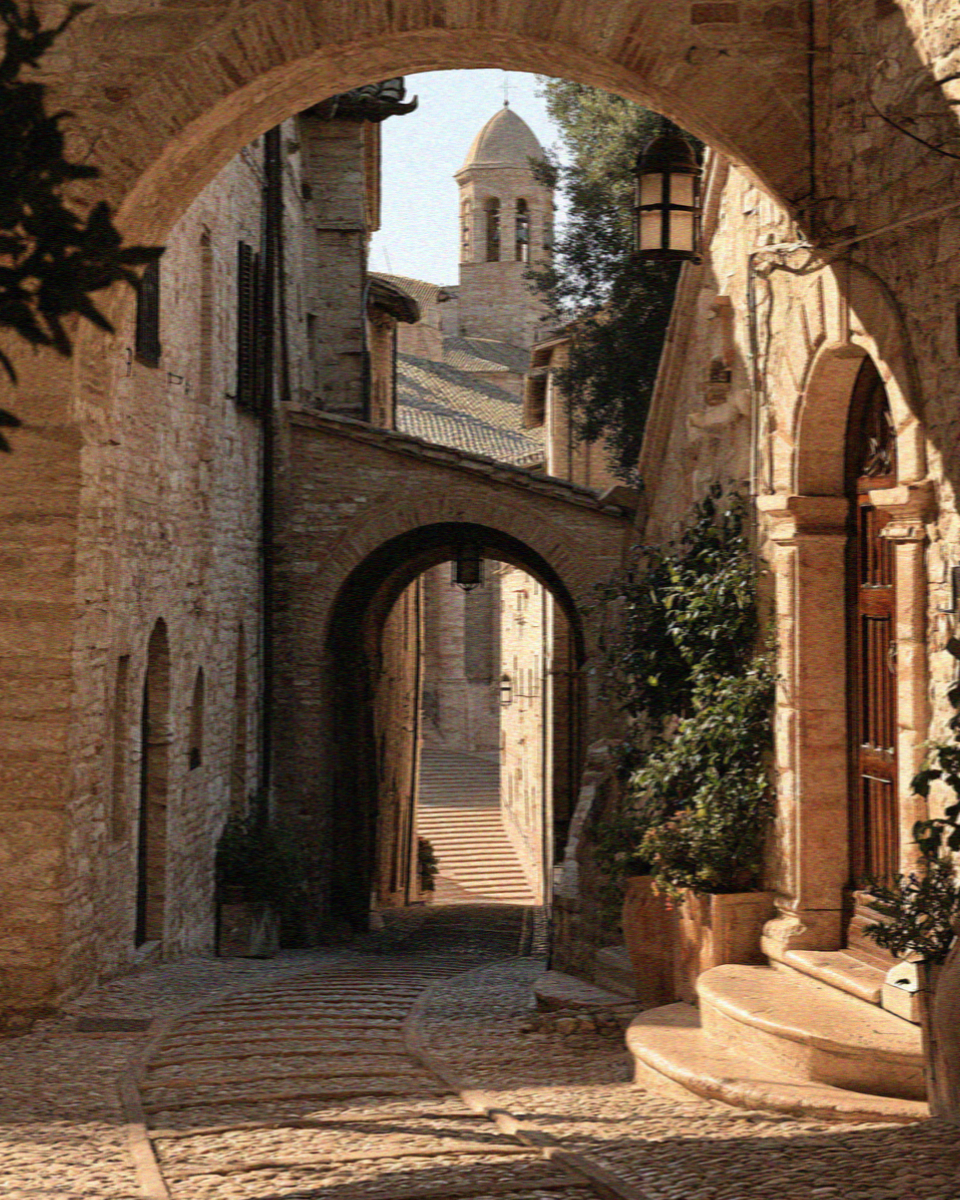
The light here is trickier because the street is narrow and largely in shade for much of the day, which is actually a gift. Soft, even shade keeps the pale stone from blowing out and lets the arches read cleanly. Early morning before the day-trippers arrive gives you an empty street, which is worth setting an alarm for. If you want a single human figure walking away up the slope, mid-morning gives you gentle bounced light without harsh contrast. This street is also the spine of a good day on foot, and I have mapped that walk in my Assisi itinerary.
The Vicoli at Twilight
Off the main streets, Assisi dissolves into vicoli, the little arched lanes and stepped alleys that climb between the houses. These are magical, and they are at their absolute best at twilight, when the pale limestone holds the last of the daylight and the wrought-iron lamps flick on to throw pools of warm light down the steps.
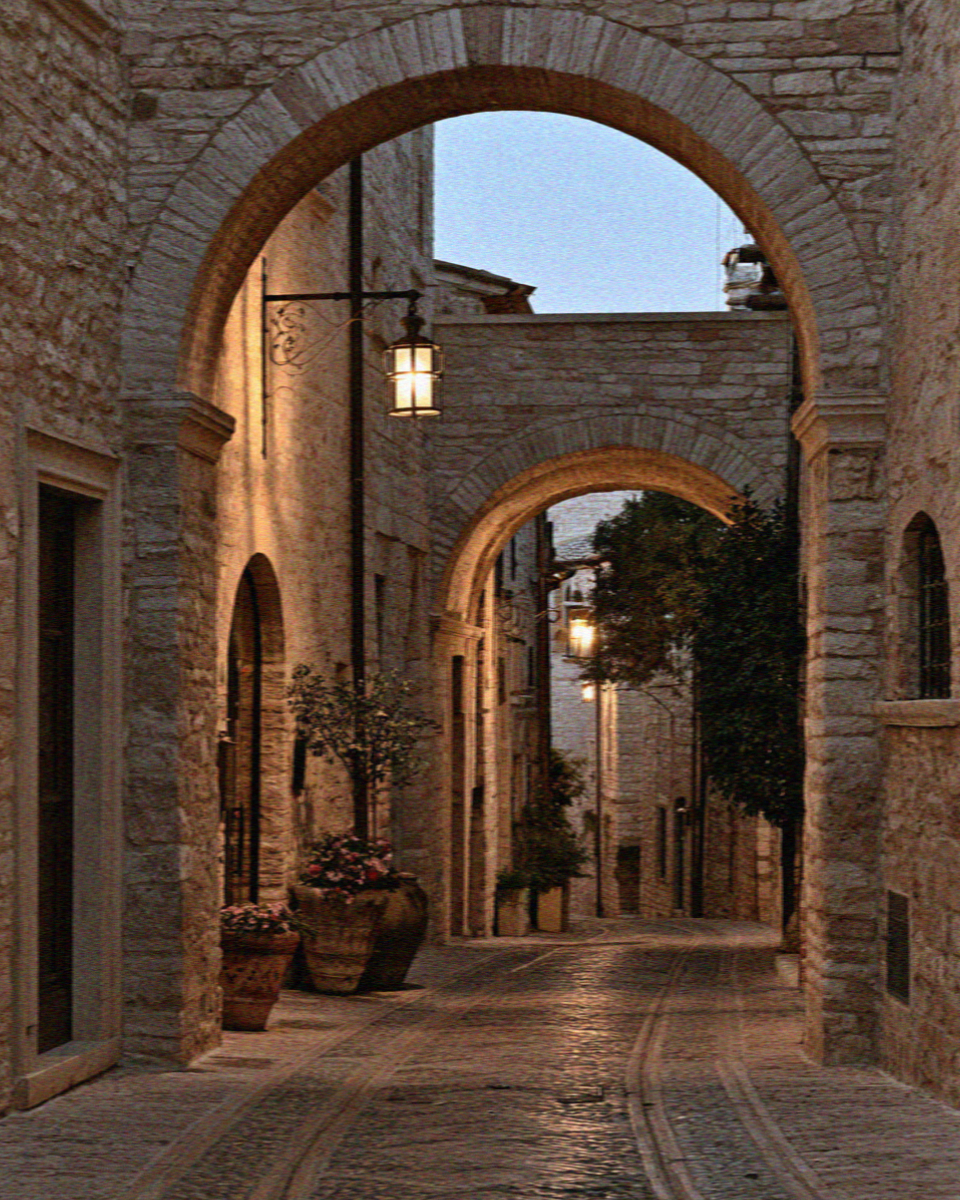
The window for this is short, that blue half hour just after sunset when the sky still has colour but the lamps are already lit. Get the balance right and you get lamplight glowing amber against a deep blue dusk, geraniums spilling from the sills, worn steps leading the eye upward. Bring something to steady the camera, a small tripod or just a wall to brace against, because the light is low and you will want to keep the ISO down. Explore the lanes above Piazza del Comune and around Via San Rufino. Half the pleasure is that you rarely meet anyone, and I have written more about wandering these back streets in my guide to the best things to do in Assisi.
Piazza del Comune and the Temple of Minerva
The main square sits over the old Roman forum, and its showpiece is the Temple of Minerva, a first-century BC Roman temple with six intact Corinthian columns, now the church of Santa Maria sopra Minerva. Those columns are the classic Assisi square shot, and the cafe terraces facing them make an easy foreground.
Come early. First light, before the square fills with people and parked delivery vans, is when you can shoot the temple facade clean and get that lovely soft raking light along the columns. Later in the day the piazza is busy and the front of the temple falls into shade. If you are after the aperitivo-hour version, with the terraces buzzing and lamps coming on, that works too, but for the architecture itself, be there at opening time with a coffee.
Santa Chiara’s Terrace
The Basilica of Santa Chiara, with its striped pink-and-white facade and dramatic flying buttresses, sits at the upper, eastern end of town, and beside it is a terrace that opens straight onto the valley. It is one of the two great free viewpoints in Assisi, and far fewer people think to shoot the panorama from here than from the Rocca.
The facade itself photographs beautifully in the morning, when the pink stone catches the eastern sun. The valley view from the terrace, on the other hand, is a lovely spot for late afternoon and early evening, when the fields and olive groves below soften into gold. It is free to visit, open roughly 09:00 to 12:00 and 14:00 to 19:00 in summer with earlier opening in the cooler months, so it slots easily into either end of the day.
The Basilica’s Piazza Inferiore
Down at the Basilica of San Francesco, the lower square, the Piazza Inferiore, is ringed by graceful arcades and opens out toward the valley. Remember, no photography inside either church, so this exterior plaza and its arcaded loggia are where you make your Basilica pictures, and they are more than enough.
The arcades give you rhythm and repeated arches to compose with, and the open side of the piazza frames the valley beyond. Since the whole complex faces southwest, afternoon and golden hour bathe the plaza and its columns in warm light, while the morning leaves it flatter and cooler. Aim for late in the day, when the arcades throw long shadows and the stone glows. Arrive at opening or in the late afternoon anyway to sidestep the tour-bus crush, which is the same advice I would give for the pictures.
A Few Practical Notes on Light
The one rule that ties all of this together in Assisi is that the town faces southwest, so the marquee subjects, the Basilica and the rooftops, want afternoon and golden-hour light. Reserve the mornings for the things that face east or sit in shade: the Temple of Minerva, the Santa Chiara facade, and the narrow shaded lanes. Twilight belongs to the vicoli. Weather helps too: a little cloud after rain gives you saturated stone and dramatic skies over the valley, while flat summer midday haze is the least flattering light of all. Good shoes matter more than a big lens here, because the best angles are earned on foot up steep cobbles.
Frequently Asked Questions
Can you take photos inside the Basilica of San Francesco?
No. Photography is not permitted inside either the Upper or Lower church, in order to protect the medieval frescoes, and the rule is actively enforced. You can photograph the exterior, the facade and the arcaded piazzas as much as you like, and there is a dress code (shoulders and knees covered) to enter the churches themselves.
What is the best time of day for photos in Assisi?
Late afternoon and golden hour for the Basilica, the rooftops and the valley views, because the town faces southwest. Early morning for the Temple of Minerva and empty streets, and twilight, that blue half hour after sunset, for the lamplit lanes.
Where is the best panoramic view of Assisi?
The Rocca Maggiore and its terrace give the widest sweep over the town and valley, and it is the spot for the classic shot of the Basilica set against the countryside. For a free alternative, the terrace beside the Basilica of Santa Chiara opens onto a lovely valley panorama.
For everything beyond the camera, start with my complete guide to Assisi, then pair this with my Assisi itinerary so you are standing in the right place at the right hour, dip into the best things to do in Assisi for the wider list, and read my Basilica of San Francesco guide before you go so you know what waits behind those walls you will only be photographing from outside.