Some links in this guide are affiliate links. If you book through one, this site may earn a small commission, at no extra cost to you. How this works.
The best things to do in Corfu are a town you should walk before breakfast, a fortress with a lighthouse on top, two little islands at dusk, a path down to a pair of bays, and a mountain with a ruined village on its shoulder.
Corfu is green in a way the rest of Greece is not: huge, twisted olive trees, cypress standing in them like punctuation, a Venetian town on the water.
This is the list I would give a friend, in roughly the order I would do it. For the island as a whole, start with my complete guide to Corfu.
What to book before you come
Most of this list is walking and swimming, which needs no booking. Four things are worth arranging in advance.
Old Town guided walk
Best on the first morning, when the Venetian, French and British layers make sense far faster with someone pointing at them.
Old Fortress, with audio guide
The climb to the lighthouse, with the story told as you go.
Paxos, Antipaxos and the Blue Caves
The full boat day most people remember, two islands and the clearest water in the Ionian.
Paleokastritsa caves by boat
A short trip from the beach into coves you cannot reach on foot. Go early, before the water gets busy.
Each button opens GetYourGuide in a new tab, so this page stays open. Booking through them supports the blog at no cost to you.
Walk the Old Town early
Corfu Town is a UNESCO World Heritage Site, and it earns it. Four centuries of Venice, then the French and the British, stacked into a fortified port of tall shuttered houses and narrow lanes.
Go early. Before nine the lanes belong to the people who live there: a shop step being hosed down, a basket lowered from a third-floor window. By late morning the cruise passengers arrive and the main streets fill.
What to see. The Spianada, the great open square, and the arcaded Liston beside it. The red-domed bell tower of Saint Spyridon. The tangle of lanes behind the Old Port called Campiello. I have written all of it up, street by street, in my walking guide to Corfu Old Town. Give it a whole morning, and get lost on purpose at least once.
Climb the Old Fortress
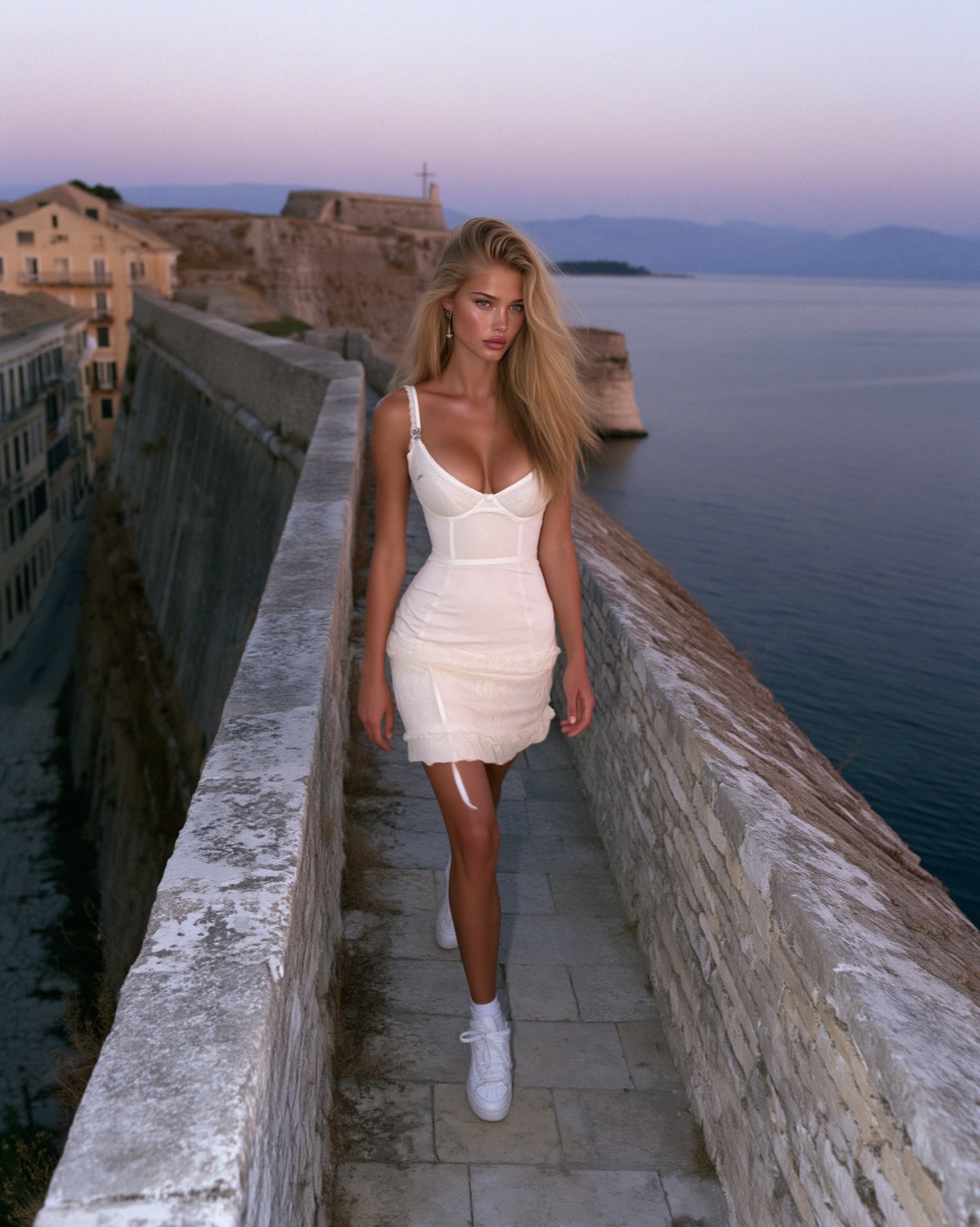
The Old Fortress sits on a twin-peaked headland at the edge of the Spianada, cut off from the town by a sea moat the Venetians dug, the Contrafossa. You cross a bridge over water to get in.
Inside, keep climbing to the lighthouse on the higher peak. From there the whole of Corfu Town is laid out: the roofs, the bell towers, the Spianada, and across the strait the mountains of the mainland.
Practical. From April to October it keeps long hours, eight in the morning until eight at night; in winter it closes by mid-afternoon. The ticket is a few euros. Go in the late afternoon, when the heat has gone out of the stone, and take water.
Kanoni, Vlacherna and Mouse Island at dusk
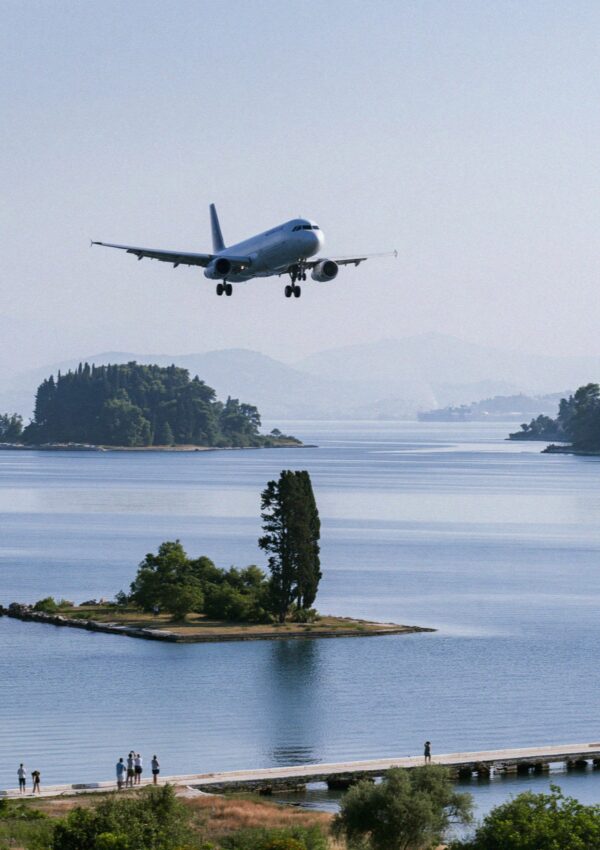
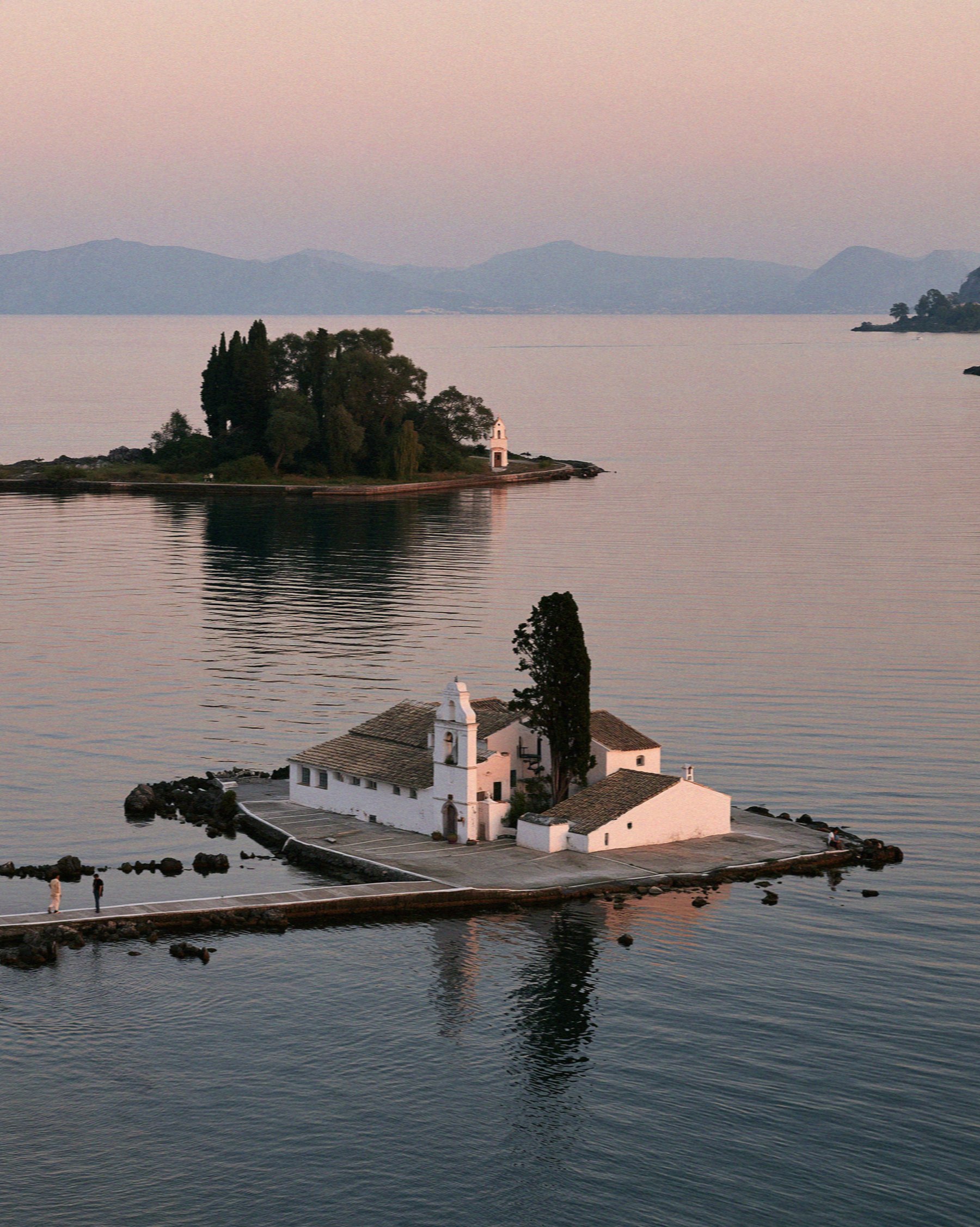
South of town, on the Kanoni peninsula, is the view that sells Corfu to the world. Below the terrace, a white monastery, Vlacherna, sits on its own islet at the end of a causeway. Beyond it, a dark wooded island rises out of the water with a small Byzantine chapel among its trees. That is Pontikonisi, Mouse Island, and the legend is that it is the ship of Odysseus turned to stone.
Then a plane comes in. The runway is right there across the lagoon, and the jets drop in so low over the causeway you feel the engines in your chest. I had come in on one of those flights, and seeing it from the ground was stranger than from the window.
How to do it. Walk down to Vlacherna along the causeway, which is free. Small boats run across to Mouse Island from beside the monastery, roughly every twenty minutes in season, for a few euros. Go late in the afternoon, cross to the island, and come back to the terrace above for the last of the light.
Swim the coves at Paleokastritsa
About 25 km from town on the west coast, Paleokastritsa is not one beach but a handful of small coves under steep green headlands, the water a clear, bottle-glass blue over pale stone.
What I’d do. Arrive early, before the coaches. Swim from one of the smaller coves rather than the main beach. Then step onto one of the boats at the main beach for half an hour poking into the sea caves under the cliffs.
The Theotokos monastery on the hill above costs nothing to visit. It closes for a couple of hours after lunch, and it expects you covered up.
For the rest of the west coast’s sand and sunsets, see the best beaches in Corfu.
Take a boat to Paxos and Antipaxos
South of Corfu lie Paxos and tiny Antipaxos. The classic day cruise stops at the Blue Caves on Paxos, anchors off Antipaxos for a swim in startlingly clear water, and gives you time in Gaios, the harbour town.
Budget the whole day: leaving from Corfu Town you are out for nine or ten hours, while boats from Lefkimmi, at the southern end of the island, cut that to around seven. When the sea is up, the open crossing can be uncomfortable, so look at the forecast before you book.
I have compared the options, group cruises against private boats, in the best Corfu boat tours.
Walk down to Porto Timoni
In the north-west, below the hill village of Afionas, a narrow neck of land runs out into the sea with a bay on either side of it. Two beaches, back to back, a few steps apart. That is Porto Timoni.
There is no road. You park in Afionas (there is a paid car park) and walk down about 1.1 km on a steep, rocky path through olive and scrub. The full loop, down and back up, is around 3 km and takes an hour or more with a swim in the middle. There are no facilities at the bottom: take water, food and proper shoes, not flip-flops.
Water taxis run from Agios Georgios, but walking down is the point: you see both bays from above first, and the climb back is the price of having them.

Mount Pantokrator and Old Perithia
Pantokrator is the island’s highest mountain, and from the top you look across the strait into Albania. On its north flank, about 400 m up, is Old Perithia, the oldest village on Corfu.
Its builders tucked it into a fold of the slope, with a view down to the water but out of sight of anything sailing past. Down on the coast there were corsairs, and malaria. At its peak the village held some 130 houses and eight churches; then, over the last century, its people drifted down to the sea. Now most of it is ruins, with a few restored houses and tavernas.
In September I drove up through the hairpins, and it was the quietest place I found on the island. The full plan, summit and village in one day, is in the best day trips from Corfu.

Lunch at Kalami, where the Durrells lived
Kalami is a small bay on the north-east coast, pebbles and very clear, calm water, with Albania across the strait. On the rocks at one end is the White House, where Lawrence Durrell and his wife Nancy lived from 1936 to 1939. He wrote Prospero’s Cell there.
It is a taverna now, open from May to October, and lunch on the terrace at the water’s edge is one of the simplest pleasures on the island.
Make a day of it. Hire a small boat at Kalami (anything under 30 hp needs no licence) and nose along the coast to Agni, the next bay, which is known for its tavernas. The north-east is the sheltered side of the island and the best place to drive yourself.
For which taverna serves what, see where to eat in Corfu.
The Achilleion gardens
In the village of Gastouri, about 10 km south of town, is the Achilleion, the palace built for Empress Elisabeth of Austria, Sisi, and later owned by Kaiser Wilhelm II.
Know this before you go. The palace itself has been shut since 2021 while it is restored, and the target for reopening is June 2029. Until then the ticket, priced down to match, covers the gardens alone.
Is it still worth it? For the gardens, if you are passing. They are full of statues, and the Dying Achilles, the palace’s emblem, has been restored and stands among them. If you were coming for the rooms, wait for 2029.
Easter in Corfu Town
Of all the Easters in Greece, Corfu’s is the best known. The week builds through processions, with the island’s philharmonic bands playing in them. There are 18 of these bands on Corfu, the first founded in 1840, and you hear them rehearsing through upstairs windows all year. I heard a child running clarinet scales one evening in September, which is how I first started asking why one island needs so many.
The moment. At eleven on the morning of Holy Saturday, after Saint Spyridon and the Epitaph have passed in procession, people start throwing red clay pots full of water, the botides, off the balconies, most of all around the Liston. Stand back, and stand where you can see a balcony.
Orthodox Easter in 2027 falls on Sunday 2 May, so Holy Saturday is 1 May. Rooms in town go early. For when else to come, see the best time to visit Corfu.
That is the island as I would want to be handed it. Everything else is in my complete guide to Corfu, the town itself is in my Corfu Old Town walking guide, and if you want to go further, to Albania or the far islands, start with the best day trips from Corfu.
Frequently Asked Questions
What is Corfu best known for?
Its Venetian Old Town, a UNESCO World Heritage Site, and its greenness: Corfu is the wettest Greek island and covered in old olive groves. Also its Easter, and the Durrells.
Is the Achilleion open?
Just the gardens, at a reduced price. Restoration has closed the palace rooms since 2021, with the work due to end in June 2029, but you can still walk among the statues, the restored Dying Achilles included.
Is Kanoni worth visiting?
Yes, late in the afternoon. The view over Vlacherna and Mouse Island is the classic Corfu picture, the causeway is free, boats cross to Mouse Island for a few euros, and landing planes pass directly overhead.
Do you need a car in Corfu?
For the town, no. For Porto Timoni, Old Perithia, Pantokrator and the quieter coves, yes. The green KTEL buses serve the big beach resorts well, but they will not get you up into the villages or down to the wilder coves.
When is Corfu Easter in 2027?
Orthodox Easter Sunday falls on 2 May 2027. The famous pot throwing happens on Holy Saturday, 1 May, at 11:00 in Corfu Town.
Read also: Corfu Old Town: A Walking Guide | The Best Beaches in Corfu | Victoria’s Complete Guide to Corfu