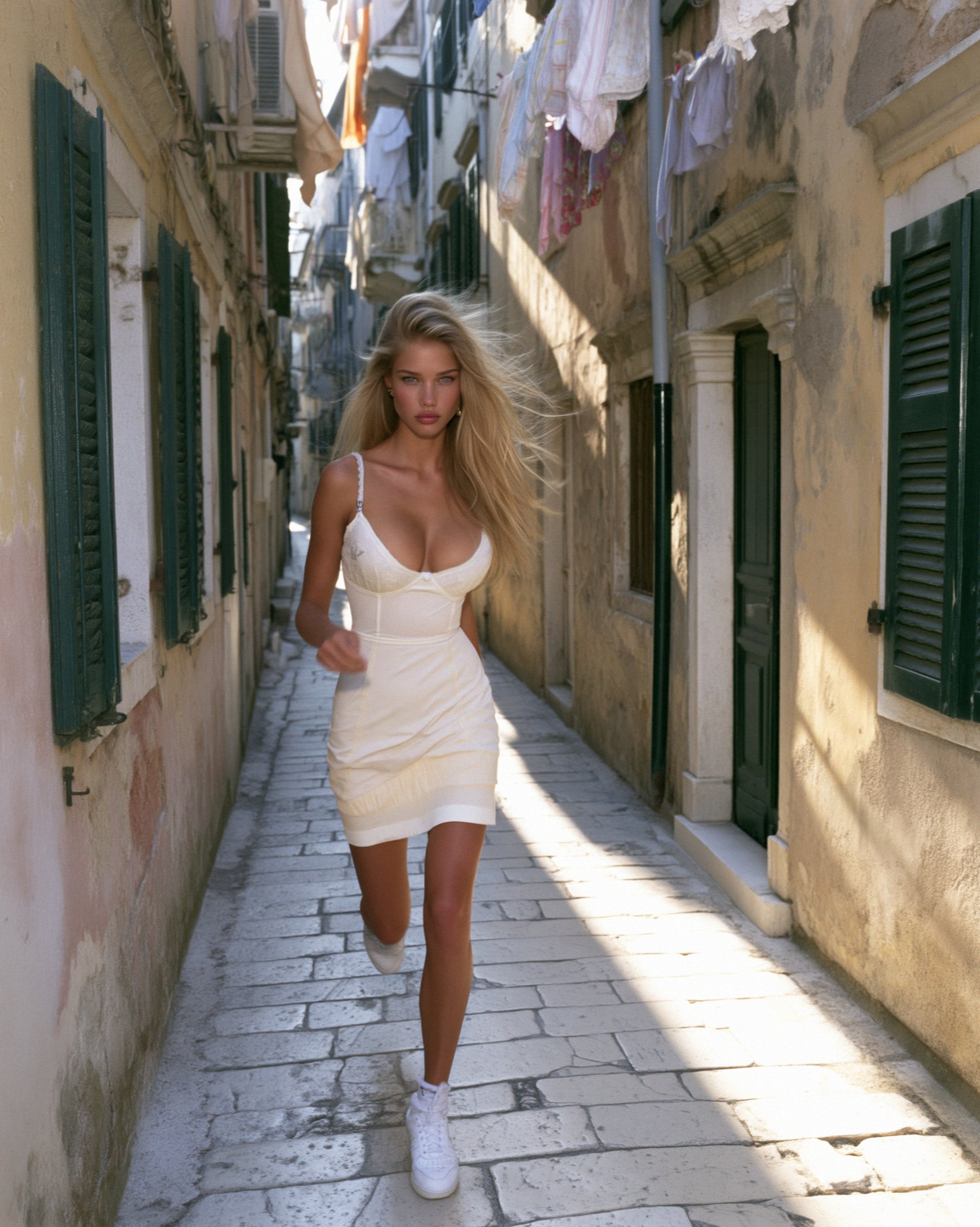
Corfu Old Town is best seen on foot, slowly, and mostly in the morning. It is small enough to cross in no time and dense enough to keep you for three days, a fortified port of tall Venetian houses, green shutters, bell towers and lanes barely wider than your shoulders.
It has been on the UNESCO World Heritage List since 2007, and the reason is the layering. Venice held it for four centuries, then the French and the British, and each left something you can still walk into.
This is the route I walked, in the order I would walk it again. For the island beyond the walls, see my complete guide to Corfu.
Getting your bearings
The Old Town sits on a blunt peninsula on the east coast, facing the mainland across the strait. Hold four landmarks in your head and you will not stay lost for long.
East: the Spianada, the huge open square, with the Old Fortress beyond it on its own headland. North-west: the New Fortress, above the Old Port. Between them, along the north shore: Campiello, the oldest quarter. In the middle: the red-domed bell tower of Saint Spyridon, which you can see from almost anywhere.
Arriving. From the airport, the blue city bus (line 15) will drop you at San Rocco Square, on the western edge of the old centre. From there, walk east and downhill and you will reach the Spianada. A taxi is quicker, barely ten minutes, and costs around 15 EUR in daylight.
When. Early. Before nine the lanes are quiet and the shutters are only just opening. Cruise passengers fill the main streets from late morning. In summer, give the middle of the day to a museum or a long lunch.
The Spianada and the Liston
The Spianada, the Esplanade, is the biggest square in Greece, and it is often called the largest in the Balkans. It is lawn, gravel, benches and trees, and on one part of it men in white still play cricket, a habit the British left behind.
Along its west side runs the Liston: a long row of arched arcades with cafe tables underneath and tall houses above. It was built in 1807, under the French, and modelled on the Rue de Rivoli in Paris.
How to use it. Walk the length of the arcade once, in the shade, then cross to the square and look back at it. The best view of the Liston is from the grass. In the evening, the whole town comes here to walk up and down.
The island’s philharmonic bands play their part here too, at feasts and processions. I wrote about the evening I first heard one rehearsing in The Band They Started by Accident.

The Old Fortress
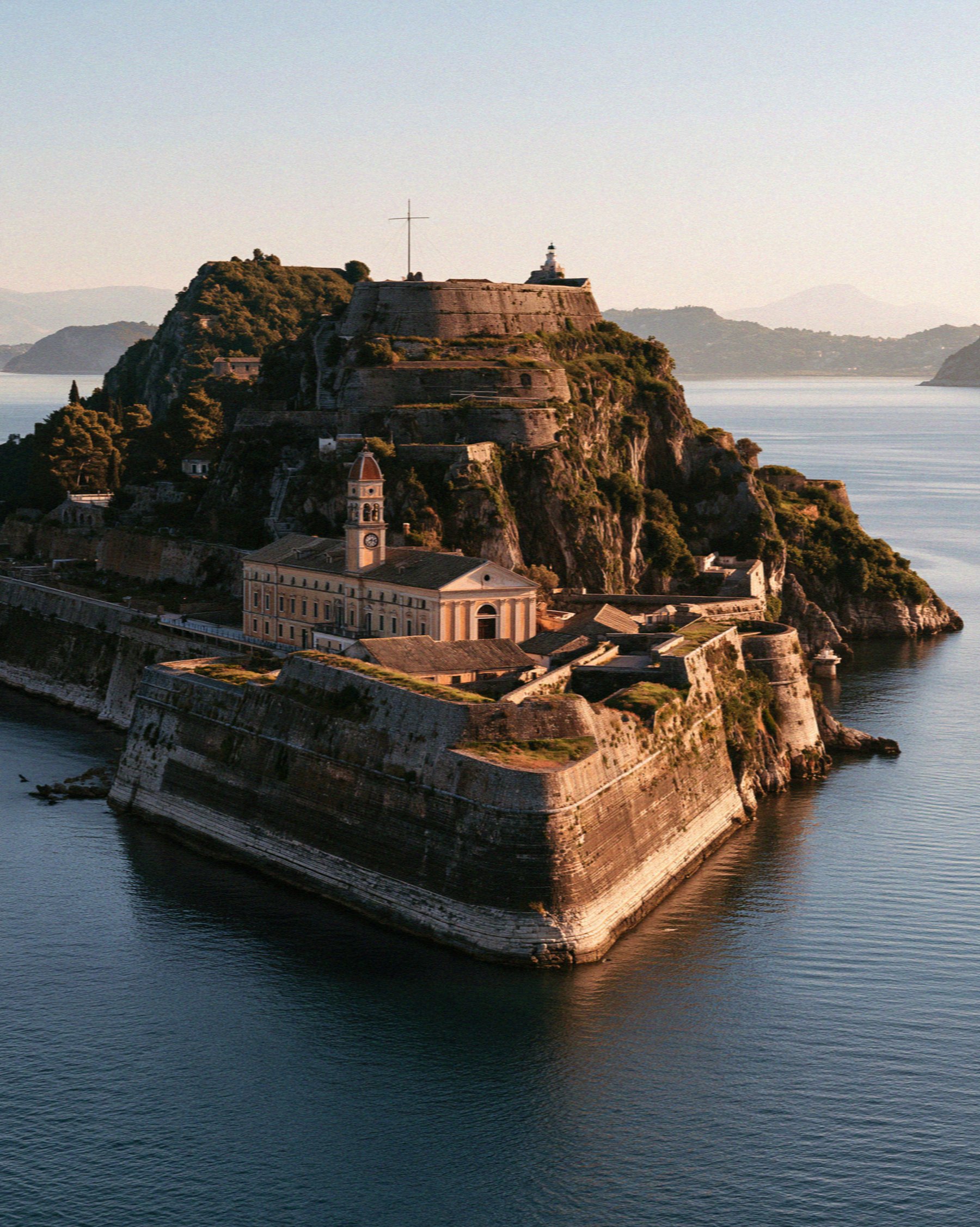
At the far end of the Spianada, the Venetians took a twin-peaked headland and cut it off from the land entirely with a sea moat, the Contrafossa. You reach the gate across a bridge, which is the moment the town drops away behind you.
Inside it is more a walk than a museum, a climb through walls, ramps and old military buildings. Keep going up. The lighthouse on the higher of the two peaks is the reward, with the roofs of the Old Town, the bell towers and the green line of the mainland all in one frame.
Practical. From 1 April to 31 October it opens daily from 08:00 to 20:00; in winter it closes much earlier, around 15:30. The ticket is a few euros. The climb is short but steep and exposed, so in summer go after four in the afternoon.
Saint Spyridon and the saint’s square
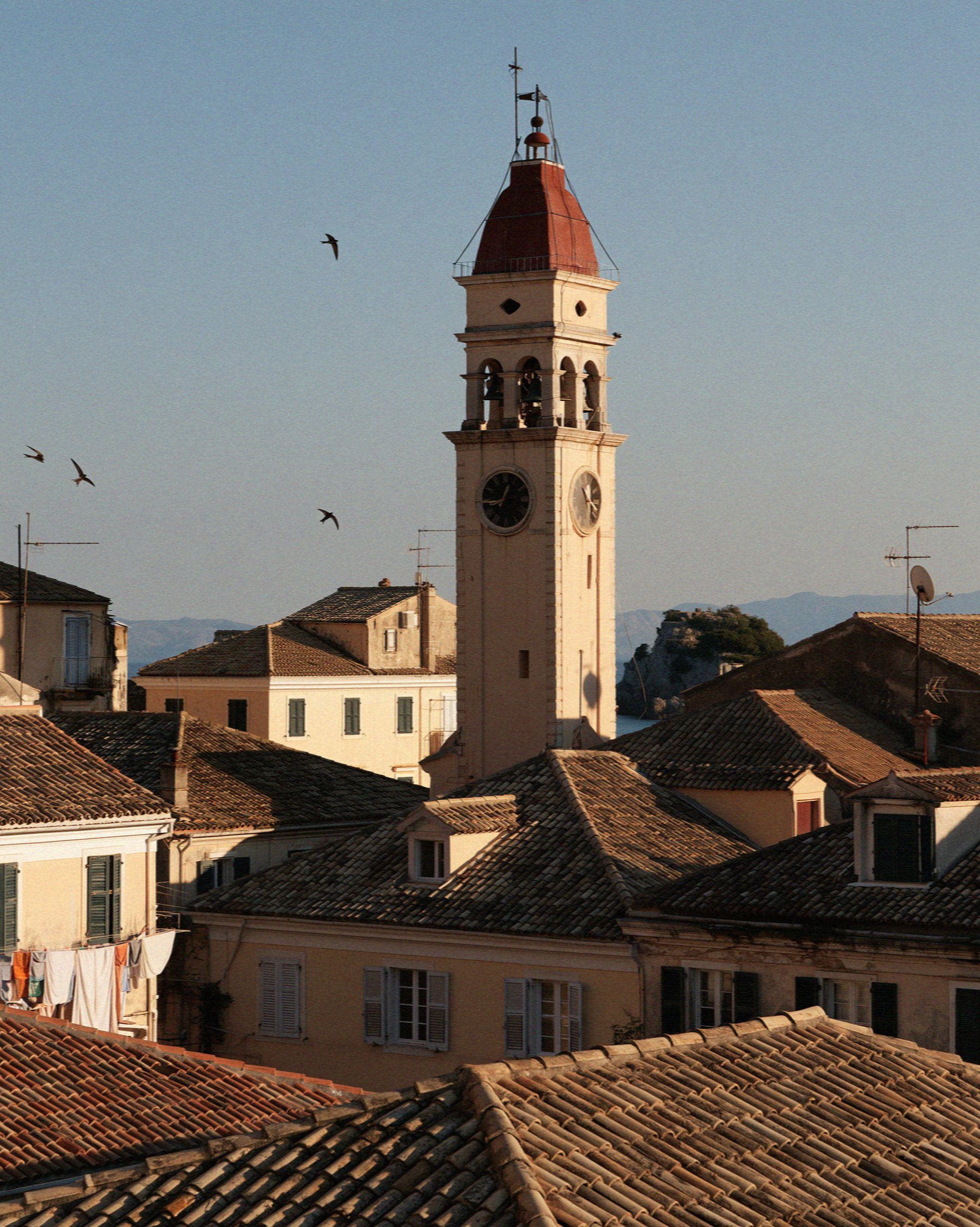
Walk back across the Spianada, through the Liston, and one street in you are at the Church of Saint Spyridon. It was built in 1589, and its bell tower, topped with a red dome, is the tallest in the Ionian Islands.
Inside it is dim and close, and it smells of candle wax. The relics of Saint Spyridon, the island’s patron, lie in a silver casket, and there is often a short, quiet queue of people waiting to pay their respects. To Corfiots he is less a figure from history than a protector who is still on duty.
Processions. Four times a year the saint is carried through the streets: on Palm Sunday, Holy Saturday, 11 August and the first Sunday of November. The bands play, the town lines the route, and if you are there for one, it is the thing to see.
Entry is free. Shoulders and knees covered.
The lanes and Campiello
From Saint Spyridon, head north towards the water. The lanes narrow, the houses rise to four and five storeys, and you are in Campiello, the oldest and densest quarter of the town.
The lanes here are called kantounia, and they are the reason to come to Corfu Town at all. Stone steps, tiny squares with a single tree and a well-head, a church door left open, washing strung from one side to the other. The tall houses keep the lanes in shade for most of the day, which is a mercy in August.
What I’d do. Put the map away. Campiello is small and bounded by the sea on one side, so you cannot go far wrong. Walk until you find a square you like, then sit.
The Palace of St Michael and St George
Back on the Spianada, on its north side, is the long, colonnaded Palace of St Michael and St George. The British built it between 1818 and 1824, in the years when Britain ran the Ionian Islands.
It is now the Museum of Asian Art, the only museum of its kind in Greece, with well over ten thousand objects: Chinese porcelain, Japanese prints, Indian sculpture in bronze, carvings from across Asia. It sounds unlikely on a Greek island and it is genuinely good, and the rooms still carry their period furniture and decoration.
Practical. In summer it opens daily from 08:00 to 20:00. It is the best place in town to spend the hottest two hours of the day.
The New Fortress and the Old Port
On the far side of town, above the Old Port, is the New Fortress, built by the Venetians between 1576 and 1588 to strengthen the town’s western defences. It is less visited than the Old Fortress, which is part of the pleasure.
The walls are massive, the passages are long and cool, and from the top you look down over the roofs of Campiello on one side and the harbour on the other. Part of it is still a naval base and closed, and the hours and any charge change with the season, so check the day before.
Below it, the Old Port is where the town meets its working water: fishing boats, ferries coming and going, the quay and its traffic.
Mon Repos and the ancient city
To finish, walk south along the bay of Garitsa to Mon Repos, about 35 minutes on foot from the Spianada, or take a short bus or taxi.
Mon Repos is a neoclassical villa in a wooded park, and Prince Philip was born in it on 10 June 1921. It is now the Museum of Palaiopolis, telling the story of the ancient city that stood here long before the Venetians. In the park, among the trees, are the remains of that city, including temple foundations you come across almost by accident.
What I’d do. Come in the late afternoon and walk the park slowly. It is the quietest place within walking distance of the town.
Where to stop for coffee
On the Liston. At least once, sit under the arcade with a coffee or a glass of tsitsibira, the island’s ginger beer, a recipe left over from the British years. You pay for the view and it is worth it.
Something sweet. Look for mandolato, the island’s nougat, and anything made with kumquat, which grows on Corfu and turns up candied and as liqueur in the shops along the main streets.
For lunch. Rex, just behind the Liston, has been open since 1932 and does the island’s classics properly, pastitsada and sofrito among them. For more on what to order, and where, see where to eat in Corfu and what to order.
In Campiello. The best coffee stop is the one you find yourself: a single table in a small square, in the shade, with nothing to do afterwards.
The Old Town will take a morning or three days, depending how you let it. For the rest of the island, go back to my complete guide to Corfu; for everything else worth doing once you leave the walls, see the best things to do in Corfu; and if you want to wake up inside the town, the Old Town hotels are in where to stay in Corfu.
Frequently Asked Questions
How long do you need in Corfu Old Town?
A full morning covers the Spianada, the Liston, Saint Spyridon and Campiello. Add an afternoon for the Old Fortress and the Museum of Asian Art, and another for Mon Repos. Two days lets you do it all slowly.
Is Corfu Old Town a UNESCO site?
Yes. The Old Town of Corfu has been on the UNESCO World Heritage List since 2007, as a fortified port town shaped by four centuries of Venetian rule and later by the French and British.
Is the Old Fortress in Corfu worth visiting?
Yes, mostly for the climb to the lighthouse and the view over the town and the strait. It opens daily from 08:00 to 20:00 between April and October, with shorter hours in winter, and the ticket is a few euros.
What is the Liston in Corfu?
The arcaded row of cafés along the west side of the Spianada. The French built it in 1807, taking the Rue de Rivoli in Paris as their model, and it is still where the town comes to sit, and to walk up and down in the evening.
When are the Saint Spyridon processions?
Four times a year: Palm Sunday, Holy Saturday, 11 August and the first Sunday of November, when the saint’s relics are carried through the Old Town.
Read also: The Best Things to Do in Corfu | Where to Eat in Corfu and What to Order | Victoria’s Complete Guide to Corfu