Some links in this guide are affiliate links. If you book through one, this site may earn a small commission, at no extra cost to you. How this works.
The best things to do in Santorini are not the ones on the postcards. The postcard is a sunset in Oia, and you can see it, but it is a crowd with a view attached. The island is better on foot along the cliff, under the roof at Akrotiri, in the warm water by the volcano, and up in the inland villages where the view faces the other way.
These are the ten things I would do, roughly in the order I would do them. For the bigger picture, when to come and where to sleep, start with my complete guide to Santorini.
What to book before you come
Three things I would book ahead, because the good departures sell out in summer.
Akrotiri and Red Beach, with a guide
The Bronze Age town with someone who can explain it, then the red cliffs on the way back.
The volcano and the hot springs
A short boat out to the volcano and a swim in the warm, rust coloured bay.
The island in a day, with wine and the Oia sunset
The easy way to see the villages, a winery and the sunset without a car.
Each button opens GetYourGuide in a new tab, so this page stays open. Booking through them supports the blog at no cost to you.
Walk the caldera from Fira to Oia
If you do one thing, do this.
The path runs north along the rim of the caldera from Fira to Oia, about ten kilometres, and takes three hours of walking and closer to five with stops. It is free, open all year, and needs no booking. Through Firostefani and Imerovigli it is paved and busy with hotel guests carrying coffee; after Imerovigli the paving ends and it becomes a proper cliff path, loose stone and dust, climbing over the shoulder of the hill with the sea a very long way below.
Start between seven and eight in the morning. By eleven there is no shade anywhere and the heat comes up off the rock. Take more water than you think, a hat, and shoes with grip: I walked it in white tennis shoes and was glad of them on the stony stretch.
Walk north, not south. You finish in Oia, have lunch, swim at Ammoudi, and catch the bus back to Fira for about two euros. Walking the other way means climbing back up into Fira in the afternoon heat.
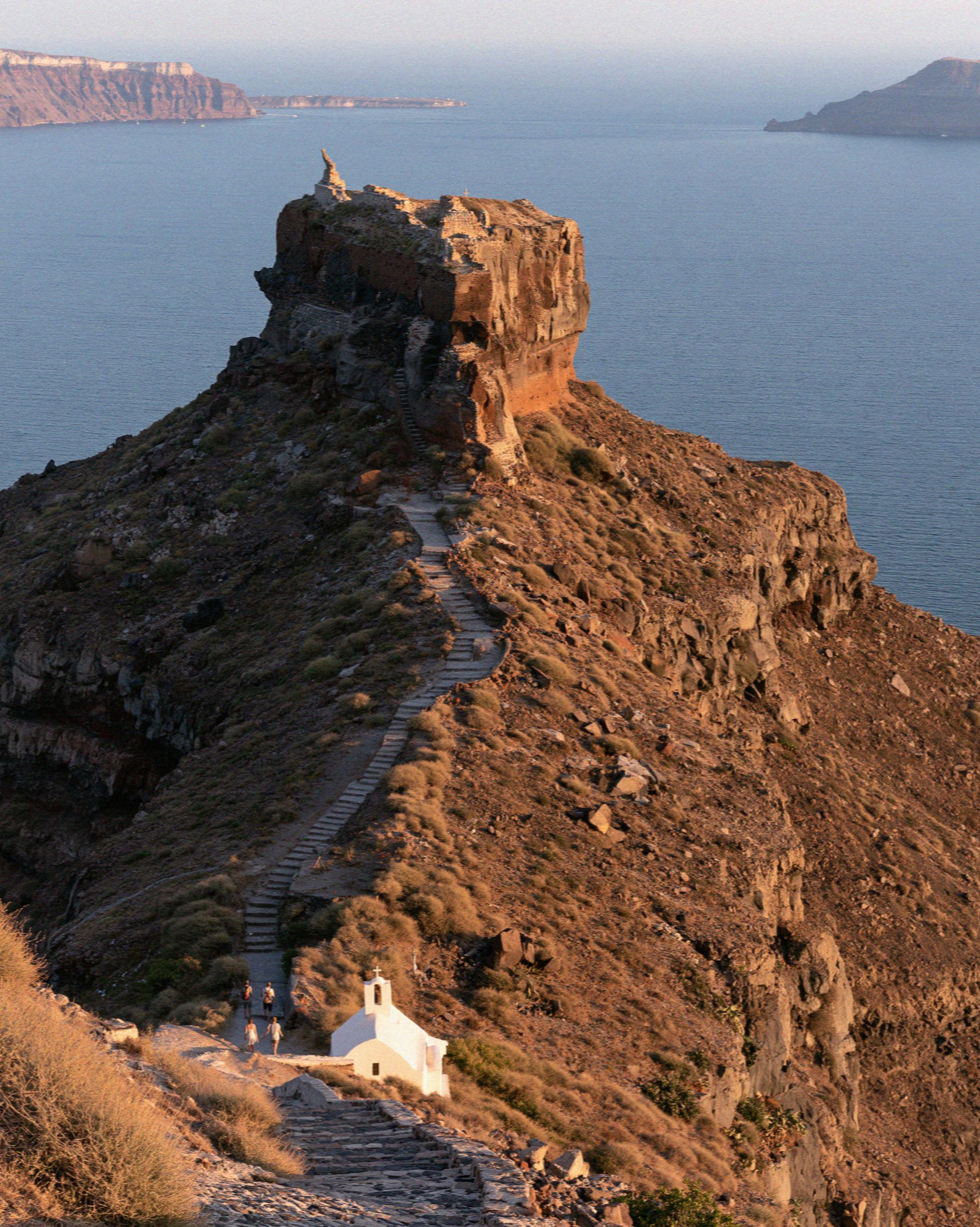
Go out to Skaros Rock
Below Imerovigli, a great lump of rock pushes out into the caldera on a narrow neck of land. In the Middle Ages it held the island’s main castle and a small town inside its walls, the place people retreated to when pirates came. Earthquakes and time took almost all of it, and what is left is the rock itself and a few broken walls on the top.
The path down from Imerovigli is a long run of steps, then a dusty track round the base. Allow an hour or so there and back, or two if you go slowly. Do not miss the small white chapel of Theoskepasti on the far side of the rock, which most people walk straight past because they turn round at the first viewpoint.
The view from Skaros, back along the whole curve of white villages, is to my mind the best on the island. It is also a fine place for sunset, with a fraction of the people at Oia.
Akrotiri, the Bronze Age town
Akrotiri is the reason to come to Santorini even if the view meant nothing to you.
It was a wealthy harbour town in the Bronze Age, trading across the Aegean, with streets and drains and painted houses of several storeys. Around 1600 BC the volcano buried it in ash and pumice, and the ash kept it. Now a huge roof covers the excavation and you walk on raised walkways through the streets, past staircases and doorways and large clay jars still sitting where they were left.
No gold has been found, and no bodies. The inhabitants seem to have had enough warning to leave, which makes the place feel less like a tomb than a house whose owners have just stepped out.
Tickets are 20 euros. Summer hours run from about eight in the morning into the evening on most days, but only until half past three on Mondays and Thursdays, and in winter it shuts on Tuesdays, so check before you go. It sits in the south, near the village of Akrotiri, about twenty-five minutes from Fira by bus or car. Hire an audio guide or join a guided visit: the town makes far more sense when someone tells you what a room was for.
The frescoes in Fira
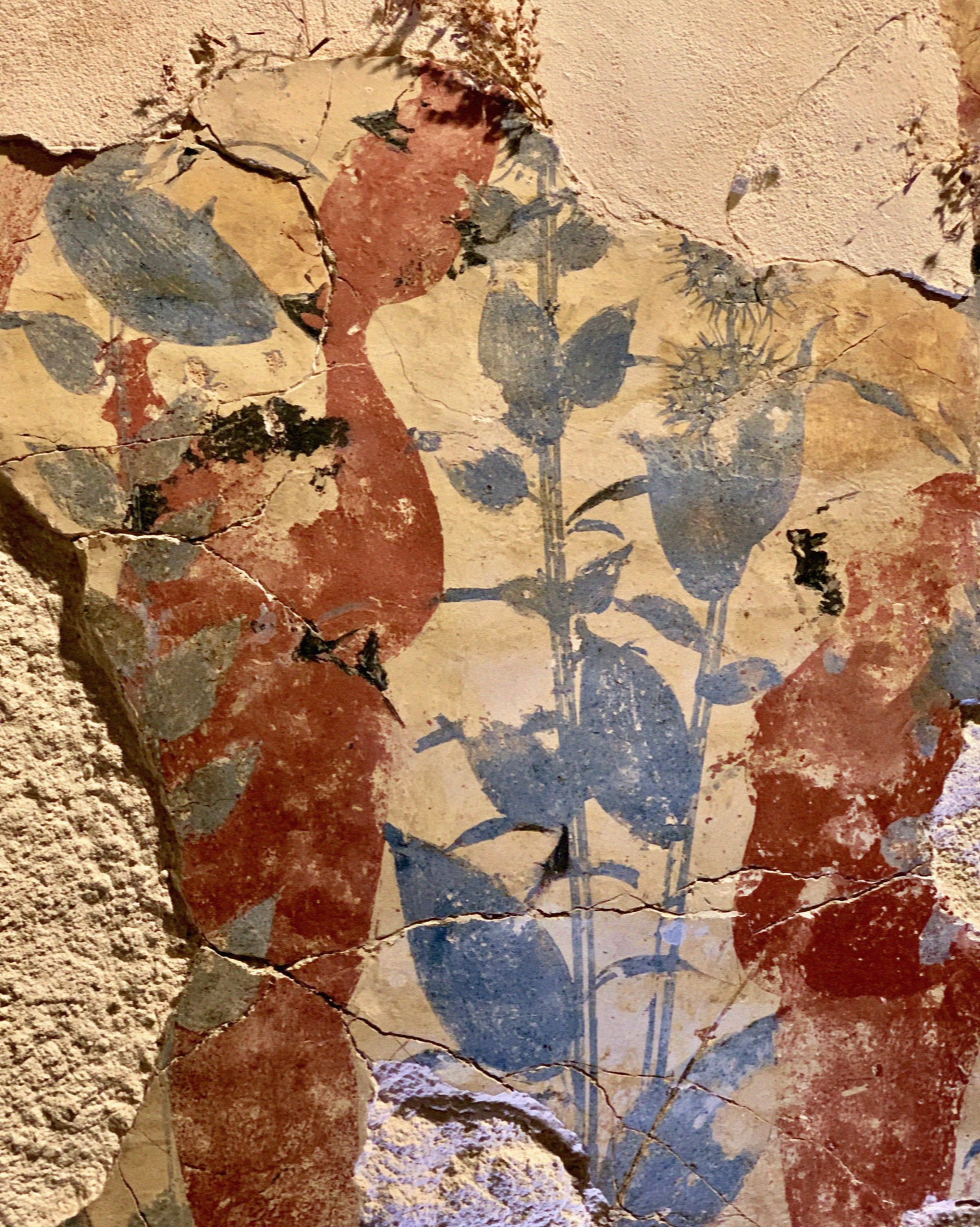
Some of the wall paintings from Akrotiri are in Fira, in the Museum of Prehistoric Thera, a small, cool, well-lit building near the bus station. Others went to the national museum in Athens.
What survives here is extraordinary less for its size than for its colour. Red, ochre, blue and black, laid on three and a half thousand years ago, still bright. Figures, animals and plants painted by people who could see the same sea you can. Entry is 10 euros, it opens from half past eight to half past three, and it closes on Tuesdays. Allow an hour. It is the best thing to do in Fira on a hot afternoon.
Sail to the volcano and the hot springs
From the old port below Fira, wooden boats leave several times a day for the black islands in the middle of the caldera.
The standard trip takes about three hours. The first stop is Nea Kameni, a younger lava island, where you walk up a path of black rock and red cinder to the crater, with small steaming vents near the top. The last eruption here was in 1950. It is a hot, exposed climb of half an hour or so, and the five euro entry fee is paid in cash on arrival. Then the boat moves round to Palea Kameni, stops in a little bay, and you jump off and swim to the hot spring, where the water turns orange and warm, around thirty degrees or a little more.
The simple trips cost roughly 25 to 45 euros. You reach the old port by the cable car or by the path of steps beside it. There is more on the different boat days, including catamarans and Thirasia, in my guide to Santorini boat tours.
A winery at sunset
Instead of fighting for a wall in Oia, watch the sun go down from a winery terrace on the caldera.
Santo Wines, near Pyrgos, has a long terrace on the cliff edge built for exactly this, and it is busy at sunset for good reason: a glass of Assyrtiko, the whole caldera below you, and a seat. Venetsanos, near Megalochori, is smaller and has a similar view. Book a tasting or arrive early for a table.
The wines themselves deserve attention, too. The vines here are trained into baskets on the ground, the soil is volcanic, and the white wine has a salty edge you will not taste anywhere else. I have written about the grapes and the best cellars in my guide to Santorini wineries.

Pyrgos and the walk to Profitis Ilias
Pyrgos crowns a hill at the centre of Santorini and was its capital until around 1800, when Fira took over. Its lanes wind upward in circles to the broken walls of a Venetian castle and churches at every turn. I took the bus there one morning precisely because it does not face the caldera, and it turned out to face everything else instead: the vineyards, the east coast, the sea on both sides.
From the village a path climbs further, about two and a half kilometres, to Profitis Ilias, a monastery founded in the eighteenth century at the top of the island, a little under six hundred metres up. The radio masts on the summit are not lovely, but the view across the whole island is. Allow an hour or so up, and go in the morning or late afternoon.
Come back to Pyrgos for sunset. It is quiet, and the sun goes down over the caldera on one side while the light moves across the vineyards on the other.
Swim off the rocks at Ammoudi
Ammoudi is the tiny harbour below Oia, a few hundred steps down a zigzag path, with fish tavernas on the quay and red volcanic cliffs above.
Walk past the last taverna along the rocks and you come to a swimming spot facing a small islet with a chapel on it. The water is deep, clear and cold even in summer, and people swim across to the islet or jump from the rocks into the sea. The rocks are uneven and slippery and there is no lifeguard, so be sensible about it, especially if the sea is up.
Then have lunch at the harbour. Climbing back up to Oia afterwards is hard work in the heat; a taxi up the road the long way round is no shame.

Ancient Thera above Kamari
Long after Akrotiri was buried, the island was settled again, and the later Greek town of Thera was built on the ridge of a mountain between Kamari and Perissa, about 360 metres above the sea. It was used for centuries, through Hellenistic and Roman times, and the ruins run along the ridge: temples, a theatre, houses, streets, with the sea dropping away on both sides.
A narrow road switchbacks up from Kamari, and there is a footpath up from Perissa for anyone who wants the climb. Entry is 10 euros. In summer it opens in the morning until mid-afternoon and is closed on Wednesdays, and outside the season the days shrink, so check before you go. It is exposed and very hot after midday.
Cross to Thirasia
Opposite Oia, across the water, Thirasia is what remains of the western rim, home to only a few hundred people.
A little local boat makes the short crossing from Ammoudi several times a day, and the fare is a euro or two. From the old harbour at Korfos a long flight of steps climbs to Manolas, the main village, which sits on the rim looking back at Santorini. It is what the caldera villages looked like before the hotels: whitewashed, quiet, with chickens and a bakery. Check the time of the last boat back before you sit down to lunch.
Many of the boat trips also stop here, if you would rather not organise it yourself.
Most of these sit naturally together over a few days, and I have put them in order in my Santorini itinerary. If you are deciding where to sleep for them, my guide to where to stay in Santorini sets out the villages one by one, and my guide to the villages of Santorini tells you what each is like to walk through.
Frequently Asked Questions
What is the number one thing to do in Santorini?
The caldera walk from Fira to Oia. It is free, takes three to five hours, and shows you the whole rim of the volcano.
Is Akrotiri worth visiting?
Yes. It is a Bronze Age town preserved under volcanic ash, with streets and houses several storeys high. Entry is 20 euros, and a guide helps a great deal.
How much is the volcano boat trip in Santorini?
Simple trips to the volcano and the hot springs cost roughly 25 to 45 euros, plus a five euro entry fee on Nea Kameni paid in cash.
Can you visit Thirasia from Santorini?
Yes. A small boat crosses from Ammoudi below Oia in about ten minutes for a couple of euros, and many boat tours stop there too.
Where can you watch the sunset in Santorini without the crowds?
Skaros Rock, Pyrgos, or a winery terrace on the caldera near Pyrgos or Megalochori.
Read also: The Villages of Santorini: Oia, Fira, Pyrgos and Beyond | Santorini Boat Tours: The Volcano, Catamarans and Thirasia | Victoria’s Complete Guide to Santorini