Every time I return to Lake Garda, I am reminded that the journey there is part of the pleasure rather than an obstacle to it. This is one of the most accessible corners of northern Italy, cradled between Milan and Venice, ringed by good roads and served by more airports than any lake has a right to expect. The trick is simply knowing which door to arrive through, because the right choice can shave an hour off your transfer and set the tone for everything that follows. Below I have gathered everything I have learned over many arrivals, from which airport to book to whether you truly need a hire car once you are here.
Which airport to choose
If you are flying, the single most important decision you will make is which airport to book, and my answer is almost always the same. I would fly into Verona Villafranca, known by its code VRN, because it sits closest to the water. From the terminal, it is only around 20 to 30 minutes to the southeastern shore at Peschiera or Lazise, and roughly 30 to 40 minutes to Sirmione. For an all round balance of proximity, transfers and onward links, nothing else comes close.
That said, Verona does not always have the flight you want, so it helps to know the alternatives. Bergamo Orio al Serio, code BGY, lies about 80 kilometres away, a drive of roughly 50 minutes to an hour, and as a Ryanair hub it often carries the cheapest fares from the UK. Brescia, code VBS and sometimes called Montichiari, sits very close to the southern shore but runs so few scheduled flights that I rarely find it useful in practice. Milan Linate, code LIN, is about 100 kilometres out, just over an hour by car along the A4 motorway. Milan Malpensa, code MXP, is the furthest of the sensible options at roughly 190 kilometres and two to three hours away, so I would only choose it if the price or schedule were genuinely compelling. Venice, code VCE, sits to the east and works surprisingly well if you are willing to take a high-speed train, around an hour to Verona and then onward to the lake.
Where you plan to base yourself should steer this choice as much as the airfare. If you are still shaping your route, my Lake Garda itinerary lays out how the shores differ and where I would settle for a first visit, which in turn tells you which airport is truly nearest.
Plan Your Visit to Lake Garda
A few things I booked and loved. These help support the blog, at no cost to you.
- Where I stayed: search Lake Garda hotels
- Gardaland and Lake Garda activity tickets
- Rent a car to explore the area
- Stay connected: get a travel eSIM
This section contains affiliate links. If you book through them I may earn a small commission, at no extra cost to you.
Getting from the airport
Once you have landed, the transfer itself is refreshingly simple, particularly from Verona. If you are not hiring a car, there is a regular shuttle bus from Verona Villafranca to Verona Porta Nuova station, and from there the regional and regional express trains carry you straight to the lakeside stops. A taxi or a pre-booked private transfer is the gentlest option after a long flight, and for a family with luggage I often think it worth the extra outlay to be delivered directly to the hotel door.
From Bergamo and the Milan airports, the pattern is the same in spirit. You either collect a hire car from the terminal and join the A4, which is the artery running the whole length of the corridor, or you take an airport coach or train into the nearest main station and change onto the Milan to Verona line. From Venice, the high-speed service to Verona is the elegant way through, and I rather enjoy the hour of watching the Veneto slide past before the water appears.
Arriving by train
I have a great fondness for arriving by train, because it removes every worry about motorway traffic and deposits you within sight of the lake. Garda is threaded by the Milan to Verona to Venice line, which follows that same A4 corridor, and the two stations actually on the water are Desenzano del Garda-Sirmione and Peschiera del Garda. The rough timings are worth committing to memory: from Milan you are looking at around 70 minutes, from Venice about 90 minutes, and from Verona a mere 15 to 20 minutes, which makes a day trip in either direction effortless.
There is one wrinkle that catches people out every year. Sirmione, for all its fame, has no station of its own. To reach it you alight at Desenzano and then take a short bus, a taxi or, my preferred method, the ferry across the little bay. It is a minor detour and, frankly, a lovely one, but it is worth knowing before you stand on the platform wondering where the Sirmione sign has gone.
The ferry network
If there is one thing that turns a Garda holiday from pleasant into magical, it is the ferries, and I never tire of recommending them. The lake is served by Navigazione Lago di Garda, universally known as Navigarda, whose boats stitch the shores together from north to south. The network links Desenzano, Sirmione, Salò, Gardone, Gargnano, Maderno and Torri del Benaco, which is the mid-lake car ferry crossing, then continues up to Malcesine, Limone, Riva and Torbole, with eastern shore stops such as Bardolino and Garda along the way. On a single ticket you can hop between medieval harbours that would take an age to reach by road.
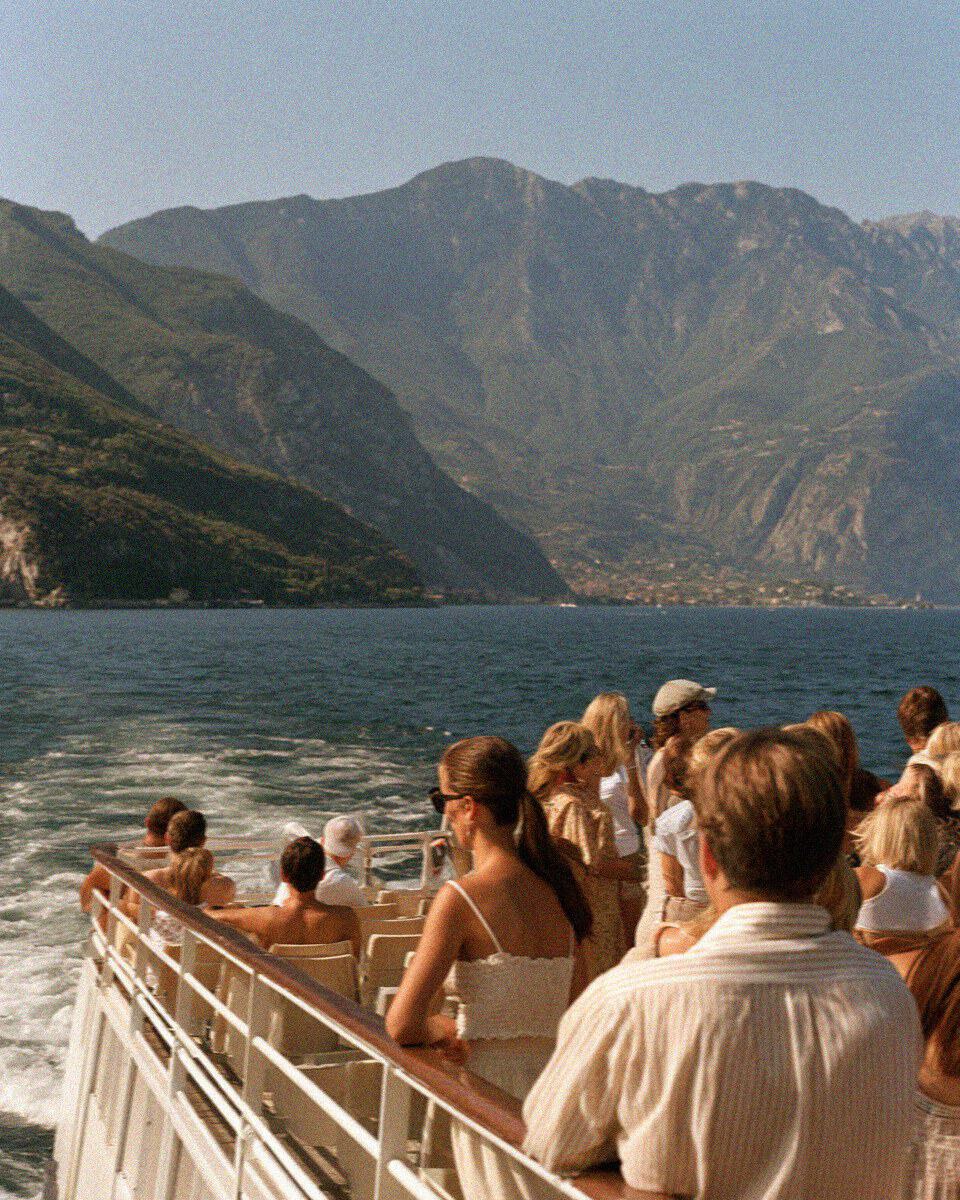
There are three kinds of vessel to know. The standard battello is the leisurely one, all open decks and unhurried views, and it is the one I choose when I have time to spare. A faster hydrofoil or catamaran runs on some routes for a small surcharge when you want to cover distance quickly. And then there is the Torri del Benaco to Maderno car ferry, which carries vehicles across the belly of the lake and saves a very long drive around either end.
Fares are gentle. A single hop runs roughly 3 to 15 euros depending on distance, while a full lake day pass sits somewhere around 25 to 35 euros, which pays for itself if you intend to wander. Zonal passes cover a cluster of towns for less, and there is a Happy Family deal that lets up to two children aged 4 to 11 travel free when accompanied by two paying adults, a kindness that adds up quickly. Do check the operator’s own fare calculator for exact town-to-town prices, as they vary by the kilometre. One caution on timing: the service runs roughly from March to October or November, with summer boats from around 8:00 to 20:00, and it is sharply reduced in winter. If your heart is set on lake hopping, the best time to visit Lake Garda is worth reading before you book, because a beautiful February day may still leave you waiting on an empty jetty.
Hiring a car versus going car-free
Whether to hire a car is the question I am asked most, and the honest answer is that it depends entirely on your plans. I would take a car if I wanted the freedom of the western shore villages, the hillside wineries above the lake, the base of Monte Baldo, or inland day trips to places like Borghetto, Valeggio sul Mincio and Verona itself. For that kind of roaming, a car is liberating and often the only practical way.
But I would happily skip the car if I were basing myself in a single walkable town such as Sirmione, Riva or Malcesine and using the trains and ferries to explore. In high summer the perimeter Gardesana roads that hug the shore become genuinely congested, and crawling through that traffic is nobody’s idea of a holiday. Going car free is frequently the more relaxing choice, and it is the one I lean towards for a first, unhurried visit.
Parking
If you do bring a car, temper your expectations about parking, particularly in the historic centres. Space is scarce in the pretty old towns, and where you find it you will generally pay around 2 to 4 euros per hour. In peak season the sensible strategy is to park a little outside the centre and walk in, or to leave the car at your hotel and travel by boat for the day. It is a small friction, easily managed once you know to plan for it, and it rarely dents the joy of being here.
However you choose to arrive, Garda makes it easy, and for the fuller picture of shores, seasons and where to stay, my complete guide to Lake Garda draws all of it together in one place.
Frequently Asked Questions
What is the closest airport to Lake Garda?
Verona Villafranca, code VRN, is the closest and my recommended all-round choice. It is around 20 to 30 minutes from the southeastern shore at Peschiera and Lazise, and roughly 30 to 40 minutes from Sirmione, with a shuttle bus linking the airport to Verona Porta Nuova station for onward trains.
Do you need a car at Lake Garda?
Not necessarily. If you are basing yourself in one walkable town such as Sirmione, Riva or Malcesine and using the trains and ferries, you can happily go car-free, which is often more relaxing given the summer congestion. I would only hire a car for the western shore villages, hill wineries, the base of Monte Baldo and inland trips to Borghetto, Valeggio and Verona.
How do you reach Sirmione?
Sirmione has no railway station of its own, so you travel via Desenzano del Garda-Sirmione on the Milan to Verona line. From Desenzano it is a short bus, taxi or ferry across the bay into Sirmione, and I always favour the ferry for the approach to the castle from the water.
Are the Lake Garda ferries worth it?
Wholeheartedly, yes. The Navigarda network links every notable town on the lake; singles run from roughly 3 to 15 euros, and a full lake day pass of around 25 to 35 euros lets you hop freely. The Happy Family deal even carries up to two children aged 4 to 11 free with two paying adults, so for exploring the shores I consider the boats indispensable.
Related
Read next: my Lake Garda itinerary, the best time to visit Lake Garda, and Victoria’s complete guide to Lake Garda.