Mykonos Town is the reason to come to Mykonos, even if you sleep on a beach at the other end of the island. It is a white maze of lanes, chapels and painted doors, built low against the wind, and it is one of the loveliest towns in the Cyclades, especially early in the morning and late at night.
Locals call it Chora, which simply means the town. This is how it is laid out, what each part is like, and how to walk it in an evening. For the rest of the island, start with my complete guide to Mykonos.
How the town is laid out
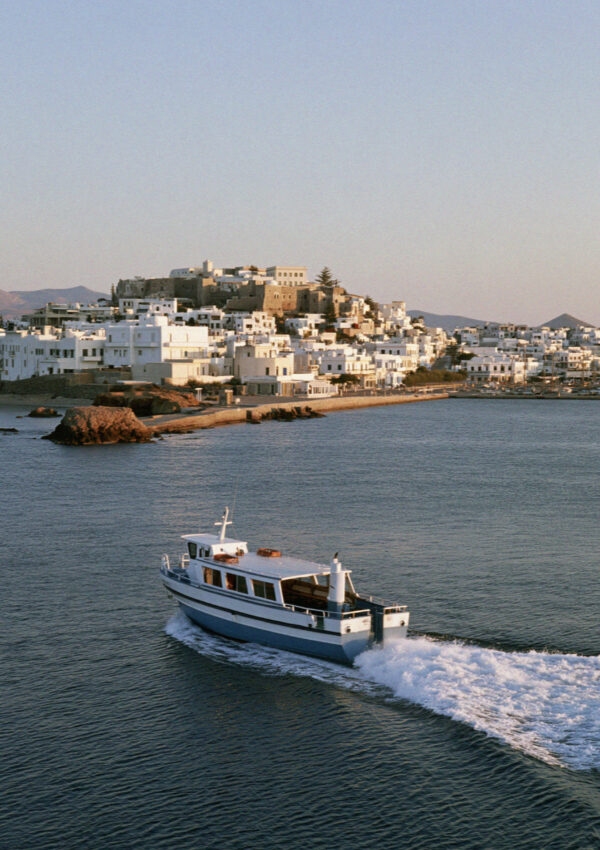
The town wraps around a curved bay on the west coast, facing the sunset and, across the water, Delos.
The old harbour is in the middle of the curve, with its fishing boats, its small white chapel on the quay and the boats to Delos. Behind it, the old town fills the low ground in a dense knot of lanes. To the south-west, the Kastro quarter sits on a small headland with Paraportiani at its tip, and Little Venice runs along the sea beyond it. Above Little Venice, on the ridge at the southern edge of town, stand the windmills. Inland, the lanes climb gently towards the ring road.
Two bus stations frame the old town: Fabrika to the south, for the south coast and the airport, and the Old Port station to the north, for the north and east of the island. The new port, where the big ferries and cruise ships dock, is a few kilometres north at Tourlos, linked to the old harbour by a small sea bus.
The whole old town is closed to cars. You can cross it on foot in fifteen minutes if you know the way, which nobody does.
The lanes, and why they twist
The lanes of Mykonos Town do not run straight anywhere. They fold back on themselves, narrow, turn corners for no visible reason and end at a chapel or the sea.
The story everybody repeats is that the town was built this way to confuse pirates, who raided these islands for centuries. The other story is the wind: a crooked lane breaks the meltemi and keeps the houses cool. I have stood in one during a strong north wind, and I would not argue with either. A lane that breaks the wind also breaks a line of sight.
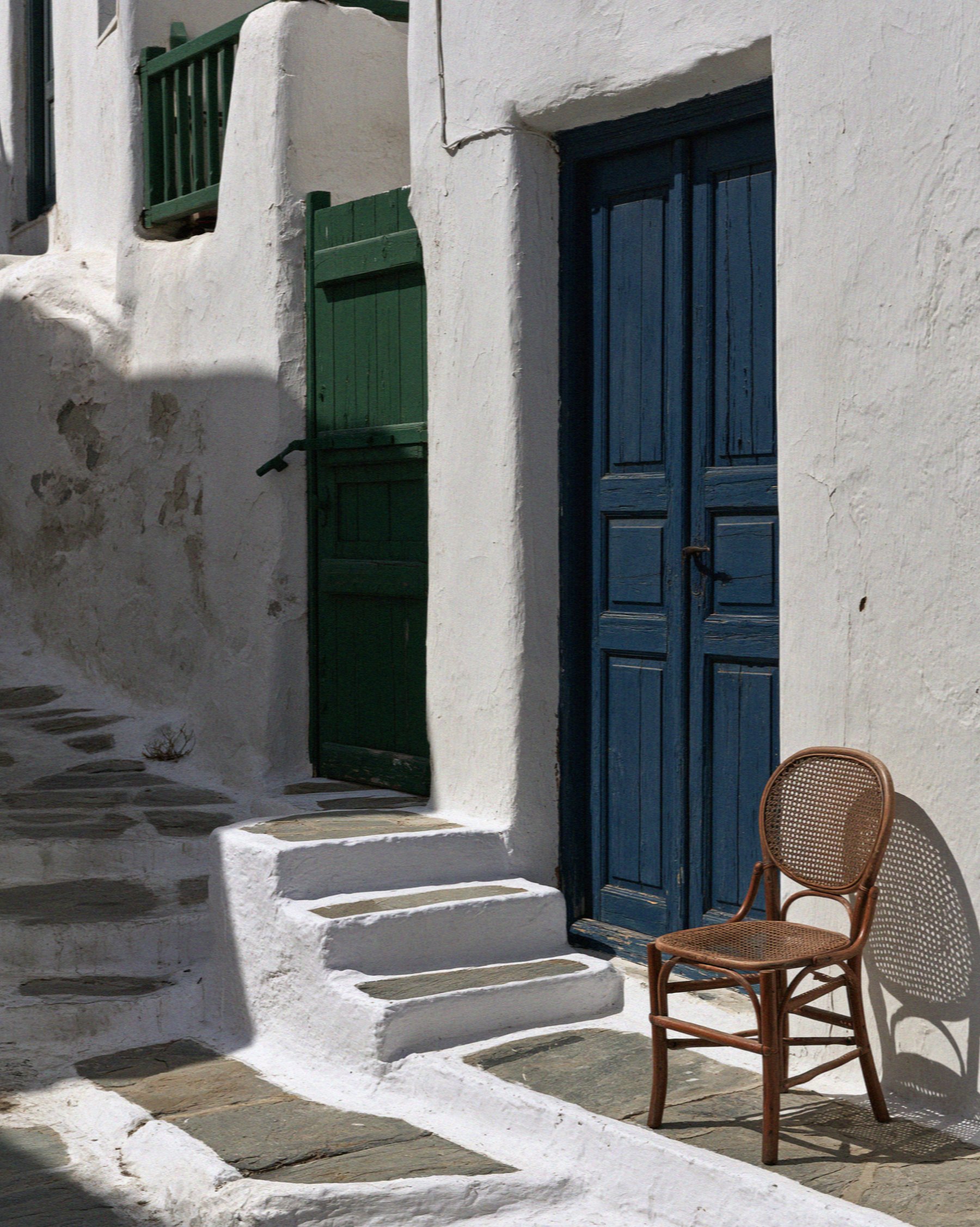
Everything is whitewashed, by hand, again and again, until the corners go soft. The lime was practical long before it was pretty, because it is clean and it reflects the heat. Even the paving is outlined in white, so the edges of the steps show at night. The colour is all in the doors, the shutters and the wooden balconies: red, blue, a green gone chalky with salt, each household’s one decision, kept up for generations. And everywhere, small chapels, many built by families to keep a promise.
The cats have worked all this out. They sleep on the warmest steps, belong to nobody in particular and are fed by everybody.
Little Venice
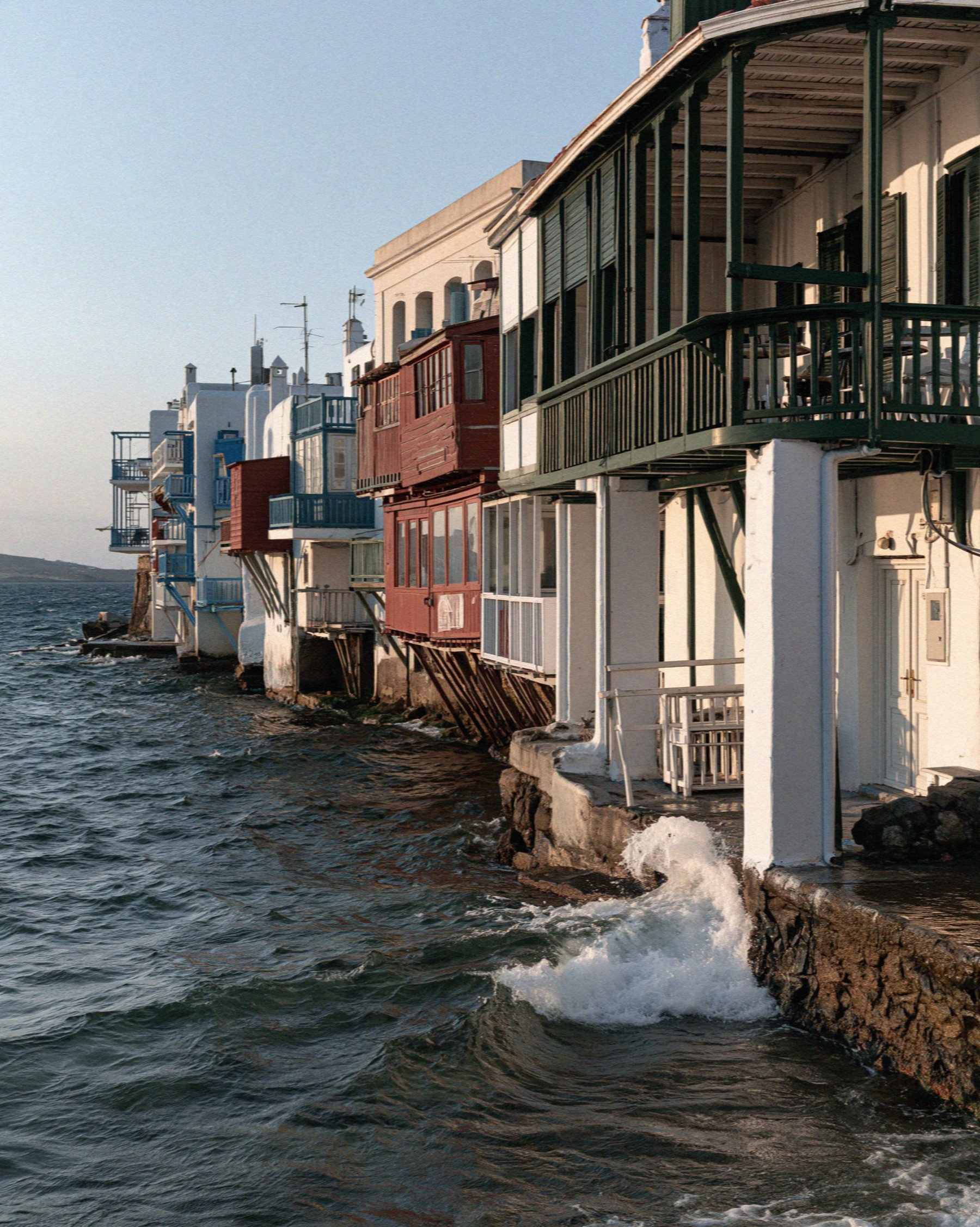
Little Venice is the row of old houses on the western shore of the town, built straight out of the sea, with wooden balconies hanging over the water.
They were built in the eighteenth and nineteenth centuries by ship captains and merchants, and the reason for building them in the sea is not entirely clear. Nobody sensible would put a house there, which is the pleasure of it. On a rough day the waves break against the foundations and the spray reaches the balconies.
Nearly all of them are bars now, and at sunset every table is taken. If you want to sit on the water, arrive well before the sun goes down or book. In the morning, the same balconies are empty, and the light on them is better.
The windmills of Kato Mili
Above Little Venice, on a low bare ridge, a row of round white windmills with pointed roofs looks out to sea. These are Kato Mili, the lower mills, and the most photographed thing on the island.
Mykonos once had close to thirty windmills. They ground grain, much of it brought in by sea, into flour for bread and for paximadi, the hard twice-baked barley rusk that kept for weeks on a ship. The island sat on a busy sailing route, and provisioning the ships that passed was part of how it lived. The mills were built from Venetian times onwards and worked into the twentieth century. Around sixteen survive across the island, some turned into houses.
Boni’s Mill, on the hill above the town to the east, is part of the island’s agricultural museum, with its machinery intact, and opens on summer evenings.
Come at sunset for the crowd and the colour, or first thing in the morning, when you will be alone with them.
Panagia Paraportiani and Kastro
The Kastro quarter, on the headland between the harbour and Little Venice, is the oldest part of the town, built where a medieval castle once stood. Almost nothing of the castle is left, but the lanes here are some of the quietest and prettiest in town.
At its tip stands Panagia Paraportiani, the strangest church in the Cyclades. It is five churches in one: four at ground level and a fifth on top, joined over about two hundred years from the fifteenth century onwards. The soft curves that make it look sculpted are simply the places where one chapel meets another. It is named after a side gate in the old castle walls, which has long since gone.

Next to it, in an old sea captain’s house, is the island’s Folklore Museum. The church is usually locked, which does not matter at all. See it in morning light and again at dusk.
Matoyianni and the shops
Matoyianni is the main lane of the old town, running inland from the harbour, and the busiest street on the island in the evening.
It is narrow, whitewashed and lined with boutiques, jewellers, galleries and the big international names, and from about eight until after midnight it is shoulder to shoulder. The side lanes off it are full of smaller shops, some of them very good, selling local ceramics, sandals and linen clothes. Prices are high, and a few places are pure tourist trade, but walking it at night is part of the town.
If you want to actually shop, go in the late afternoon, before the crowds and after the heat.
Three Wells and the museums
Tria Pigadia, Three Wells, is a small square in the middle of the old town, named after its old public wells, once the town’s main water supply. A local saying holds that whoever drinks from all three will marry on the island.
Two of the town’s small museums are right beside it. Lena’s House is a perfectly kept middle-class Mykonian home from the nineteenth century, with its furniture, embroidery and family portraits still in place, open on summer evenings. The Aegean Maritime Museum next door has ship models, maps, navigation instruments and the restored lantern of the Armenistis lighthouse.
The Archaeological Museum is on the other side of town, near the Old Port, with finds from Rhenia and a great seventh-century BC clay jar decorated with one of the earliest known images of the Trojan Horse. It is closed on Tuesdays.
The harbour and the pelican
The old harbour is the most ordinary part of town and one of the nicest: fishing boats, nets on the quay, old men on benches, a small white chapel at the water’s edge and the boats leaving for Delos in the morning.
It is also the home of the town’s pelican. The first, Petros, was found wounded off the coast by a fisherman in the 1950s and became the island’s mascot. Today his successors wander the quay and the lanes nearby, entirely unbothered by people and quite capable of stealing your lunch.
Manto Mavrogenous Square, at the harbour’s edge, is named after a local woman who spent her fortune on ships and men in the Greek War of Independence of 1821.
Mykonos Town at night
The town changes completely after dark.
From about nine, the lanes fill with people dressed for dinner, the shops stay open until midnight, the tables come out into the lanes and Matoyianni is a slow-moving crowd. Little Venice fills for the sunset and stays full. After midnight, the bars in the lanes take over, small and loud and spilling out onto the steps, and some of them stay open until morning.
If you are a light sleeper, choose a room on the edge of the old town rather than in the middle of it, because in July and August the music carries.
The bars and clubs are in my guide to Mykonos beach clubs and nightlife.
Walking it in an evening
This is the walk I would do on a first evening, starting about two hours before sunset.
Begin at the old harbour, by the small chapel on the quay, and look for the pelican. Walk round the bay to Manto Mavrogenous Square, then into the lanes behind it and up Matoyianni before the crowds arrive. Turn off into the side lanes and drift towards Three Wells, then on towards the sea and the Kastro quarter. Find Paraportiani at the tip of the headland. Walk along Little Venice, then up the short path to the windmills, and watch the sunset from the rocks. Come back down into the lanes for dinner, late.
It is about two kilometres, all of it on foot, and takes as long as you let it. Wear proper shoes: the paving is polished smooth and slippery, especially going down.
To spend more time on the island, my guide to the best things to do in Mykonos has the rest, and my guide to where to stay in Mykonos covers sleeping in town.
Frequently Asked Questions
What is Little Venice in Mykonos?
A row of old captains’ and merchants’ houses built straight out of the sea on the western edge of Mykonos Town, with wooden balconies over the water. Most are now bars, best known for the sunset.
Can you go inside the Mykonos windmills?
Most are private and closed. Boni’s Mill, part of the agricultural museum on the hill above town, opens on summer evenings.
Why are the streets of Mykonos Town so confusing?
The lanes were built narrow and crooked, traditionally to confuse pirates and also to break the strong north wind and keep the houses cool.
Is Mykonos Town walkable?
Yes, completely. The old town is closed to cars and you can cross it in fifteen minutes, though the lanes are steep in places and the paving is slippery.
Is Mykonos Town noisy at night?
In July and August, yes, in the centre and around Little Venice. For a quieter night, choose a room on the edge of the old town or on the slopes just above it.
Read also: The Best Things to Do in Mykonos | Where to Stay in Mykonos: Choosing Your Base | Victoria’s Complete Guide to Mykonos