Some links in this guide are affiliate links. If you book through one, this site may earn a small commission, at no extra cost to you. How this works.
Santorini wineries are the best reason to leave the caldera rim. The island makes wine in a way you will not see anywhere else, from vines woven into baskets on bare volcanic ground, and the white it is known for, Assyrtiko, tastes of the place more obviously than almost any wine I know: dry, bright, and faintly salty, like the air.
The wineries sit mostly inland, among the vineyards between Pyrgos, Megalochori and Episkopi, with a few on the edge of the caldera. This is how the wine is made, what to taste, which cellars to visit and how to get round them without driving. For the island as a whole, see my complete guide to Santorini.
What to book before you come
Three wine afternoons I would book, each with transport, so nobody has to drive back.
Three wineries, shared or private
A smaller operator: three cellars with pickup and snacks, and the option of a private tasting.
Three wineries with a guide
A small group, Assyrtiko from the basket vines and a little Vinsanto at the end.
The island in a day, with a winery and the Oia sunset
A winery stop inside a day of the villages, for anyone who would rather not plan a separate afternoon.
Each button opens GetYourGuide in a new tab, so this page stays open. Booking through them supports the blog at no cost to you.
Why Santorini wine is different
Walk into any vineyard here and the first thing you notice is that there are no rows of vines on wires. The vines lie on the ground, trained round and round into low baskets called kouloura, with the grapes hanging inside the ring. Each basket is a small shelter: the leaves protect the fruit from the sun and from the strong summer wind, and the shape traps a little moisture.
Moisture is the whole story. It barely rains here between spring and autumn, the soil is pumice and ash that holds almost no water, and the vines survive largely on the dew and sea mist that come in at night.
The volcanic soil did something else. The phylloxera louse, which destroyed most of Europe’s vineyards in the late nineteenth century, never established itself here, so Santorini’s vines were never grafted onto American rootstock. Many of the root systems are very old, some reportedly centuries old, and the growers renew the baskets above ground while the roots stay put.
The result is small yields, very concentrated grapes and wines with high acidity, which is why they age well and taste so fresh.
Assyrtiko, Nykteri and Vinsanto
Assyrtiko is the island’s grape and its everyday white: dry, high in acid, lemony, with that mineral, saline edge. Young, it is perfect with fish and tomatoes. Aged, it becomes richer and more complex, and the best producers make single-vineyard versions that are worth seeking out.
Nykteri comes from the old practice of harvesting and pressing at night, to keep the grapes cool. Today it means a fuller, oak-aged Assyrtiko, rounder and deeper in colour; to carry the name it must reach at least 13.5 per cent alcohol and spend at least three months in oak.
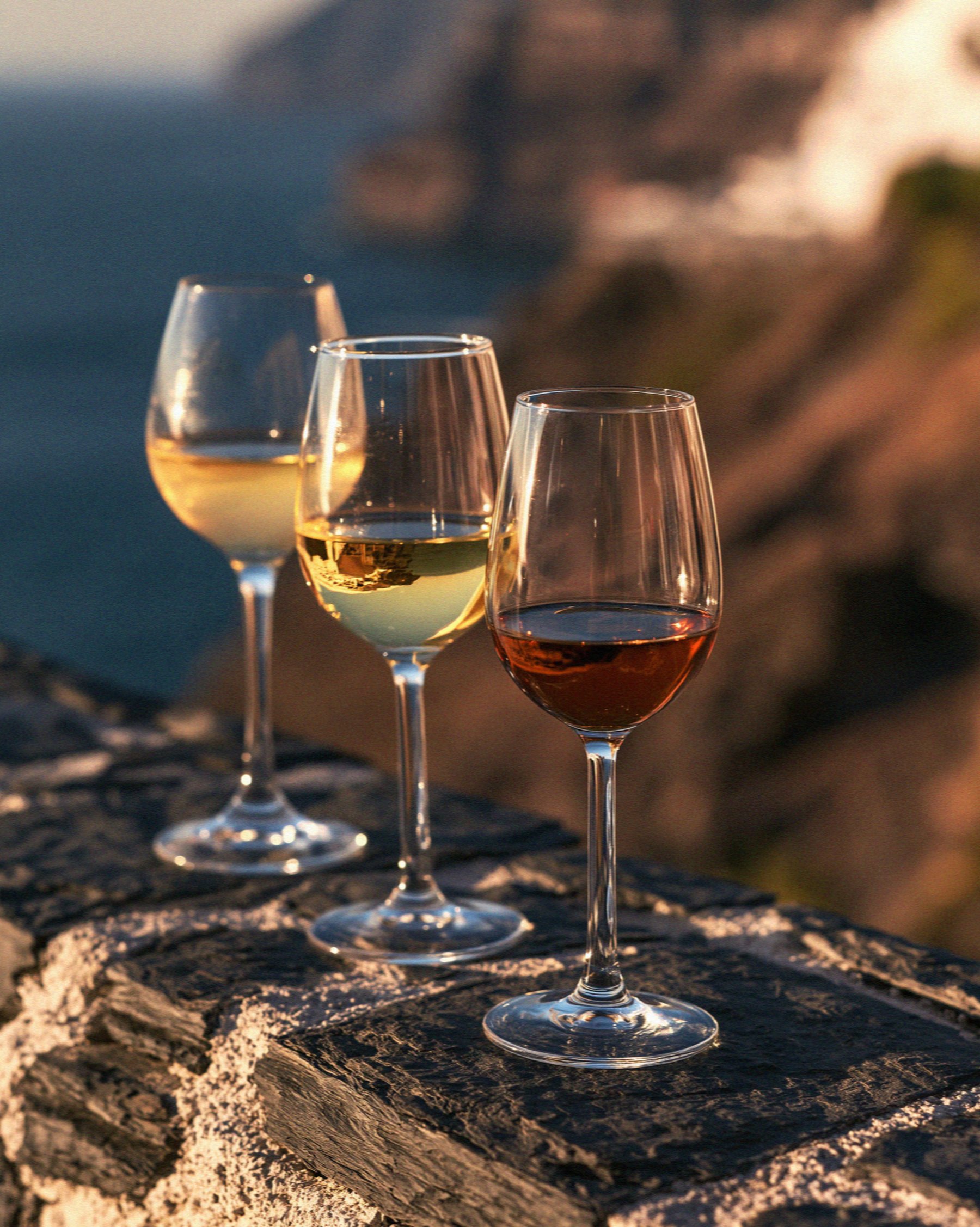
Vinsanto is the island’s sweet wine, made from grapes laid out in the sun to dry for days before pressing, then aged in barrel for a minimum of two years, often far longer: the labels say 4, 8, 12 or 20 years. It comes out amber to dark brown, tasting of dried fruit, honey and coffee, and old Vinsanto is one of the great sweet wines of the Mediterranean.
You will also find Aidani and Athiri, two other local white grapes often blended with Assyrtiko, and Mavrotragano and Mandilaria among the reds.
Santo Wines
Santo Wines is the island’s cooperative winery, founded in 1947 as the Union of Santorini Cooperatives and now representing around 1,200 grower members. It sits on the caldera rim just outside Pyrgos, and its terrace is the most famous wine view on the island: a long sweep of tables on the cliff edge, the whole caldera below.
It is busy, especially at sunset, and the experience is more about the view than the wine, though the wines are reliable and the Assyrtiko and Vinsanto are both good. Tastings range roughly from 18 to 38 euros depending on how many wines you choose. For sunset, book a tasting or arrive well before the light starts to go, or you will be standing at the back.
If you can do only one winery and want the view, this is it.
Estate Argyros
For the wine itself, Estate Argyros is the one most serious drinkers put first. It is a family estate near the village of Episkopi Gonia, with some of the oldest vines on the island, and its aged Assyrtikos and long-aged Vinsanto have won serious international praise.
The winery is modern, the tastings are well structured and properly explained, and there is no caldera view, which keeps the crowds smaller. Tastings run roughly from 25 to 45 euros. Go in the morning, before your palate has met anything else.
Venetsanos
Venetsanos, just outside Megalochori, is built down the caldera cliff in stepped stone levels. It was designed to use gravity, so that the grapes arrived at the top and the wine flowed down through the building as it was made, an advanced idea when it was built in the middle of the twentieth century.
Today the old winery is a tasting terrace and a small museum of itself, with a caldera view that rivals Santo’s and a fraction of the people. It is my choice for a sunset glass if you want the view without the queue. In the evening the wind can be strong on the terrace, so bring something warm.

Domaine Sigalas
Domaine Sigalas sits among flat vineyards near Oia in the north of the island, a modern winery founded by one of the people most responsible for the modern reputation of Santorini wine.
The tastings are more detailed than most, with very good food pairings in its restaurant, and it is the best place to taste single-vineyard Assyrtikos side by side. Tastings run roughly from 35 to 65 euros. It is not walkable from Oia; take a taxi, and pair it with an evening in the village afterwards.
Smaller cellars worth the detour
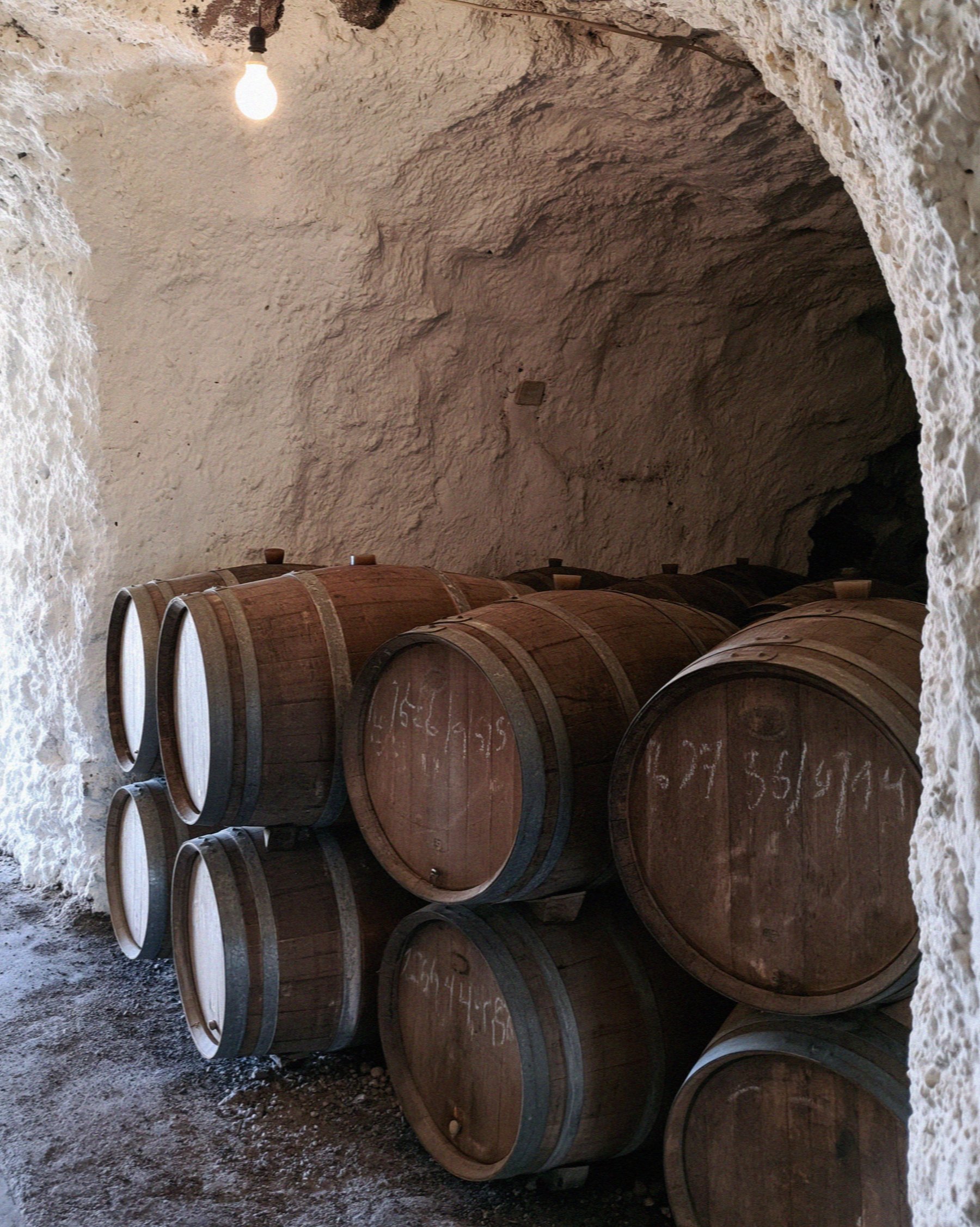
The traditional wine cellar here is a canava, dug into the soft volcanic rock, cool all year round. Several smaller producers still work from them.
Gavalas, in Megalochori, is an old family winery working with rare local grape varieties, with a small, friendly tasting room.
Hatzidakis, near Pyrgos, is a cult name among natural wine lovers, with wines made in a cellar cut into the rock. Visits need booking well in advance.
Artemis Karamolegos, also at Exo Gonia, is a modern, award-winning winery best known for its single-vineyard Assyrtikos, including one called simply 34, with a courtyard restaurant, Aroma Avlis, for lunch after the tasting.
Vassaltis is one of the newest wineries on the island, contemporary in style, with barrel-aged Assyrtiko and tastings at roughly 25 to 45 euros.
Art Space, at Exo Gonia, is an old canava turned into a working winery and an art gallery, with tastings among paintings and sculpture in the tunnels.
And the Koutsoyannopoulos Wine Museum, at Vothonas, takes you through the island’s wine history in a long underground passage, with a tasting at the end. It is good on a hot afternoon.
There is a more serious side to all this. Santorini’s harvests have been shrinking for years, through drought, heat and vineyards lost to building, and the 2026 harvest was expected to be smaller again. One estimate put it at as little as 400 tonnes of grapes, against 2,500 tonnes in 2020, even as demand and prices keep rising. If you find a wine you love here, buy it here: some of these bottles are genuinely scarce. Wrap them well and pack them in your hold luggage.
Tours, tastings and getting there
The wineries are spread across the island and none is walkable from the caldera villages, so you need a plan.
A guided wine tour. The easiest way. Half-day tours visit three or four wineries with transport and tastings included, usually with an afternoon departure that ends at a caldera winery for sunset.
A hired car. Freedom to choose, but someone has to stay sober, and tastings add up. A sensible loop: Estate Argyros in the morning, lunch in Pyrgos or Exo Gonia, Gavalas or Venetsanos in the afternoon, sunset at Santo or Venetsanos.
The bus and a taxi. Buses from Fira reach Pyrgos and Megalochori cheaply, and from either a short taxi ride covers the rest.
When. Most wineries open from late March or April to late October and close for winter. The harvest here is one of the earliest in Greece, usually from early to mid August, so a visit in late August catches the cellars at their busiest. September and early October are calmer and lovely for tasting. Book the popular tastings ahead in summer.
The inland villages around the wineries are in my guide to the villages of Santorini, and the food to drink these wines with is in my guide to where to eat in Santorini. My Santorini itinerary gives the wine country a whole day.
Frequently Asked Questions
Which is the best winery in Santorini?
Estate Argyros for the wine, Santo Wines for the caldera view, Venetsanos for a quieter view, and Domaine Sigalas for detailed tastings with food.
How much is a wine tasting in Santorini?
Roughly 18 to 65 euros, depending on the winery and how many wines are in the flight.
What wine is Santorini known for?
Assyrtiko, a dry, mineral white, and Vinsanto, a sweet amber wine made from sun-dried grapes.
Why are Santorini vines grown in baskets?
The baskets, called kouloura, shelter the grapes from strong wind and sun and help keep in moisture on dry volcanic soil.
Are Santorini wineries open in winter?
Most close from about November to March. Check before you go in the shoulder months.
Read also: Where to Eat in Santorini and What to Order | The Villages of Santorini: Oia, Fira, Pyrgos and Beyond | Victoria’s Complete Guide to Santorini