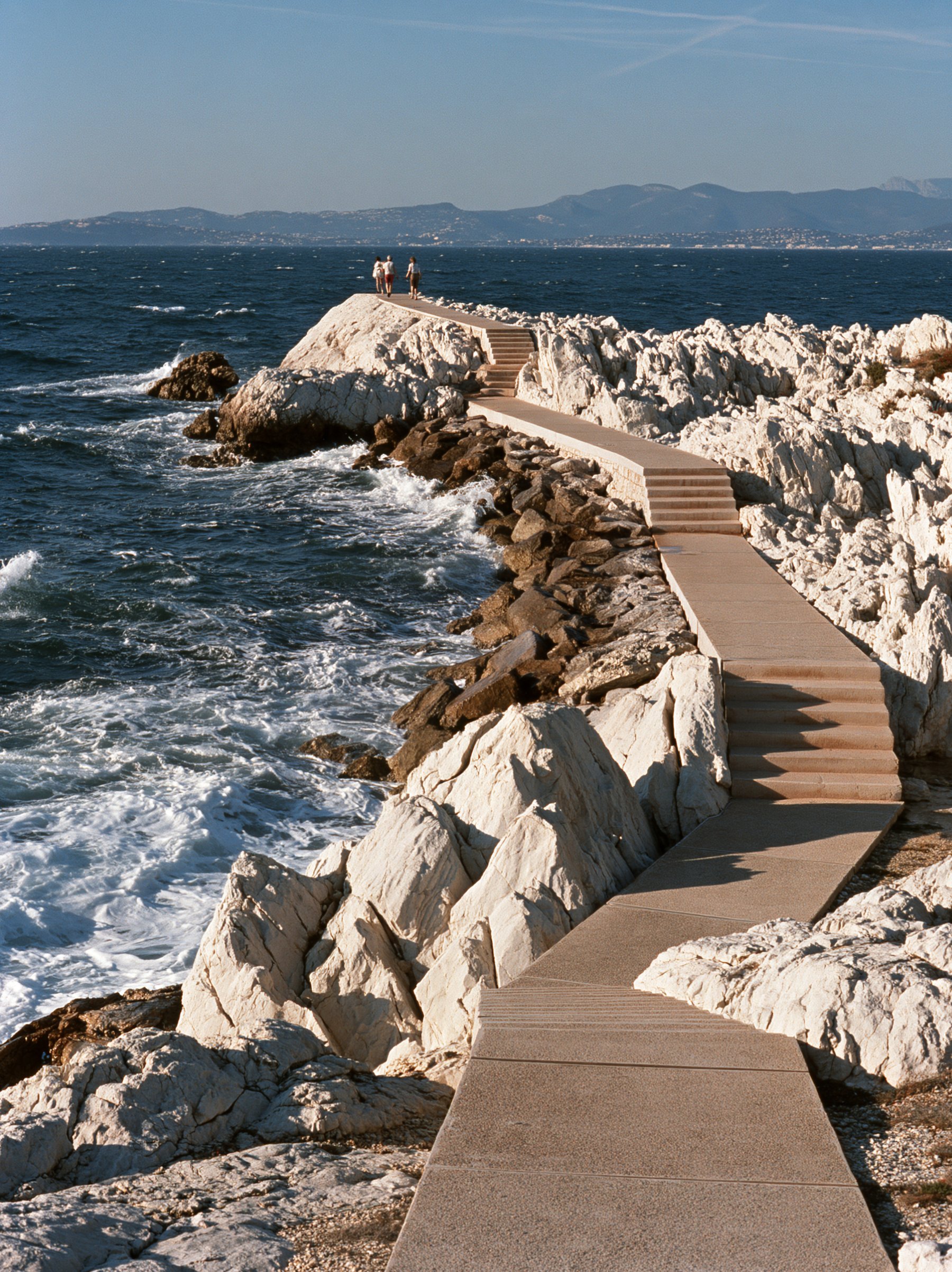
The coastal path around Cap d’Antibes is called Tire-Poil, after the wind that pulls your hair, and on a breezy morning you understand the name within a few steps. It is the best way into a peninsula that otherwise keeps itself behind walls, hedges and long private drives.
The Cap is the wooded headland that hangs south of Antibes, between the old town on one side and Juan-les-Pins on the other. It is small, rich, quiet, and far more walkable than it looks on a map. This is how I spend a day there: the path, the beach at La Garoupe, the lighthouse on the hill, two gardens worth planning around, and the hotel at the tip. The old town and the rest of the commune are in my Antibes guide, which ties it all together.
What the Cap is
Antibes and Juan-les-Pins are one commune, and the Cap is the green thumb of land between them, pointing out into the Mediterranean. The old town and Port Vauban lie to the north-east, the resort beaches of Juan-les-Pins to the west, and the Cap fills the space below.
Most of it is residential: villas in pine woods, many of them invisible from the road. There is no centre and no village square. What there is, instead, is a ring of public things threaded through the private ones: a customs path along the rocks, a sandy bay, a lighthouse with a chapel beside it, a Belle Époque villa and a botanical garden owned by the state. Put them together and you have a very good day.
The Tire-Poil coastal path
The Sentier de Tire-Poil follows part of the old customs path around the southern end of the Cap. Walked as a loop from the car park at Plage de la Garoupe, it is about 5 kilometres and takes an hour and a half to two hours.
The path runs along the rocks just above the sea, uneven in places but secured. It sits within a Natura 2000 site, so stay on it. It closes in rough weather, so check before you set out on a windy day.
The loop returns inland along Avenue Mrs L. D. Beaumont, a quiet road between villa walls. Wear proper shoes rather than sandals, take water, and go early in summer, because there is very little shade on the rocks. I walk it whenever I am on this coast, and it is never the same twice: flat and glassy one morning, white water everywhere the next.
Plage de la Garoupe
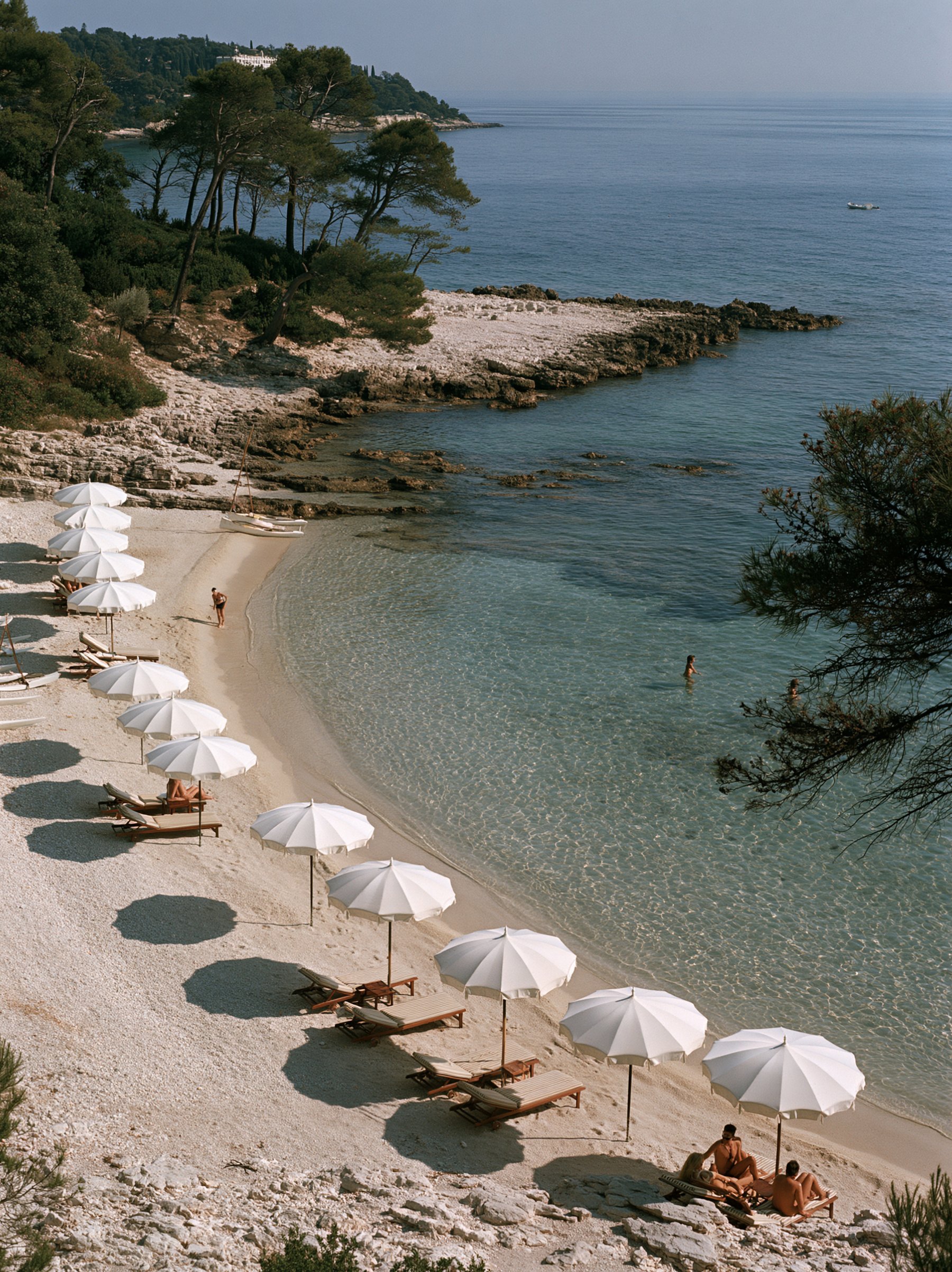
La Garoupe is a small sandy bay on the eastern side of the Cap, and the natural start and finish for the coastal path. In summer most of the sand is given over to private beach concessions, Plage Keller among them, with sunbeds, parasols and lunch. There is a public strip too, smaller, where you can lay a towel for free.
The water is calm and clear on a still day, and the bay is backed by pines. Come early in July and August if you want a place on the public part, or book a sunbed at one of the concessions. Outside high summer it is much quieter. For the other beaches on the Cap and in town, from the sandy ones under the ramparts to the coves where you climb down a ladder, see my guide to the best beaches in Antibes.
The lighthouse and the chapel
The Phare de la Garoupe stands on a plateau 103 metres up, the highest point of the Cap. The first lighthouse was built in 1837, destroyed in August 1944, and rebuilt in 1948.
Beside it is the Sanctuaire de la Garoupe, a chapel known for its marine ex-votos. Opening times vary, so check before you make the climb just for the inside. The outside is always worth it: a viewing table next to the chapel looks along the coast and, on a clear day, to the Alps.
You can walk up through the residential lanes from La Garoupe or drive up. Either way, it is the place to understand the shape of the Cap, with Antibes and its walls on one side and the open sea on the other.
Villa Eilenroc
Villa Eilenroc is a Belle Époque villa on 11 hectares at the tip of the Cap. It was built in the 1860s for a Dutchman, Hugh Hope Loudon, and its name is an anagram of Cornélie, his wife’s name. In 1927 it was bought by an American couple, the Beaumonts (the avenue on the path’s return leg carries her name), and in 1982 Mrs Beaumont left it to the town on the condition that the gardens be opened to the public.
The gardens are the reason to come. There is a rose garden planted with hundreds of varieties, most of them bred in Antibes, an olive grove begun in 2000 with fifty trees for children born that year, and views over the bay from about 30 metres above the sea. There is also a tea room you can reach from the coastal path.
Plan carefully. The villa opens on Saturdays only, from about 10:00 to 17:00, and entry is around 2 euros. It closes for the whole of August because of fire risk, and openings can be irregular, so check with the town before going.

The Thuret garden
The Jardin botanique de la Villa Thuret is the opposite case: free, open on weekdays and closed at weekends and on public holidays. The botanist Gustave Thuret began it in 1857, and a few years after his death it was given to the French state, which still owns it. Today it is run by INRAE, the national research institute for agriculture and the environment.
It is a scientific garden first, which is why it is so interesting. From the beginning, plants from abroad were grown here in trials to see which would adapt to this coast, and those introductions helped make the Côte d’Azur look the way it does now.
Opening hours are 08:00 to 18:00 in summer and 08:30 to 17:30 in winter. If your day on the Cap falls on a Saturday, choose Eilenroc; on a weekday, Thuret.

The Hôtel du Cap
At the southern tip of the peninsula, behind its gates, is the Hôtel du Cap-Eden-Roc: the white château, the pine avenue down to the sea, and the saltwater pool cut into the rocks. I have stayed there more than once, and the walk past its gates still makes me slow down.
You cannot visit it casually. The ways in for non-guests are lunch at the Eden-Roc Restaurant or dinner at Louroc, booked ahead. The hotel opens from April to October only. Its history, rooms, restaurants and prices are all in my guide to the Hôtel du Cap-Eden-Roc.
Fitzgerald, the Murphys and the Cap
The Cap became a summer place because of one couple. In 1923 Gerald and Sara Murphy, two Americans, talked the Hôtel du Cap into staying open past spring, at a time when the whole Riviera emptied out once the heat arrived. Their friends came after them, the Fitzgeralds, Hemingway and Picasso among them.
The Murphys later built their own house near the lighthouse, Villa America, and Fitzgerald used the Cap and the hotel in Tender Is the Night. Over in Juan-les-Pins, the house Scott and Zelda lived in is a hotel today, Belles Rives. There is no plaque trail to follow, but walking the path with the novel in mind changes how you see the rocks.
Getting around the Cap
The Cap is easy to reach and less easy to get around. Local Envibus buses run from Antibes onto the peninsula, but they do not reach every beach directly, and the stops can be a walk from where you want to be.
On foot, the old town to La Garoupe is a fair walk, mostly along roads. A bike suits the Cap well, since distances are short, although the climb to the lighthouse is steep. A car gives the most freedom, with a car park at La Garoupe. A taxi from Antibes is the simplest way to reach the hotel or a restaurant in the evening. All the transport details are in my guide to getting to Antibes and around.
A day on the Cap
Morning: start at the car park at Plage de la Garoupe and walk the Tire-Poil loop before the heat, allowing two hours.
Late morning: back at La Garoupe, swim from the public strip or take a sunbed at one of the concessions.
Lunch: at a beach restaurant on the bay, or, if you have booked, at the Eden-Roc Restaurant at the Hôtel du Cap.
Afternoon: Villa Thuret on a weekday, or Villa Eilenroc on a Saturday outside August.
Late afternoon: climb to the lighthouse and the chapel for the view back over Antibes and, if the air is clear, the Alps.
Frequently Asked Questions
How long is the coastal path on Cap d’Antibes?
The Sentier de Tire-Poil is about 5 kilometres as a loop from the car park at Plage de la Garoupe and takes an hour and a half to two hours. It closes in rough weather.
Is Plage de la Garoupe a public beach?
Partly. Most of the sand is taken by private beach concessions in summer, but there is a smaller public strip where you can swim for free.
When is Villa Eilenroc open?
On Saturdays only, from about 10:00 to 17:00, with entry around 2 euros. It closes for all of August because of fire risk, and openings can be irregular.
Can you walk up to the Garoupe lighthouse?
Yes. The lighthouse stands 103 metres up at the highest point of the Cap, with a chapel and a viewing table beside it. You can walk up through the lanes from La Garoupe or drive.
Is the Villa Thuret botanical garden free?
Yes. It is free and open on weekdays only, from 08:00 to 18:00 in summer and 08:30 to 17:30 in winter, and closed at weekends and on public holidays.
Read also: Hôtel du Cap-Eden-Roc: the History, the Pool and How to Visit | The Best Beaches in Antibes and Juan-les-Pins | Victoria’s Complete Guide to Antibes and Cap d’Antibes