The best photo spots in Pisa and Lucca are not, in the end, the ones you already have on your phone from someone else’s holiday. Yes, there is the tower, and yes, there is the tourist crouching on the lawn pretending to prop it up. But these two cities give far more than a single postcard, and the pictures I keep coming back to were mostly taken away from the crowd: a river turning copper at dusk, a rooftop garden of oak trees a hundred and twenty feet up, an oval piazza that was once a Roman arena. What follows is where I actually point my camera, and when the light is worth the walk.
Piazza dei Miracoli and the tower angle
You come through the gate in the city wall and the whole of Piazza dei Miracoli opens at once: the cathedral, the round baptistery, the Camposanto, and the tower leaning off to one side, all of it in pale marble on a wide green lawn. It is a lot to take in, and the instinct is to photograph everything, which never quite works. I find it better to choose one building and let the others sit behind it.
The forced-perspective shot, the one where you look as though you are holding the tower up, does genuinely work here, and it works because the lawn gives you the distance to line it up. You need one person well back near the tower and one person much closer to the camera with a hand raised against the empty air where the tower appears to lean. It takes a few tries and a patient friend. I will admit I have taken the picture more than once and laughed at it every time. If you would rather skip the pose, walk to the far edge of the lawn and shoot the tower against the cathedral instead; the lean reads more honestly from an angle than head on.
Plan Your Visit to Pisa and Lucca
A few things I booked and loved. These help support the blog, at no cost to you.
- Where I stayed: search Pisa hotels
- Leaning Tower and Cathedral tickets
- Rent a car to explore the area
- Stay connected: get a travel eSIM
This section contains affiliate links. If you book through them I may earn a small commission, at no extra cost to you.
The Leaning Tower at golden hour
The tower is white marble, and white marble does something lovely in low sun: it warms to cream, then to a soft gold, and the shadows in the carved arcades deepen so the whole cylinder gains depth it simply does not have at midday. Come back to the piazza in the last hour before sunset and you will find the harsh flat glare gone and the crowds noticeably thinner, since most of the coach groups leave by late afternoon.
If the sky is doing anything at all, position yourself so the tower sits against it rather than against the cathedral, and give the composition some empty space on the leaning side; the tilt needs room to breathe. It is worth staying until the light has properly gone, because the buildings are lit after dark and the marble takes on a different, cooler glow entirely.
The Arno and the Lungarni at sunset
This is my favourite spot in Pisa, and it is one most day trippers never see because they arrive, photograph the tower and leave without ever reaching the river. The Lungarni are the streets that run along both banks of the Arno, lined with tall houses painted in ochre, terracotta and faded rose. In the evening the low sun comes straight down the water and the whole river surface goes to molten copper, with the buildings and their reflections meeting in the middle.
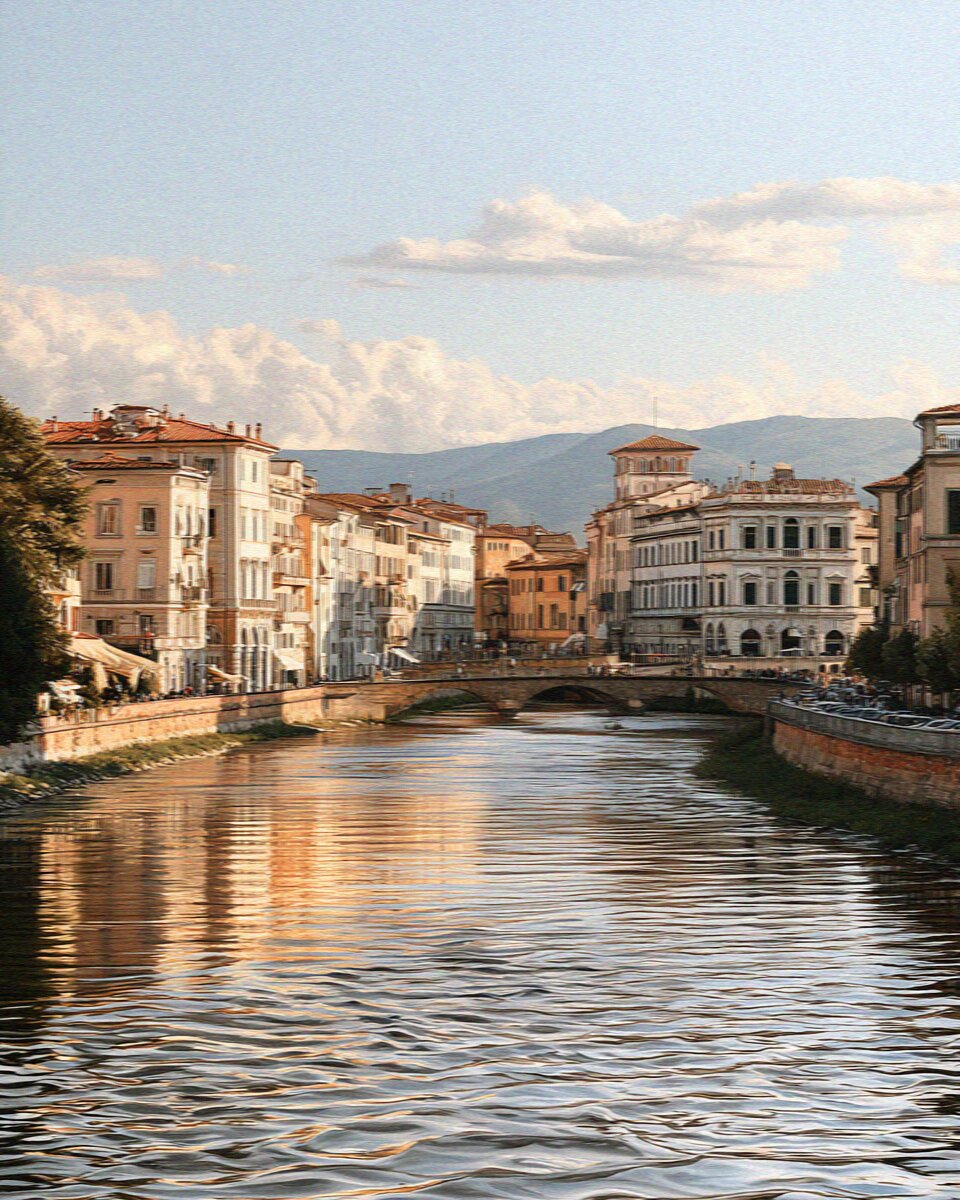
The Ponte di Mezzo, the central bridge, is the obvious place to stand, and it earns its reputation: from the middle you get both banks curving away and the reflections running long across the water. But I often prefer a spot on the embankment a little upstream, shooting back towards the bridge with the row of houses catching the light. Keep an eye out for the tiny spiky church of Santa Maria della Spina on the south bank, a Gothic jewel box that photographs beautifully when the sun is behind you. The light here changes fast, so arrive well before sunset and let it come to you.
The view from the Guinigi Tower
Over in Lucca, the Guinigi Tower is the one you cannot miss because it has trees growing out of the top of it. A cluster of ancient holm oaks crowns a medieval brick tower some forty metres up, a rooftop garden that has been there in some form for centuries. From street level, framed against the sky above the terracotta roofs, it is one of the strangest and most photogenic silhouettes in Tuscany.
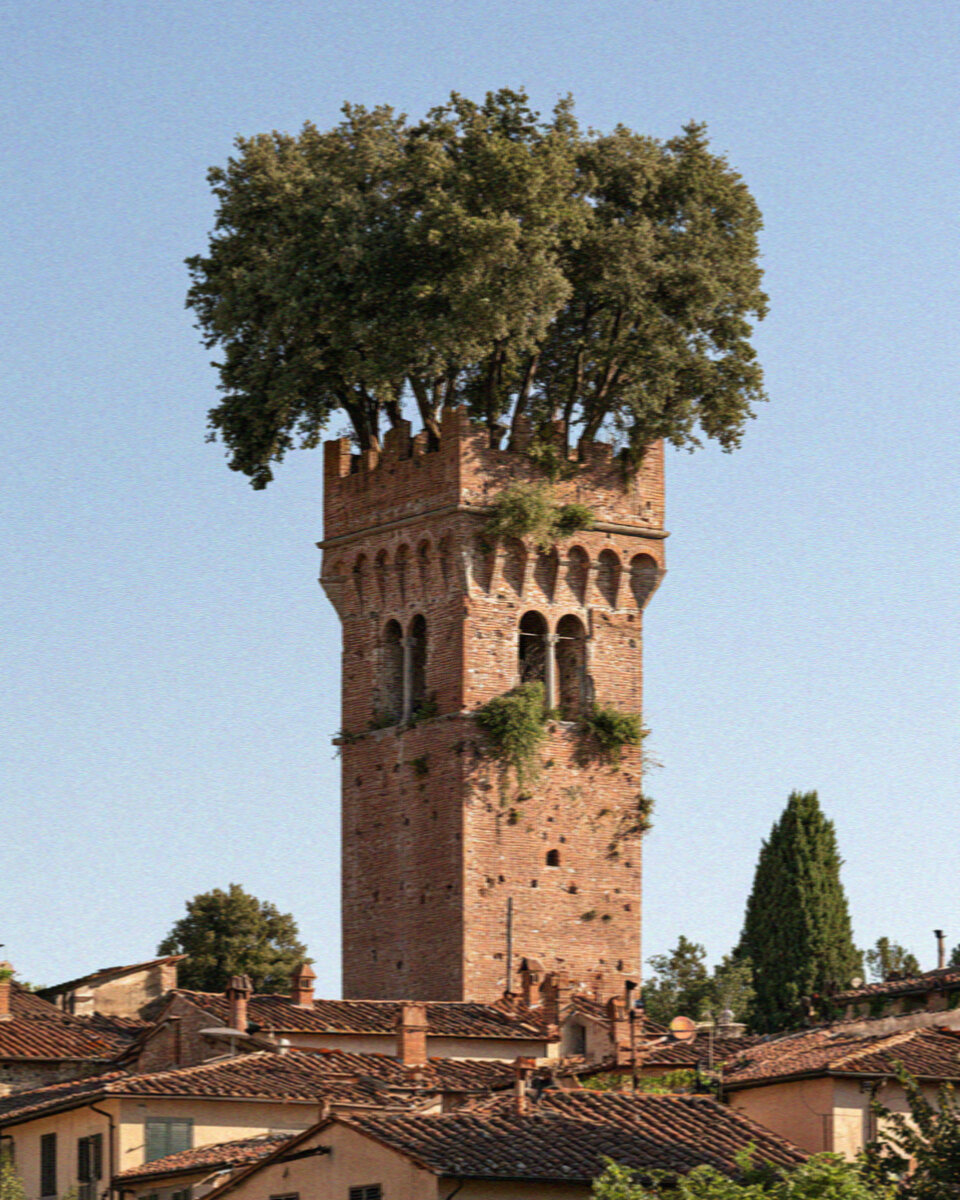
Then you climb it. There are around 230 steps to the top, and the reward is the best rooftop view in Lucca. You come out among the oaks themselves, their roots held in raised planters, and beyond them the whole city spreads out in warm tile: the red roofs, the outline of the walls encircling everything, the Roman street pattern still legible below, and the tall clock tower, the Torre delle Ore, standing off across the rooftops. For photographs, the oaks give you a natural frame in the foreground that almost no other rooftop view can offer. Late afternoon light rakes across the tiles and makes them glow.
Walking the walls of Lucca
Lucca is still completely ringed by its Renaissance walls, and the top of them is now a broad tree-lined promenade that runs an unbroken circuit of a little over four kilometres right around the old town. Nowhere else that I know of can you walk a full loop above a city on its own fortifications, with plane trees and chestnuts arching overhead and the rooftops on one side, the newer town on the other.
For pictures, the walls are less about one big set-piece and more about the small ones: cyclists and dog walkers passing under the trees, dappled light falling across the path, glimpses out over the bastions. The green tunnel of the avenue itself is the shot, especially when morning or late-afternoon sun comes in low and sidelong through the leaves. From the projecting bastions you get clear views back over the walls to the towers rising above the tiles, the Guinigi oaks among them.
Piazza dell’Anfiteatro
This is the picture people remember from Lucca. Piazza dell’Anfiteatro is a closed oval square, and it is oval because it sits exactly where a Roman amphitheatre once stood; the houses that now ring it were built on the old arena’s foundations, following its ellipse. You reach it through one of four low archways set into the ring, and stepping out of the dim passage into the bright enclosed oval is genuinely one of the nicest small surprises in the city.
The buildings are all warm yellows, ochres and soft pinks, shuttered and slightly uneven, and the curve pulls your eye around and around. To photograph the shape you really want height, and there is no public viewpoint above it, so the honest shot from the ground is to stand at one end and let the ellipse sweep away from you, cafe tables and all. I like it early, before the tables fill, when the low sun lights one arc of the curve and leaves the other in shade. The archway entrances make good frames too, catching the bright oval at the end of a dark tunnel.
San Michele in Foro
You come out of one of Lucca’s narrow lanes and the front of San Michele in Foro rears up in front of you, far taller than the church behind it, because the facade was built up as a great decorative screen. It stands on the square where the Roman forum once was, which is how it got its name, and the effect of that soaring marble front in such a tight space is theatrical in the best way.
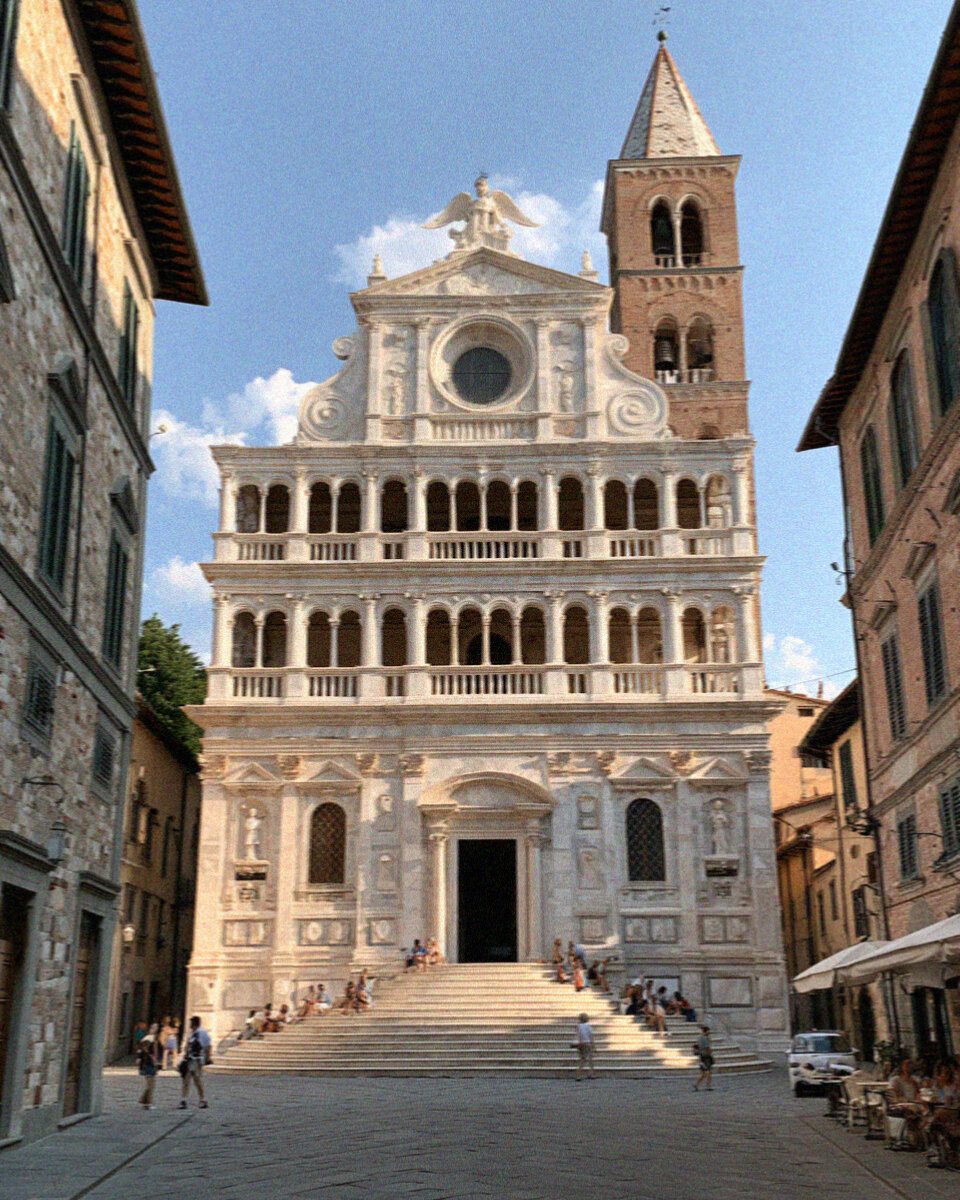
The facade climbs in tiers of little loggias, row upon row of slender columns, each one different, inlaid with coloured marble. Right at the top stands the Archangel Michael with metal wings spread, spearing the dragon, flanked by two angels. On a clear day, with the sun catching the wings, it is a remarkable thing to photograph. The square is open enough to step well back and take in the whole height, and I find it best in the morning when the light falls full on the front rather than raking across it. Look for the detail too: no two columns match, and close crops of the twisted, banded shafts make lovely abstract frames.
When the light is best
If I had to reduce all of this to a rhythm, it would be this. Photograph San Michele and Piazza dell’Anfiteatro in the morning, while the sun is on the marble and the squares are quiet. Climb the Guinigi Tower or walk the walls in the late afternoon, when the tiles glow and the promenade light turns golden through the trees. Save the Arno and the Leaning Tower for the last hour of the day, because both are at their finest as the sun goes down and both are far less crowded then. Overcast days are not wasted, either; soft grey light is kind to marble detail and to the coloured walls of the piazzas.
Frequently Asked Questions
What is the best time of day to photograph the Leaning Tower of Pisa?
The last hour before sunset is the one I would choose. The white marble warms to gold, the carved arcades gain depth, and most of the coach groups have already left, so the lawn is far less crowded than it is at midday. Early morning is a good quieter alternative if you want the piazza almost to yourself, though the light is cooler and flatter.
Can you photograph the oval shape of Piazza dell’Anfiteatro from above?
Not easily, because there is no public viewpoint overlooking the square, and the surrounding houses are private. The best honest shot from the ground is to stand at one end of the oval and let the curve sweep away from you, ideally early in the day before the cafe tables fill and while one arc of the ellipse is still catching low sun. The four archway entrances also make strong frames.
Is it worth climbing the Guinigi Tower for photos?
Yes. It is around 230 steps, but the ancient holm oaks at the top give you a foreground frame that no other viewpoint in Lucca can, and the rooftop panorama takes in the red tiles, the ring of walls and the other surviving towers. Go in the late afternoon, when the sun rakes low across the roofs and lights everything warm.
For more on both cities beyond the camera, see my Best Things to Do in Pisa and Best Things to Do in Lucca, or plan the trip around the itinerary. Everything sits within my complete guide to Pisa and Lucca.