Some links in this guide are affiliate links. If you book through one, this site may earn a small commission, at no extra cost to you. How this works.
Half the pleasure of Antibes is how little effort it takes to leave it. The coastal railway runs right through the town, Cannes is a few minutes one way and Nice a little more the other, and behind the coast the hills climb almost at once into villages of potters, glassblowers and painters. You can be on a boat to a monastery island, or in a perfume factory, and back on the ramparts for the evening.
These are the days out I would actually take, how to reach each one, and what to plan around. Antibes itself is covered from end to end in my main Antibes guide.
What to book before you come
Three days out I would book ahead, because they run in small groups.
The Lérins Islands under sail
A small sailing boat out to the islands off Cannes, with time to snorkel and paddle in the clear water.
Monaco and Eze, privately
A driver collects you in Antibes for the hill village of Eze and the harbour at Monaco.
The best of the Riviera in a day
The classic loop of the coast and the perched villages. It starts in Nice, twenty minutes away by train.
Each button opens GetYourGuide in a new tab, so this page stays open. Booking through them supports the blog at no cost to you.
How to plan a day out
The coast and the hills are two different kinds of day. Cannes, Nice and Monaco sit on the railway, so you can go without a car or a booking and come back whenever you like.
The hill villages are another matter. Biot, Saint-Paul-de-Vence and Grasse are all reachable by public transport, but each involves a bus or a climb from a station below, and a car makes them far easier, especially if you want two in a day. Saint-Paul and Biot pair well; Grasse is best on its own.
Two things catch people out. Museums close on different days: most in Antibes close on Mondays, while the Fernand Léger museum in Biot and the Picasso chapel in Vallauris close on Tuesdays. And in July and August, the coast road and the car parks of the villages fill by late morning, so leave early or go by train.
Cannes
Cannes is the easiest day out from Antibes. The train takes about ten minutes, and the station is a short walk from the Croisette.
Walk the Croisette first, past the grand hotels and the Palais des Festivals, then climb into Le Suquet, the old quarter on the hill above the port, for the view back over the bay from the top. The Marché Forville, the covered market just below Le Suquet, is at its best in the morning. In the afternoon, take a boat to the islands (below).
In May, the film festival takes over the town completely (12 to 23 May in 2026). I was on this coast in the quiet days just before it this year; once the barriers go up along the Croisette, the town belongs to the festival. If you want to see it, read my Cannes Film Festival guide first, and my guide to getting to Cannes for the trains and the roads.

The Lérins Islands
The Lérins Islands lie just off Cannes, and they are the day trip I recommend most. Sainte-Marguerite, the larger island, is covered in pine and eucalyptus forest, with paths all the way round, small rocky coves for swimming, and the Fort Royal, where the Man in the Iron Mask was held. Saint-Honorat, the smaller, belongs to the monks of Lérins Abbey, who tend vineyards there and make wine.
Everything sails from the old port of Cannes. Trans Côte d’Azur and Horizon both cross to Sainte-Marguerite in about a quarter of an hour, Planaria serves Saint-Honorat separately in around twenty minutes, and an adult return on any of them costs about 19 euros.
Take water, a picnic and swimming things, and check the last boat back before you set off into the woods; it is earlier than you might think.

Nice
Nice is a city, which is the point after a few days of Antibes. The train takes about twenty to twenty-five minutes.
Go in the morning for the Cours Saleya, the long market in the old town, with flowers and produce every day except Monday (on Mondays it is an antiques and flea market instead). Then lose yourself in the old town, Vieux Nice, a tangle of narrow, tall streets painted in ochre and red, and eat socca from a street stall. In the afternoon, walk the Promenade des Anglais or climb the Colline du Château for the view over the Baie des Anges.
The Matisse museum, up on the hill of Cimiez, and the Chagall museum, on the way up to it, are both worth the climb. Either can fill a morning, but not both in one day if you want to see Vieux Nice properly.
Biot
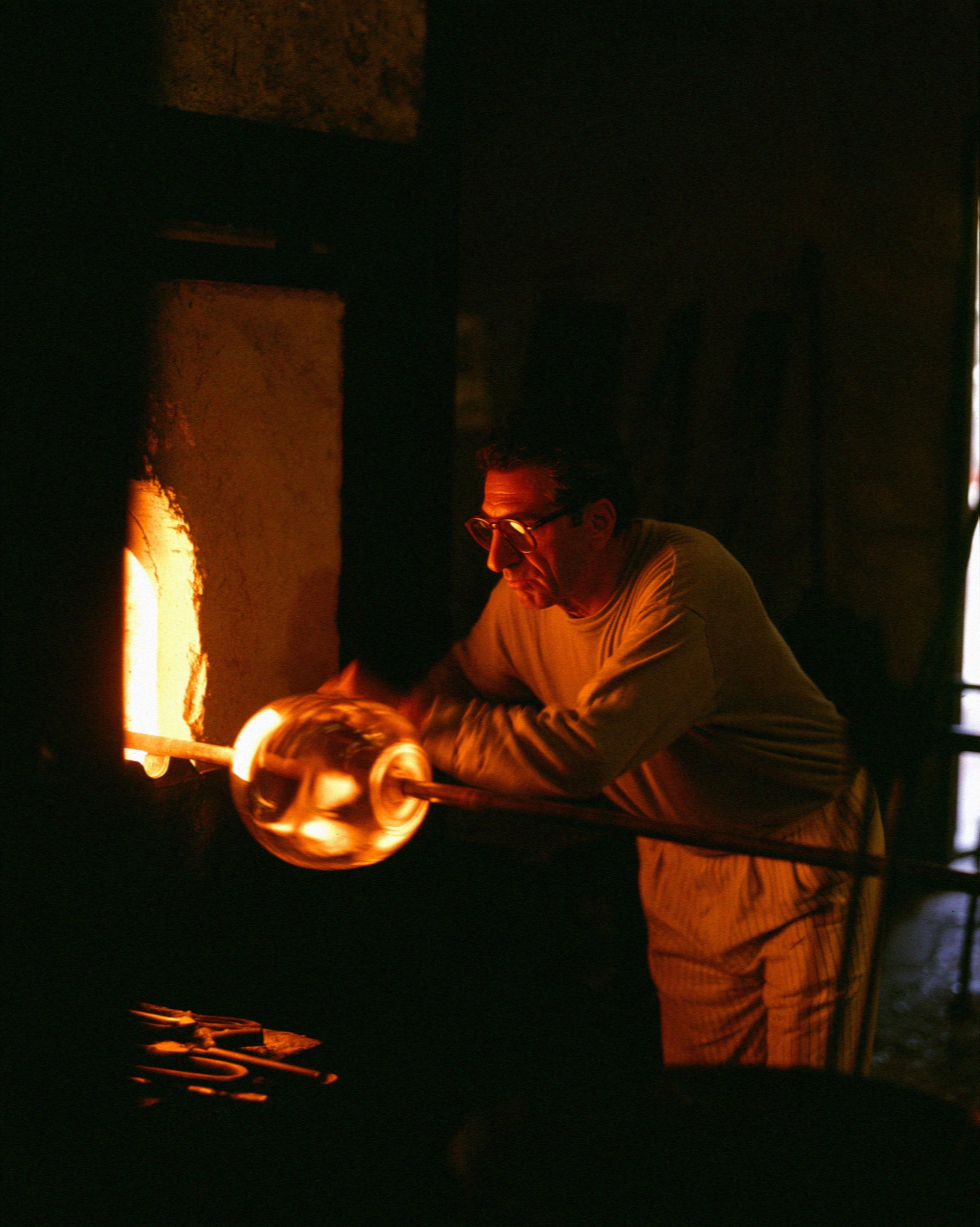
Biot is the closest hill village to Antibes, a few kilometres inland. It has been a village of potters for centuries and of glassblowers since the 1950s, and it still feels like a working place.
The glassworks, La Verrerie de Biot, sits just below the village, and you can watch the glassblowers at the furnaces, working the bubbled glass the village is known for. Up in the village, the arcaded square and the narrow streets are lined with workshops and small galleries. Below it, the Musée National Fernand Léger, built to show the artist’s work, has a great mosaic façade you can see from the road. It is closed on Tuesdays and costs about 8 euros, a little more during exhibitions.
By car, Biot is about fifteen minutes from Antibes. Without one, Envibus buses run to the village from Antibes. There is a Biot station on the coastal railway, but it sits down by the sea, a few kilometres from the village and well below it.
Saint-Paul-de-Vence
Saint-Paul-de-Vence is the most famous of the hill villages, and in summer it is also the most crowded. It is a walled village on a ridge, with ramparts you can walk all the way round, cobbled lanes paved in patterns of pebbles, galleries on every corner and the Alps behind.
Just below the village, the Fondation Maeght is the reason I go back. It is a private art museum among pines, with sculptures by Giacometti in the courtyard and a garden of Miró’s work. It is worth the trip on its own.
By car, Saint-Paul is about thirty to forty minutes from Antibes. By public transport it is slower, with a train to Cagnes-sur-Mer or Nice and a bus up from there. Go early, park below the village, and leave before the tour buses arrive. Biot is a natural second stop on the way home.
Vallauris
Vallauris, just above Golfe-Juan on the other side of the Cap, is where Picasso lived and worked from the late 1940s into the 1950s, and where he took up ceramics. The town has made pottery for centuries, and the main street is still full of potters’ shops.
The reason to go is the Musée National Picasso La Guerre et la Paix, in the old Romanesque chapel of the château. In 1952 Picasso painted two great compositions facing each other on the curved vault, War on one side and Peace on the other. It is a small space and a short visit, and deeply moving. The museum is closed on Tuesdays and is free on the first Sunday of the month.
Vallauris is close enough to Antibes to see in a morning. The Zou! airport bus (line 82) ends in Vallauris, and it is a short drive.
Grasse
Grasse, in the hills behind Cannes, is the old capital of French perfume, its flowers grown for centuries in the fields around the town. The old town is steep and a little faded, which I rather like.
The Fragonard perfume house runs free guided visits of its historic factory in the town, and the Musée International de la Parfumerie tells the history of perfume from antiquity to the present. If you want to make your own scent, several houses run workshops, which need booking.
Direct trains run from Antibes to Grasse in about forty to forty-five minutes. Grasse station is below the town, so take a bus up or allow time for the climb.
Monaco
Monaco is about fifty minutes from Antibes by train, along the coast past Nice, with the line running almost on the water for much of the way. The station is underground, in the middle of the principality.
Climb to the old town on the Rock for the Prince’s Palace and the narrow streets around it, walk down to the harbour and the yachts, then up to the Place du Casino. It is small enough to cover on foot, but the hills are steep, and there are public lifts between the levels. A day is plenty.
Without a car
Without a car, you can still see almost all of this. Frequent, cheap trains from Antibes station, a short walk from the old town, reach Cannes and the islands, Nice, Monaco and Grasse. Buses reach Biot and Vallauris. Only Saint-Paul-de-Vence is genuinely awkward, and even that is a train and a bus.
If you are deciding where to sleep with day trips in mind, the old town and the port are best, because they are walking distance from the station. I explain the choice in my guide to where to stay in Antibes, and the trains, buses and boats in detail in my guide to getting to Antibes and around.
Frequently Asked Questions
What is the best day trip from Antibes?
The Lérins Islands, reached by a short train to Cannes and a fifteen to twenty-minute boat from the old port. Sainte-Marguerite has forest paths and coves for swimming, and Saint-Honorat belongs to the monks of Lérins Abbey.
Can you visit Saint-Paul-de-Vence from Antibes without a car?
Yes, but it is slow: a train to Cagnes-sur-Mer or Nice and then a bus up to the village. By car it takes about thirty to forty minutes, and it pairs well with Biot on the way back.
How long is the train from Antibes to Monaco?
About fifty minutes on a direct train. They run often, and the line hugs the shore past Nice for much of the way.
How do you get from Antibes to the Lérins Islands?
By train to Cannes, a walk down to the old port, then a boat: roughly a quarter of an hour to Sainte-Marguerite, for about 19 euros return.
Read also: An Antibes Itinerary: 2 to 4 Days | Getting to Antibes and Around | Victoria’s Complete Guide to Antibes and Cap d’Antibes