The best hidden gems in Bologna are not really hidden at all, they are simply overlooked by people hurrying between the two famous towers and a plate of tagliatelle. This is a city that rewards the slow walker, the one who looks up at portico ceilings and down through glass floors. I have spent whole mornings here finding nothing on any must-see list and feeling as though I had been let in on something. What follows is my knowing insider’s walk through the corners locals half-assume you will never notice.
The Seven Secrets of Bologna
Ask a Bolognese and they will tell you the city keeps a list of “seven secrets”, small riddles hidden in plain sight. Not all of them are grand. That is rather the point. Together they make the loveliest free treasure trail in the city, and you can knot most of them into a single afternoon of wandering.
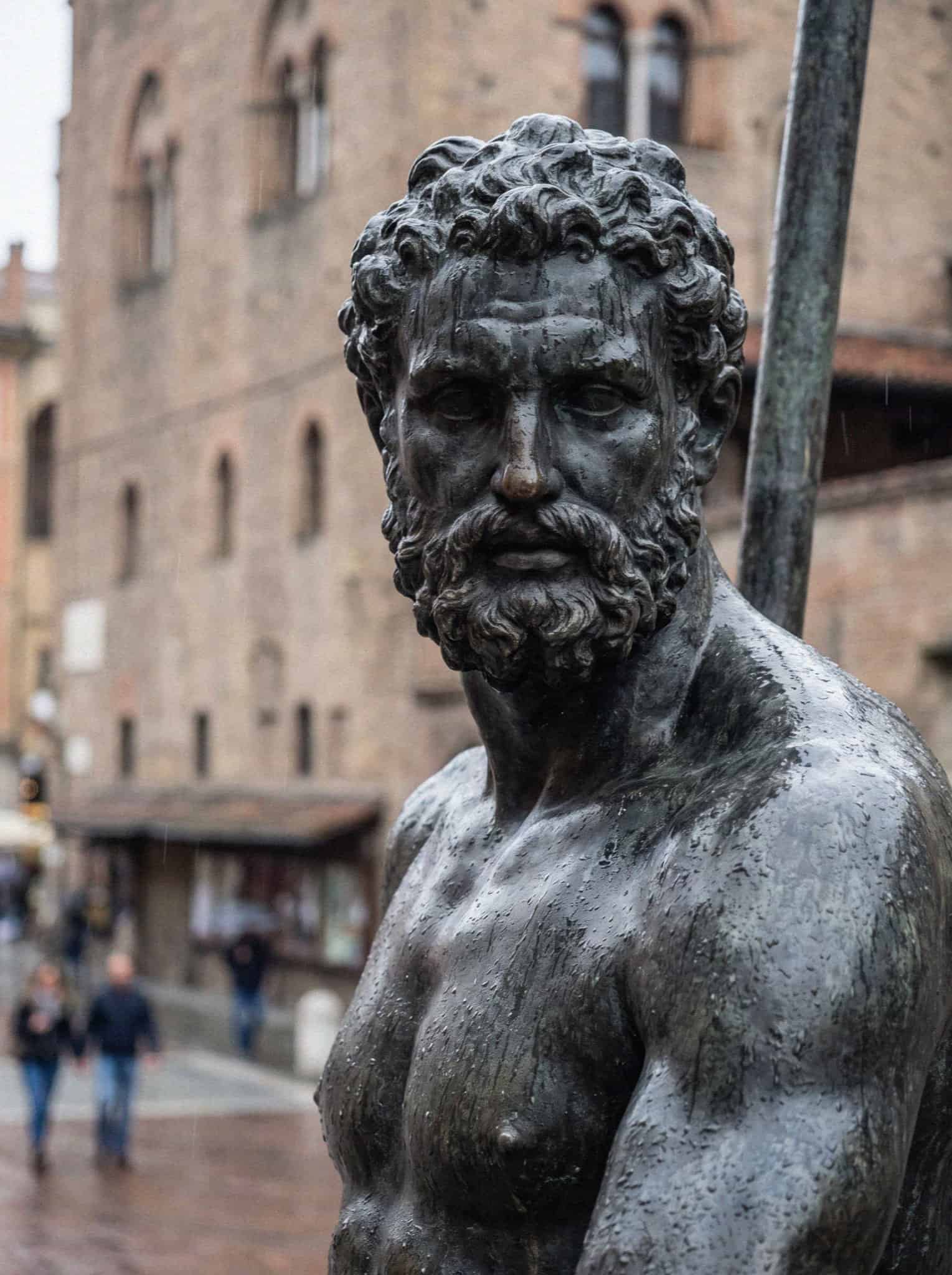
Start in Piazza Maggiore with the cheekiest of them. Giambologna’s bronze Neptune, cast between 1563 and 1567, dominates his fountain with a raised hand, but the god has a second gesture the sculptor tucked in for those who know where to stand. Walk to the far corner behind him, near the entrance to Palazzo d’Accursio, look back up at his outstretched left hand, and the perspective turns his thumb into something rather less dignified. It is the sort of Renaissance joke Bologna loves.
A few steps away, under the Palazzo del Podestà, is the Voltone del Podestà, a vaulted crossroads of four arches that carries a whisper. Stand facing into one corner, have a friend do the same in the diagonally opposite corner, and speak softly against the stone. Your voice travels the curve of the vault and arrives at their ear as though you were standing beside them. It is free, always open, and the best party trick in the city centre.
Now drift east to Strada Maggiore 19 and step into the wooden portico of Corte Isolani, one of the last surviving medieval timber porticoes in Bologna. Crane your neck. Buried in the beams of the ceiling are three arrows. The story goes that assassins loosed them at a nobleman, missed when a beautiful woman appeared naked at a window to distract them, and left the arrows lodged in the wood forever. Whether or not you believe it, spotting them feels like solving a puzzle the city set for you five centuries ago.
For the fifth, look low rather than high. On the wall at Via dell’Indipendenza 3 a small Latin inscription reads “Canabis Protectio”, a proud little memorial to the hemp that once made Bologna rich. For centuries the plains around the city grew some of Europe’s finest cannabis for rope and sail-cloth, and the trade paid for a good deal of the beauty you are walking through. The sixth secret is a legend rather than a sight: a broken vase said to sit atop the Torre degli Asinelli as a charm. You cannot climb up to check, the tower has been closed to visitors since 2023, but you can stand in Piazza di Porta Ravegnana and enjoy knowing the story is up there. The seventh, the little window over the canal, deserves a section of its own.
Plan Your Visit to Bologna
A few things I booked and loved. These help support the blog, at no cost to you.
- Where I stayed: search Bologna hotels
- Tickets and things to do in Bologna
- Stay connected: get a travel eSIM
This section contains affiliate links. If you book through them I may earn a small commission, at no extra cost to you.
The Canals and the Finestrella
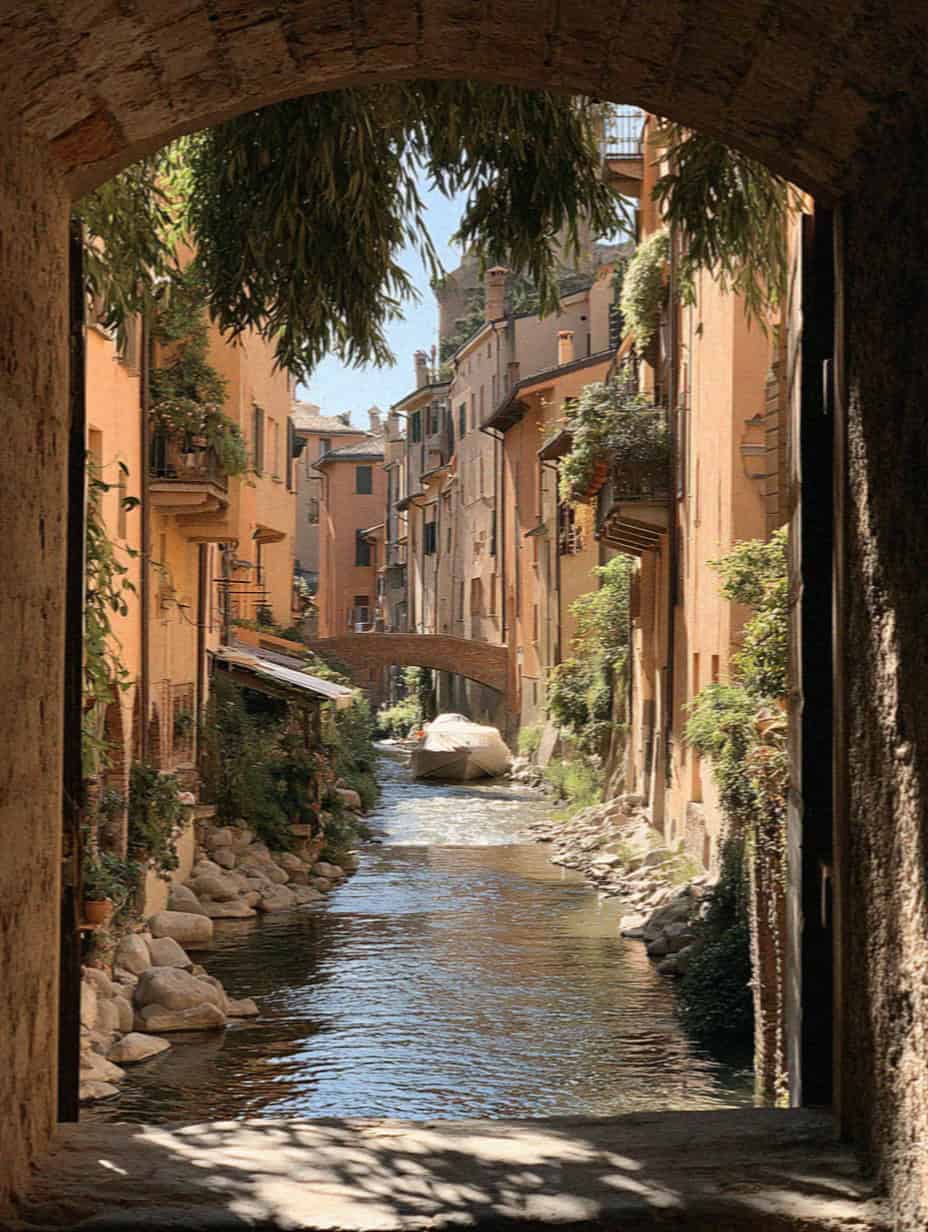
Almost nobody arrives in Bologna expecting water, which is exactly why the Finestrella di Via Piella lands so well. Bologna was once threaded with canals, a working network of mills and locks, and most of it was paved over in the twentieth century and runs on unseen beneath your feet. But at Via Piella 16/a to 18/a there is a small shuttered window in a wall, and when you push its wooden panels open you look straight down onto the Canale delle Moline, tall ochre and russet houses leaning over green water. People call it Bologna’s Little Venice, which oversells it a touch, yet the surprise of it, a hidden river in a city you thought had none, is genuinely disarming.
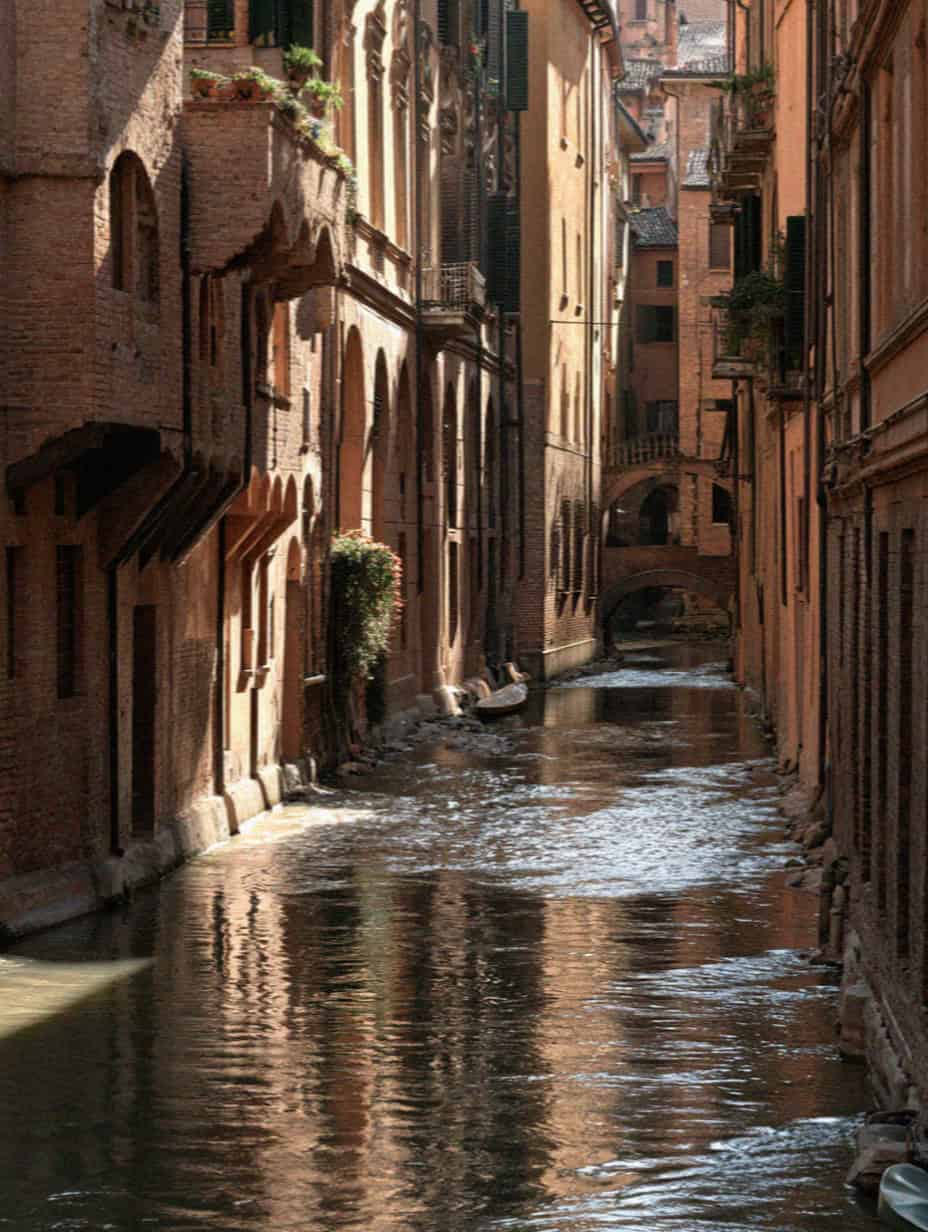
Go early, ideally before ten in the morning, because the little window has become well enough known that a small queue forms for the photograph on weekends. Once you have had your look, walk a minute to the open viewpoint on Via Oberdan where you can see the same Canale delle Moline without any jostling at all. If you want the whole story, the “Bologna sotterranea” underground tours take you down into the covered stretches of the canal system, and I will come back to those at the end. For now, the pleasure is simply standing at a shutter in a wall and realising the city has been keeping a river from you.
Quiet Corners Away from the Crowds
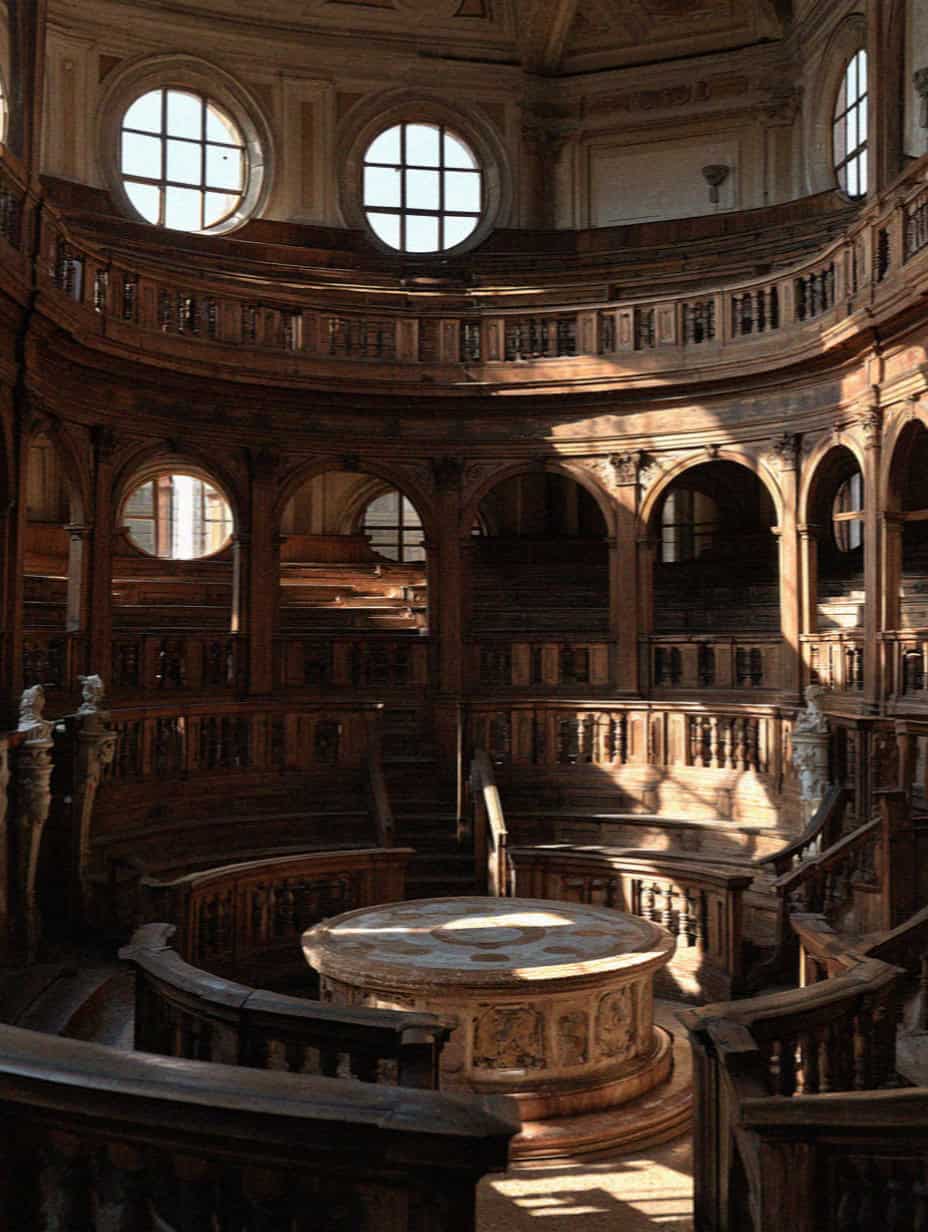
Some of Bologna’s finest rooms are free and nearly empty. Slip off Via Zamboni through the church of San Giacomo Maggiore to reach the Oratorio di Santa Cecilia, a single small hall lined with early sixteenth-century frescoes by Francesco Francia and Lorenzo Costa. There is no ticket desk, no crowd, just ten luminous scenes and, usually, the sound of your own footsteps. I have sat there for twenty minutes and had the place entirely to myself, which in a city this beautiful feels like a small theft.
Walk south to the Basilica di San Domenico, also free, and find the great marble ark that holds the saint’s tomb. It was carved across generations by Nicola Pisano and Niccolò dell’Arca, and then, around 1494, by a young Michelangelo, who added three small figures: a kneeling angel holding a candlestick, San Petronio and San Procolo. They are easy to miss and easy to stand in front of for far too long once you know whose hand shaped them. A restoration has recently been under way, so a piece may be under cover when you visit, but the ark rewards the detour either way.
My last quiet corner is the most unexpected. The Biblioteca Salaborsa on Piazza Nettuno is the city’s public library, free to walk into, a soaring covered courtyard where students read under a glass ceiling. Look down. Set into the floor is a glass panel, and beneath it lie the excavated stones of Roman and medieval Bologna, right under the reading tables. It is the whole city in one glance, twenty centuries stacked below people quietly answering their emails, and it costs nothing.
Osteria del Sole, a Drink and Nothing Else
Down a slip of a lane called Vicolo Ranocchi hides the osteria I send everyone to, though I always explain the rules first. Osteria del Sole has been pouring wine since 1465, which makes it the oldest wine bar in Bologna, and it does one thing only: it sells you a glass of wine and a seat at a long communal table. There is no kitchen. There is no menu of small plates. If you want to eat, and you should, you bring your own food, spread it out on the worn wood, and settle in among strangers who have done exactly the same.
This is where the Quadrilatero market next door earns its keep. Buy mortadella and a wedge of parmigiano from Salumeria Simoni on Via Drapperie, some bread, a few olives, and carry the lot to the osteria. Bring cash, order your wine at the bar, and you have one of the cheapest and most genuinely Bolognese lunches going. It suits anyone who values atmosphere over polish and does not mind sharing a table with a retired man reading his newspaper. It does not suit anyone after a quiet, waited dinner. Go for the company as much as the wine.
Green and Modern Bologna
Hidden gems do not have to be old. When the medieval lanes start to press in, I walk out to the Giardini Margherita, the city’s biggest park, laid out in 1879 just beyond Porta Santo Stefano. It is where Bologna comes to breathe: joggers, prams, students sprawled on the grass, a little lake, kiosks doing a brisk trade in coffee and spritz. On a warm evening it is the least touristy and most quietly happy place in the city, and it costs nothing to join in.
For something stranger, book the “Bologna sotterranea” underground walk that takes you beneath the streets to the covered waterways that once drove the mills. It reframes the whole city; you never look at a manhole the same way again. And for a jolt of the contemporary, MAST is a free foundation dedicated to art, photography and industry, with changing exhibitions of real quality and a calm, light-filled interior. It closes on Mondays, so plan around that. Between a nineteenth-century park, a subterranean river and a sleek photography gallery, you have a whole day of Bologna that most visitors never suspect exists.
Frequently Asked Questions
What are the seven secrets of Bologna?
They are a local list of small hidden curiosities: the Finestrella di Via Piella window over the canal, Neptune’s mischievous finger illusion in Piazza Maggiore, the three arrows in the wooden portico ceiling of Corte Isolani, the whispering arch of the Voltone del Podestà, the “Canabis Protectio” hemp inscription on Via dell’Indipendenza, the “Panum Resis” motto at Palazzo Poggi, and the legendary broken vase atop the Torre degli Asinelli. You can find most of them on foot in an afternoon, and they are all free to see.
Can you still climb the Two Towers?
No. The Torre degli Asinelli has been closed to visitors since October 2023 with no reopening date, and the leaning Torre Garisenda is cordoned off under a long stabilisation project. You can still view and photograph both from Piazza di Porta Ravegnana. For a high panorama instead, climb the Torre dell’Orologio in Palazzo d’Accursio for around ten euros, or walk up to the San Luca sanctuary on its hill for a free, wider view.
Is the Finestrella di Via Piella worth visiting?
Yes, for the surprise of it more than the grandeur. It is a small shuttered window at Via Piella 16/a to 18/a that opens onto the Canale delle Moline, one of Bologna’s few visible stretches of its old canal network. Go before ten in the morning to beat the small weekend queue, and stroll to the open viewpoint on Via Oberdan afterwards for the same water without the crowd.
These corners are only one thread of a much bigger city, and if you want the whole picture I have gathered everything into my complete guide to Bologna. To turn these secrets into a proper day out, pair them with my pick of the best things to do in Bologna, and if you are the sort who travels with a camera in hand, my guide to the best photo spots in Bologna will show you exactly where the light falls.