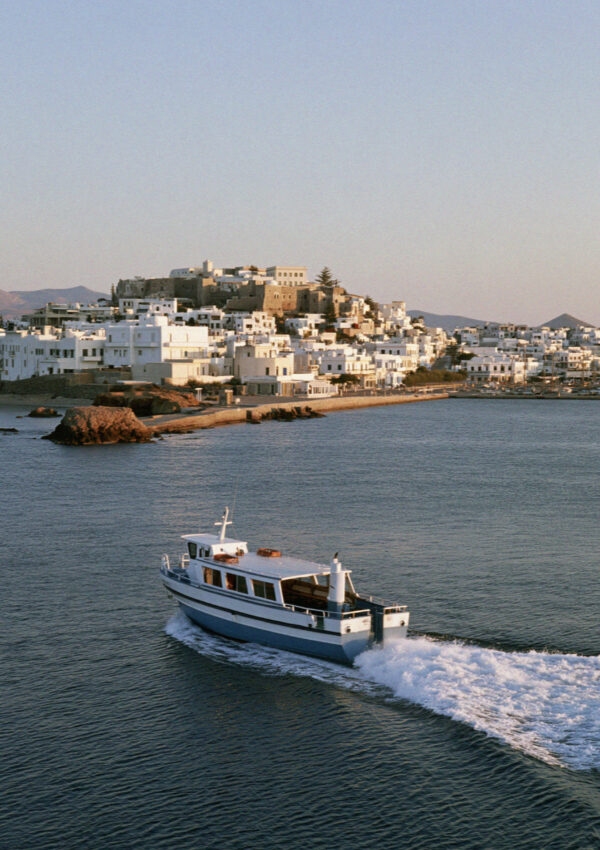
Locals call it Chora, the ferry timetables call it Naxos, and most visitors meet it with a bag on one shoulder, trying to work out which way is up. Up, as it happens, answers most questions here. The town rises from the harbour in layers: the waterfront cafes, then the old market lanes, then the Venetian walls of the Kastro on the crown of the hill, with the marble doorway of the Portara standing apart on its islet to the north.
It is the island’s capital and its port, and it is lived in all year round, not only in summer. I arrived from Mykonos on the forty-minute crossing in early October and spent my evenings in these lanes. This is how it fits together and what to see. Everything beyond the town is in my complete guide to Naxos.
How the town is laid out
Think of it in layers. The harbour front, the long seafront road, runs south from the ferry quay, lined with cafes, tavernas, ticket agencies and car hire, with the small port for day boats and the marina alongside. Behind it the old market quarter, the Bourgos, is a tangle of whitewashed lanes and arches climbing the slope. On top sits the Kastro, the walled Venetian quarter.
North of the ferry quay, a causeway runs out to the Portara on the islet of Palatia, with the rocks and little beach of Grotta below the houses on that side. At the southern end of the front, the town gives way to Agios Georgios, the town beach.
All of it is walkable. From the quay up to the Kastro is a short climb; from the quay to Agios Georgios is an easy stroll along the water. Wear flat shoes: the marble lanes are polished smooth in places.
The Portara
The Portara is the entrance to a temple that was never completed. It was begun around 530 BC by Lygdamis, then tyrant of the island, and work stopped, most likely when he was overthrown in 524 BC. Over the centuries the rest of the stone was carried away for other buildings, and the doorway was left. It stands on Palatia, joined to the town by the causeway, and is said to face towards Delos. It is usually called the Temple of Apollo, though some scholars believe it was meant for Dionysus.
There is no ticket and no gate. You can go right up to it, a low rail stops you climbing on the marble, and the frame is floodlit after dark. At sunset the causeway is busy and good-humoured, with everyone waiting for the sun to go down over the sea beyond it. For quiet, go at first light. I walked out to it with my bag before I had even found my room, and went back on my last morning to have it nearly to myself.
The old market quarter
Below the Kastro walls, the Bourgos was largely where the Greek townspeople lived and traded while the Venetian Catholic families held the hill above. Today it is the busiest part of town on a summer evening: a maze of whitewashed passages, archways and steps, with shops selling ceramics, linen, jewellery and island produce, and tavernas tucked into tiny squares.
It is the place to buy food to take home. Look for kitron in its three colours, graviera cheese, and island honey. The shops just below the Kastro steps keep the liqueur bottles in the window; I bought a green one there on my way to the ferry.

Inside the Kastro
The Kastro dates from 1207, when the Venetian Marco Sanudo made Naxos the capital of his Duchy of the Archipelago, and the Catholic families who ruled under him built their houses within its walls. A few of their descendants still live here. Doorways carry carved coats of arms, and some lanes run under the houses in vaulted passages, dark and cool at noon.
The things to find: the Catholic cathedral, near the top; the former Ursuline convent and the old Catholic school of commerce, first founded by the Jesuits, where Nikos Kazantzakis, the author of Zorba the Greek, was sent briefly as a boy; and the Glezos tower, also called the Crispi tower, on the walls. Behind the cathedral I came across a mason working with his doors open, the floor white with marble dust, which told me more about this island than any plaque.
The quarter is small but disorientating. Do not follow a map too faithfully. Walk until you meet a wall, then turn.
The museums in the Kastro
The Archaeological Museum of Naxos normally fills a large building in the Kastro, but that building is closed for a long rebuild. In the meantime a small temporary exhibition is shown in the former Ursuline convent, the St Ursula cultural centre: roughly one room of Cycladic figurines and pottery. It is free, opens 09:00 to 14:00, and is closed on Tuesdays, with last entry 20 minutes before closing. Go for the figurines and expect one room.
The Della Rocca-Barozzi Venetian Museum is an old Venetian family house inside the walls, and in season it holds evening concerts in its garden. Its opening hours differ from source to source, so check before you go, especially if you are hoping for a concert.
If you want an ancient site to pair with the museum, the Sanctuary of Dionysus at Yria is a short drive inland from town. Its hours are 08:30 to 15:30, Tuesdays excepted.
Grotta and the town beach
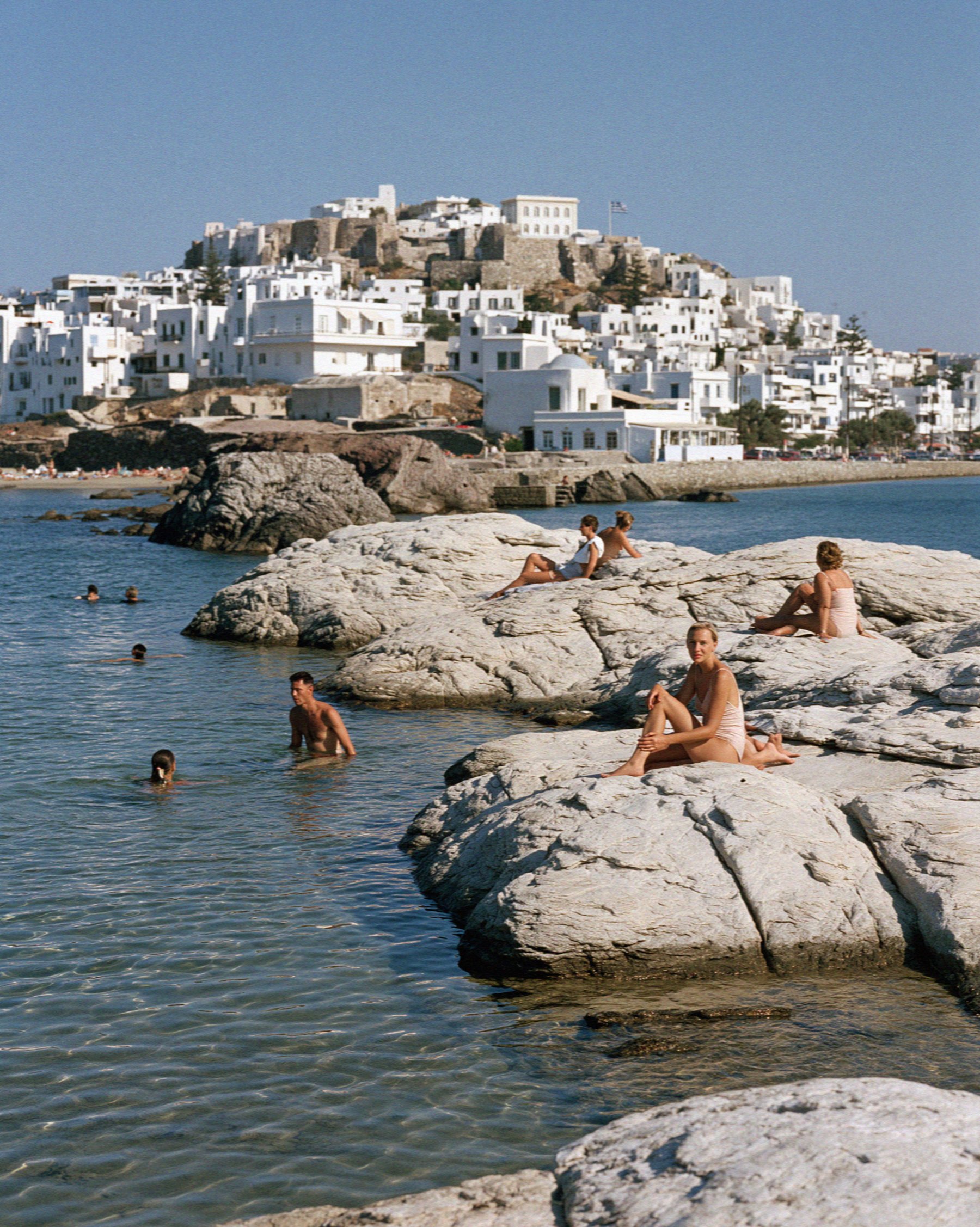
North of the ferry quay, below the houses on the hill, Grotta is a stretch of flat rocks and a small beach where people swim straight off the stones. On a still morning it is a lovely place for a dip with the Portara in view. When the north wind blows it takes the waves head on, so keep it for a calm day.
Agios Georgios, at the southern end of town, is the proper town beach: a curve of sand with shallow water, sunbeds, cafes and hotels behind it, and a windsurf school for beginners. It is the easiest swim on the island if you are staying in town and do not want a bus. The west coast begins just beyond it, and my guide to the best beaches in Naxos goes down it beach by beach.
The harbour front
The waterfront is where the town does its business: ferries coming and going, ticket offices, car and scooter hire, the KTEL buses leaving from the port, and a long row of cafes facing the boats. Early and late, it is the town’s sitting room.
For breakfast, the harbour bakeries sell cheese pies from early morning, and on my last day I ate two of them on the sea wall. The small port beside the main quay is where the day boats leave, including the Delos and Mykonos cruise, and the marina next door is where the Express Skopelitis sets off for the Small Cyclades. If you are planning a day off the island, my guide to day trips from Naxos has the options and the times.
Naxos Town at night
After dark the town turns inwards. The Portara glows on its rock. The waterfront tavernas fill. The old market lanes are busiest late in the evening, and up in the Kastro the small shops and galleries keep their lights on, so the vaulted passages feel lived in rather than shut.
For dinner, the town has more good tables than you will have nights. Metaxi Mas is popular and good value, so go early or book. Doukato has a leafy courtyard, Oniro a roof terrace below the Kastro, and Antamoma and Barozzi are both worth a look. My guide to where to eat in Naxos covers the rest. In summer, a concert in the Della Rocca-Barozzi garden is the most civilised evening in town.

A walk for your first evening
Start at the ferry quay an hour before sunset and walk out along the causeway to the Portara. Watch the sun go down over the water beyond the doorway, then come back along the water as the lights come on along the front.
Turn up into the old market by one of the lanes off the waterfront and wander uphill through the Bourgos, stopping wherever looks interesting. Keep climbing until you pass through a gateway into the Kastro, then drift: the cathedral, the vaulted passages, the coats of arms over the doors. When you come out, drop back down to the harbour for a late dinner and a small glass of kitron.
The loop takes about two hours with stops, and it gives you the town in the right order: the ancient first, then the market, then the Venetian quarter, then the sea.
Frequently Asked Questions
Is Naxos Town walkable?
Yes. The harbour front, the old market quarter, the Kastro, the Portara and the town beach at Agios Georgios are all within easy walking distance of the ferry quay, though the lanes up to the Kastro are steep and stony.
Is the Portara in Naxos free?
It is. The marble doorway on the islet of Palatia has no ticket and no opening hours, and it is floodlit after dark. Sunset is the busy time; first light is the quiet one.
Can you visit the archaeological museum in Naxos Town?
Partly. The main museum building in the Kastro is closed for a long rebuild, and a temporary exhibition of about one room of Cycladic figurines and pottery is open in the former Ursuline convent. Entry is free, from 09:00 to 14:00, every day but Tuesday.
Is there a beach in Naxos Town?
Two, in effect. Agios Georgios at the southern end of town is a sandy beach with shallow water and sunbeds, and Grotta at the northern end has flat rocks and a small beach for swimming on calm days.
Where should I watch the sunset in Naxos Town?
At the Portara, from the causeway or the islet of Palatia, where the sun sets over the open sea beyond the doorway. Move along the rocks to frame it the way you want. Arrive early in summer.
Read also: The Best Things to Do in Naxos | Where to Eat in Naxos and What to Order | Victoria’s Complete Guide to Naxos